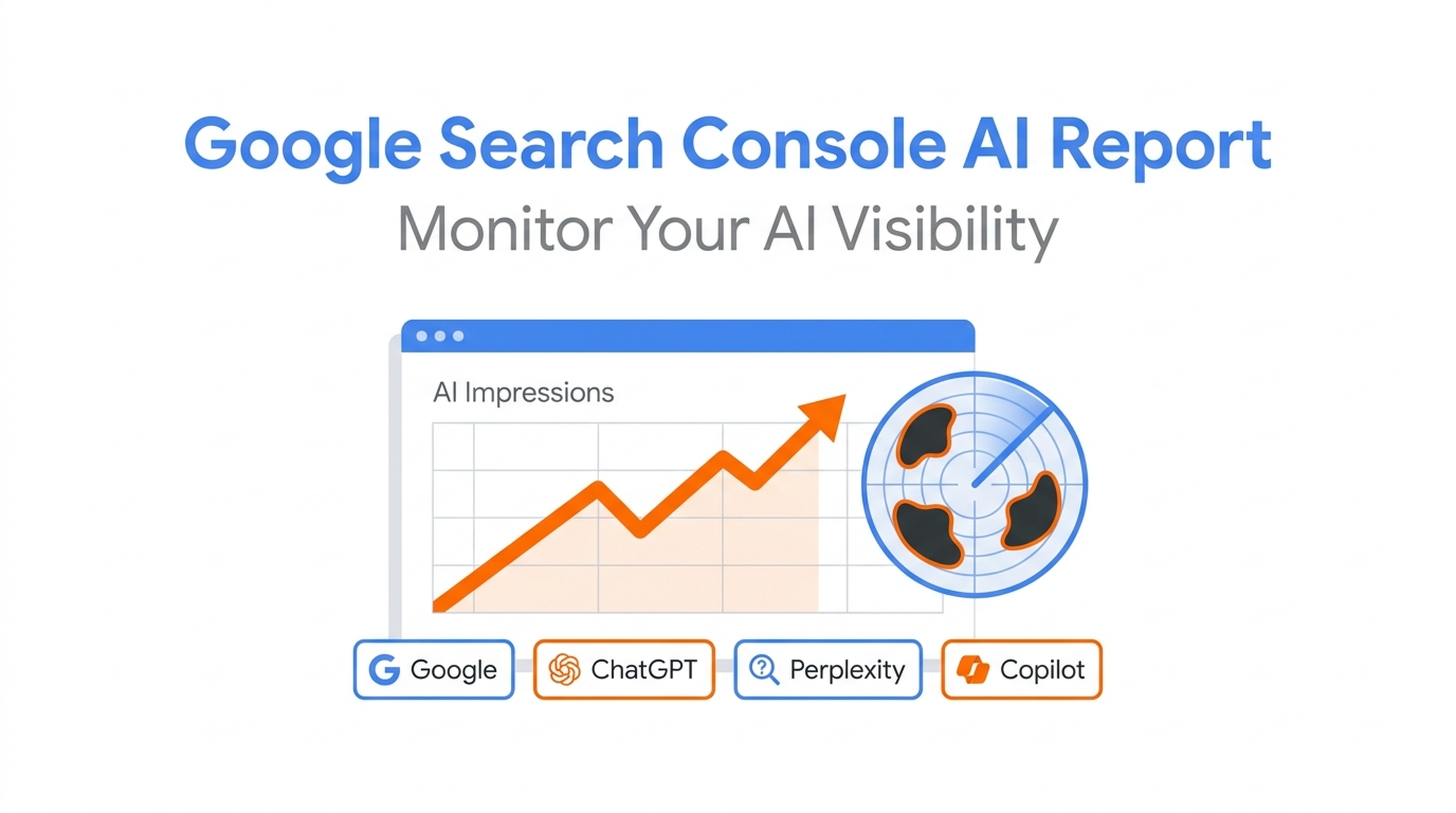
Google's Search Generative AI performance report landed in Google Search Console on June 3, 2026, giving website owners their first free look at how often their content surfaces inside AI Overviews and AI Mode. For the first time you can see, in numbers, whether your pages are being pulled into Google's AI-generated answers — without guessing from referral-traffic dips.
That matters because AI Overviews now appear on roughly 48% of all Google queries (up from 31% a year earlier), and when an AI Overview is present, organic click-through rate drops about 61%. Visibility inside the answer is becoming the new top-of-funnel.
But here is the catch most coverage glosses over: the report tells you what appeared, not why, not whether anyone clicked, and not how you compare across ChatGPT, Perplexity, and Copilot. This guide explains exactly what the report shows, its three blind spots, and a practical GSC + multi-engine workflow that turns visibility data into citation-rate action.
What the GSC AI Search Report Actually Shows
Inside Search Console, go to Performance → Generative AI (it sits as its own dedicated view, separate from the regular Search results and Discover reports). If you don't see it yet, your property hasn't been included in the phased rollout — more on that below.
When you do have access, the report breaks your AI-surface visibility across five dimensions:
Dimension | What it means | How it's useful |
|---|---|---|
Impressions | Times your URLs appeared in AI Overviews, AI Mode, and AI features in Discover | Your raw AI-visibility volume |
Pages | The specific URLs Google's AI selected to support answers | The single most valuable tab — your "cited page" template |
Countries | Geographic breakdown of where your content was surfaced | Spot regional AI-visibility gaps |
Devices | Mobile vs desktop split (Search report only) | Inform mobile-first content decisions |
Dates | Hourly, daily, weekly, monthly granularity; data starts May 18, 2026 | Track AI-visibility trends over time |
A few important counting rules: impressions are aggregated at the property level (two results from the same site in one AI Overview count as one impression), the table caps at 1,000 rows, dates are in Pacific Time, and the newest data is preliminary and may shift within a few hours.
The Three Blind Spots That Make GSC's AI Data Half a Picture
The report is genuinely useful, but three gaps mean it cannot, on its own, tell you whether your AI visibility is good or getting better.
1. No click, CTR, or conversion data. Google confirmed there are no click counts and no click-through rates. You can see that a page was shown 9,000 times inside AI Overviews, but you cannot tell whether those appearances sent any traffic, let alone revenue. This is "visibility without outcome" — the core frustration SEOs have raised since launch.
2. No query data. The report does not show which search queries or questions triggered your content to appear. You know which pages were cited, but not which prompts surfaced them. That makes it impossible to optimize for the specific questions AI searchers are actually asking.
3. Google-only. GSC measures Google's AI surfaces exclusively. ChatGPT, Perplexity, Microsoft Copilot, and other generative engines are invisible here — yet for many B2B and technology brands, those engines now drive a meaningful share of AI referrals. A page that's invisible in Google AI Overviews might be the most-cited result in Perplexity, and GSC would never tell you.
These three blind spots are why treating the GSC report as your complete AI-search dashboard leads to wrong decisions. You need a second layer of measurement that fills each gap.
How to Access the Report (and What to Do If You Don't Have It Yet)
Rollout is phased and began in the United Kingdom before spreading to India, Switzerland, and other markets. Two conditions must be met: (1) your property must be in a rollout wave, and (2) your site must have received enough AI-feature impressions to generate data. Even prominent SEO journalists didn't get access until early July 2026, so a missing tab is normal, not a penalty.
If you don't see the Generative AI view yet:
- Confirm your property is verified and has steady organic impressions in the regular Performance report.
- Keep producing AI-friendly content — clear answers, first-hand expertise, well-structured pages with schema markup.
- Check weekly; Google is expanding the rollout continuously.
- In the meantime, start multi-engine measurement now (see the workflow below) so you have a baseline the day GSC access arrives.
The GSC + Multi-Engine Workflow: Turn Visibility Into Citations
This is where the report becomes actionable. The idea is simple: GSC tells you which pages Google's AI surfaces; multi-engine GEO measurement tells you which prompts cite you, how often, and across which engines. Combine the two and you can finally answer "is my AI visibility improving and why?"
Step 1 — Pull your top AI-impression pages from GSC
In Performance → Generative AI → Pages, export the URLs with the most impressions. These are the pages Google's retrieval system already considers authoritative for AI answers. Sort descending by impressions and take the top 20–50.
Step 2 — Map those pages to the prompts that should cite them
For each high-impression URL, identify the 3–5 questions or prompts a user would ask that should surface that page. This is the query data GSC withholds. Use your regular Search Console Performance report (Queries tab) for the same URLs as a starting seed, then expand with buyer-language prompts — the conversational, multi-clause questions people actually type into ChatGPT and Perplexity.
Step 3 — Measure citation rate across engines
Run those prompts through a multi-engine GEO checker — Auspia's GEO Checker measures whether your brand/pages are cited across Google AI Overviews, ChatGPT, Perplexity, and Copilot, and surfaces the actual prompts that trigger a citation. Now you've filled blind spots #2 and #3: you know the queries, and you know the cross-engine picture.
Step 4 — Diagnose the retrieved-vs-cited gap
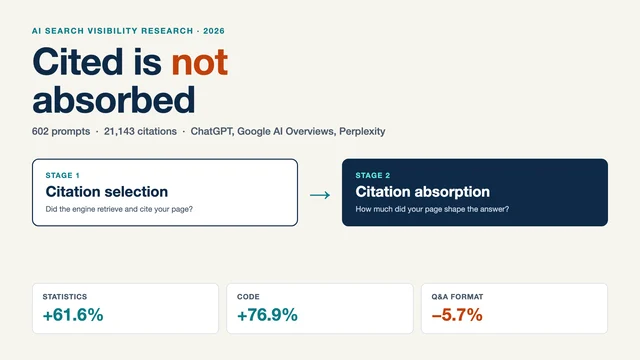
Here's the insight most teams miss. A page can be retrieved (pulled into the AI's context) without being cited (named in the answer). In practice, only a fraction of retrieved content makes it into the visible citation — research suggests roughly 15% of retrieved passages get cited. So a page with high GSC impressions (retrieved often) but low citation rate (rarely named) has a formatting or extractability problem, not an authority problem. Look for: missing TL;DR, buried answers, no comparison tables, weak H2-as-question structure.
Step 5 — Optimize, then re-measure on a 7–9 day window
Rewrite the weak pages for extractability — lead with a 2–3 sentence direct answer, use H2/H3 as real user questions, add comparison tables and bullet lists, and add FAQPage or HowTo schema. Because AI citations are stochastic, re-measure on a rolling 7–9 day window with enough prompt repetitions to establish a confidence interval, and measure each engine separately (Copilot, for instance, tends to cite more liberally than Google's AI Overviews).
This five-step loop — GSC impression pages → prompt mapping → cross-engine citation measurement → retrieved-vs-cited diagnosis → extractability rewrite — is how you convert the report's visibility signal into a rising citation rate.
The Opt-Out Toggle: Should You Block Your Content From AI Overviews?
Alongside the report, Google added an opt-out toggle (effective June 17, 2026) that lets you block your content from appearing in AI Overviews and AI Mode. Google confirmed this does not hurt your regular search rankings.
For the vast majority of sites, leave it off. AI Overviews are the fastest-growing surface in search, and voluntarily removing yourself is rarely the right call unless you have a specific licensing or content-protection reason. It's also important not to confuse three different controls:
Control | What it does | What it doesn't do |
|---|---|---|
Google-Extended (robots.txt) | Blocks content from being used to train Google's AI models | Does NOT block appearing in AI Overviews — Overviews pull from the organic index |
nosnippet (meta tag / X-Robots-Tag) | Blocks Google from showing snippets/summaries of your page | Does NOT control AI training |
New Search Console opt-out toggle | Blocks content from appearing in AI Overviews and AI Mode | Does NOT affect regular search rankings |
A common mistake: blocking Google-Extended thinking it removes you from AI Overviews. It doesn't. If your goal is to stay cited, make sure none of these three are accidentally suppressing your visibility.
From GSC Data to Content Action: A 5-Step Mapping
If you want the shortest version of the workflow, here's the mapping from what GSC shows you to what you should do:
GSC signal | What it tells you | Content action |
|---|---|---|
High impressions, single page | Google's AI favors this page's structure/topic | Clone its pattern: same H2-as-question format, same answer-first opening, same evidence density |
High impressions but flat citation rate (from GEO checker) | Retrieved but not cited — extractability gap | Add TL;DR, comparison table, FAQ schema; surface the answer in the first 2 sentences |
Pages with impressions you didn't expect | Latent AI-visibility you weren't targeting | Build a supporting content cluster around those topics to compound the surface |
Zero AI impressions despite strong organic rankings | Classic SEO page that isn't AI-extractable | Restructure for answers: shorter paragraphs, direct definitions, structured data |
Country skew in impressions | Regional AI-visibility concentration | Localize or translate high-impression topics for under-served regions |
Quick Checklist
- [ ] Open Performance → Generative AI in Search Console (if available)
- [ ] Export your top 20–50 AI-impression pages
- [ ] Map each page to 3–5 real user prompts (filling GSC's no-query gap)
- [ ] Measure citation rate across Google, ChatGPT, Perplexity, Copilot with a GEO checker
- [ ] Identify retrieved-but-not-cited pages and rewrite for extractability
- [ ] Confirm Google-Extended, nosnippet, and the opt-out toggle are all set as intended
- [ ] Re-measure on a 7–9 day rolling window; track citation rate, not just impressions
FAQ
Does the GSC AI report show clicks or CTR? No. As of July 2026 the report includes impressions, pages, countries, devices, and dates only — no clicks, CTR, or query data. Google has said it's "continuing to work with website owners" on additional metrics but given no timeline.
Why don't I see the Generative AI report in my Search Console? The rollout is phased and began in the UK. Your property needs to be in a rollout wave and receive enough AI-feature impressions. Check weekly; access is still expanding.
Can I see which queries triggered my AI Overviews appearances? Not in GSC. The report omits query data entirely. Use your regular Performance report's Queries tab as a seed, then verify actual citation-triggering prompts with a multi-engine GEO checker.
Does blocking Google-Extended remove me from AI Overviews? No. Google-Extended controls AI training data, not AI Overviews visibility. Overviews pull from the organic search index. Only the new Search Console opt-out toggle (or nosnippet for summaries) affects what appears in AI answers.
Is the GSC report enough to measure my AI search performance? It's a strong starting point for Google visibility, but it has three blind spots: no clicks, no queries, and Google-only coverage. Pair it with cross-engine GEO measurement to understand citation rate, the prompts that cite you, and your position in ChatGPT and Perplexity.
Author: Owen Hartwell, Google AI Overview Tracker Across 40+ Verticals at Auspia. Owen writes about AI Overviews, Google Search AI features, and how growth teams turn SERP shifts into measurable visibility wins.