The Short Answer
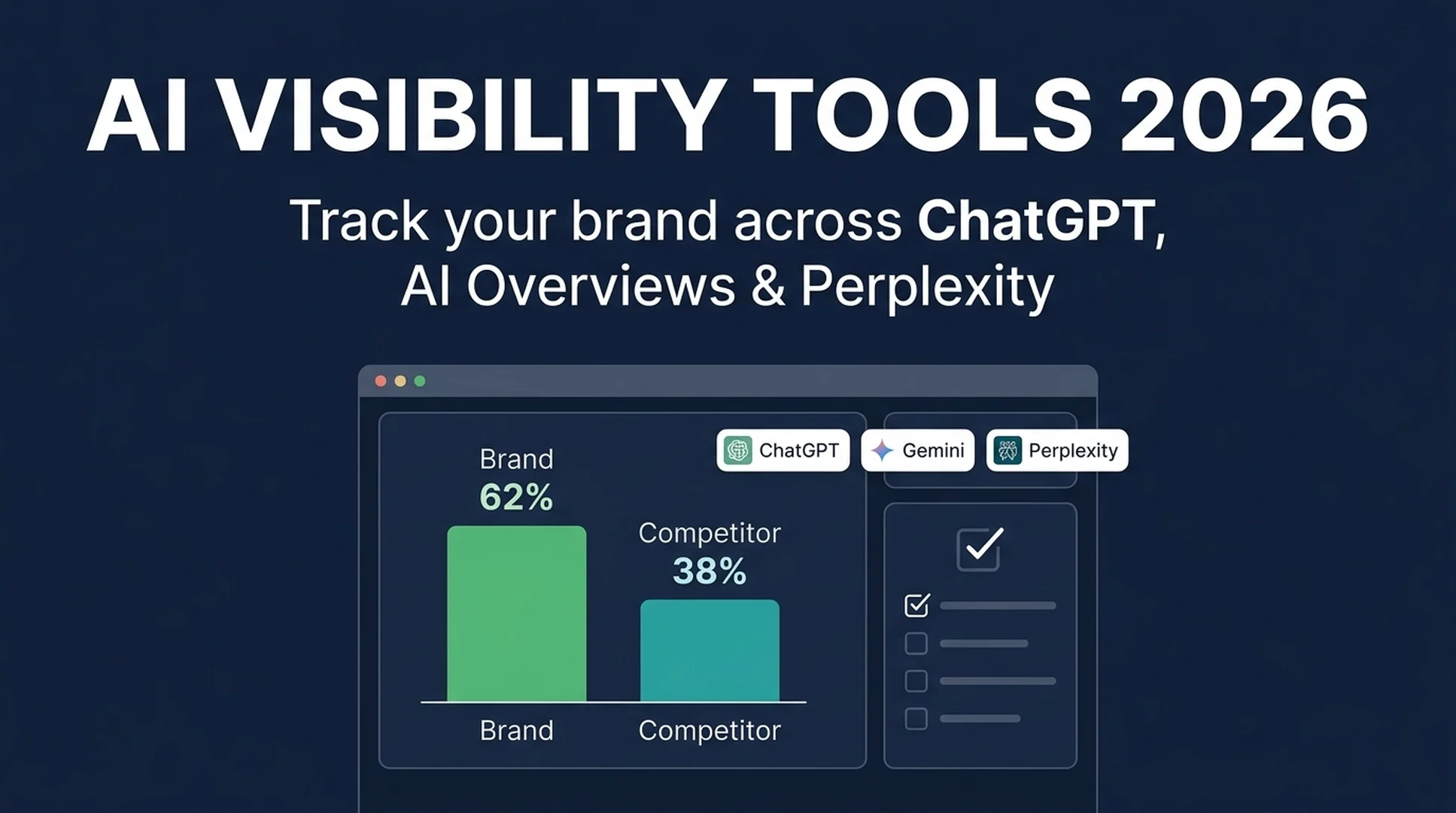
AI visibility means how often your brand or website gets named as a source inside AI answers — ChatGPT, Google AI Overviews, Perplexity, Gemini, Claude, and Copilot. It is the ranking position of the 2020s: if an AI answer mentions your competitors but not you, the decision is already made before anyone clicks your link.
You do not need a $189/month tool to start. This guide walks through the eight best AI visibility tools of 2026, explains what each actually measures, and then shows a free 30-minute Codex skill that tracks your brand across the main AI platforms with no paid subscription. Try the free method for one month; buy a paid tool only when you outgrow it.
Who this is for: solo founders, marketers, and small teams who want to know whether AI search is silently pushing their brand aside, without having to guess.
What an "AI Visibility Tool" Actually Measures
The eight tools below fall into five capability buckets. Knowing the buckets is more useful than memorizing tool names, because the same feature ships under different names in every product.
Capability | What it does | Why a beginner cares |
|---|---|---|
AI Overview appearance tracking | Watches Google AI Overviews and AI Mode to see if your URL appears and where | Google is still where most people search; AI Overviews change what they see above the fold |
LLM answer presence tracking | Runs your brand or keyword through ChatGPT, Gemini, Claude, and Perplexity and records whether you are referenced | These engines recommend products and services directly — no search results page involved |
Brand mention monitoring | Scans AI answers for your brand name, plus context and sentiment | Tells you whether the mention is helpful, neutral, or damaging |
AI ranking & citation detection | Finds which of your URLs the AI cited, how often, and in what position | Your actual pages matter, not just your brand name |
Content optimization (GEO/AEO) | Audits pages for AI-readiness and suggests rewrites, schema, or new answer content | Fixes the root cause instead of just reporting the symptom |
A tool can be strong in one bucket and weak in another. A cheap tool that tracks ChatGPT mentions perfectly might ignore Gemini entirely — which means it reports a sunny picture while your brand disappears from a second engine.
Three extras worth paying for (or not)
Most vendors add one or more of these differentiators. Weigh them only after the five core buckets:
- Competitive AI visibility tracking — benchmarks your mentions against 2–10 named competitors in the same dashboard. This is the single most useful upgrade for a beginner, because a number means nothing until you compare it.
- Evidence logs and screenshots — stores the raw AI answer (and sometimes a screenshot) behind each mention. Essential for client reporting and for checking that a "mention" is real.
- API or export access — lets you pull data into a spreadsheet or dashboard. Nice to have; rarely the deciding factor in month one.
How to Judge Any AI Visibility Tool (the 4 Checks)
Independent testing in 2026 found wide quality gaps that marketing pages hide. In one round of testing, 12 tools were checked against 600 verified prompt–answer pairs (GTECH, 2026):
- Average mention-detection accuracy was 81%, ranging from 67% to 94% across platforms.
- 9% of reported mentions were false positives — the tool said a brand was mentioned when it was not.
- Sentiment classification was only ~72% accurate, the weakest layer measured.
- Only 4 of 12 tools refreshed their prompts daily; the rest updated weekly or monthly, even though AI answers changed in about 47% of re-runs.
- Only ~29% of brands appeared on more than one major LLM for the same query — so a tool that skips Perplexity or Claude is missing genuinely different placements, not duplicates.
Price did not predict accuracy. Apply these four checks to any tool before you subscribe:
- Platform coverage — which AI surfaces does it actually query? If your buyers are in B2B, Perplexity and ChatGPT matter; if you are a local business, Google AI Overviews matter more.
- Refresh frequency — does it re-run prompts daily or monthly? In a volatile answer environment, monthly data is history, not signal.
- Citation capture — does it show the source URLs behind a mention, or just a count? A mention without a citation is a half-answer.
- Manual spot-check — run 10–20 of your own prompts on the free versions of ChatGPT and Perplexity, compare to the tool's dashboard, and trust your own eyes over the sales deck.
The 8 Best AI Visibility Tools of 2026 Compared
Pricing is as published on vendor pages in August 2026 and can change — always confirm before buying.
Tool | Starting price | Platforms tracked | Best for |
|---|---|---|---|
RankScale AI | $20/mo | 20+ engines incl. DeepSeek, Grok, Mistral | Budget users who want the widest engine coverage |
Otterly AI | $29/mo | ChatGPT, Perplexity, AI Overviews, Copilot (+ AI Mode, Gemini as add-ons) | Solo marketers wanting an audit layer, not just counts |
Am I Cited | €50/mo | ChatGPT, Perplexity, AI Overviews | Dedicated AI-only monitoring on a mid budget |
Semrush AI Toolkit | $99/mo | ChatGPT, AI Overviews, Gemini, Perplexity | Teams already inside the Semrush stack |
SE Visible (SE Ranking) | $99/mo | ChatGPT, Perplexity, Gemini, AI Overviews, AI Mode | Teams that want SEO + AI visibility in one platform |
Peec AI | €89/mo (AI Mode + Gemini as add-ons) | ChatGPT, Perplexity, Gemini, AI Overviews, Grok | Mid-market teams doing content research; URL-level citations |
Ahrefs Brand Radar | included with Ahrefs plans ($129+/mo) | AI Overviews, AI Mode, ChatGPT, Copilot, Gemini, Perplexity | Existing Ahrefs users who want brand-level metrics |
Profound | $99/mo (ChatGPT only) to $399+ | Up to 10 engines on enterprise | Fortune-100-scale teams needing SOC 2, SSO, API |
Who each tool is actually for
RankScale AI ($20/mo) — the cheapest real tracker and the widest engine list (20+). Its credit system (one prompt on one engine costs roughly 0.25 credits) means cost scales with how many engines you check. Best for a solo founder who wants to see mention counts across many platforms before committing to a bigger tool. The interface has a learning curve and it does not detect AI crawlers — it reports model output only.
Otterly AI ($29/mo) — the most accessible audit-first option. Its GEO audit scans 25+ on-page factors (crawlability, schema, content depth) and turns them into prioritized fixes. This makes it a good "what should I actually change?" answer for beginners. Watch the add-ons: full Google coverage (AI Mode and Gemini) adds about $18/month on the Lite plan.
Am I Cited (€50/mo) — a focused, AI-only monitor built around the citation question: are you or your competitors cited in ChatGPT, Perplexity, and AI Overviews, and by which URLs? No SEO stack, no content tools — a clean single purpose.
Semrush AI Toolkit ($99/mo) — for teams already paying for Semrush, the AI Visibility toolkit layers ChatGPT, AI Overviews, Gemini, and Perplexity tracking onto the existing keyword and backlink data. If you are not a Semrush user, its standalone value is weaker than purpose-built tools at the same price.
SE Visible ($99/mo, or $49 as an SE Ranking add-on) — SE Ranking's AI-visibility layer. Good for agencies and multi-brand operators who want SEO and AI tracking in one dashboard with predictable tiered pricing. It tracks ChatGPT, Perplexity, Gemini, AI Overviews, and AI Mode with weekly updates and multi-country coverage. Depth in citation prediction and AI traffic attribution is thinner than specialized competitors.
Peec AI (€89/mo) — Berlin-based, popular with mid-market teams and European agencies. Its standout research feature distinguishes "used" (content shaped the answer) from "cited" (URL appears), with URL-level citation insight across 14+ languages. Be aware that AI Mode and Gemini are paid add-ons, so full Google coverage costs more than the headline price.
Ahrefs Brand Radar (included with Ahrefs $129+/mo) — a brand-level AI visibility dashboard over the Ahrefs index, tracking mentions across six AI platforms plus YouTube and Reddit. The catch: several 2026 reviews reported notable accuracy issues in ChatGPT and Perplexity mention counts, so treat its numbers as directional and verify important placements manually. Best as a convenience layer for people who already pay for Ahrefs.
Profound ($99–399+/mo) — the enterprise tier. Real user-interface monitoring across up to 10 engines, CDN-log integration (Cloudflare/Akamai) to connect AI crawler activity to real sessions, SOC 2, SSO, and role-based access. If you are a Fortune-100 brand, this is built for you. If you are a solo founder, it is wildly over-spec'd.
Track Your Brand Free in 30 Minutes (Codex Skill)
Before you spend anything, run the free method below. It uses OpenAI Codex (or Claude Code) to turn your brand name and a few keywords into a repeatable AI-visibility tracker. No paid SEO tools, no API keys.
The skill does three things: builds your prompt set, walks you through running those prompts on the free versions of ChatGPT, Perplexity, and Google AI Overviews, then records every answer into a tracker that shows your share of voice versus competitors and flags your weakest placements.
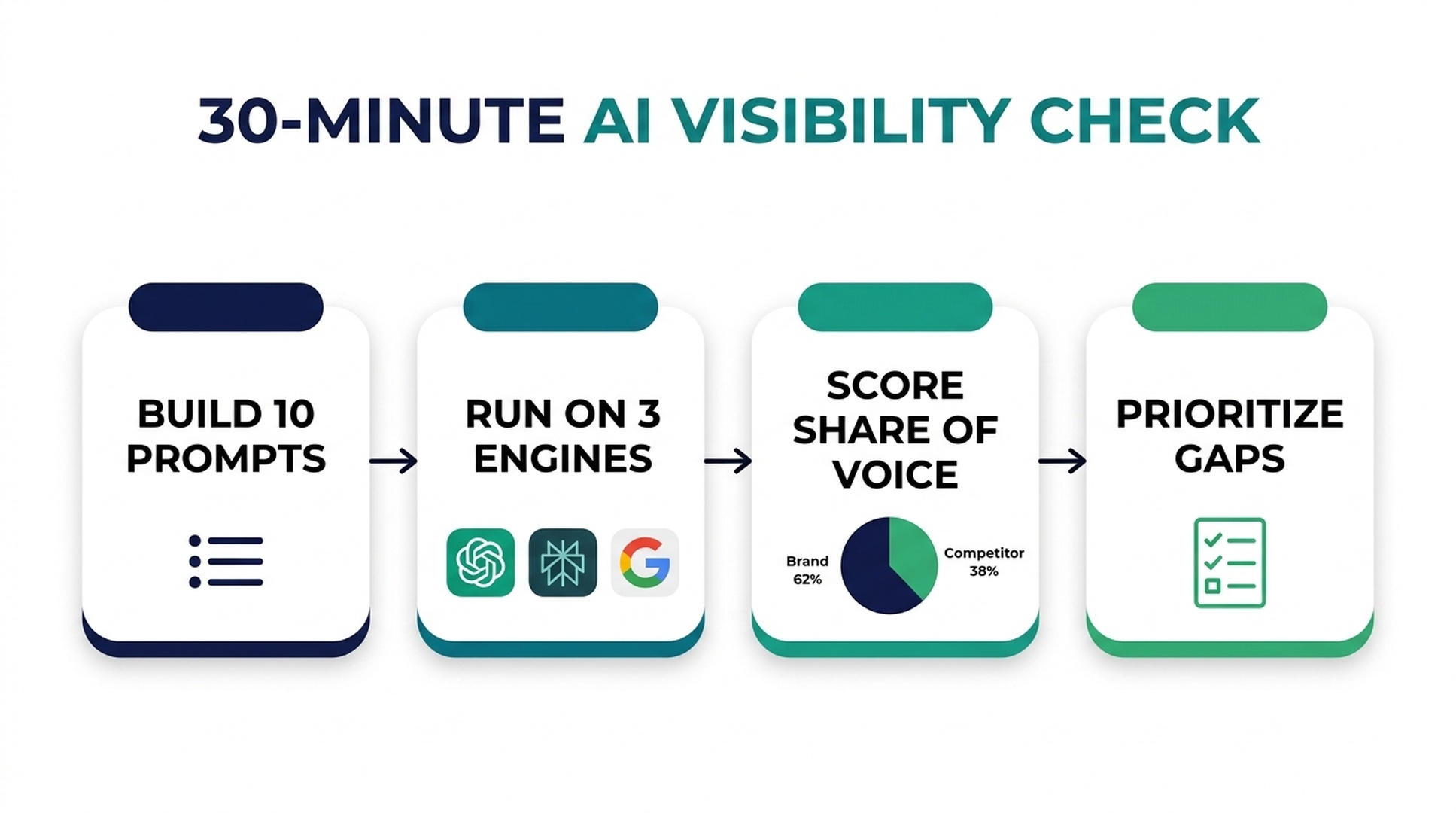
Save the file below as ~/.codex/skills/ai-visibility-monitor/SKILL.md, then invoke it in Codex with /ai-visibility-monitor. If you do not use Codex, paste the prompt text from the "Manual Prompts" section straight into ChatGPT or Claude.
---
name: ai-visibility-monitor
description: Build a repeatable AI visibility tracker for your brand across ChatGPT, Perplexity, and Google AI Overviews. Produces a share-of-voice tracker, competitor comparison, and prioritized gap list. No paid tools or API keys required.
---

# AI Visibility Monitor

A beginner-friendly workflow that shows where your brand does and does not appear in AI answers, using only free accounts.

## Input

Ask the user for:
- Brand name (the exact name people search for)
- Website URL
- Top 5 keywords or phrases their customers search
- Top 3 competitor brand names
- Target market or country (optional; changes Google AI Overviews results)

## Prerequisites

- A free ChatGPT account (web search can be enabled on the free tier for some queries)
- A free Perplexity account
- Google search access for AI Overviews checks
- No paid SEO tools and no API keys required

## Step 1: Build the prompt set

Generate 10 prompts from these three patterns:

1. Brand presence (3 prompts): "{brand}" / "what is {brand}?" / "is {brand} good for {primary use case}?"
2. Category recommendations (4 prompts): "best {category} for {audience}" / "top {category} tools" / "{category} vs {category}" / "what should I use for {category}?"
3. Competitor probes (3 prompts): each competitor's brand name in a recommendation query.

Write the prompts into a table: Prompt | Engine | Date | Brand mentioned? (Y/N) | Which competitor mentioned? | Source URL cited? | Notes.

## Step 2: Run the prompts

For each of the 10 prompts, run it on ChatGPT (web search on), Perplexity, and Google (check whether an AI Overview appears). Record one row per prompt per engine. Do not invent results — if the answer does not mention the brand or show an AI Overview, record N and move on.

## Step 3: Score your share of voice

For each engine, count:
- Brand mentions = times the brand appears in an AI answer
- Competitor mentions = times each competitor appears
- Total answer slots = number of prompts where any answer was shown

Share of voice = brand mentions ÷ total answer slots, expressed as a percentage per engine.

## Step 4: Build the gap list

Sort the tracker by engine and prompt. Flag any prompt where:
- A competitor is mentioned but the brand is not
- The brand is mentioned but no URL or source is cited
- The brand is named with neutral or negative phrasing (note the wording)

Each flagged item becomes one row in a prioritized action list: Prompt | Engine | What happened | What to do.

## Output

Return:
1. The completed tracker table (all 10 prompts × 3 engines)
2. Share-of-voice percentage per engine and overall
3. A prioritized gap list with one concrete action per gap

## Safety rules

- Never fabricate an AI answer, mention, or citation. If you did not run it, mark it "not checked".
- Never ask for or print API keys, cookies, passwords, or tokens.
- Do not claim the skill improves rankings or guarantees citations — it measures current state.
- If an engine requires login or payment to run a prompt, note it and skip it rather than guessing.

## Manual Prompts

If you are not using Codex, run these manually and fill the tracker yourself:

- "What is {brand}?" on ChatGPT, Perplexity, and Google (look for an AI Overview).
- "Best {category} for {audience}" on all three.
- "{competitor} vs {brand}" on all three.
- For each result, write down: mentioned? which competitors? any source URL?
How to read your first report
In one sitting you will see three outcomes, and each tells you something different:
- You appear in answers but with no citation. AI engines can summarize you without linking a source. This usually means your content is being absorbed but your page is not clearly the origin — strengthen the exact page that matches the prompt and add explicit "sources cited" cues like named studies, dates, and entity statements.
- Competitors appear, you do not. Your content does not answer the prompt's intent clearly. Open the winning competitor page, note the structure (question → direct answer → evidence → sources), and rebuild your page to that shape.
- Nobody appears (no AI Overview, no LLM mention). The prompt may be too niche for AI to bother answering, or AI coverage is low in your category. That is useful information too — it tells you where not to waste effort.
Track the same 10 prompts once a month. Three months of data will show you which platforms are actually moving for your brand, which is exactly the evidence you need before choosing a paid tool.
When to Buy a Paid Tool (and Which)
Move to a paid tool when one of these is true:
- You are already running your free tracker monthly and it is becoming tedious. A paid tool automates the re-runs and refreshes daily.
- You need to report to a boss or client. Evidence logs and share-of-voice dashboards make a professional report in minutes instead of an afternoon.
- You operate in a competitive category where placement inside AI answers drives revenue. If ChatGPT recommendations decide purchases in your market, a few hundred dollars a month pays for itself.
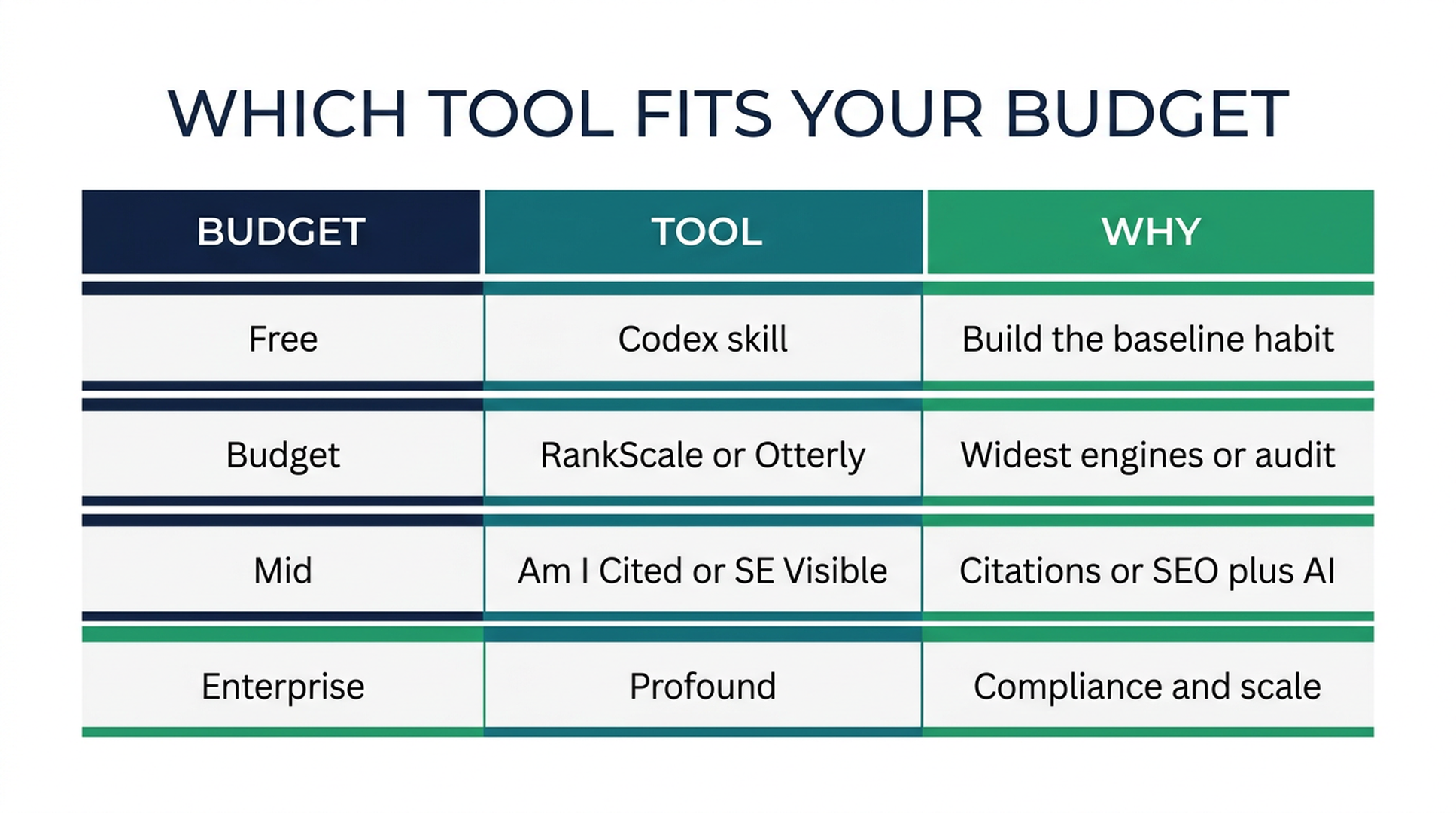
Budget paths, from leanest up:
Budget | Recommendation | Why |
|---|---|---|
$0/month | Codex skill above | Builds the habit and the baseline data |
$20–50/month | RankScale AI or Otterly AI | Widest engine coverage or the best audit layer |
$100/month | Am I Cited or SE Visible | Clean citation focus, or SEO + AI in one dashboard |
Enterprise | Profound | Compliance, scale, and 10-engine coverage |
What Changes in AI Visibility in 2026–2027
Three shifts are already measurable and worth planning for:
Conversational search is becoming the default answer surface. Google's AI Mode merges voice, vision, and text into one conversational experience, and ChatGPT reached roughly 900 million weekly active users in early 2026 (third-party estimates). "Go ask ChatGPT" is now as natural as "let me Google it" — which is why tracking each engine individually matters more than it did last year.
Being cited as a source beats being ranked. As generative answers answer before users click, the value shifts from a ranking position to being the source named inside the answer. That is why citation capture (which URLs an AI cites) is the feature beginners should care about most, not raw mention counts.
Entity clarity and structure decide whether you get cited at all. AI engines reconstruct your business from public signals — consistent naming, a clear About page, dates, named entities, and clean schema. A tool tells you where you are missing; it does not fix the missing. The fixes are the same fundamentals SEO has always rewarded, applied to a new surface.
FAQ
What is AI visibility?
AI visibility is how often your brand or content is featured in AI-generated answers — from ChatGPT and Perplexity to Google AI Overviews and Gemini. It measures whether AI engines can find, understand, and cite you when people ask about your category.
Why did my website lose visibility in AI answers?
The most common reasons are: content that does not directly answer the question, outdated or unstated facts, unclear entity signals (inconsistent brand naming, no About page), or technical blockers that stop AI crawlers. LLMs favor clear, well-cited sources over generic filler.
Can AI visibility improve my organic SEO?
Indirectly, yes. Pages that rank well in AI answers share the same underlying qualities as pages that rank well in Google: clear intent coverage, authoritative structure, and fresh, accurate facts. Improving one tends to improve the other, but improving AI visibility is not a shortcut to rankings.
Which AI visibility tool is the cheapest?
RankScale AI at $20/month is the cheapest dedicated tracker, and Otterly AI at $29/month is the cheapest with a strong audit layer. The truly free option is the Codex skill in this article, which uses free accounts and no paid tools.
Can I track AI visibility without paying?
Yes. Run the 10-prompt tracker in this article once a month on the free versions of ChatGPT, Perplexity, and Google. It takes about 30 minutes and gives you a defensible baseline without any subscription.
Author: Alice Monroe, AI SEO Tools Analyst at Auspia. Alice covers AI visibility software, SEO tooling, and the workflows that make them useful to small teams.