The short answer
If a GEO operator takes over a new brand and starts with "we need more articles," the project is already drifting.
The first job is not publishing. It is finding out how AI answer systems currently understand the brand, where that understanding is wrong or thin, and why competitors look safer to mention.
A reliable GEO workflow usually moves in this order:
- Audit AI answers for brand and buying-scenario questions.
- Map why competitors are being cited or recommended.
- Translate keyword research into real buyer questions.
- Build a clean brand fact base.
- Create citeable content assets, not filler posts.
- Place evidence across sources that can confirm each other.
- Make pages easier for humans and AI systems to parse.
- Add structured data after the content is clear.
- Monitor scenario answers, not only brand-name prompts.
- Use the gaps to plan the next content and evidence cycle.
That is the difference between a GEO program and a content calendar with a new label.
Why "publish more" is the wrong starting point
A lot of teams still treat GEO as SEO with a different acronym. The plan sounds familiar: write more posts, target more keywords, distribute them across more channels, then wait for AI systems to notice.
It looks busy. There are briefs, drafts, spreadsheets, approvals, and weekly reports.
Then someone asks ChatGPT, Gemini, Perplexity, or another AI search interface a simple buying question: "Which companies should I look at for this problem?" The brand is missing. Or worse, the answer mentions the brand but describes it inaccurately.
That usually does not happen because the team failed to publish enough. It happens because the web does not give AI systems enough clean, consistent, useful evidence to work with.
GEO is not a volume contest. It is the work of making a brand understandable, verifiable, and safe to reference inside AI-generated answers.
Step 1: run an AI perception audit before writing anything
Start with the current state. Ask AI systems two kinds of questions.
Brand questions:
- What does [brand] do?
- Who is [brand] best suited for?
- How is [brand] different from alternatives?
- What are the common complaints or limitations of [brand]?
- Is [brand] a good fit for small teams, enterprise teams, agencies, or developers?
Scenario questions:
- What should a small company use when its sales pipeline is messy?
- How should a SaaS team choose an AI search visibility tool?
- What are the best options for checking whether a website is ready for AI crawlers?
- Which vendors are worth comparing for [specific use case]?
- What are the common mistakes when choosing [category] software or services?
Record the answers. Do not only check whether the brand appears. Look for accuracy, missing context, wrong category labels, competitor bias, outdated facts, and whether the system can explain when the brand is a good fit.
This is where tools such as Auspia's AI Search Visibility Checker can help teams turn scattered prompt testing into a repeatable audit.
Step 2: study why competitors look trustworthy
Competitor analysis in GEO is not just "where did they publish?" or "how many posts do they have?"
The better question is: why does the AI answer feel comfortable mentioning them?
A competitor may appear often because its website explains the product category clearly. Another may have detailed case studies. Another may show up in comparison pages, review sites, analyst roundups, Reddit discussions, or practitioner blogs. Another may be attached to a specific use case so consistently that AI systems treat it as a natural example.
Look behind the sentence.
If an AI answer says a competitor is "good for small businesses," check whether the web supports that claim. Does the competitor have SMB case studies? Pricing pages? Implementation timelines? Setup guides? Reviews from small teams? Third-party discussions that repeat the same positioning?
If your brand lacks those materials, the problem is not that AI is unfair. The evidence chain is weaker.
What AI answer says | Evidence to look for | GEO gap to fix |
|---|---|---|
"Good for small teams" | SMB case studies, pricing clarity, onboarding guides | Publish fit criteria and small-team examples |
"Strong enterprise option" | Security pages, procurement docs, named customer stories | Add enterprise proof and implementation details |
"Easy to start" | Setup docs, tutorials, short workflows, user reviews | Create beginner workflows and product screenshots |
"Trusted in the category" | Independent mentions, expert roundups, community discussion | Build third-party proof around real use cases |
GEO is less about asking AI systems for a recommendation slot. It is more about supplying the evidence required for that recommendation to make sense.
Step 3: move from keywords to buyer questions
Traditional SEO often begins with a keyword list: CRM software, AI SEO tool, website audit, content automation, technical SEO checklist.
AI search behavior is messier and more specific. People ask questions that sound like problems:
- Our sales team keeps losing deal history. What should we use?
- We need to know whether AI crawlers can access our site. Where do we start?
- We have content, but AI answers never cite us. What is missing?
- Is it worth creating an llms.txt file for a B2B SaaS site?
- Which tool helps a small team check SEO and GEO issues without hiring an agency?
These are the entry points for GEO. The brand has to be connected to problems, audiences, constraints, and decision stages.
A useful question map usually covers five stages:
- Discovery: "What is this problem and why is it happening?"
- Comparison: "Which approaches or vendors should I compare?"
- Risk: "What mistakes should I avoid?"
- Budget: "What can I do with limited time or money?"
- Brand follow-up: "Is this specific brand a fit for my situation?"
If the brand only has generic category content, AI systems may know the name but still not know when to bring it up.
Step 4: build a brand fact base before polishing copy
Many company websites are full of adjectives and short on facts.
"Powerful." "Trusted." "End-to-end." "AI-driven." "Built for modern teams." These phrases are easy to approve and hard to cite.
A brand fact base is plainer and more useful. It should answer:
- What does the company do in one sentence?
- Which customers is it built for?
- Which customers is it not built for?
- What problems does it solve?
- What workflows does it support?
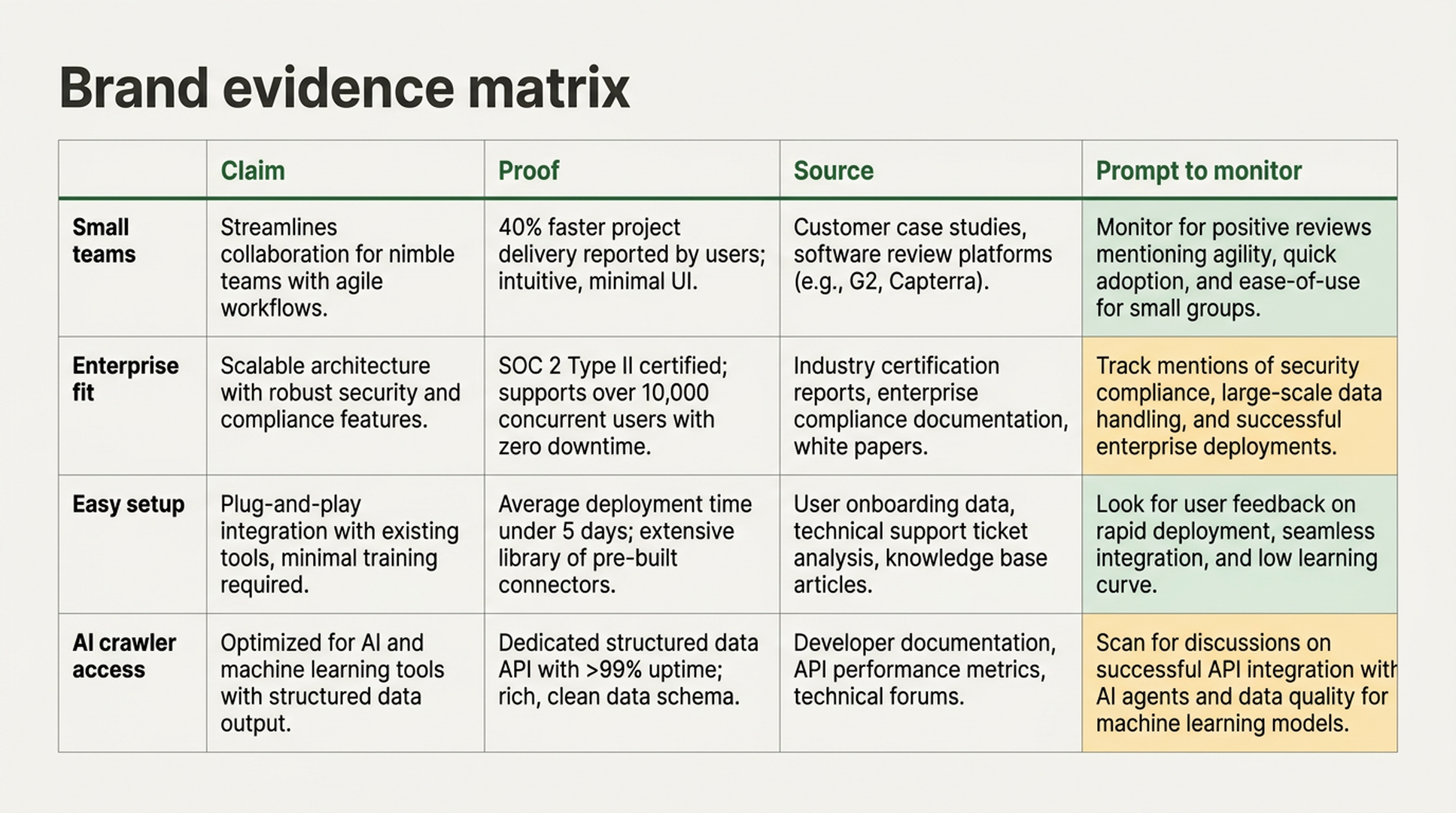
- What proof exists: customer examples, benchmarks, integrations, documentation, screenshots, certifications, processes?
- What claims should every channel repeat the same way?
- What claims should the company avoid because they are vague or unsupported?
This document is not only for writers. It is the source of truth for website pages, comparison pages, FAQs, schema, sales collateral, partner descriptions, and founder interviews.
When the website says one thing, the blog says another, and third-party profiles say a third thing, AI systems often stitch together a blurry brand picture. Clean facts come first. Better copy comes later.
Step 5: create citeable assets, not just blog posts
The strongest GEO content is easy to extract. It has a clear question, a direct answer, specific examples, stable structure, and claims that can be checked.
For many brands, the first asset set should include:
- A category explainer that defines the problem and available approaches.
- A product or service fit page that explains who should and should not use the offer.
- A comparison guide that states trade-offs without pretending every option is bad except yours.
- A buyer checklist that helps users evaluate vendors.
- A pricing or implementation page that reduces uncertainty.
- A case study with the situation, actions, constraints, and results separated clearly.
- A FAQ page that answers real sales and support questions.
These assets may never become viral posts. That is fine. Their job is to become reliable material for people, search engines, and AI answer systems.
If you are working on technical visibility, pair the content work with basic crawl and access checks. Auspia's LLMs.txt Generator / Checker is one practical starting point, especially when teams need a clean way to document AI-facing site guidance.
Step 6: build sources that confirm each other
GEO does not mean spraying the same press release across every possible platform.
AI systems evaluate patterns. They notice who says what, where the information appears, whether different sources agree, and whether the claims look useful or recycled.
Each source type should have a job:
Source | Best role in a GEO program |
|---|---|
Website | Define the brand, product, audience, use cases, pricing, documentation, and proof |
Blog | Explain problems, methods, comparisons, buyer questions, and category opinions |
Help docs | Show workflows, implementation details, integrations, and troubleshooting |
Case studies | Prove that specific customers solved specific problems |
Review sites | Add user language, objections, strengths, and fit signals |
Practitioner communities | Surface real questions, workarounds, and category vocabulary |
Industry media or partner pages | Provide third-party context and independent confirmation |
The goal is not identical messaging everywhere. The goal is consistent facts in different forms.
Step 7: reduce the cost of understanding
Some pages contain good information, but they bury it.
The headline is vague. The intro circles around the point. The product page uses ten adjectives before naming the customer. The case study hides the result. The FAQ answers are written like ad copy.
For GEO, write in a way that makes extraction easier:
- Put the answer near the top of each section.
- Use descriptive headings, not clever ones.
- Keep paragraphs short when they carry facts.
- Use tables for comparisons and criteria.
- Separate claims from proof.
- Name the audience and use case directly.
- Explain boundaries: who the product is not for, where it needs setup, what it does not replace.
This does not mean every page should read like a manual. It means the page should not make readers or AI systems guess what matters.
Step 8: use structured data after the content is clear
Schema, FAQ markup, organization data, author data, breadcrumbs, product information, and article metadata all matter. They help machines parse what is already on the page.
But structured data cannot rescue thin content.
If the case study is vague, marking it up will not make it convincing. If the FAQ gives promotional non-answers, FAQ schema will not turn it into evidence. If the brand story changes across channels, organization markup will not fix the confusion.
Use this order:
- Clarify the facts.
- Turn the facts into useful pages.
- Make the pages easy to parse.
- Add structured data to support interpretation.
- Monitor whether AI answers change.
Most weak GEO projects do not fail because the schema is missing. They fail because the underlying evidence is too thin.
Step 9: monitor scenario visibility, not only brand visibility
Asking "Does AI know our brand?" is useful, but it is only the baseline.
Commercial value usually lives in scenario prompts:
- What should a startup use to audit AI search visibility?
- Which tools help check whether AI crawlers can access a website?
- How should a marketing team compare GEO vendors?
- What are the common risks when optimizing for AI answers?
- Which companies are worth shortlisting for [specific problem]?
Track several signals:
- Whether the brand appears.
- Whether the description is accurate.
- Whether the brand is framed positively, neutrally, or with caveats.
- Which competitors appear before it.
- Which source types seem to support the answer.
- Which scenarios keep excluding the brand.
- Which answers contain wrong or outdated information.
This gives the team a backlog. If AI answers know the brand but never connect it to small business use cases, build proof around that scenario. If the answers mention competitors with stronger documentation, improve docs and comparison pages. If the brand is described incorrectly, fix the source-of-truth pages and the third-party profiles that repeat the error.
Step 10: run GEO as a repair loop
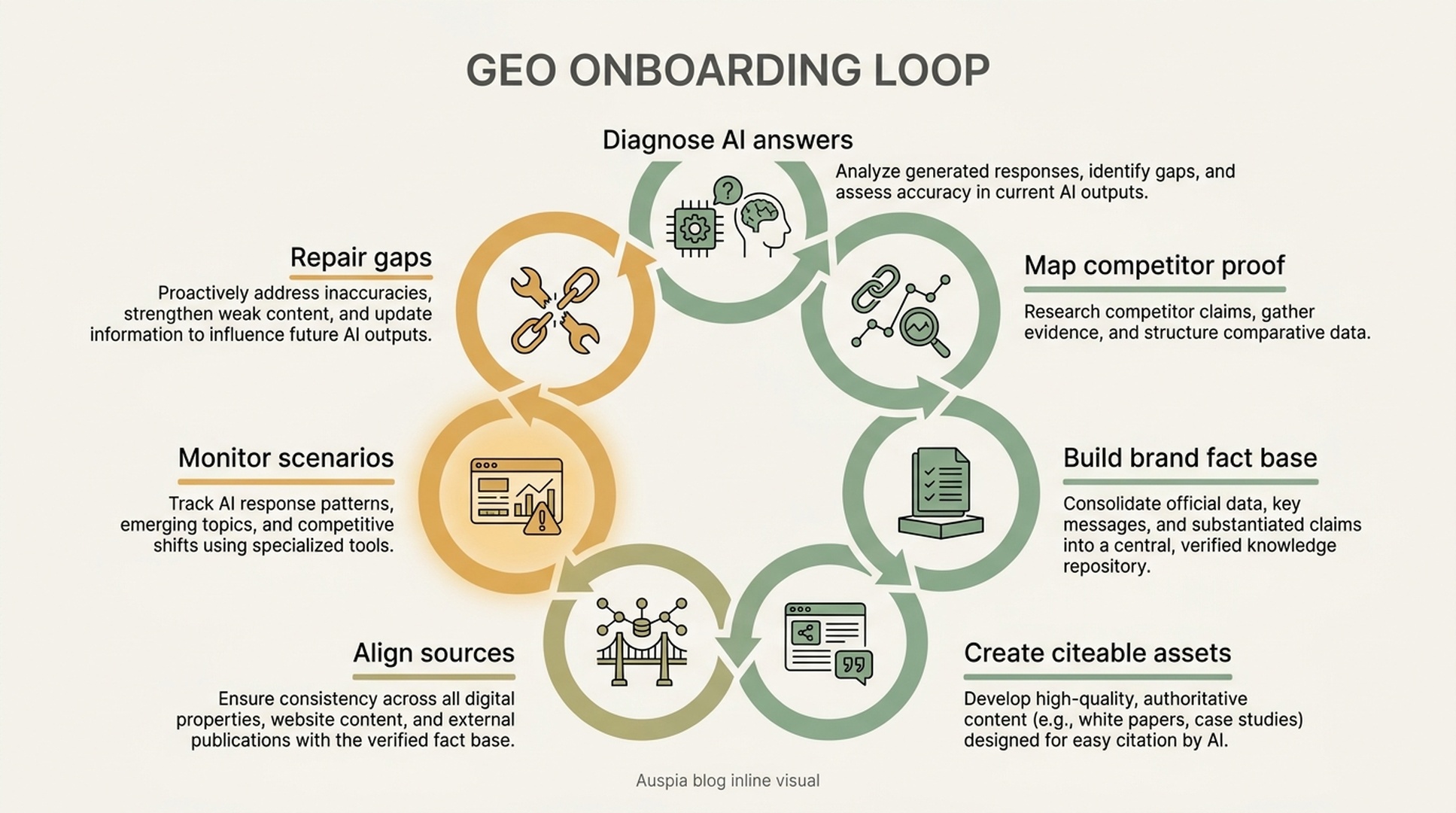
A GEO program is not a one-time publishing sprint. It is a loop:
Audit answers. Find gaps. Build evidence. Publish assets. Improve source consistency. Monitor again. Repeat.
The next action should come from the gap:
What the audit shows | Likely cause | Next action |
|---|---|---|
AI does not mention the brand | Weak category association or low evidence | Build use-case pages, comparison assets, and third-party mentions |
AI describes the brand incorrectly | Inconsistent source material | Clean website copy, profiles, docs, and public descriptions |
AI mentions competitors first | Competitors have stronger proof | Add case studies, buyer guides, documentation, and review coverage |
AI mentions the brand but does not recommend it | Fit, trust, or proof is unclear | Add customer examples, limitations, pricing context, and implementation details |
AI cannot cite the brand's content | Pages are hard to parse or too generic | Rewrite with direct answers, tables, FAQs, and clearer headings |
That loop is the real operating model. Not "publish 20 posts this month." Not "add schema and wait." Not "copy the competitor's content map."
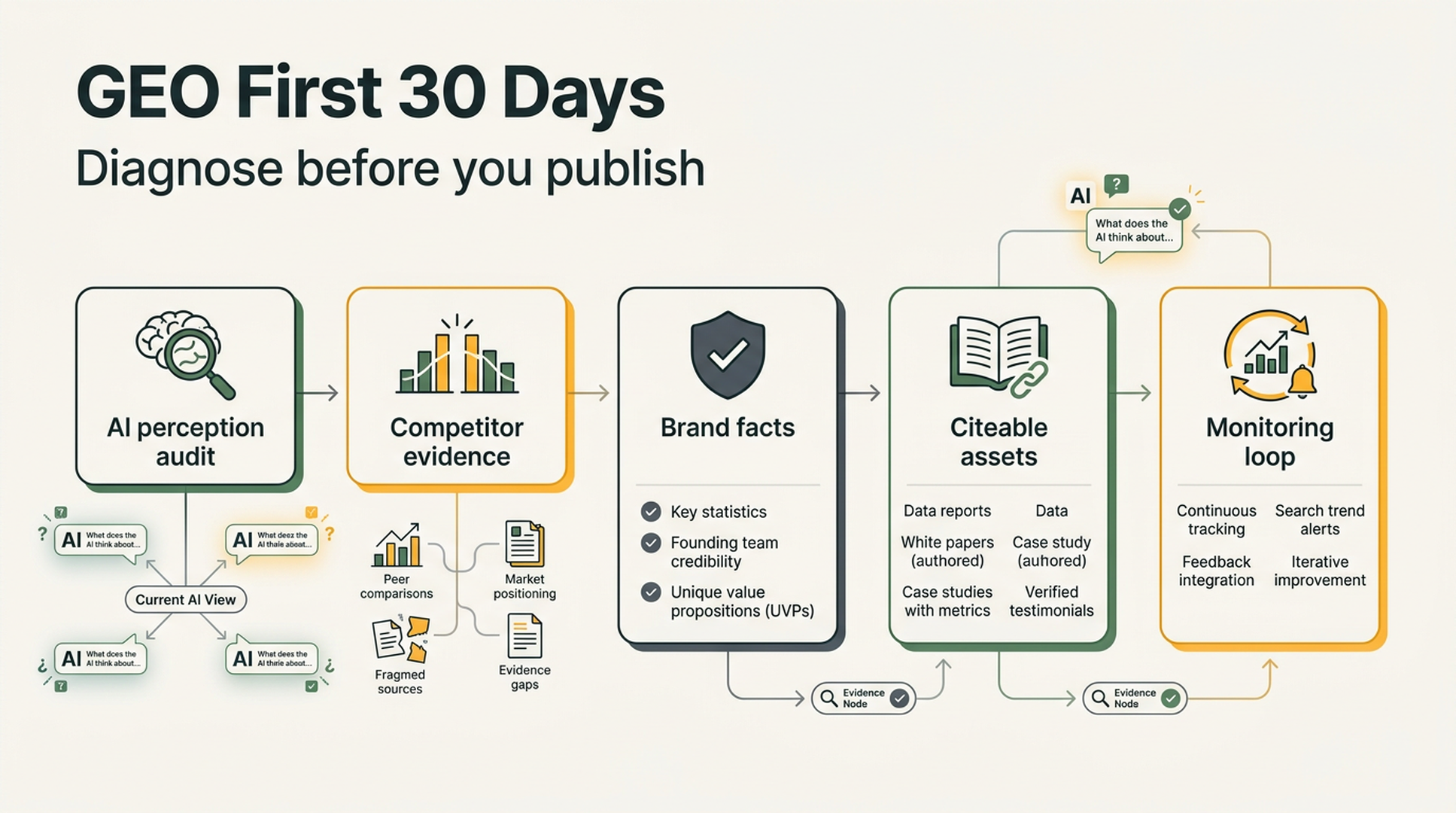
A practical first-30-days GEO plan
Here is the workflow I would want from a GEO operator taking over a new brand.
Day range | Workstream | Output |
|---|---|---|
Days 1-3 | AI perception audit | Prompt set, answer screenshots, accuracy notes, competitor mentions |
Days 4-7 | Competitor evidence map | Source inventory explaining why competitors appear |
Days 8-10 | Buyer-question map | Discovery, comparison, risk, budget, and brand follow-up prompts |
Days 11-14 | Brand fact base | Approved claims, proof points, audience fit, exclusions, terminology |
Days 15-21 | Content asset plan | Pages and posts tied to specific AI-answer gaps |
Days 22-25 | Source consistency cleanup | Website, profiles, docs, and third-party descriptions aligned |
Days 26-30 | Monitoring loop | Baseline dashboard, recurring prompts, next evidence backlog |
The first month should end with a clearer brand, a sharper evidence map, and a prioritized build plan. Content production can start during that month, but it should follow the diagnosis.
Auspia takeaway
The best GEO operators do not sound mystical. They sound operational.
They can explain where a brand is misunderstood, which sources created the confusion, why competitors look easier to recommend, and what evidence must be built next.
AI answer visibility is not won by noise. It improves when the brand is clear, the proof is available, and the web repeats the same core facts in credible places.
That is a slower answer than "publish more." It is also the one that works.
FAQ
What should a GEO operator do first when taking over a new brand?
Start with an AI perception audit. Test how AI systems describe the brand, which competitors they mention, what source types they seem to rely on, and where the answers are wrong or incomplete.
Is GEO just SEO with AI tools added?
No. SEO often starts with rankings and keyword demand. GEO starts with how AI answer systems understand entities, scenarios, evidence, and trust. The two overlap, but the operating sequence is different.
How many articles should a GEO program publish?
There is no useful fixed number. Publish the assets required to close specific evidence gaps: FAQs, comparison pages, fit pages, case studies, documentation, and scenario guides. Ten clear assets can beat fifty vague posts.
Does structured data matter for GEO?
Yes, but it should come after the content is clear. Schema helps machines interpret pages. It does not turn vague claims into useful evidence.
How often should teams monitor AI answer visibility?
For an active GEO program, monitor a stable set of brand and scenario prompts weekly or biweekly. Track changes in accuracy, mentions, competitors, source patterns, and missing scenarios.