The short answer
Not every company needs a full GEO program this quarter. Some teams still win mostly through local referrals, direct sales relationships, or simple impulse purchases where customers do not ask an AI assistant for help.
But if buyers use ChatGPT, Gemini, Perplexity, Claude, or AI Overviews before they compare vendors, your brand has already entered a new discovery channel. In that case, GEO is not a vanity project. It is part search visibility, part category education, and part reputation control.
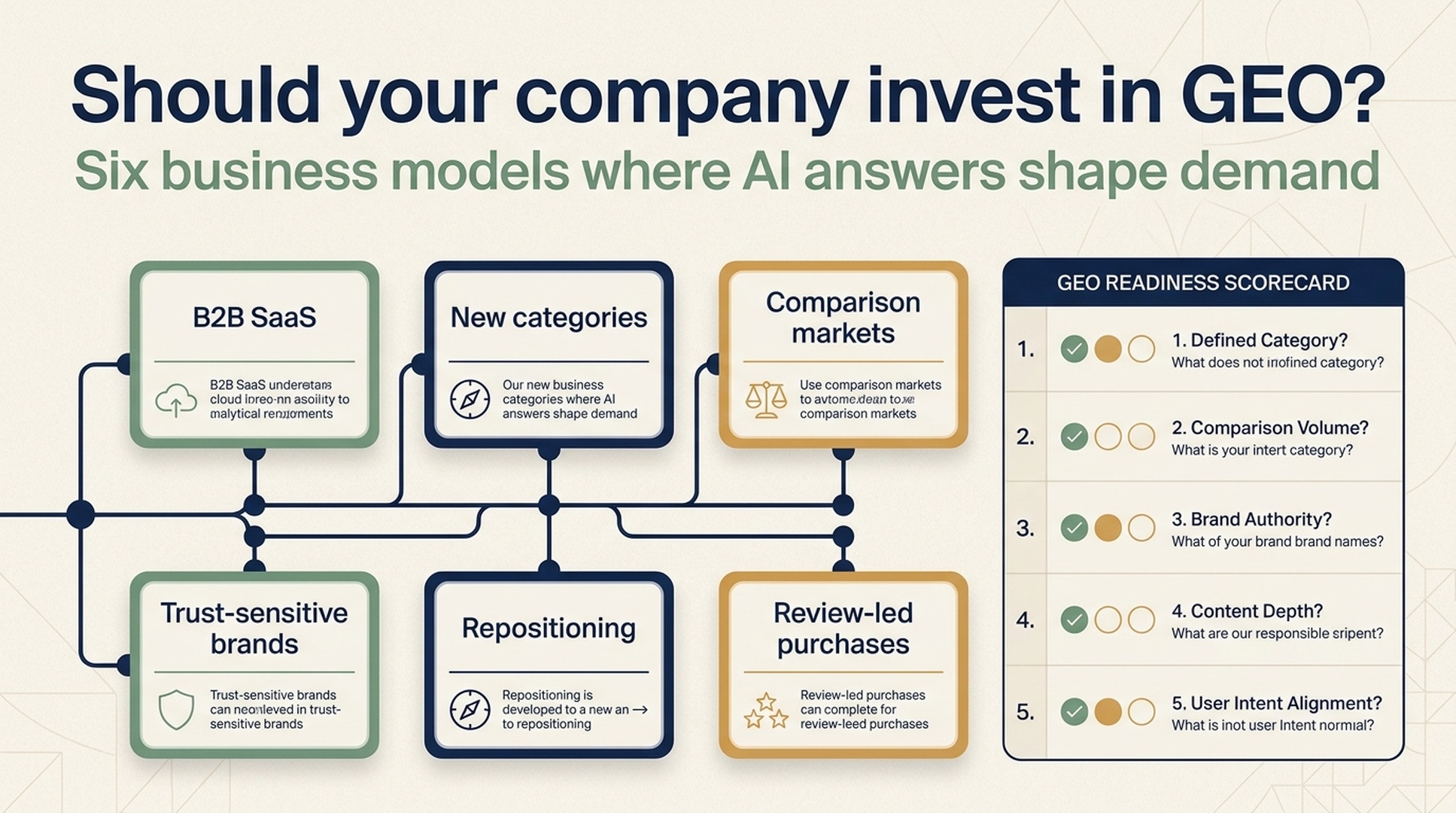
A working rule: if your customer asks AI before buying, comparing, or trusting, you should at least audit your AI visibility. If three or more of the five questions in the scorecard below are true, start building GEO assets now.
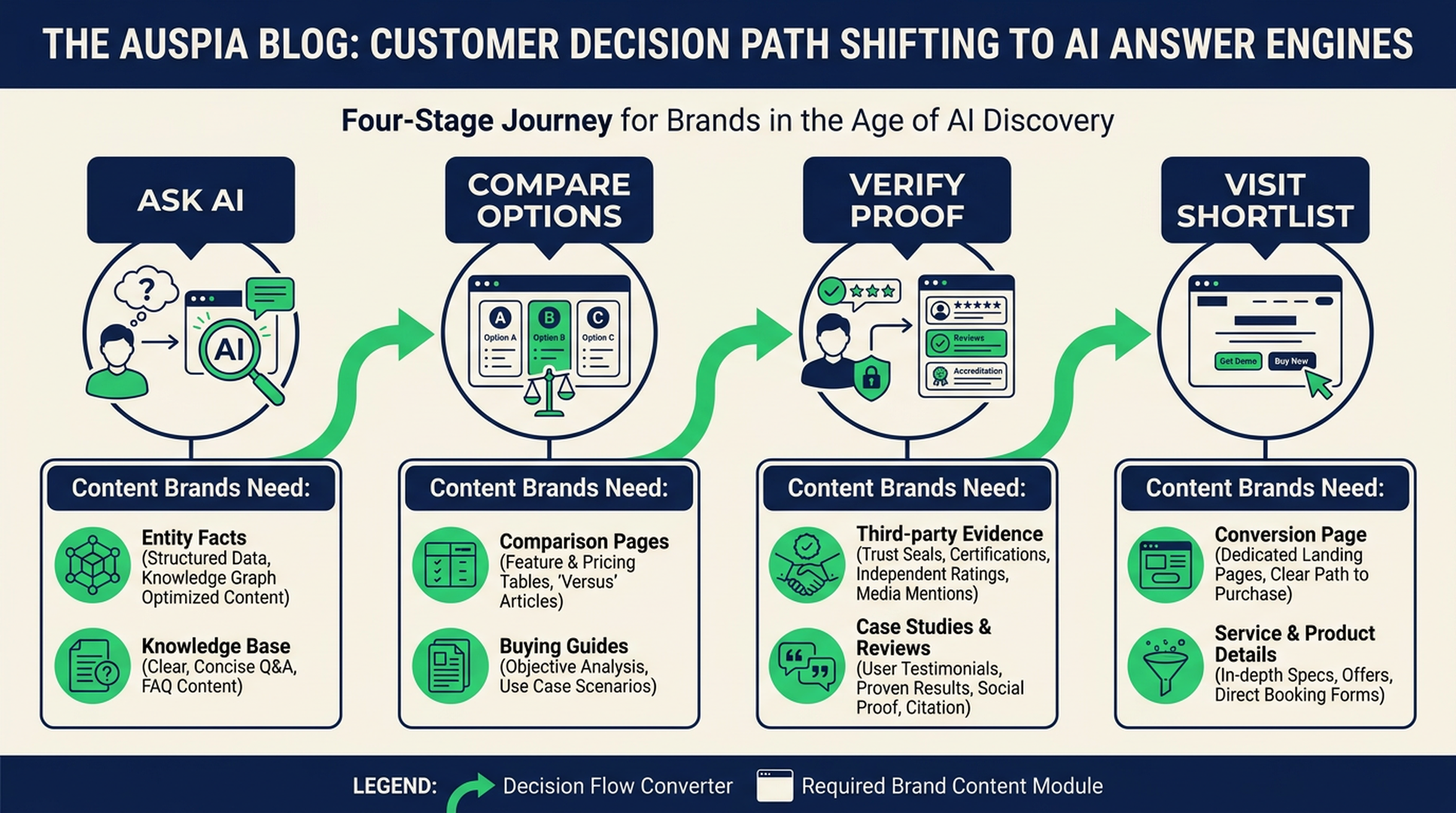
Caption: The AI-era decision path starts before the visitor reaches your website.
What "ready for GEO" actually means
A company is not ready for GEO just because its marketing team has heard the term. It is ready when AI systems have started to influence the early part of the buyer journey.
You can usually spot it in these places:
Signal | What it means | Why it matters |
|---|---|---|
Buyers ask explanatory questions | "What is this category?" "Do I need it?" | AI may define the category before your sales team does. |
Buyers ask comparison questions | "Which tool is better for a 50-person team?" | AI may decide whether you enter the shortlist. |
Buyers ask trust questions | "Is this company reliable?" "What are the risks?" | AI may summarize your reputation with outdated or thin evidence. |
If you see two of these signals, GEO deserves a place in your growth plan. If you see all three, delaying means competitors get to teach the market how to describe you.
This is why GEO is different from a normal SEO backlog item. SEO often starts with keywords and pages. GEO starts with questions, entities, proof, and how answer engines assemble recommendations.
1. B2B SaaS and complex software
B2B SaaS is the cleanest fit for GEO because buyers rarely choose software from a single branded search. They ask layered questions:
- "Best CRM for a Series A startup"
- "HubSpot alternatives for enterprise sales teams"
- "Project management tools for agencies with client approvals"
- "SOC 2 compliant knowledge base software"
Those questions invite AI systems to explain the category, compare vendors, and create a shortlist. If your product is missing from those answers, the buyer may never reach your website.
The risk is not only absence. Misclassification is just as damaging. A platform built for mid-market teams can be described as a small-business tool. A security feature can be omitted. A new AI workflow can be ignored because the model saw older documentation first.
For SaaS teams, the first GEO assets are usually straightforward:
- A clear entity page that states what the product is, who it serves, and what it should be compared against.
- Use-case pages written around buyer questions, not only feature names.
- Comparison pages that are fair, specific, and easy for AI systems to parse.
- Third-party evidence from review sites, partner pages, documentation, and expert mentions.
If you sell CRM, analytics, cybersecurity, data infrastructure, workflow automation, developer tools, or AI products, GEO should not sit in an experimental corner. It should connect to product marketing, lifecycle content, sales enablement, and review management.
2. New categories with high education cost
Some companies do not have a demand problem. They have a language problem.
The buyer does not yet know what to call the category. They are unsure how the product differs from an older workflow. They may understand the pain, but not the new buying frame.
That is where AI answers become powerful. Before a prospect searches for a vendor, they ask:
- "What is agentic workflow automation?"
- "How is AI search optimization different from SEO?"
- "Do I need an LLMs.txt file?"
- "What is the difference between AEO and GEO?"
If AI answers those questions using your definitions, your brand earns early mental availability. If it uses a competitor's framing, you are forced to sell against someone else's vocabulary.
This matters for AI-native software, new professional services, vertical automation tools, climate tech, healthcare innovation, fintech infrastructure, and any product that asks buyers to change an old habit.
The job is not to stuff a page with "what is" keywords. The goal is to publish the best explanation in the market, supported by examples, constraints, and proof. A useful GEO asset explains the concept in a way a buyer, analyst, journalist, and AI answer engine can all reuse without distortion.
3. Comparison-heavy markets
AI is built for comparison. It can turn a messy purchase question into a table, a shortlist, or a recommendation in seconds.
That changes the competitive problem. You are no longer fighting only for awareness. You are fighting for three positions:
- Inclusion: does the AI mention you at all?
- Framing: does it compare you against the right alternatives?
- Recommendation: does it describe the situations where you are the right choice?
Comparison-heavy markets include SaaS, online education, healthcare services, financial products, insurance, automotive, home appliances, travel, agencies, and high-ticket consumer categories.
In these markets, a smaller brand can sometimes win attention if its content answers real comparison questions better than larger competitors. A buying guide with specific scenarios beats a generic landing page. A transparent comparison beats a vague "why us" page. A well-structured FAQ beats a brochure.
Auspia's view: comparison content should be honest enough for humans and structured enough for machines. If every row says your brand is better, it reads like advertising. If the page clearly explains fit, trade-offs, constraints, and buyer profiles, it becomes something AI systems can cite or summarize.
4. Trust-sensitive and regulated industries
Some brands lose money when they are ignored. Others lose trust when they are described incorrectly.
Healthcare, legal, finance, cybersecurity, insurance, pharmaceuticals, consulting, and enterprise services all depend on accurate explanation. If an AI system gives outdated information, confuses your brand with a competitor, or misses a compliance boundary, the damage can show up in sales calls, support tickets, or reputation risk.
For these industries, GEO is partly a risk-management function. The question is not "Can we get more AI traffic?" It is "Can we reduce the chance that AI systems explain us badly?"
Useful work includes:
- Keeping core company facts consistent across the website, profiles, documentation, and third-party pages.
- Publishing plain-language pages for risk, compliance, eligibility, and limitations.
- Making expert authorship and review processes visible where appropriate.
- Monitoring recurring AI answer errors and updating the source material that likely caused them.
This is where an AI search visibility checker can be useful. You need to know how answer engines describe the brand before you can decide what to fix.
5. Large brands launching a new product or repositioning
Big brands have a different GEO problem. They are usually known, but known for the old thing.
That becomes a problem during a product launch, rebrand, new market entry, merger, or strategic repositioning. The company may spend months changing the narrative while AI answers continue to repeat the old one.
This lag is easy to underestimate. AI systems do not automatically absorb a new positioning deck. They infer from public pages, documentation, press coverage, reviews, community discussions, and third-party descriptions. If the web still says the old story, AI will often say the old story too.
A launch GEO checklist should include:
- Updated entity descriptions on the main site and high-authority profiles.
- Fresh product pages that clearly state the new category and buyer.
- Analyst, partner, and customer proof that matches the new narrative.
- Comparison content that explains how the new product relates to the legacy product.
- Monitoring prompts for "What is [brand]?" and "Is [brand] good for [new use case]?"
The bigger the brand, the stronger the old mental model. GEO helps replace that model in the places where AI systems learn.
6. Review-led and recommendation-led businesses
Some businesses live inside other people's opinions. Hotels, restaurants, DTC brands, software marketplaces, agencies, education providers, healthcare clinics, travel services, and local service chains all depend on third-party recommendations.
AI does not eliminate that dynamic. It compresses it.
Instead of reading 20 review pages, a buyer asks an assistant to summarize the options. The assistant may blend reviews, listicles, forum comments, marketplace profiles, and brand pages into one answer.
That means reputation work has to become more structured. You still need reviews and mentions, but you also need those signals to be easy to understand:
- What are customers consistently praising?
- What use cases are you known for?
- Which locations, segments, or buyer types do you serve best?
- What objections appear often, and have they been addressed publicly?
The companies that win here usually do not rely on one perfect brand page. They build a web of consistent evidence across owned, earned, and third-party sources.
Who can wait
Some companies can move slower.
If most sales come from offline referrals, if the product is simple and low-consideration, or if customers rarely research before buying, a heavy GEO program may not be urgent. A neighborhood service business with trusted word-of-mouth may get more from local SEO and review operations first.
Still, "not urgent" is not the same as "irrelevant." Buyer behavior changes gradually, then suddenly. A quarterly check is enough for many teams: test your main buying questions in several AI systems, record whether your brand appears, and note any wrong descriptions.
If the answers start influencing real conversations with prospects, the priority has changed.
The 5-question GEO priority scorecard
Use this quick test before you commit budget.
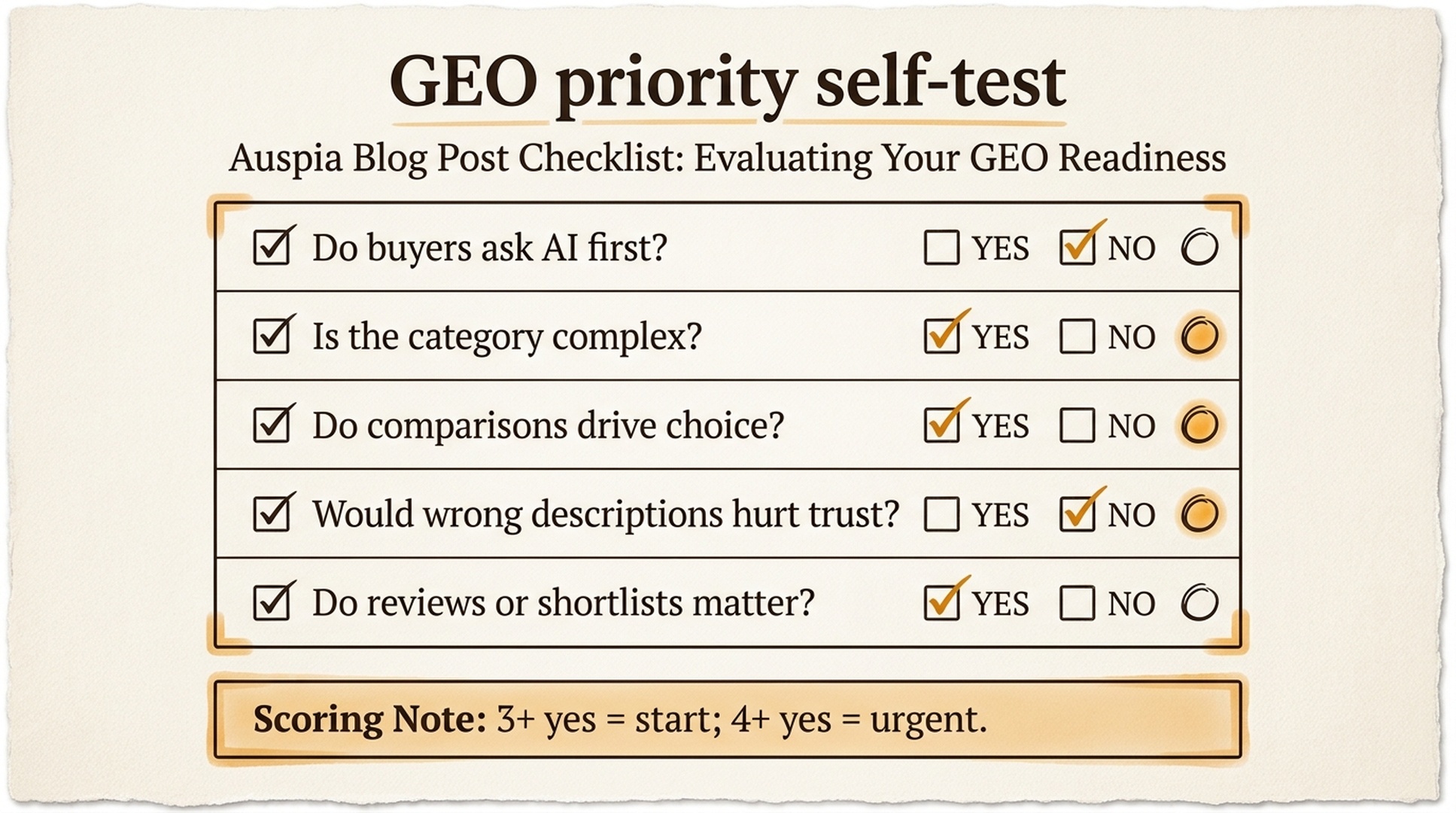
Caption: If three or more answers are yes, GEO deserves active work, not casual monitoring.
Question | Yes or no |
|---|---|
Do buyers ask AI before they understand the category or shortlist vendors? | |
Do buyers compare options using questions like "best," "alternative," or "for my use case"? | |
Does the product require explanation before someone can buy with confidence? | |
Would an inaccurate AI description hurt trust, compliance, or conversion? | |
Does your market depend on reviews, expert recommendations, rankings, or third-party proof? |
Scoring:
- 0 to 1 yes: monitor quarterly. Focus on stronger SEO, reviews, and core website clarity first.
- 2 yes: run a GEO audit and fix obvious entity or reputation gaps.
- 3 yes: build a starter GEO program with entity pages, comparison content, FAQs, and proof assets.
- 4 to 5 yes: treat GEO as a strategic channel. Assign ownership, measure visibility, and refresh assets monthly.
What to do in the first 30 days
Do not start with a 40-page strategy deck. Start with evidence.
First, collect 20 to 30 real prompts your buyers might ask before they contact sales. Include category questions, comparison questions, risk questions, and alternatives.
Second, test those prompts across several AI systems. Record whether your brand appears, how it is described, which competitors appear, and which sources seem to influence the answer.
Third, fix the most expensive gaps. Usually that means clarifying your entity facts, publishing better comparison pages, adding use-case explanations, strengthening third-party proof, and correcting outdated descriptions.
Fourth, measure again. GEO is not a one-time rewrite. It is a feedback loop between buyer questions, public evidence, AI answers, and conversion pages.
Auspia takeaway
The real question is not "Should every company do GEO?" The better question is: "Has AI started shaping the first half of our buyer's decision?"
If the answer is yes, GEO is already part of your market, whether or not your team has named it. The brands that move early will not simply get more mentions. They will help define the questions, comparisons, and proof standards that buyers see before they ever land on a website.
Start small, but start where the risk is real: the prompts that decide whether you are understood, compared fairly, and trusted.
FAQ
What type of company benefits most from GEO?
Companies with complex, high-consideration, comparison-heavy, or trust-sensitive buying journeys benefit most. B2B SaaS, healthcare, finance, legal, education, automotive, travel, and review-led consumer categories are strong fits.
Is GEO only for large brands?
No. Large brands need GEO to manage reputation and repositioning, but smaller brands can use GEO to enter comparison sets earlier. A smaller company with clear explanations and strong proof can sometimes appear in AI answers before it wins traditional search dominance.
How is GEO different from SEO?
SEO improves visibility in search results. GEO improves how generative answer systems understand, cite, compare, and recommend a brand. The two overlap, but GEO puts more emphasis on entity clarity, source diversity, comparison framing, and answer-level monitoring.
How often should a company check AI visibility?
For low-priority categories, quarterly checks are enough. For SaaS, regulated industries, active launches, or competitive comparison markets, monthly monitoring is safer because AI answers, sources, and competitor content can shift quickly.
What is the first GEO asset to create?
Start with the asset that fixes the biggest misunderstanding. For many companies, that is a clear entity page or category explainer. For comparison-heavy markets, it may be a use-case comparison page. For trust-sensitive sectors, it may be a page that explains qualifications, limitations, and risk controls.