Executive summary
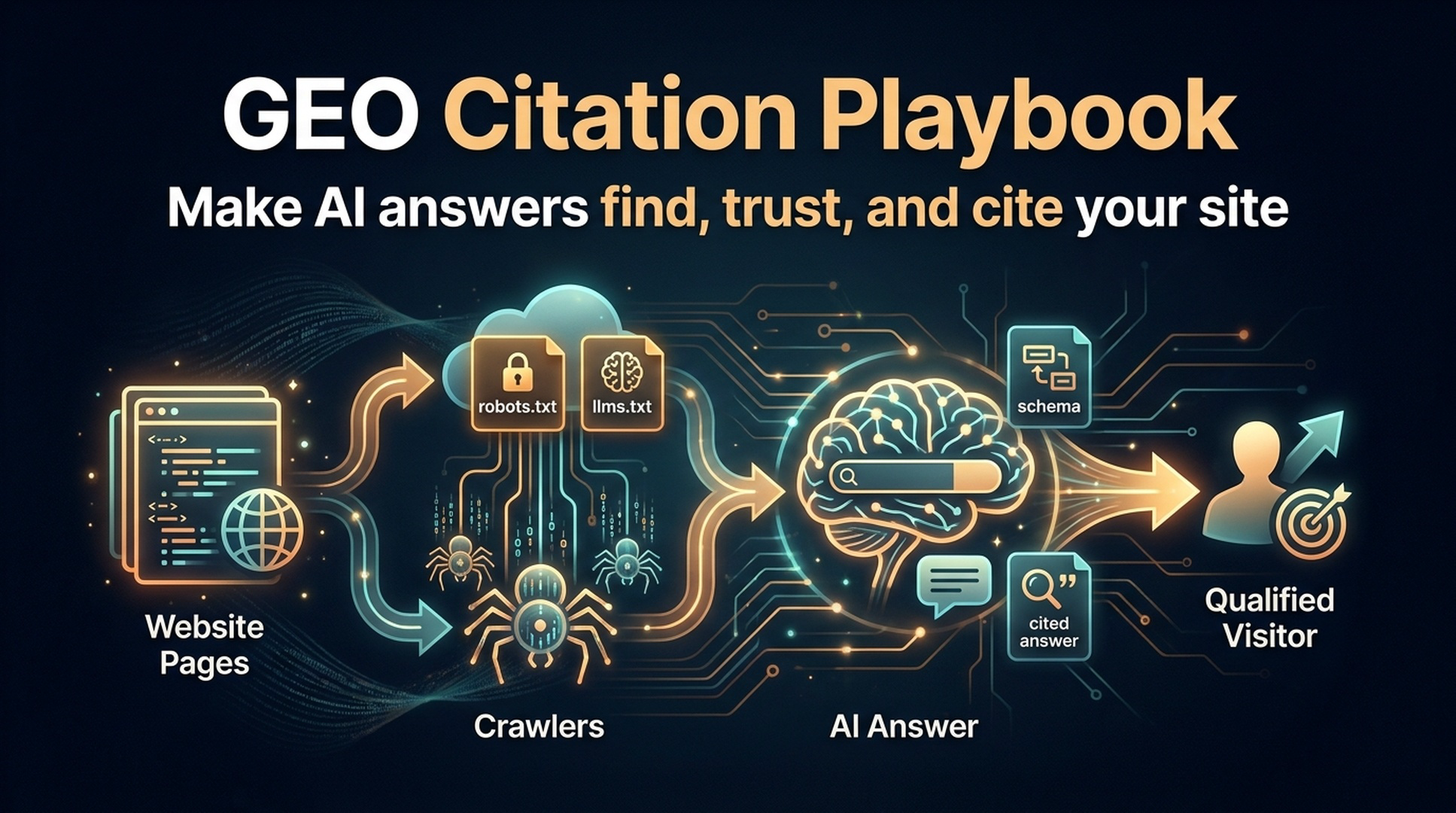
GEO is the work of making your website easy for AI answer engines to find, understand, trust, and cite. SEO still matters, but it is no longer enough to win a blue-link ranking. If buyers ask ChatGPT, Perplexity, Gemini, Claude, or Google AI answers for a recommendation, your content has to be usable as an answer source.
The practical path is simple: open the right crawler access, give AI systems a clean map of your best pages, add structured evidence, and rewrite important pages so each section can stand alone as a useful answer. Teams that treat GEO as a content packaging problem, not a magic ranking trick, will move faster.
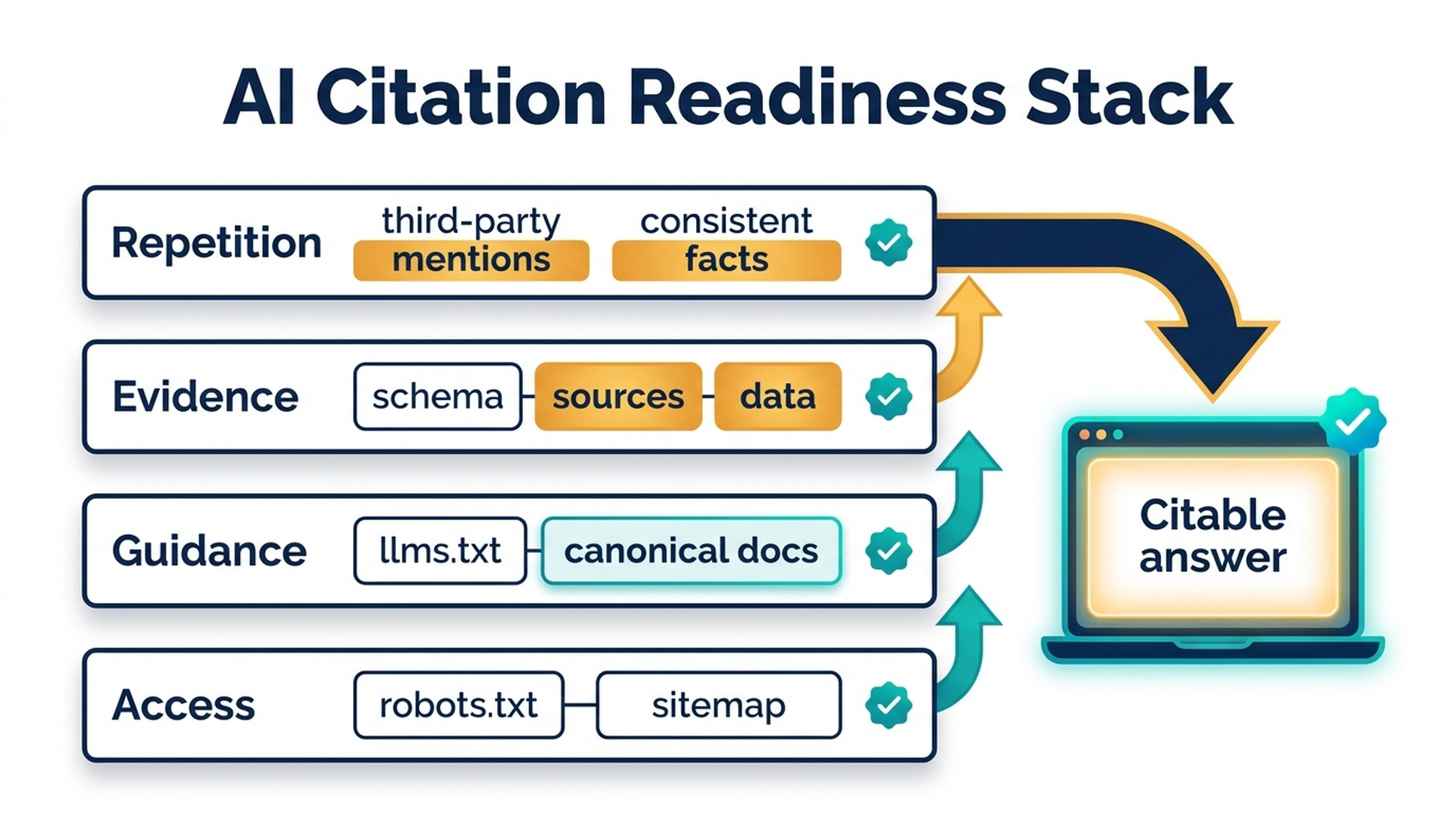
From ranking pages to becoming the cited source
Traditional SEO asks: "Can we rank when someone searches this query?" GEO asks a different question: "When an AI system writes the answer, are we one of the sources it can safely use?"
That shift changes the job. You are no longer optimizing only for the human scanning search results. You are also optimizing for retrieval systems, crawlers, answer synthesis models, and the trust checks around them.
A page that performs well in AI answers usually has four traits:
Trait | What it means | What to check |
|---|---|---|
Accessible | Crawlers can reach the page and its supporting assets |
|
Interpretable | Machines can identify entities, products, claims, and relationships | Schema, headings, clean HTML, internal links |
Citable | The page has direct answers, numbers, comparisons, and source context | Answer-first sections, tables, FAQs, dated evidence |
Consistent | The same facts appear across your site and reputable third-party sources | Profiles, docs, review sites, partner pages, media mentions |
The mistake is treating GEO as a separate channel that replaces SEO. It does not. Most AI answer systems still lean on crawlable pages, conventional authority signals, and source quality. GEO sits on top of that foundation and makes your existing work easier to reuse inside answers.
Why this matters now
The buyer journey is getting compressed. A user who once searched "best customer support software for startups," opened ten tabs, and built a shortlist may now ask an AI assistant for a ranked comparison. The assistant may summarize options, name tradeoffs, and suggest the next step before the user ever sees a search result page.
That creates a visibility problem. If your brand is missing from the answer, the user may never know you were a possible option.
It also creates a quality problem. AI systems prefer sources that reduce uncertainty. A vague homepage with polished claims is less useful than a page that says exactly who the product is for, what it costs, what integrations it supports, how it compares with alternatives, and where the evidence comes from.
For growth teams, GEO is useful because it forces better content hygiene:
- Your product and category pages become more specific.
- Your docs and comparison pages become easier to parse.
- Your evidence is attached to claims instead of buried in sales copy.
- Your brand facts become consistent across your site and the wider web.
That is good for AI visibility. It is also good for humans.
Build the technical entry points first
Before rewriting content, confirm that AI systems can reach and interpret your site. Many teams skip this because it feels basic. It is basic. That is why it should not be broken.
1. Check crawler access
Review robots.txt for the pages that matter: homepage, product pages, docs, pricing, comparison pages, case studies, glossary pages, and category explainers. Do not blindly block AI crawlers if your goal is citation visibility.
Use a crawler check to verify whether major bots can access the pages you want surfaced. If your legal or security team requires restrictions, document the rule clearly. GEO does not mean opening every URL. It means being intentional about which pages can become public evidence.
A practical audit:
Page type | Should AI crawlers access it? | Common issue |
|---|---|---|
Product overview | Usually yes | Blocked by broad |
Pricing | Usually yes, if public | JavaScript-only content or outdated canonical |
Docs | Usually yes | Fragmented pages with no summary |
Customer data | No | Private paths not explicitly protected |
Internal search pages | Usually no | Thin pages wasting crawl budget |
If you want a quick first pass, run the Robots.txt AI Crawler Checker against your domain and review the rules for GPTBot, ClaudeBot, Google-Extended, PerplexityBot, and other known crawlers.
2. Add an llms.txt file
An llms.txt file is a plain-text guide that points AI systems toward your most useful public content. Think of it as a short reading list for your site: product pages, docs, comparison pages, glossary entries, policies, and high-quality explainers.
Keep it selective. A bloated llms.txt that links everything is not helpful. The best version tells a model what your company does, which pages are authoritative, and which pages should not be treated as product truth.
A simple structure works:
# Company name
Short description of what the company does.

## Core product pages
- Product overview: https://example.com/product
- Pricing: https://example.com/pricing
- Documentation: https://example.com/docs

## Best explanatory content
- What is [category]: https://example.com/blog/what-is-category
- Comparison guide: https://example.com/compare/alternative

## Notes
Use docs and pricing pages as the source of truth for capabilities and plans.
Auspia has a free LLMs.txt Generator / Checker if you want to draft and validate one quickly.
3. Use schema where it clarifies facts
Schema is not a citation guarantee. It is a translation layer. It helps machines identify your organization, products, FAQs, authors, reviews, breadcrumbs, and article metadata.
Prioritize schema for pages with facts that AI systems might reuse:
- Organization schema for brand identity, logo, sameAs links, and official URL.
- Product or SoftwareApplication schema for product category, features, pricing hints, and reviews where appropriate.
- FAQPage schema for direct answers to repeated questions.
- Article schema for editorial content, dates, authors, and images.
- BreadcrumbList schema for page hierarchy.
Do not stuff schema with claims that are absent from the page. That creates inconsistency, and inconsistency is poison for AI citation.
Rewrite content so each section can be cited
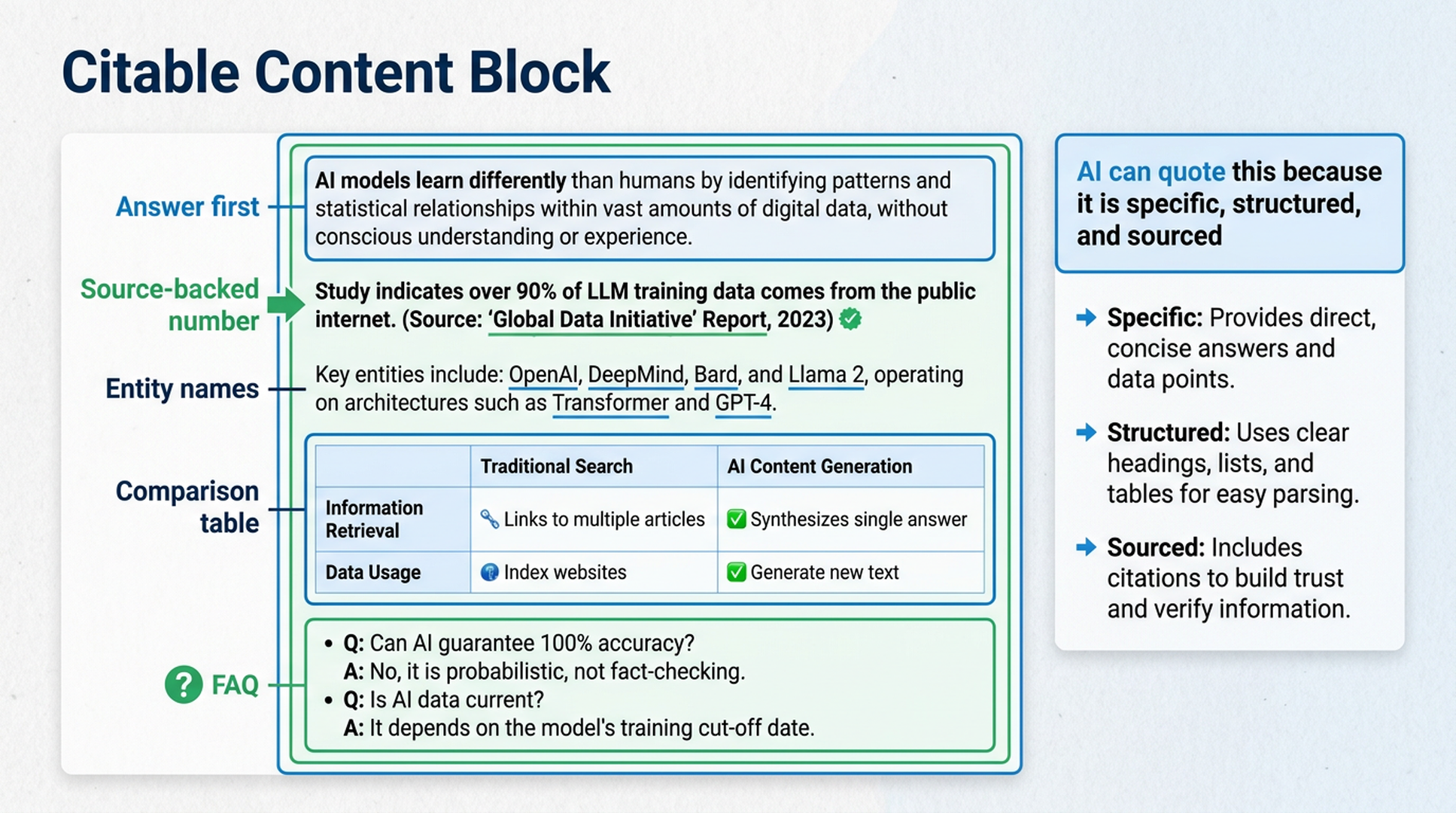
AI answer engines do not want your whole article. They want the best extract. That means your content has to work at paragraph level, table level, and FAQ level.
Put the answer before the buildup
A citable section starts with the answer. Context can follow.
Weak:
In today's changing digital environment, many businesses are exploring new ways to adapt their content strategy for AI-driven discovery.
Better:
GEO improves AI answer visibility by making public pages crawlable, structured, source-backed, and easy to quote.
The second version gives the model a usable sentence. It has the entity, the action, and the criteria. There is no warm-up paragraph to strip away.
Attach evidence to claims
Do not write "AI traffic converts better" without saying where the number came from, what was measured, and whether it applies to your market. AI systems are more likely to reuse claims that have context.
Use this pattern:
Claim + number + source + date + scope + caveat.
Example:
In our Q2 2026 analysis of 42 B2B SaaS sites, AI-referred sessions had a higher demo-request rate than generic organic search, but the sample was small and skewed toward high-intent comparison pages.
That sentence is not flashy. It is useful. It tells a human and a model how far the evidence can travel.
Use comparison tables
Tables are underrated GEO assets. They compress decision criteria in a format that AI systems can parse and summarize.
For product and service pages, add tables like:
Question | Good answer format | Why it helps AI answers |
|---|---|---|
Who is this for? | "Best for B2B SaaS teams with long sales cycles" | Clarifies audience fit |
What does it replace? | "Manual content audits and spreadsheet-based GEO checks" | Gives category context |
What does it integrate with? | List named tools and systems | Supports recommendation queries |
What are the limits? | State exclusions clearly | Reduces hallucinated claims |
How is it priced? | Public plan ranges or pricing model | Helps comparison answers |
If you sell into a competitive category, create comparison pages that are fair and specific. Do not write attack pages. Models tend to favor balanced pages that name real tradeoffs.
Make FAQs answer real questions
FAQ sections are useful when they answer questions buyers actually ask. They become weak when they exist only for schema.
Good GEO FAQ questions sound like search and sales-call questions:
- "How is GEO different from SEO?"
- "Should we allow AI crawlers in robots.txt?"
- "What pages should be listed in llms.txt?"
- "Can AI systems cite pages behind a login?"
- "How do we measure AI answer visibility?"
Each answer should be short enough to quote and specific enough to stand alone.
Build source consistency outside your own site
AI systems do not only read your website. They compare your claims against other places where your brand appears. That includes review sites, GitHub, docs portals, partner directories, podcasts, industry newsletters, app marketplaces, and public profiles.
For global companies, this matters more than platform-specific posting. You do not need to chase every social network. You need clean, repeated facts in places that your audience and AI systems already trust.
Start with these surfaces:
Surface | What to keep consistent |
|---|---|
Website | Product description, category, pricing, docs, comparison pages |
LinkedIn/company profiles | Short description, audience, official URL |
G2/Capterra/Product Hunt/app stores | Category, use cases, screenshots, review language |
GitHub/docs portals | Installation steps, version notes, license, support links |
Partner pages | Integration descriptions and mutual value proposition |
Founder/executive bios | Role, company description, topic expertise |
The goal is not to manufacture noise. The goal is to remove ambiguity. If one source calls you an "AI SEO platform," another calls you a "content automation tool," and a third says "analytics dashboard," an answer engine has to guess. Make the facts converge.
A 14-day GEO cleanup plan
You do not need a six-month transformation to start. Run a focused cleanup sprint.
Day | Task | Output |
|---|---|---|
1 | Pick 10 money pages | List of pages that should appear in AI answers |
2 | Check crawler access | Fixed |
3 | Draft | Short guide to authoritative pages |
4 | Add organization and breadcrumb schema | Cleaner entity signals |
5 | Add product/software schema where relevant | Better machine-readable product facts |
6 | Rewrite page intros answer-first | Citable opening sections |
7 | Add comparison tables | Decision criteria models can reuse |
8 | Add real FAQs | Buyer questions with concise answers |
9 | Attach sources to claims | Dated evidence and caveats |
10 | Clean internal links | Stronger topical paths |
11 | Update external profiles | Consistent brand facts |
12 | Review docs and pricing accuracy | Reduced contradiction risk |
13 | Test AI answer prompts | Baseline visibility notes |
14 | Prioritize next content gaps | Backlog for new glossary, comparison, and case pages |
Use the AI Search Visibility Checker to test whether your brand appears for the questions that matter. Track prompts over time, but do not overreact to one answer. AI results fluctuate. Patterns matter more than screenshots.
What most teams get wrong
The common mistake is writing "for AI" in a way that makes content worse for people. GEO should not produce stiff pages stuffed with definitions and schema. It should produce clearer pages.
Watch for these problems:
- Blocking important pages while assuming AI systems can still cite them.
- Publishing
llms.txtwith too many low-quality URLs. - Adding FAQ schema without useful FAQ content on the page.
- Making unsupported claims because "AI likes data."
- Creating dozens of thin glossary pages instead of a few strong answer hubs.
- Treating Reddit, LinkedIn, reviews, and partner pages as spam surfaces instead of reputation surfaces.
- Measuring only mentions, not whether the mention appears in a buying context.
A cleaner rule: if a paragraph would embarrass you in front of a serious buyer, it should not be written for an AI system either.
Auspia take
GEO is not a hack. It is an operating habit: make the best version of your facts easy to access, easy to parse, and easy to verify.
The teams that will benefit first are not necessarily the ones with the biggest content libraries. They are the teams with the clearest public evidence. A small site with strong docs, honest comparison pages, consistent third-party profiles, and source-backed explainers can be more citable than a large site full of vague copy.
Start with the pages closest to revenue. Make them crawlable. Give models a guide. Add schema where it clarifies facts. Rewrite the content so each section answers a real question. Then test the prompts your buyers actually ask.
That is the practical version of GEO: less mystique, more usable evidence.
FAQ
How is GEO different from SEO?
SEO focuses on visibility in search results. GEO focuses on whether AI answer engines can use your content as a trusted source inside generated answers. The two overlap because AI systems still depend on crawlability, authority, and content quality.
Should every website allow AI crawlers?
No. Public marketing, docs, pricing, and educational pages are often good candidates. Private data, internal tools, gated customer content, and low-value pages should stay protected. The right policy depends on your legal, security, and growth goals.
Is llms.txt required for AI visibility?
No, but it is useful. llms.txt gives AI systems and retrieval tools a cleaner path to your authoritative pages. It works best when paired with strong internal linking, schema, sitemaps, and accurate content.
What content is most likely to be cited by AI systems?
Direct answers, comparison tables, sourced numbers, definitions, product facts, FAQs, documentation, and balanced buyer guides are strong candidates. Vague thought leadership is harder to cite because it gives the model little concrete material to reuse.
How should teams measure GEO?
Track AI answer visibility for a stable prompt set, citation frequency, brand inclusion in recommendation queries, referral traffic from AI platforms, and downstream conversions. Use trends rather than one-off screenshots because AI answers change often.