The short answer
GEO is starting to look noisy because too many teams are describing it by origin story: SEO-led, PR-led, content-led, tool-led, data-led. That is a useful clue about where a provider came from, but it is a poor way to judge whether the work will help a brand show up accurately in AI answers.
The better question is simple: can the team run a complete GEO system?
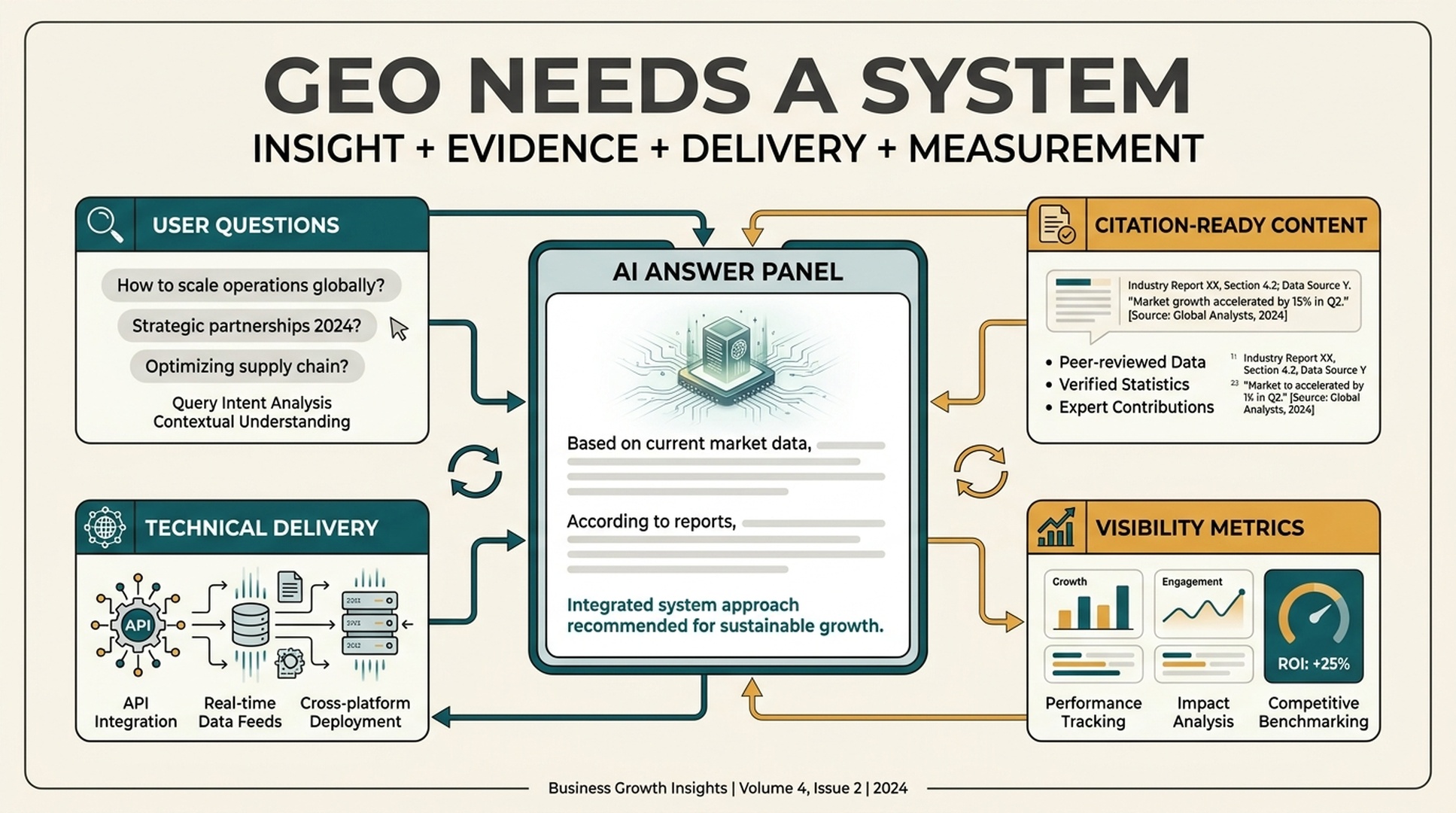
A complete system connects five things: demand signals, entity facts, credible evidence, technical delivery, and measurement. If one part is missing, the work becomes fragile. You may get content without visibility, dashboards without action, citations without entity clarity, or technical fixes with no answer strategy behind them.
For growth teams, the next phase of GEO will not be won by labels. It will be won by operating loops.
Why the "GEO school" debate is misleading
Every young market loves a taxonomy. It makes the space feel easier to buy.
One vendor says it is technical because it monitors AI answers and crawler behavior. Another says it is editorial because AI systems need reliable content to cite. A former SEO team says GEO is mostly machine-readable optimization. A PR team says the real asset is third-party authority. A data platform says the first job is prompt and intent research.
They are all partly right.
That is the trap.
Each view captures a real piece of GEO, then quietly stretches that piece into a whole strategy. The result is a market where origin stories get mistaken for operating models. A tool company naturally sees tool problems first. A content agency naturally sees content gaps first. An SEO team naturally sees crawl, structure, and entity problems first.
None of those entry points is wrong. They are just incomplete.
The question for a brand is not "which camp is correct?" The question is "which team can connect the parts?"
A GEO system has five working parts
A useful GEO program is less like a campaign and more like a revenue operations loop. It has inputs, decisions, production, distribution, measurement, and correction.
Module | What it answers | Typical outputs | What breaks when it is missing |
|---|---|---|---|
Demand signals | What do buyers ask AI systems before they choose? | Prompt library, intent map, competitor answer audit | Teams optimize pages nobody asks about |
Entity facts | What should AI systems know about the brand? | Product facts, differentiators, use cases, proof points | AI answers describe the brand vaguely or incorrectly |
Evidence network | Which sources can verify the claims? | Case pages, partner mentions, expert content, third-party references | Content sounds self-promotional and hard to trust |
Page delivery | Can crawlers and AI systems parse the information? | Structured pages, schema, internal links, crawl checks | Good information stays buried or fragmented |
Measurement | Is visibility improving across answer surfaces? | Share-of-answer tracking, citation monitoring, sentiment checks | Teams cannot tell what changed or why |
This is where many GEO programs stall. They have a module, not a system.
A dashboard alone does not make a brand more citable. A batch of articles alone does not prove authority. A schema cleanup alone does not answer buyer questions. Third-party mentions alone do not fix a confusing product narrative.
The work starts to compound only when the modules talk to each other.
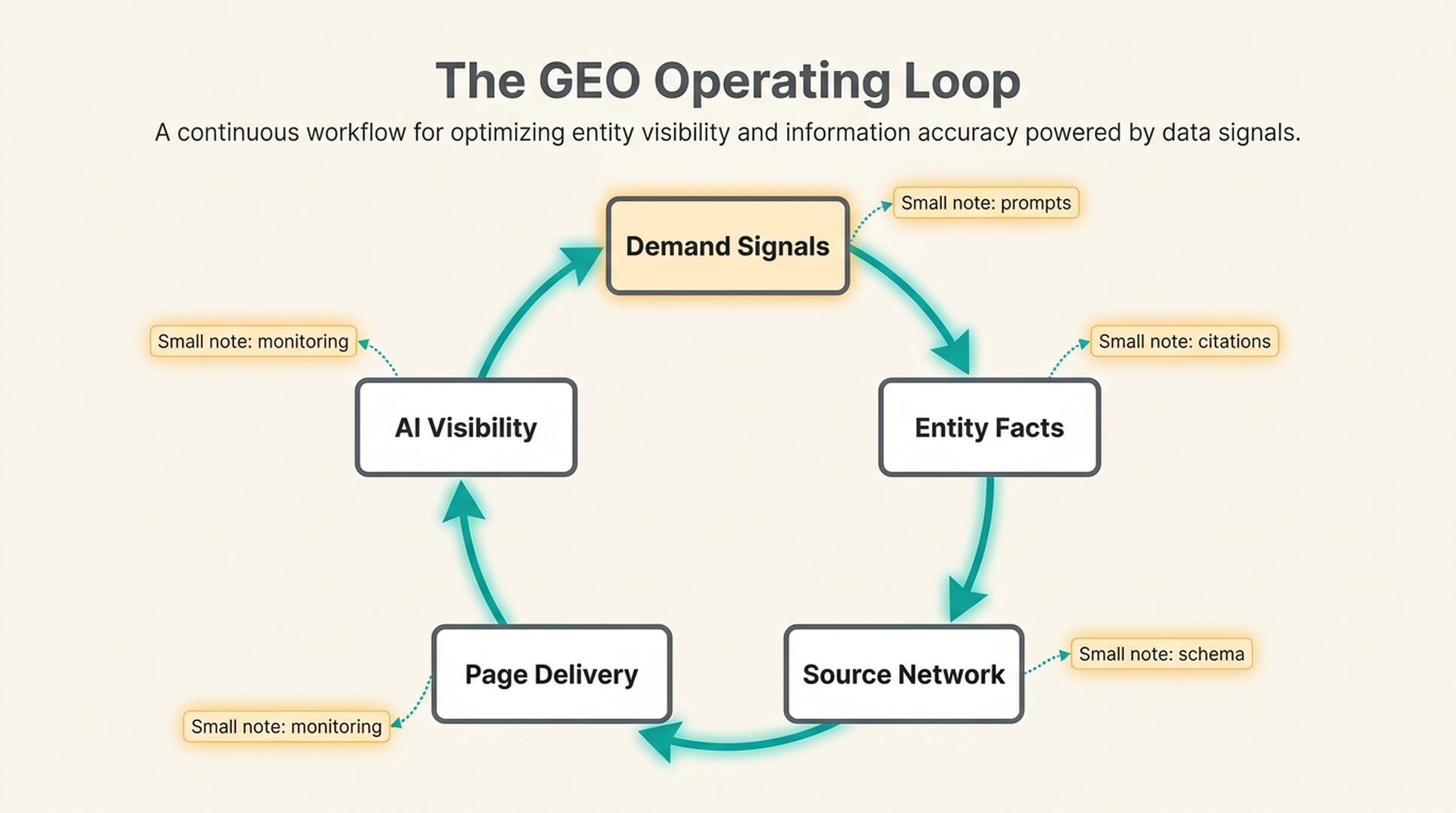
Caption: A practical GEO workflow should turn answer demand into entity facts, source coverage, page delivery, and recurring visibility measurement.
Single-point advantages decay fast
In the early phase of a market, a single capability can feel like a moat.
The first teams with answer monitoring can sell visibility. The first teams with media access can sell authority. The first teams with SEO experience can sell technical confidence. The first teams with data can sell insight.
But single-point advantages do not stay scarce for long.
Monitoring tools become easier to build. Content templates spread. SEO checks become automated. Prompt research becomes a common planning step. What looked like differentiation in year one often becomes table stakes by year three.
That does not mean those capabilities stop mattering. It means they stop being enough.
The durable advantage is integration: knowing which prompt families matter, what evidence AI systems can verify, where the brand entity is weak, which pages should be rebuilt, and how to measure whether the answer layer is moving in the right direction.
This is also why GEO cannot be treated as a one-off publishing sprint. AI answer visibility changes as models update, search integrations shift, new sources get indexed, competitors publish, and customer questions move. A static content plan will age quickly.
A system can adapt. A pile of assets cannot.
The buyer's mistake: asking for a label
A lot of GEO buying conversations begin with the wrong question: "Are you a technical provider or a content provider?"
That framing makes the evaluation easier, but it also narrows the problem too early.
A better buying conversation sounds like this:
Area | Better question | Weak answer to watch for |
|---|---|---|
Insight | How do you decide which AI prompts and buyer questions matter? | "We use generic keyword research." |
Entity clarity | How do you turn brand facts into machine-readable claims? | "We will write more thought leadership." |
Evidence | What sources will verify the claims outside our own site? | "We can publish a lot of posts." |
Delivery | How do you structure pages so AI systems can parse them? | "Our writers know SEO." |
Measurement | How will we know whether AI visibility changed? | "Rankings should improve over time." |
The most important question is the follow-up: how do these parts connect?
If a provider can explain how insight changes content priorities, how entity facts shape page structure, how source coverage supports claims, and how measurement feeds the next sprint, you are probably talking to a team with an operating model.
If every answer returns to one favorite capability, you are probably buying a module.
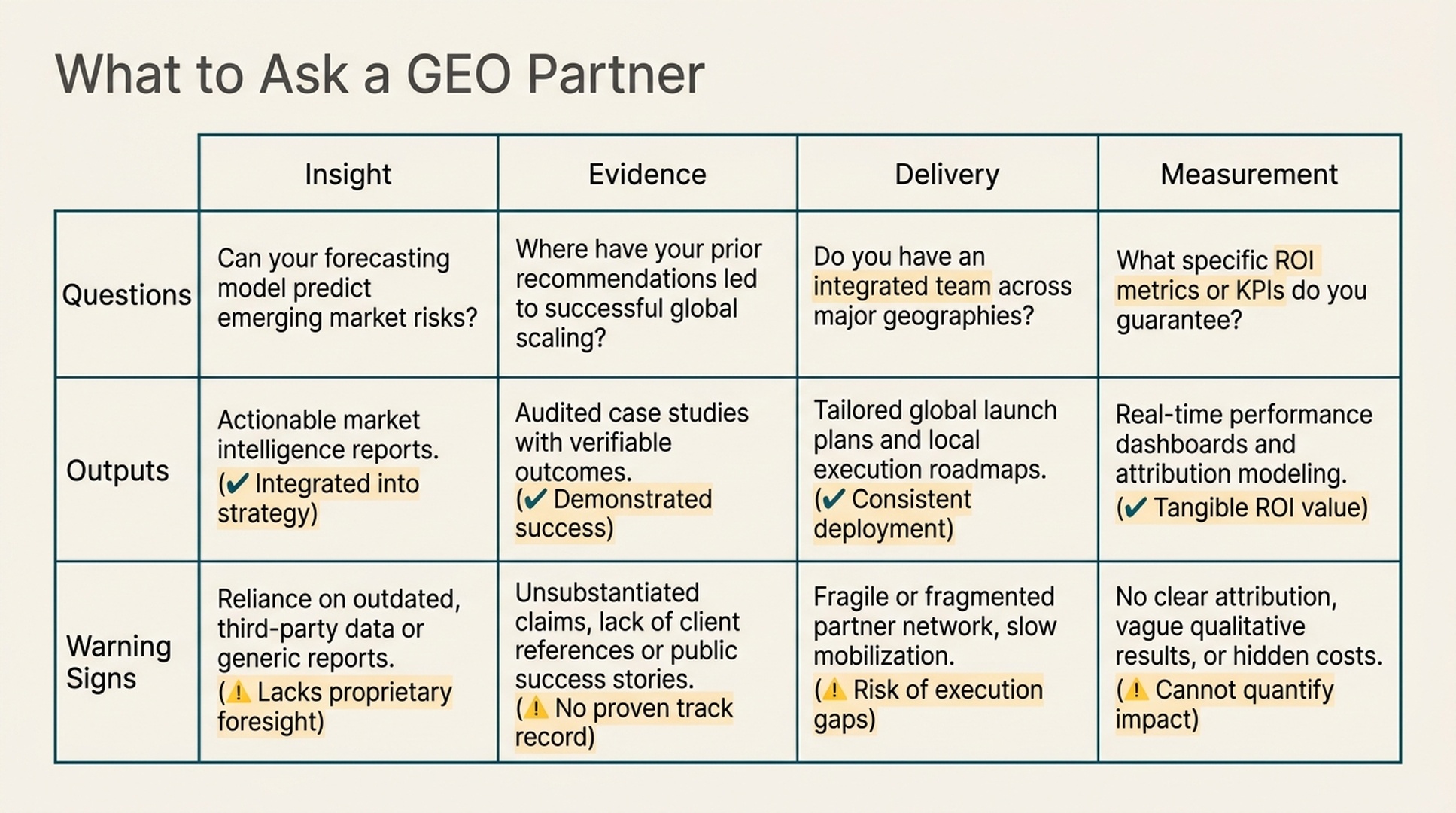
Caption: Evaluate GEO partners by the loop they can run, not by the label they choose for themselves.
What a complete GEO operating loop looks like
A simple version of the loop can run in six steps.
First, map the questions. Build a prompt library around real buyer tasks: comparison, vendor shortlisting, implementation risk, pricing assumptions, alternatives, compliance, and category education. Keyword research helps, but it is not enough because people ask AI systems in longer, more situational ways.
Second, audit the current answers. Test where the brand appears, where it is missing, which competitors get cited, and which claims are wrong or weak. This is where tools such as an AI Search Visibility Checker become useful. The goal is not a vanity score. The goal is to find the missing facts and sources behind the score.
Third, clean up the entity layer. Document the brand's category, product names, use cases, markets, integrations, proof points, and comparisons. Make sure the same facts appear consistently across the website, product pages, help content, profiles, and third-party references.
Fourth, build citation-ready assets. This usually includes comparison pages, use-case pages, case studies, original data, explainers, partner pages, and concise FAQ sections. The content should answer extractable questions, name entities clearly, and avoid claims that cannot be verified.
Fifth, fix delivery. Improve crawl access, internal linking, schema, page hierarchy, metadata, canonical signals, and AI crawler readiness. If a page is important for AI visibility, it should be easy to discover, parse, and quote.
Sixth, measure and iterate. Track answer presence, citation sources, sentiment, competitor share, query clusters, and false or outdated claims. Then feed those findings into the next content and technical sprint.
That loop is not glamorous. It is operational. That is exactly why it matters.
What most teams still miss
The most common mistake is treating GEO as a publishing problem.
Publishing matters, but AI systems do not reward volume by itself. They need clean entity information, corroboration, accessible pages, and answer-level relevance. Ten generic blog posts may do less than one well-structured comparison page backed by credible references and clear internal links.
The second mistake is treating GEO as a monitoring problem.
Measurement is necessary, but a dashboard cannot fix the underlying entity or evidence gaps. If the system says your brand is absent from high-intent prompts, the next question is not "how do we improve the chart?" It is "what facts, sources, and pages would make us a reasonable answer?"
The third mistake is outsourcing judgment to the vendor's label.
A content-led team may have strong technical delivery. A technical team may have excellent editorial discipline. A PR-led team may understand source trust better than anyone else. The label tells you where they started, not what they can run now.
Auspia's take
GEO is moving from naming to operations.
The early market needed labels because buyers were trying to understand a new category. That phase is useful, but it should not last too long. Labels simplify the sales conversation; systems improve the result.
For most brands, the winning pattern will be boring in the best way: recurring audits, tight entity facts, useful pages, credible external signals, technical cleanliness, and measurement that changes the next sprint.
If you are planning a GEO program now, do not ask vendors to defend a school of thought. Ask them to show the loop.
Practical checklist for your next GEO review
Use this checklist before you buy a GEO service or restart an internal program.
- Do we know the AI prompts and buyer questions that matter to pipeline, not just traffic?
- Do our product, company, and category facts stay consistent across key pages and profiles?
- Do we have credible sources that support the claims we want AI systems to repeat?
- Are our most important pages structured for extraction, comparison, and citation?
- Can we see how our brand appears across AI answer surfaces over time?
- Do visibility findings change the next content and technical sprint?
- Can the team explain the operating loop without hiding behind a label?
If the answer is no on three or more items, the issue is probably not the "school" you chose. The issue is that the system is not complete yet.
FAQ
Is GEO just SEO with a new name?
No. GEO borrows from SEO, especially around crawlability, structure, content quality, and authority. But the target surface is different. GEO focuses on how AI systems understand, summarize, compare, and cite entities inside generated answers.
Should GEO start with tools or content?
Start with diagnosis. If you do not know which prompts matter or where the brand is absent, content becomes guesswork. If you only monitor without improving facts, sources, and pages, tools become reporting theater. The work needs both.
What is the biggest warning sign in a GEO vendor pitch?
Be careful when a provider turns one capability into the whole strategy. "We have a dashboard," "we can publish content," or "we understand SEO" may all be true, but none of them is a complete operating model.
How often should a GEO program be reviewed?
For active categories, review answer visibility at least monthly and run deeper entity, source, and page audits quarterly. Review faster if you launch a product, change positioning, enter a new market, or see competitors appearing in AI answers where you are absent.
What should a small team do first?
Build a focused prompt library, audit current AI answers, fix the most important entity facts on your site, and create one or two citation-ready pages for high-intent questions. Do not try to cover the entire category at once.