The short answer
GEO became popular because it promises something every brand wants: appear inside the answer, not merely somewhere in a list of links.
That sounds simple. It is not. Generative engine optimization changes the traffic bargain between brands, search engines, agencies, publishers, and AI platforms. SEO used to ask, "Can our page rank high enough to earn the click?" GEO asks, "Can our information become part of the answer before the user clicks anywhere?"
That difference is why the topic feels so urgent. If AI answers become a major decision layer, some budgets will move away from traditional search ads, old SEO retainers, media placements, and publisher inventory. At the same time, most of the value may still flow to the core AI platforms that own the user, the data, the interface, and the rules.
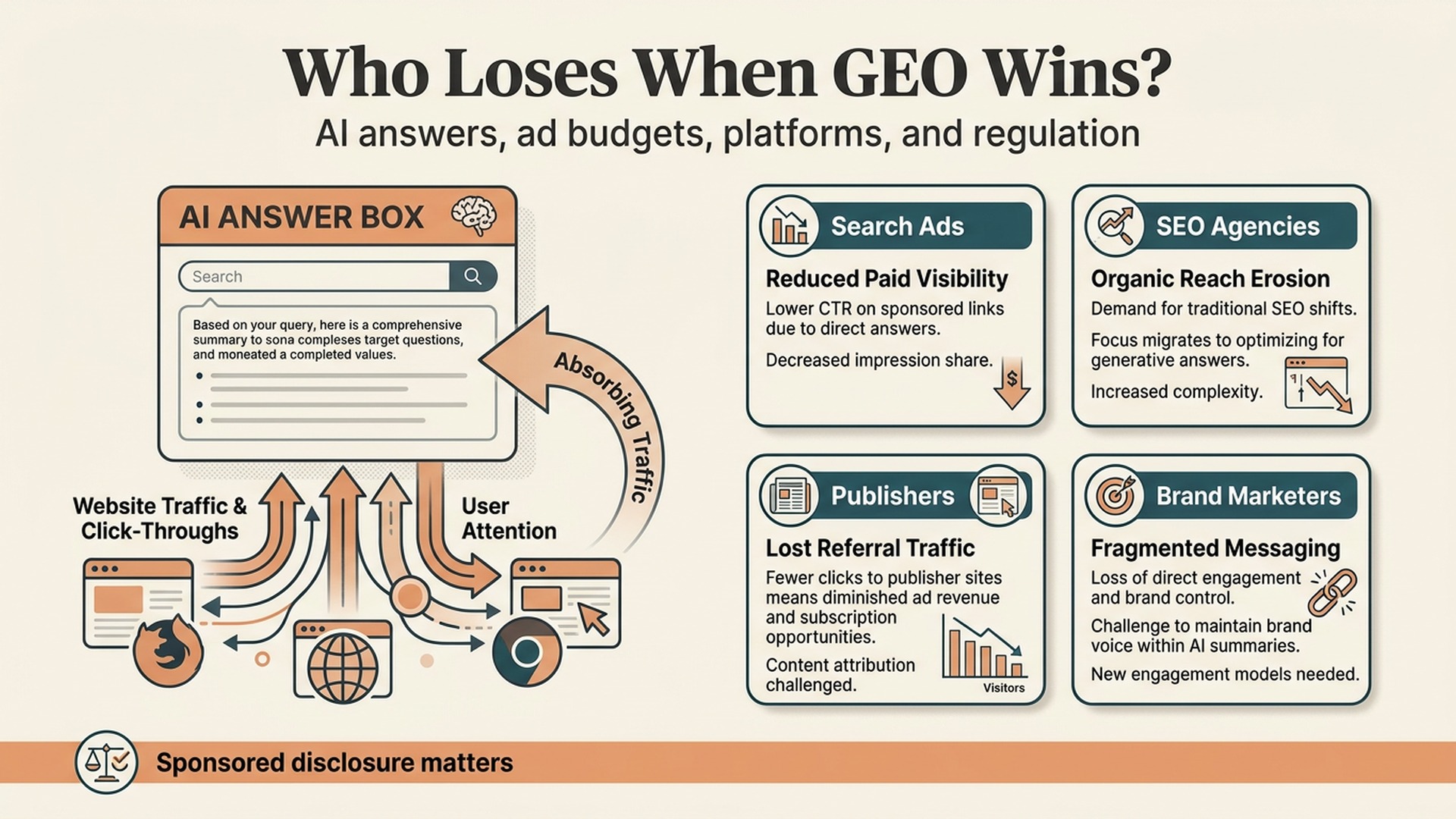
So who loses when GEO wins? Not one group. The pressure spreads across the old search economy.
1. GEO is bigger than a new SEO label
GEO, or generative engine optimization, can be understood in two ways.
As a technique, it is the work of making brand information easier for AI systems to understand, verify, retrieve, and cite. That includes content structure, entity clarity, source quality, data freshness, technical accessibility, and the way a brand is represented across trusted third-party sources.
As a service, it is being sold as the new growth layer for brands that want visibility in AI search, chat assistants, answer engines, and AI-generated buying advice.
The appeal is obvious. Users increasingly ask AI systems for recommendations, comparisons, product checks, local options, and purchase validation. If the answer includes your brand, you are present at the decision point. If it does not, the user may never reach your website.
This is the core shift: GEO is not only about traffic acquisition. It is about becoming machine-readable evidence inside a decision.
The old model was:
Old search model | GEO model |
|---|---|
User searches a keyword | User asks a full question |
Search engine returns links | AI system returns an answer |
Brand competes for ranking | Brand competes for inclusion and citation |
Click creates the visit | Answer may influence the decision before any click |
Measurement centers on rank and traffic | Measurement expands to mentions, citations, sentiment, and source quality |
That is why brands are paying attention. Visibility is moving closer to the moment of decision.
2. The market story sounds huge because the incentive is huge
Every new marketing category arrives with oversized market forecasts. GEO is no different. Some estimates will be too aggressive. Some numbers will be more narrative than science.
Still, the direction is hard to ignore. If buyers keep using AI assistants to check products, compare vendors, summarize reviews, and shortlist options, brands will spend money to influence the evidence those systems can find.
The budget logic is straightforward:
- Search ads are expensive and increasingly crowded.
- Organic SEO takes time and no longer guarantees a click when answers appear above links.
- Social and creator campaigns can create demand, but they often do not control the final answer a buyer sees.
- AI answers sit closer to research, comparison, and decision-making.
In that sense, GEO looks like advertising, SEO, PR, and content strategy compressed into one messy category. It is not purely any of them.
Auspia's view is that teams should avoid treating GEO as magic. The work has to be grounded in evidence: can AI systems identify the brand, understand the offer, trust the sources, and cite pages that support the answer? If not, the first job is diagnosis, not hype.
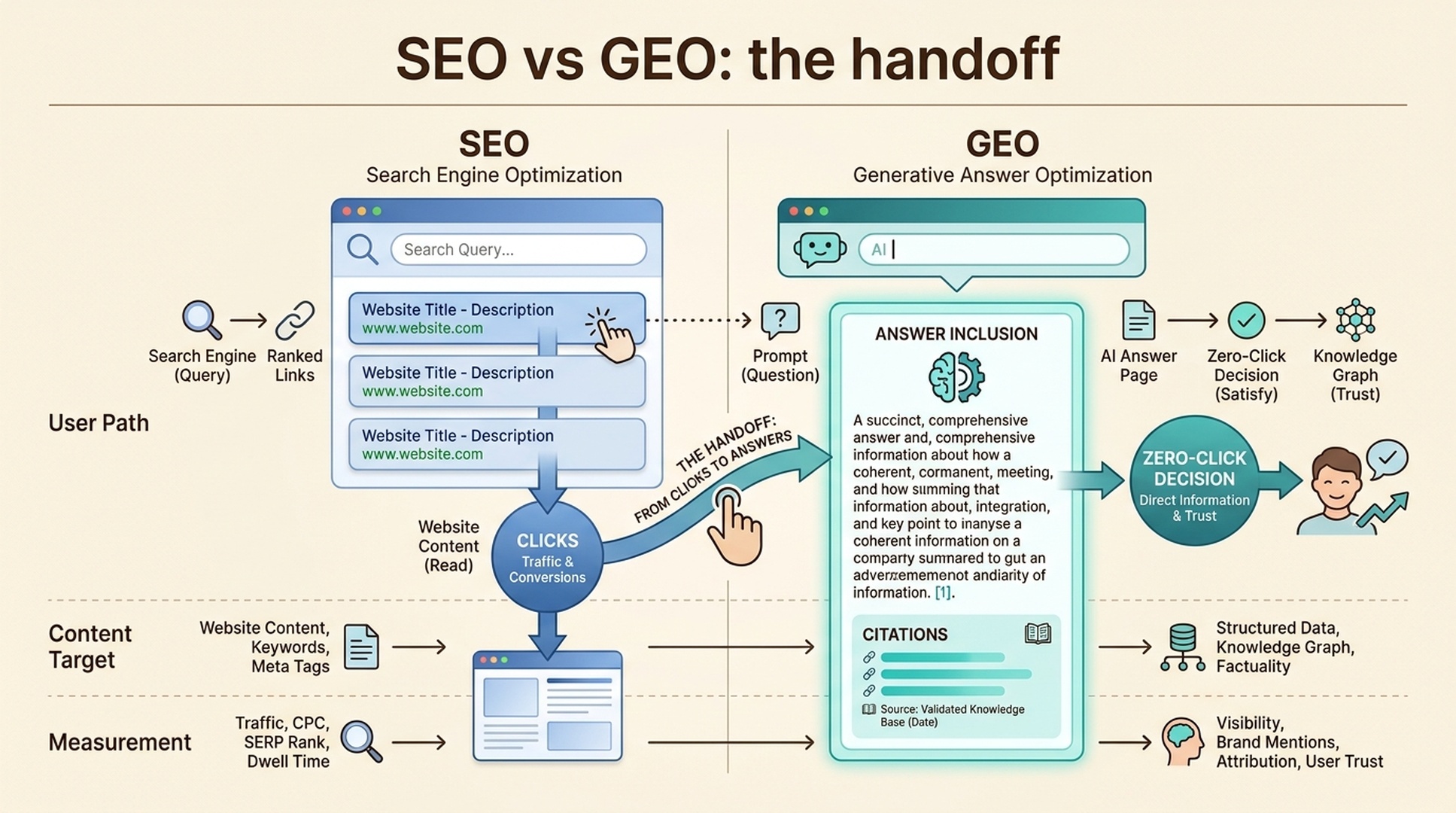
Caption: SEO optimizes for ranked discovery. GEO optimizes for answer inclusion, citation, and decision influence.
3. What GEO changes in the user journey
The original search journey had friction. A user searched, scanned results, opened pages, compared claims, and made a decision.
AI answers compress that path. The user asks a more detailed question, such as:
- "Which project management tool is best for a 20-person remote design team?"
- "What are the quietest portable fans for a small office?"
- "Which payroll providers are good for a US startup hiring in Europe?"
- "Is this skincare ingredient safe for sensitive skin?"
A good AI answer may infer constraints that the user did not spell out: price, portability, noise, compliance, integrations, return policy, reviews, or risk. That creates three changes.
First, intent becomes richer. The query is no longer just a keyword. It is a situation.
Second, the answer becomes more selective. AI systems do not need to list every brand. They summarize what seems most relevant from the available evidence.
Third, the click becomes less guaranteed. A user may act on the answer, refine the question, or ask for a shortlist without visiting a brand site.
This is why GEO feels threatening to any business built around clicks. When the answer absorbs more of the journey, the old path loses leverage.
4. Who gets hurt first?
The pressure will not land evenly. Four groups feel it earlier than others.
Traditional SEO providers
SEO does not disappear. Crawlability, topical authority, structured content, internal links, and technical health still matter. In many cases, they matter more because AI systems need retrievable sources.
But a narrow SEO service that only sells ranking reports and keyword pages will feel exposed. GEO asks harder questions:
- Is the brand easy for AI systems to identify as an entity?
- Are the claims supported by credible sources?
- Does the content answer real comparison and decision questions?
- Are important pages accessible to search and AI crawlers?
- Does the brand appear in the sources that answer engines already trust?
SEO teams that can answer those questions will adapt. Teams that cannot may lose budget to GEO consultants, AI visibility tools, PR teams, or platform-native products.
Advertising and media agencies
Traditional ad agencies also face pressure. If brands believe AI answers influence purchase decisions, they will ask agencies to do more than create campaigns. They will ask them to understand how AI systems interpret the brand.
That changes the brief. Creative still matters, but the work expands into structured claims, source strategy, product evidence, review ecosystems, comparison content, and measurement across AI answer surfaces.
Agencies that only buy media may find themselves far from the new decision layer.
Publishers and traditional media
Publishers face the hardest version of the problem. AI answers can summarize information that used to require a visit to a media site. At the same time, brand budgets may shift from display inventory and sponsored articles toward AI visibility work.
This does not mean publishers have no role. Trusted media, expert reviews, and independent reporting can become valuable sources for AI systems. But the economics change. If the platform captures the user interaction and the publisher supplies only evidence, the publisher has to fight for attribution, licensing, and commercial value.
Brands without strong evidence
The quiet loser is the brand that has relied on paid acquisition while neglecting its evidence base.
A brand may have a polished website and still be hard for AI systems to recommend. Maybe its product pages are vague. Maybe customer proof is thin. Maybe review profiles are inconsistent. Maybe technical pages are blocked. Maybe comparison content is missing. Maybe third-party sources mention competitors but not the brand.
In the AI answer economy, weak evidence becomes a growth problem.
5. The platforms may still eat most of the value
Here is the uncomfortable part: even if GEO becomes a large service market, the biggest winners may be the core AI platforms.
They own the interface. They see the questions. They control retrieval, ranking, answer formatting, citations, ads, shopping units, and policy. They also decide which content types are trusted, which sources appear, and how commercial results are disclosed.
That gives platforms several advantages.
First, brands will naturally optimize for the platforms where users ask the questions.
Second, platforms can change the rules. A tactic that works this quarter may disappear after a retrieval update, citation policy change, or sponsored-answer format rollout.
Third, platforms can bundle the value. Search, ads, cloud services, shopping data, analytics, and AI assistants can become one commercial ecosystem.
This is why the GEO service layer may end up fighting for the margin while platforms control the market structure.
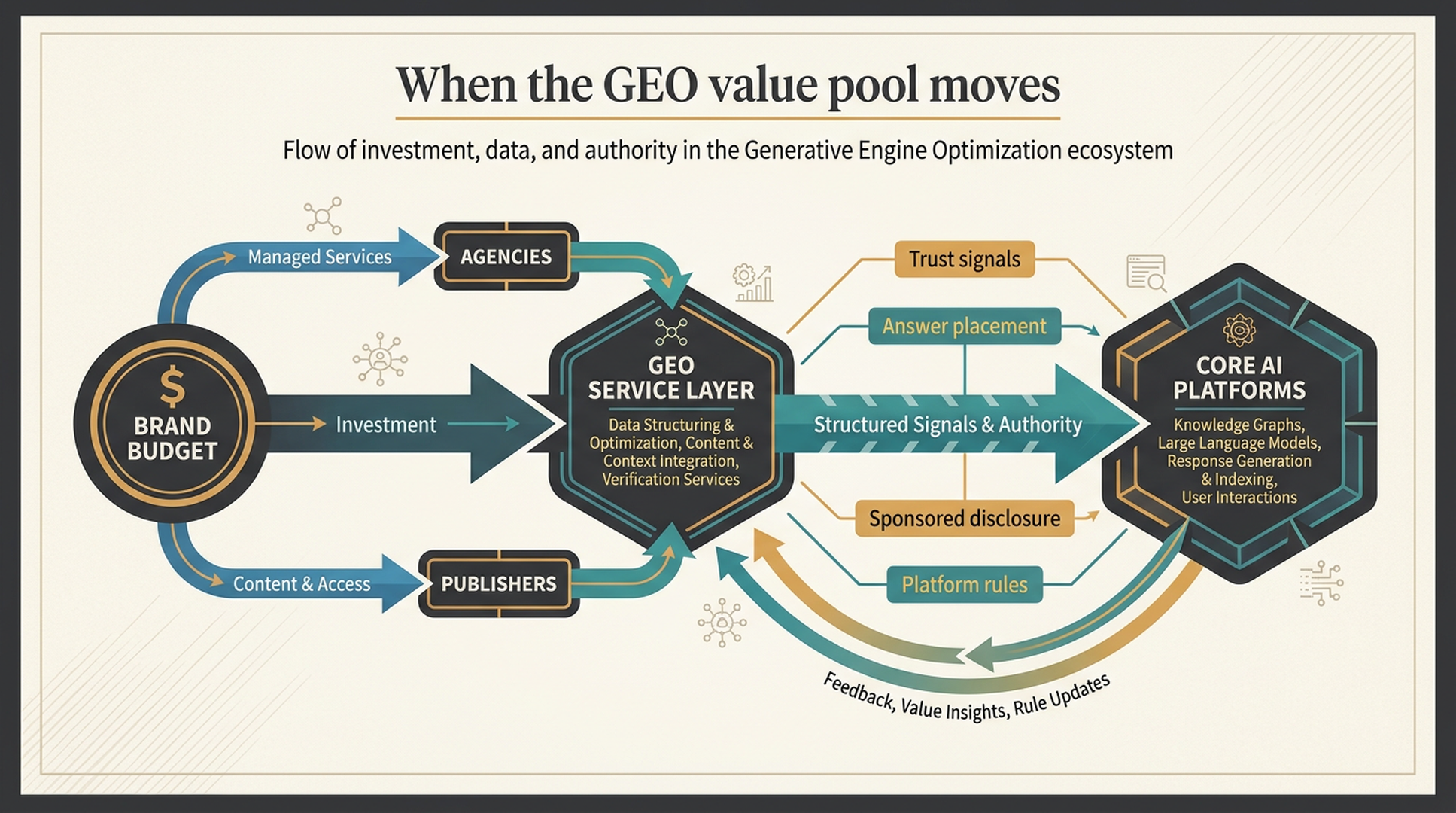
Caption: GEO creates work for agencies and consultants, but platform owners may control the largest value pool.
6. GEO only works if two hard conditions are met
There is a reason not every AI visibility promise should be trusted. GEO depends on two hard conditions.
The first condition is answer quality. If an AI search product gives weak, irrelevant, outdated, or hallucinated answers, users will not rely on it for decisions. Without user trust, GEO has no durable commercial base.
The second condition is source trust. Platforms need reliable signals about what is real, current, expert, and commercially influenced. Otherwise, GEO becomes a spam race. Brands flood the web with optimized claims. Agencies sell shortcuts. Users lose confidence. Regulators step in.
For brands, this means the best GEO work is not simply "get mentioned by AI." It is:
- make the brand entity clear;
- publish useful, specific, verifiable content;
- earn credible third-party evidence;
- keep product and policy information fresh;
- make pages accessible to crawlers;
- measure AI answers with a stable prompt set;
- separate organic evidence from paid placement.
This is also why Auspia does not recommend buying GEO as a black-box placement product. If a provider cannot show the evidence chain, the risk is too high.
7. The regulatory question is unavoidable
There is another issue the market cannot dodge: when does GEO become advertising?
If a brand pays to improve its chance of appearing in an AI answer, the work may look like SEO, PR, or content optimization. But if payment leads to preferential placement inside an answer, product card, recommendation unit, or shopping result, regulators will likely treat it as advertising.
In the United States, the Federal Trade Commission expects endorsements and sponsored content to be disclosed when they can affect consumer decisions. In the European Union, platform rules and consumer protection standards also push toward clearer labeling of commercial influence. Google has long labeled sponsored search ads. Perplexity and other AI search products have experimented with ad formats that identify sponsored placements.
The exact rules for AI answers are still developing, but the direction is clear: paid influence cannot stay invisible forever.
That matters for GEO buyers. A strategy based on hidden paid placement may create short-term visibility and long-term risk. A better strategy builds legitimate evidence and treats sponsored exposure as sponsored exposure.
8. What brands should do now
Brands do not need to panic. They do need to build a practical GEO operating loop.
Start with a prompt library. Use real buyer questions, not just keywords. Include comparison, pricing, alternatives, local intent, risk checks, and late-stage purchase questions.
Run a baseline. Check whether your brand appears, how it is described, which competitors appear, and which sources are cited.
Audit your evidence. Review your website, docs, author pages, reviews, case studies, third-party mentions, directories, partner pages, and media coverage.
Fix crawl access. Use tools such as the Robots.txt AI Crawler Checker and LLMs.txt Generator / Checker to find obvious access and instruction gaps.
Create answer-ready pages. Build comparison pages, product explainers, use-case pages, methodology pages, data-backed guides, FAQs, and customer proof that can support a cited answer.
Retest regularly. AI answers change. A one-time report is not a strategy.
If you want a quick readiness check, Auspia's GEO Score Checker can help surface early gaps before you spend money on outside services.
9. Auspia's take
GEO is not just another acronym in the marketing stack. It points to a real shift: the answer layer is becoming a commercial layer.
But the hype hides a harder truth. Brands will not win by stuffing the web with AI-friendly copy. Agencies will not win by renaming SEO packages. Publishers will not win by hoping traffic patterns stay the same. Platforms will not keep user trust if commercial influence is hidden.
The practical path is less glamorous: better evidence, cleaner technical access, clearer source authority, honest measurement, and visible disclosure when money shapes placement.
GEO is moving the fight to a new surface. The old players are still there, but the rules are changing.
FAQ
Is GEO replacing SEO?
No. GEO depends on many SEO foundations, including crawlability, structured pages, internal linking, topical coverage, and trusted sources. What changes is the target. SEO optimizes for rankings and traffic. GEO also optimizes for answer inclusion, citations, and AI-mediated decisions.
Why are brands interested in GEO now?
Because buyers are using AI systems to compare products, validate choices, and get recommendations before they click through to websites. If a brand is absent from those answers, it can lose influence near the decision point.
Who is most at risk from GEO growth?
Narrow SEO providers, media sellers, publishers dependent on referral traffic, and brands with weak evidence bases are most exposed. Platforms that own AI answer interfaces may capture more of the value.
Is paid GEO placement advertising?
If payment influences placement, recommendation, or visibility inside an AI answer or shopping unit, it will likely need clear disclosure. The rules are still developing, but hidden commercial influence is a regulatory risk.
What should a brand measure first?
Start with a fixed prompt set, brand mentions, citations, answer sentiment, cited URLs, competitor inclusion, and whether the cited sources are trustworthy. Then connect those findings to content, technical, and evidence-building actions.