Quick answer
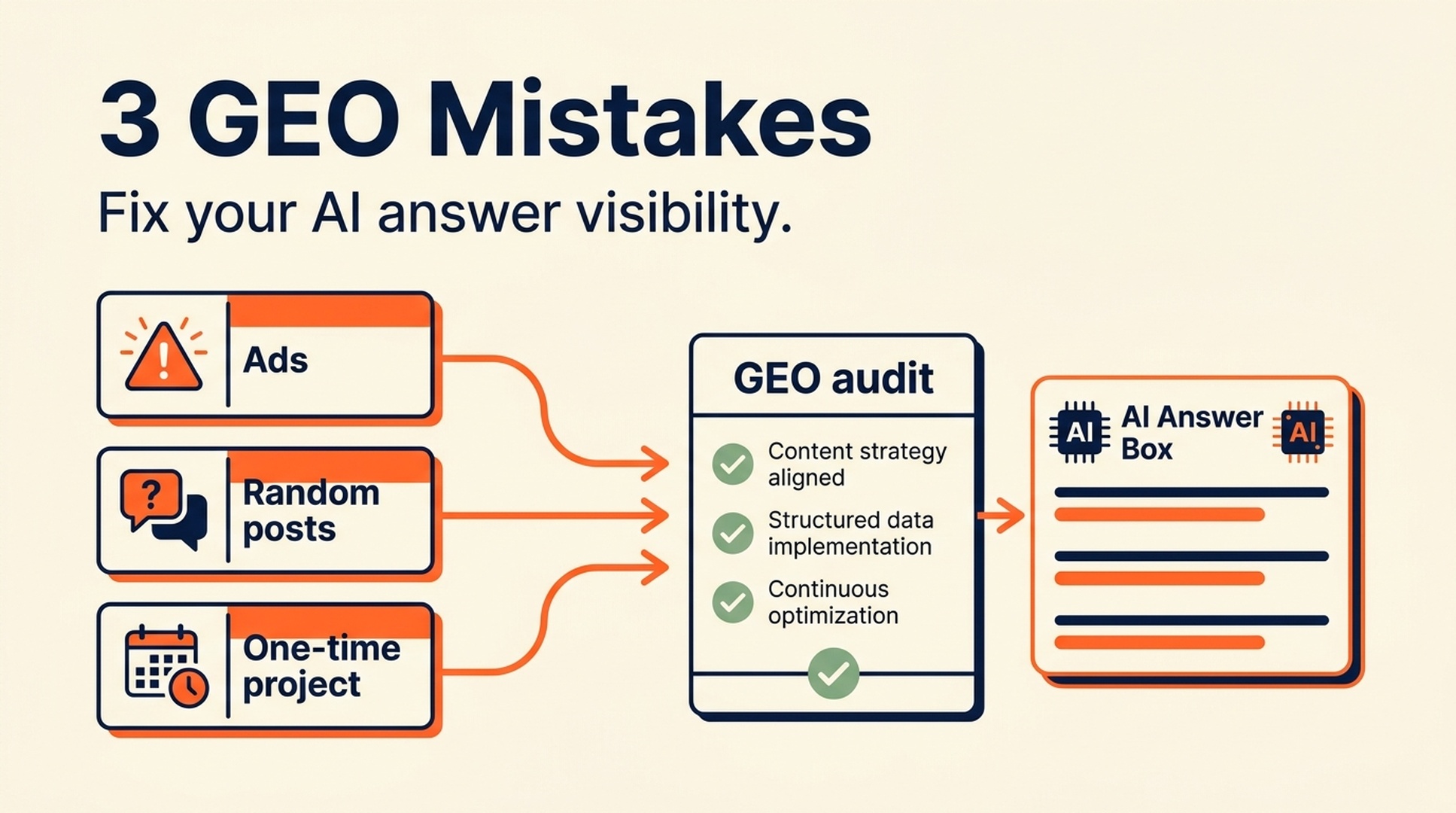
Most GEO programs fail for a boring reason: the team treats GEO as a campaign instead of an operating system. Buying visibility, publishing a few random posts, or doing one short sprint can create activity, but it rarely gives AI answer engines enough clear, repeated evidence to recommend your brand.
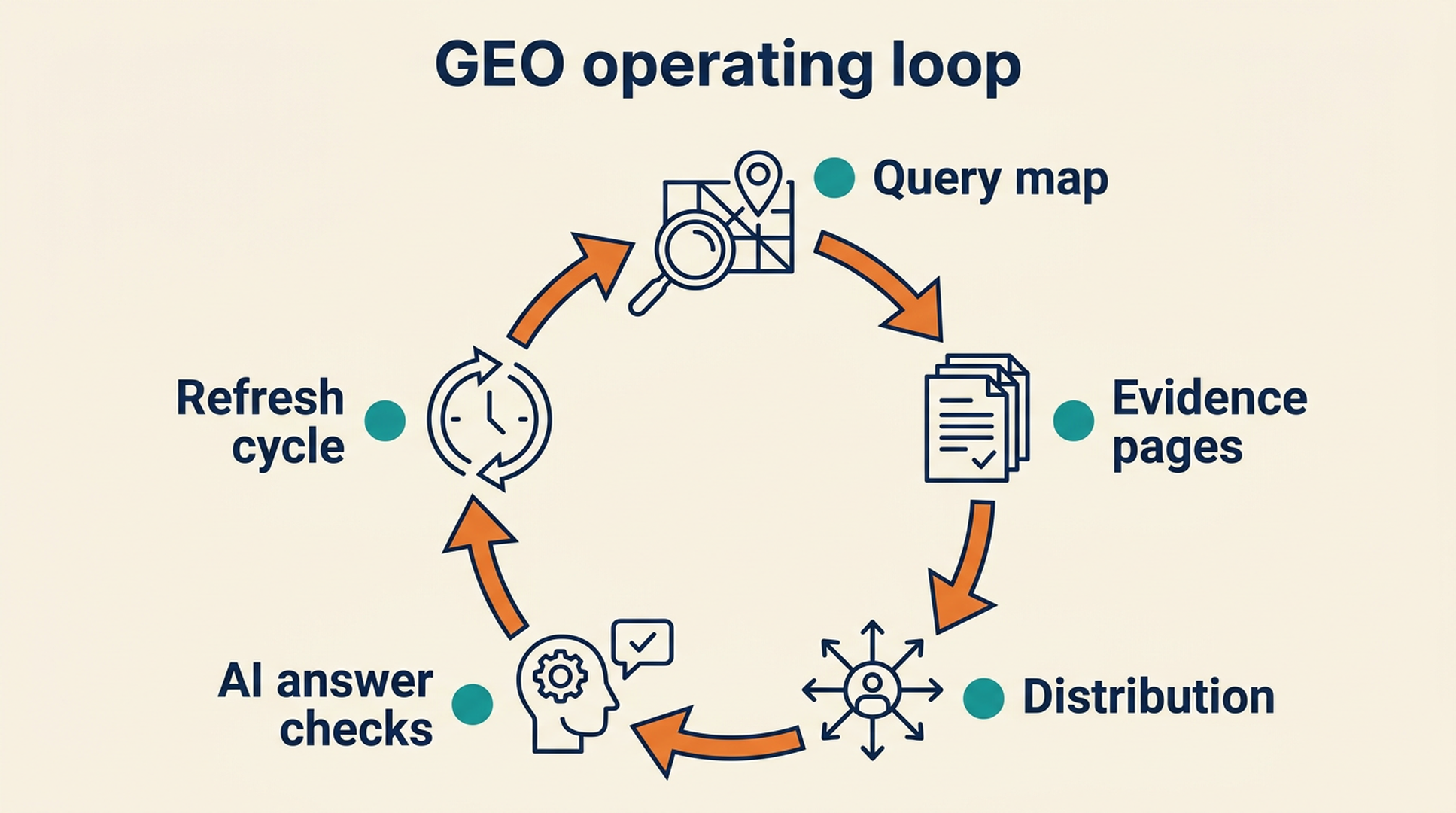
The fix is not complicated. Map the questions buyers ask, publish evidence-rich pages that answer those questions, distribute them across trusted channels, check how AI systems describe your brand, then refresh the content before competitors become the easier recommendation.
The three mistakes we see again and again
GEO still sounds new enough that teams project old habits onto it. Paid media teams hear "AI visibility" and think ads. Content teams hear it and think blog volume. Founders hear it and hope a three-month project will permanently solve the problem.
That is where the trouble starts.
GEO, or generative engine optimization, is the work of making your brand easier for AI search and answer systems to understand, trust, compare, and cite. It sits close to SEO, but the goal is slightly different. You are not only trying to rank a page. You are trying to become a credible answer.
Here are the three mistakes to fix first.
Mistake 1: treating GEO like advertising inside AI tools
This one usually appears in the first ten minutes of a GEO conversation:
"Can we just pay ChatGPT or Perplexity to recommend us?"
Maybe some platforms will add more ad inventory over time. That does not make advertising the same thing as GEO.
Paid placement can buy attention. GEO earns inclusion in natural answers by giving AI systems consistent evidence about who you are, what you do, who you help, and why your answer is reliable. Those are different games.
If a buyer sees your brand because it is clearly labeled as an ad, they process it like an ad. If an AI answer mentions your brand alongside a useful explanation, comparison, source, or proof point, the trust dynamic is different.
What to do instead:
- Build clear entity pages that state your product category, audience, use cases, pricing model, and proof points.
- Publish comparison, tutorial, use-case, and customer-problem pages that answer real buyer questions.
- Make claims specific. "Helps teams improve AI visibility" is weak. "Audits whether ChatGPT, Perplexity, Gemini, and Google AI Overviews can identify your brand for 25 buyer prompts" is easier to understand.
- Put the same core facts in your website, documentation, profiles, partner pages, and reputable third-party mentions.
Auspia's view: ads can support demand capture, but they should not be the backbone of GEO. The backbone is structured evidence.
Mistake 2: publishing a few posts and expecting AI answers to change
The second mistake is more common inside marketing teams. Someone learns the concept, asks the content team to "write some GEO articles," and checks a few AI tools two weeks later.
Nothing changes. Then GEO gets blamed.
The problem is not that content does not work. The problem is that random content does not work very often.
A real GEO content system needs five decisions before production starts:
Decision | What it means | Example |
|---|---|---|
Query map | Which buyer prompts should mention you? | "best AI SEO tool for B2B SaaS" |
Entity facts | What should AI systems know about the brand? | category, audience, workflows, proof |
Content types | Which assets support the answer? | guides, comparisons, templates, case pages |
Distribution | Where will evidence be repeated? | site, blog, docs, profiles, review pages |
Measurement | How will you check progress? | prompt set, citation tracking, competitor checks |
That planning work is less glamorous than shipping another article. It is also the difference between a content calendar and a GEO program.
What to do instead:
- Start with 20-50 buyer prompts, not article titles.
- Group those prompts by intent: definition, comparison, evaluation, implementation, troubleshooting, and vendor selection.
- Create one strong page for each important cluster before expanding into supporting posts.
- Add summary blocks, tables, FAQs, and concrete examples so answer engines can extract the point quickly.
- Track the prompts monthly. Look for whether the answer understands your category, mentions your brand, cites your assets, or recommends competitors instead.
Mistake 3: running GEO once and stopping
The third mistake is the most expensive one because it often happens after early progress.
A team runs a three-month sprint. Brand descriptions improve. A few prompts start returning the company in AI answers. Everyone relaxes.
Then the market moves.
Competitors publish fresher pages. Product positioning changes. AI answer systems update retrieval behavior. New comparison pages appear. Old claims become thin. Six months later, the brand is no longer the obvious answer.
GEO is closer to fitness than a website redesign. You do not need to train every hour, but you do need a rhythm.
A practical maintenance cadence:
Company situation | Minimum cadence | Better cadence |
|---|---|---|
Early-stage brand with one product | 2-4 strong updates per month | Weekly article or evidence-page update |
Growing SaaS or service business | 4-8 updates per month | 2-3 updates per week across pages and channels |
Multi-product company | 8-12 updates per month | Dedicated prompt clusters by product line |
Competitive category | Monthly AI answer audit | Biweekly prompt and citation review |
The point is not to flood the internet. The point is to keep the evidence current enough that AI answer systems do not have to guess.
A 10-point GEO self-check
Use this as a quick audit. Count each "yes." Be strict. If the answer is "kind of," mark it as no and write down what is missing.
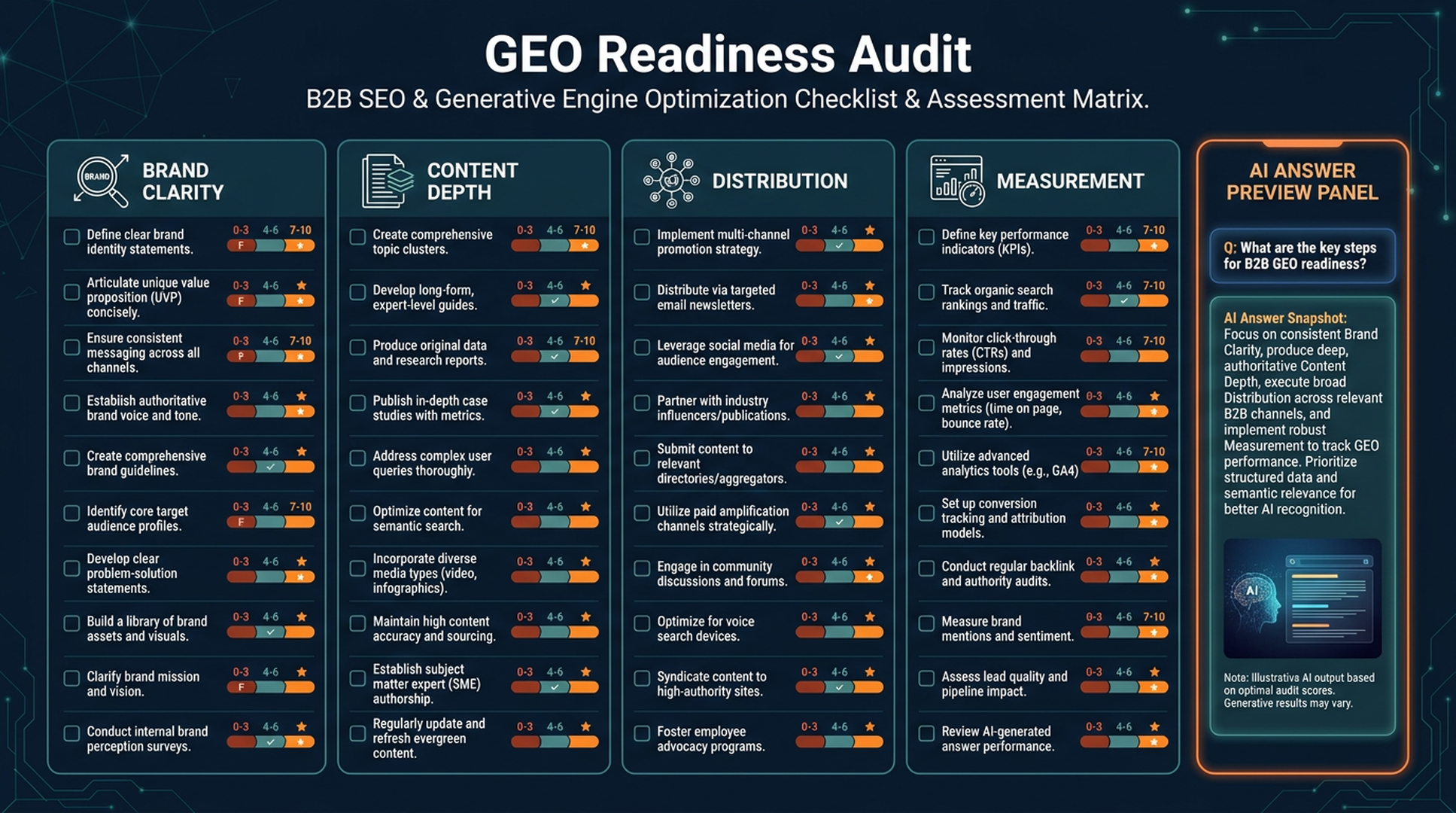
# | Check | Yes / No | Notes |
|---|---|---|---|
1 | AI tools can accurately describe your brand when asked by name. | ||
2 | AI tools can place your brand in the right product or service category. | ||
3 | Your website has a clear entity page or about page with audience, use cases, and proof. | ||
4 | You have pages for the buyer prompts that matter most, not just generic blog posts. | ||
5 | Your content includes summaries, tables, FAQs, examples, and specific claims. | ||
6 | Your brand facts are consistent across your site, profiles, documentation, and third-party pages. | ||
7 | You publish original viewpoints, data, workflows, or examples instead of rewritten commodity content. | ||
8 | You adapt content for different channels instead of syndicating the same post everywhere. | ||
9 | You check AI answer visibility at least once a month for a fixed prompt set. | ||
10 | You compare your AI answer presence against the competitors that buyers already know. |
Scoring:
Score | What it means | Next move |
|---|---|---|
8-10 yes answers | You have a working foundation. | Improve weak prompt clusters and refresh proof. |
5-7 yes answers | You have pieces, but the system is uneven. | Build a query map and fix entity consistency. |
3-4 yes answers | You are early. | Start with brand facts, buyer prompts, and 3-5 evidence pages. |
0-2 yes answers | You do not have a GEO program yet. | Run a baseline audit before producing more content. |
What a better GEO workflow looks like
A working GEO program usually has a simple loop.
First, define the answer you want AI systems to give. Not a slogan. A factual answer: what the brand does, who it is for, what problem it solves, where it is strongest, and when it is not the right fit.
Second, build evidence pages around the questions buyers ask before they trust that answer. These are not all blog posts. Some should be comparison pages, methodology pages, templates, case studies, pricing explainers, integration docs, or problem pages.
Third, distribute the evidence. Your site matters, but AI systems also learn from other surfaces: trusted directories, documentation, partner pages, reviews, social posts, newsletters, and media mentions. The exact mix depends on your category.
Fourth, check the answers. Ask the same prompts every month. Save the outputs. Watch whether the answer gets more accurate, whether citations improve, and whether competitors are being described more clearly than you.
Fifth, refresh what is stale. Add examples. Replace vague claims. Update screenshots. Clarify positioning. Publish a new comparison when the market changes.
That is the boring version. It is also the version that tends to work.
FAQ
Is GEO the same as SEO?
No. SEO focuses on earning visibility in search results. GEO focuses on making your brand and content useful enough for AI answer systems to understand, cite, and recommend. The two overlap, but GEO needs more attention to entity clarity, answer extraction, evidence, and prompt-level measurement.
Can ads help with GEO?
Ads can create awareness, but they do not replace organic evidence. A paid impression does not automatically make an AI system trust your brand as a good answer for a buyer question.
How long does GEO take?
It depends on category competition, existing content quality, brand authority, and how often AI systems retrieve your pages. A useful first milestone is not "ranking." It is whether AI systems can accurately describe your brand and place it in the right category.
How many articles should we publish each month?
Start with quality and coverage, not volume. If your foundation is weak, a few strong evidence pages are better than 20 generic posts. Once the core pages exist, most teams need a steady monthly cadence of updates, supporting articles, and prompt checks.
What should we measure first?
Measure a fixed set of buyer prompts. Track whether your brand appears, how accurately it is described, which sources are cited, which competitors appear, and what information is missing from the answer.
The Auspia takeaway
If your GEO plan can be summarized as "run ads," "publish more posts," or "do a quick sprint," it is probably too thin.
A better plan starts with buyer prompts, turns those prompts into evidence pages, distributes the evidence across trusted surfaces, and checks whether AI answers are actually changing. It is less flashy than chasing hacks. It also gives your brand a real chance of becoming the answer buyers see before they ever click a link.
If you want a baseline, start with the 10-point checklist above. Then pick the weakest three items and fix those before adding another content topic to the calendar.