Executive summary
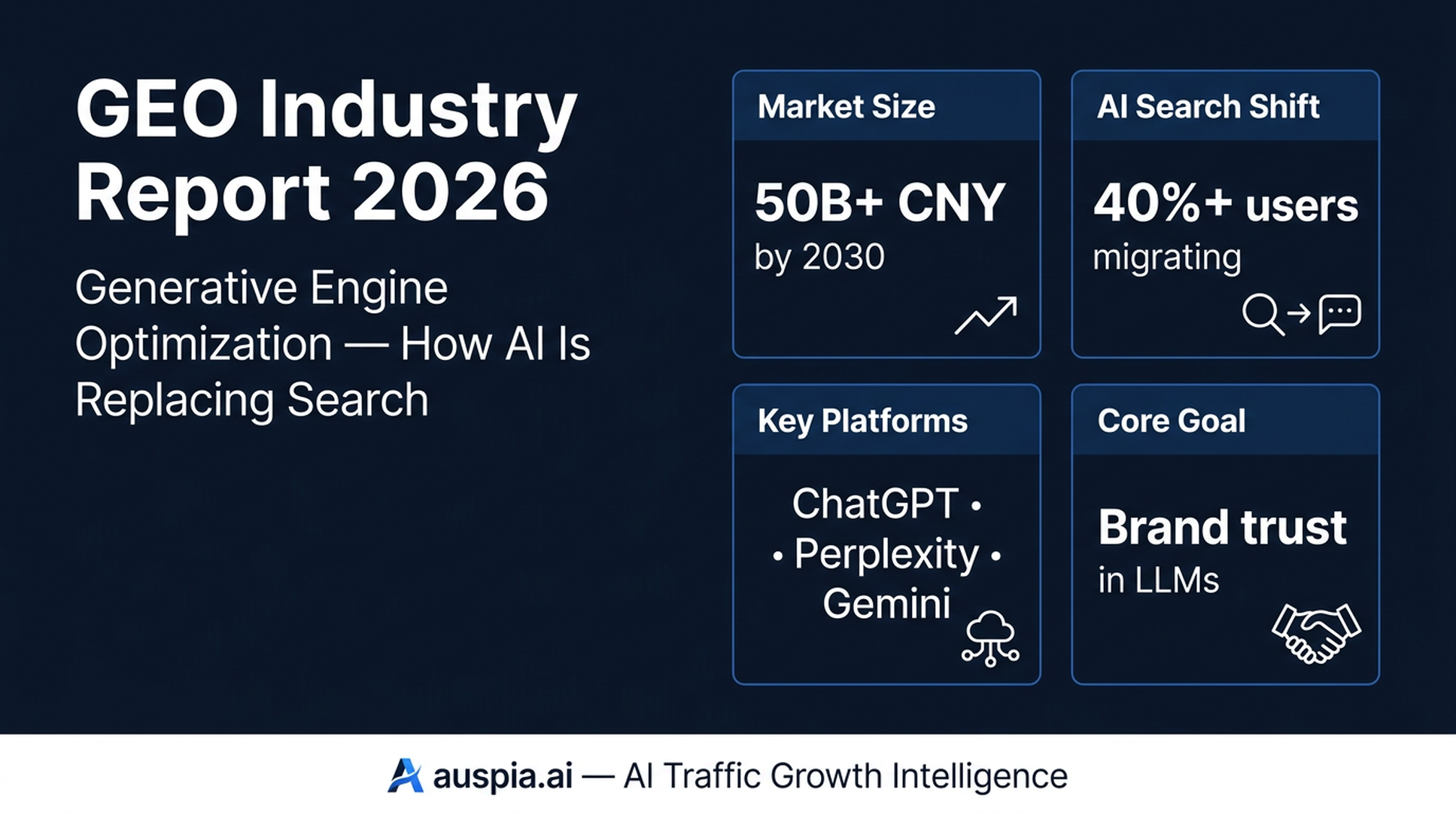
GEO, or Generative Engine Optimization, is the shift from optimizing only for blue-link rankings to optimizing for AI-generated answers. The strategic goal is not just visibility, but trust: making your brand or product easier for LLMs to understand, retrieve, and cite.
That matters because user search behavior is changing fast. More people are using AI search for discovery, comparison, and decision support, which means brands now compete for citation slots inside answers, not only positions on a results page.
For growth teams, GEO is best treated as a brand and knowledge system, not a short-term ad tactic. The winners will be the companies that build reliable content assets, clear entity structure, and measurable AI visibility over time.
What is GEO?
GEO is a content and information optimization strategy designed for generative AI systems. Instead of focusing only on search engine ranking signals, GEO focuses on how AI models perceive, interpret, and reuse brand information when generating answers.
A practical way to think about it:
- SEO tries to earn clicks from result pages.
- GEO tries to earn citations inside AI answers.
- Both matter, but they solve different visibility problems.
The core objective is to create a trust link between your brand and the AI system so that your content becomes a usable knowledge source.
Why GEO matters now
AI has moved from experimental utility to a mainstream information interface. In many categories, users no longer start with a query and a list of links; they start with a question and expect a synthesized answer.
That changes marketing economics in three ways:
- The first impression shifts from SERP snippets to AI-generated summaries.
- The decision path becomes shorter, so missing from the answer can mean missing the buyer.
- Content competition expands from ranking against pages to competing for model trust.
For brands, this is a structural shift in traffic capture, not a temporary channel trend.
How user search behavior is changing
Traditional search was link-led. AI search is answer-led.
That sounds simple, but it changes everything about how users consume information:
- They ask longer, more contextual questions.
- They compare options inside a single interface.
- They rely on synthesized answers for early-stage evaluation.
- They may never click if the answer already feels complete.
This is why GEO is becoming relevant to product marketing, content strategy, SEO, PR, and knowledge management at the same time.
Why brands should care about AI search
AI search is not just another traffic source. It is becoming a decision layer.
When AI systems summarize a category, the brand that gets cited first often gains disproportionate attention, even if the user still clicks later to verify details. That makes AI visibility valuable for awareness, consideration, and conversion.
The practical implication is that marketing leaders need to manage not only rankings and ad performance, but also:
- how AI systems describe the brand,
- which competitors are mentioned alongside it,
- and whether the brand is represented accurately.
Common misunderstandings about GEO
The biggest mistake is treating GEO like old-school SEO or performance advertising.
That leads teams to expect:
- quick wins,
- permanent rankings,
- or direct-response outcomes from every optimization.
GEO works differently. It is closer to building a durable knowledge asset than running a campaign. The point is not to game an algorithm briefly, but to make your brand more legible, more credible, and more reusable by AI systems.
How GEO works technically
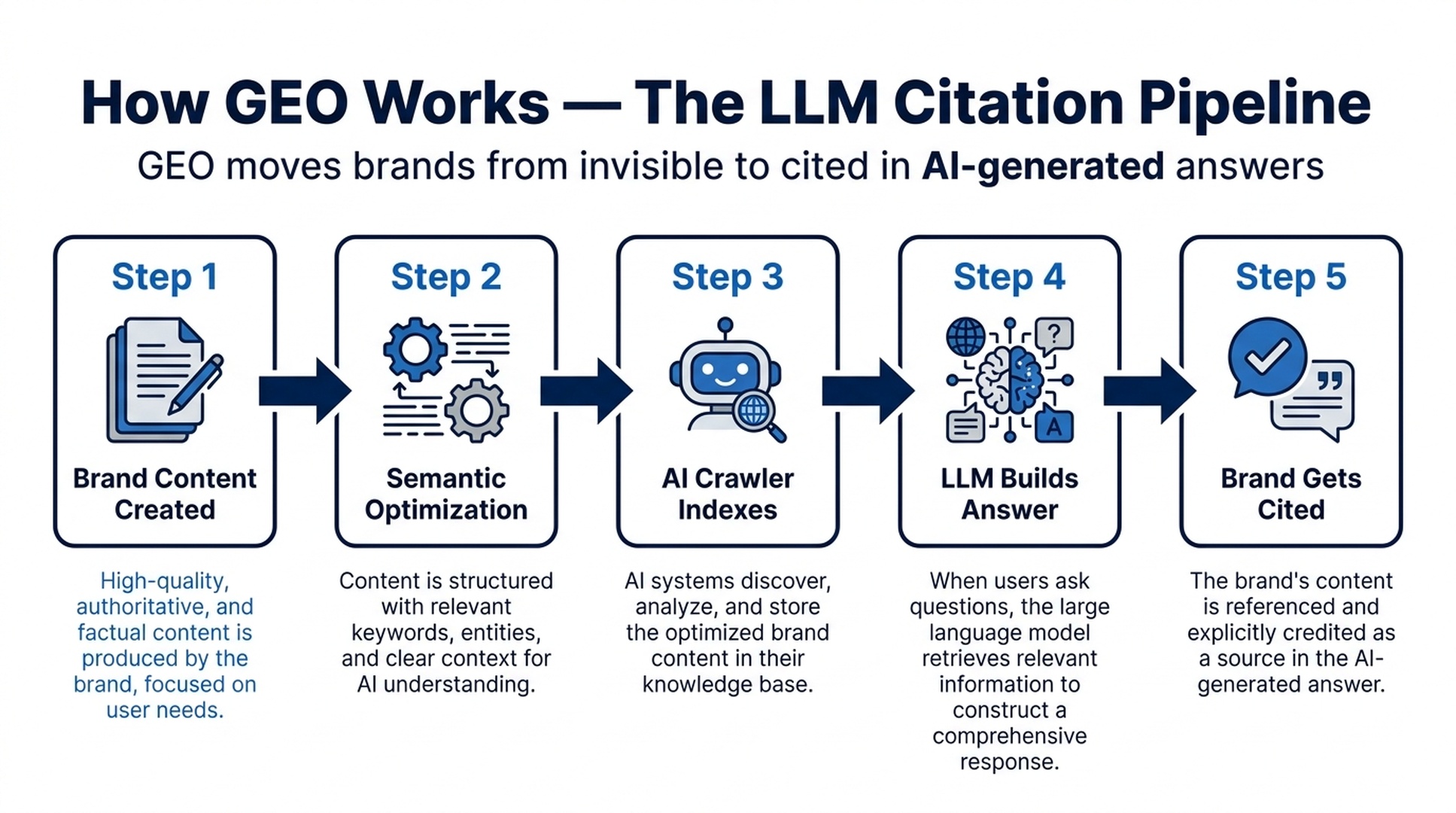
At a high level, GEO is about improving the way content is crawled, understood, indexed, and recalled by LLM-driven systems.
That usually means strengthening three layers:
- Content quality: clear definitions, original explanations, and complete coverage.
- Semantic structure: entity consistency, internal links, headings, and supporting context.
- Machine readability: clean markup, stable URLs, and information that can be extracted easily.
The technical goal is to move your brand from "one of many pages" to "a trusted source of knowledge."
How GEO moves a brand from content production to AI citation.
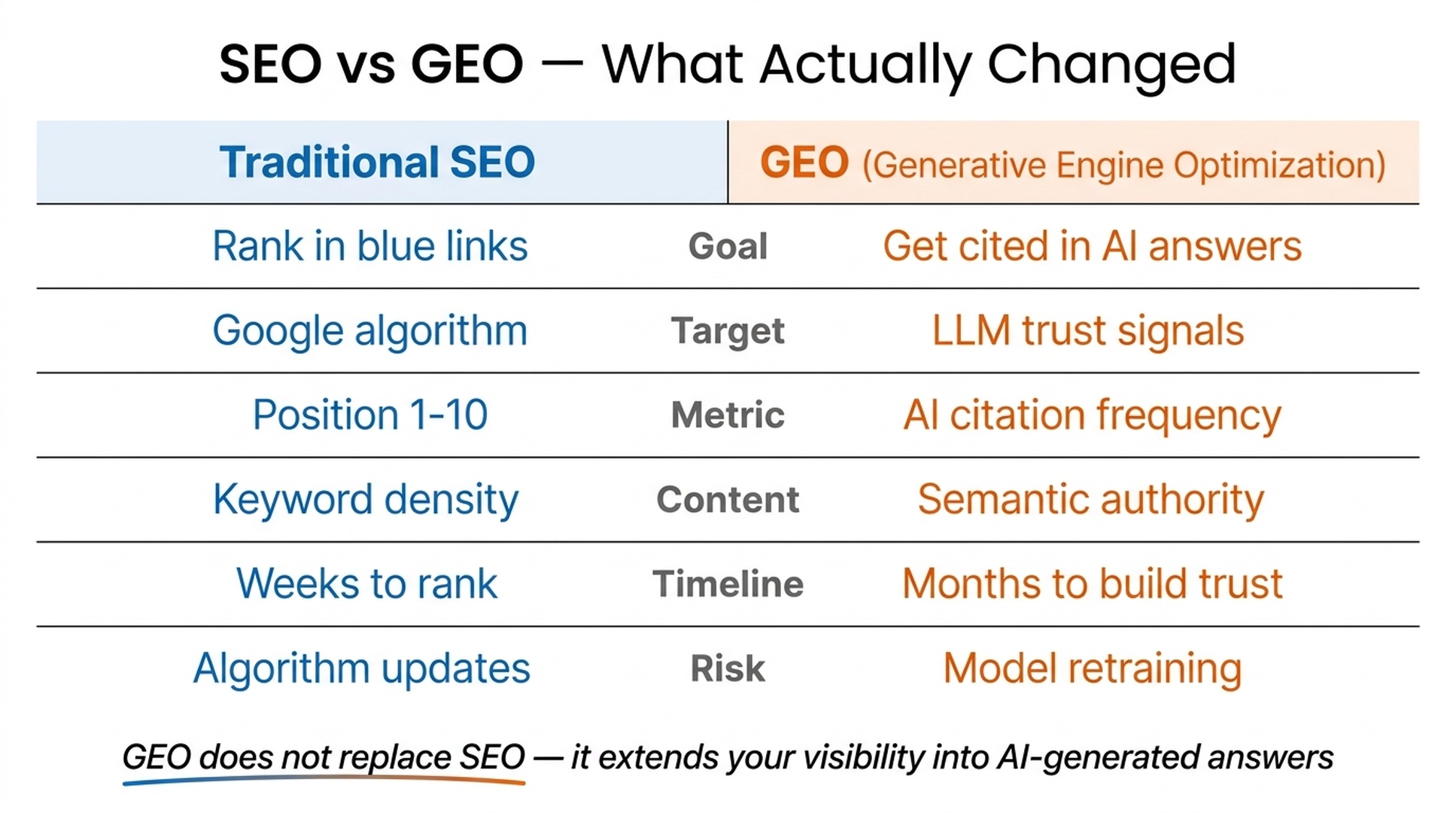
SEO vs GEO
Dimension | SEO | GEO |
|---|---|---|
Primary goal | Rank in search results | Get cited in AI answers |
Main system | Search engine algorithms | LLM trust and retrieval systems |
Core signal | Relevance, authority, links | Clarity, entity strength, content usefulness |
Success metric | Position, impressions, clicks | Citation frequency, AI visibility, answer inclusion |
Content style | Keyword-targeted pages | Structured knowledge assets |
Time horizon | Weeks to months | Months to build durable trust |
SEO and GEO overlap, but the objective changes from ranking to citation.
How the GEO market is evolving
The GEO market is still early, but the budget logic is already visible.
We are seeing three types of spend shift:
- budget moving from pure SEO into AI visibility work,
- budget moving from PR and reputation work into structured knowledge assets,
- and budget moving into technical services for content systems, schema, and monitoring.
As AI platforms become more commercialized, this category will likely split into strategy, tooling, measurement, and managed services.
What the GEO ecosystem looks like
The GEO ecosystem usually has four layers:
- AI platforms — the systems generating answers.
- Content and data sources — the corpus models learn from.
- GEO service layer — agencies, consultants, and tooling providers.
- Brand operators — in-house teams managing content, PR, SEO, and product messaging.
The more mature the market becomes, the more important measurement and governance will be.
What GEO content engineering includes
GEO is not a single optimization trick. It is a content engineering process.
A strong GEO program usually includes:
- topic and entity mapping,
- content gap analysis,
- FAQ and comparison asset creation,
- source consistency checks,
- page-level semantic cleanup,
- and ongoing answer visibility monitoring.
The key idea is to reduce ambiguity. If your content is vague, fragmented, or inconsistent, AI systems are less likely to treat it as reliable.
How to implement GEO content optimization
The simplest rule is this: be close to the user's semantic coordinates.
That means your content should align with how real people ask, compare, and decide. Practical implementation usually looks like this:
- Define the entity clearly.
- Cover the category with complete, structured content.
- Add comparison logic, use cases, and constraints.
- Use concise headings and extractable summaries.
- Keep supporting facts consistent across the site.
The goal is not to write more content. The goal is to write content AI can safely reuse.
How to measure GEO effectiveness
GEO measurement is still immature, but teams can already track useful signals.
A useful measurement stack includes:
- Visibility metrics: how often the brand appears in AI answers.
- Content metrics: which pages or topics get cited.
- Technical metrics: crawlability, structure, and machine readability.
- Business metrics: referral quality, assisted conversions, and branded demand.
Attribution is still imperfect, so teams should avoid pretending every AI mention has a clean last-click path.
What it takes to become an authority AI cannot ignore
In the long run, AI-friendly authority will look a lot like real marketing authority: deep user understanding, clear value, and consistent proof.
Brands that win will usually do three things well:
- publish stronger knowledge than competitors,
- organize that knowledge better,
- and maintain consistency across channels.
This is less about tricks and more about durable expertise.
Auspia perspective
From Auspia's point of view, GEO should be treated as a visibility layer on top of a broader content system.
That means teams should not isolate GEO from SEO, AEO, product marketing, or PR. The best results come when all of those functions reinforce the same entity story.
If you want AI systems to trust your brand, your site needs to answer three questions clearly:
- What is this brand?
- What does it do?
- Why should it be trusted over alternatives?
What teams should do next
If you are starting GEO work this quarter, prioritize these actions:
- audit the pages most likely to define your category,
- map the entities and claims you want AI to repeat correctly,
- create comparison and FAQ assets that answer high-intent questions,
- unify your terminology across site, docs, and external profiles,
- and set up a simple AI visibility tracking routine.
Do not start with 50 pages of speculative content. Start with the knowledge assets that matter most.
Common mistakes
Teams usually fail when they:
- optimize for short-term exposure instead of long-term trust,
- publish content that is broad but not specific,
- ignore entity consistency,
- confuse AI visibility with direct conversion,
- or rely on low-quality mass content.
GEO rewards clarity and credibility. It does not reward noise.
FAQ
Is GEO replacing SEO?
No. GEO extends visibility into AI-generated answers, but SEO still matters for search demand, discovery, and owned traffic.
What kind of content is best for GEO?
Content that is clear, structured, and knowledge-rich: definitions, comparisons, decision guides, FAQs, and expert explanations.
Can GEO be measured precisely?
Not yet. Measurement is improving, but attribution remains imperfect. Track visibility, citations, and business impact together.
Is GEO only for large brands?
No. Smaller teams can move faster if they build focused, high-quality knowledge assets in a specific niche.
What is the first GEO asset to create?
Usually a strong category page, comparison page, or FAQ hub that defines the entity and answers the questions users ask most.