The short version
In 2026, the flashiest organic win is no longer simply "we rank on Google's first page." It is "when a buyer asks an AI system who to consider, our brand appears in the answer, with the right reason attached."
That does not make Google rankings obsolete. It means rankings are no longer the whole scoreboard. A buyer may ask ChatGPT, Perplexity, Gemini, Copilot, or an AI shopping assistant to narrow a market before they ever see ten blue links. If your brand is absent from that shortlist, the lost click will never show up as a lost click. It will look like nothing happened.
A recent @aisearchagency post put the idea bluntly: clicks are becoming a legacy metric, and the real fight is whether AI recommends your brand when buyers ask for options. I would soften one part of that. Clicks are not dead. But they are downstream. The upstream battle is citation share: how often AI systems mention, cite, compare, and accurately describe your brand across buyer prompts.
Why "page one" is losing its bragging rights
Page-one rankings were easy to understand because the interface was stable. A searcher typed a query. Google returned a list. SEO teams fought for position, title relevance, snippets, and links.
Generative search breaks that clean chain. The interface is now a conversation. The answer may include citations, may not include citations, may name brands without links, and may compress a messy market into a few recommended options. The buyer's question is also longer and more commercial:
- "What are the best tools for tracking AI search visibility for a small SaaS team?"
- "Which cybersecurity vendors are good for a 200-person healthcare company?"
- "What are alternatives to HubSpot for a B2B startup that needs strong reporting?"
- "Which project management tool should a remote agency use if clients need read-only access?"
Those prompts are not classic keywords. They are buying situations. The answer engine is not just retrieving pages. It is assembling a shortlist.
That is why the brag has changed. "We rank" is still useful. "We are recommended in the buyer's shortlist" is more useful.
The evidence: clicks are thinner, AI referrals are growing, and buyers are changing the route
This shift is not based on vibes. Three data points explain why growth teams are paying attention.
First, Gartner predicted in February 2024 that traditional search engine volume would drop 25% by 2026 as AI chatbots and virtual agents take share from conventional search behavior. Forecasts can be wrong in size and timing, but the direction is hard to ignore: more discovery work is moving into AI-assisted interfaces. Source: Gartner, "Search Engine Volume Will Drop 25% by 2026." https://www.gartner.com/en/newsroom/press-releases/2024-02-19-gartner-predicts-search-engine-volume-will-drop-25-percent-by-2026-due-to-ai-chatbots-and-other-virtual-agents
Second, zero-click search keeps rising. SparkToro's 2024 study found that 58.5% of U.S. Google searches and 59.7% of EU Google searches ended without a click. SparkToro's 2026 update argues that less than one third of Google searches now send a click to the open web. The exact number will vary by market, device, and query class, but the trend is clear enough: many searches create visibility without traffic. Sources: SparkToro 2024 zero-click study and 2026 update. https://sparktoro.com/blog/2024-zero-click-search-study-for-every-1000-us-google-searches-only-374-clicks-go-to-the-open-web-in-the-eu-its-360/ and https://sparktoro.com/blog/in-2026-less-than-one-third-of-google-searches-still-send-a-click/
Third, AI referrals are no longer a curiosity. Adobe reported that traffic from generative AI sources to U.S. retail websites rose sharply from 2024 into 2025, including a 1,200% increase in February 2025 compared with July 2024. Adobe's 2025 holiday data also reported a 693.4% year-over-year increase in AI-source traffic to retail sites. Source: Adobe Analytics reports on generative AI traffic. https://blog.adobe.com/en/publish/2025/03/17/adobe-analytics-traffic-to-us-retail-websites-from-generative-ai-sources-jumps-1200-percent and https://business.adobe.com/resources/holiday-shopping-report.html
Put together, the picture is practical: search is not disappearing, but the measurement layer is getting messier. Buyers still click. They also ask, compare, summarize, and shortlist before the click.
The metric to add: AI citation share
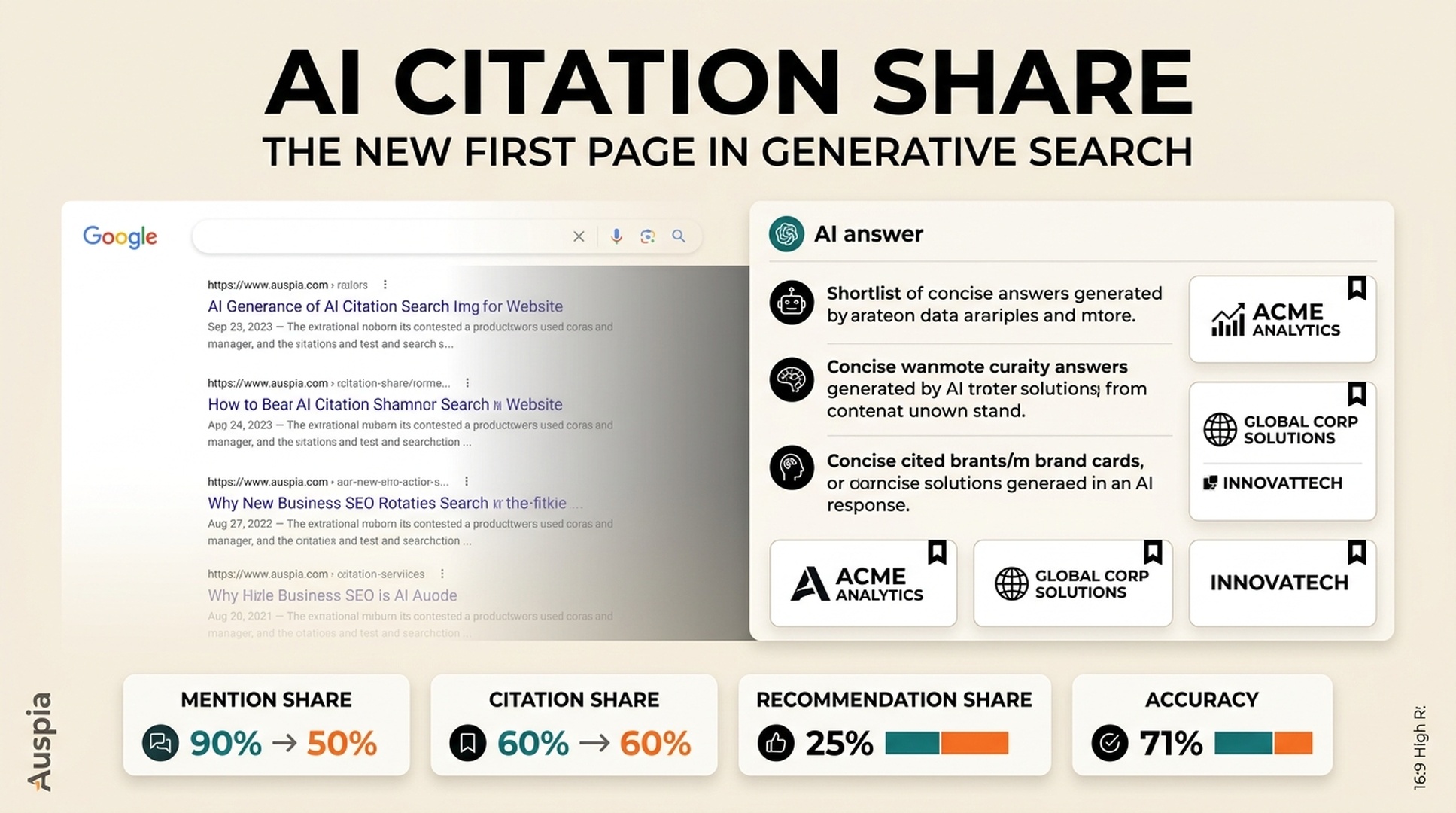
AI citation share measures how often your brand appears in AI-generated answers across a defined prompt set, compared with the total brand mentions or cited sources in that same set.
It is not one metric. It is a small family of metrics:
Metric | What it answers | Why it matters |
|---|---|---|
Mention share | How often is the brand named? | Measures shortlist presence, even when no link appears. |
Citation share | How often is the brand cited with a source link? | Measures retrievable evidence and source authority. |
Recommendation share | How often is the brand recommended for the right buyer situation? | Measures commercial visibility, not just awareness. |
Attribute accuracy | Is the brand described correctly? | Prevents the wrong positioning from spreading. |
Competitor co-mention rate | Which brands appear beside yours? | Shows the comparison set AI systems place you in. |
This is where GEO becomes more than "write for LLMs." A serious GEO program defines the buyer prompts that matter, runs them on a schedule, records which brands appear, checks which sources are cited, and fixes the missing evidence.
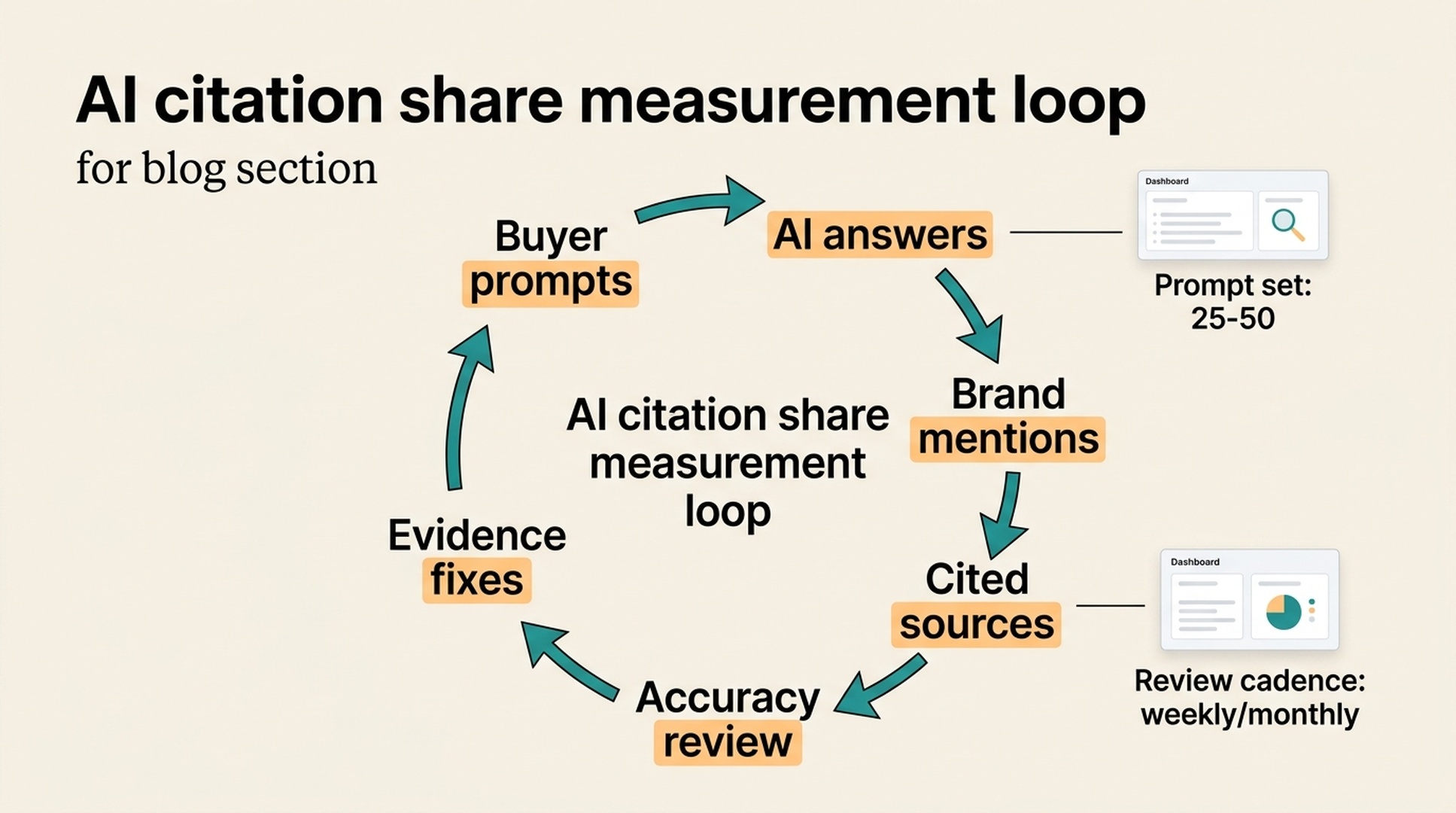
AI citation share improves when teams measure buyer prompts, inspect citations, repair evidence, and repeat the same prompt set over time.
What AI systems need before they can recommend you
Most brands want to be recommended before they have made themselves easy to recommend.
AI systems tend to favor brands with clear, repeated, externally supported facts. That means your website matters, but it is not the only input. Your brand may be shaped by review sites, comparison pages, documentation, partner pages, marketplaces, customer stories, knowledge panels, social mentions, and high-authority articles.
A brand is easier to recommend when the public web can answer these questions without guessing:
- What category is the company in?
- Who is it best for?
- What problem does it solve?
- How is it different from close alternatives?
- Which use cases, industries, sizes, or regions fit best?
- What proof exists outside the company's own homepage?
- Are pricing, integrations, security, and support details easy to verify?
If those facts are vague, scattered, or contradicted across sources, AI answers will either skip the brand or describe it poorly.
This is the uncomfortable part for teams that grew up on classic SEO. You cannot only optimize the page. You have to optimize the evidence graph around the brand.
A simple prompt set beats a giant dashboard
You do not need a 500-prompt system on day one. Start with 25 to 50 prompts that represent real buyer situations.
Use five prompt types:
Prompt type | Example | What to inspect |
|---|---|---|
Category shortlist | "Best [category] tools for [audience]" | Whether your brand appears at all. |
Alternative search | "Alternatives to [competitor] for [use case]" | Whether AI understands your competitive lane. |
Problem-led search | "How should a [team] solve [pain]?" | Whether the brand appears as a solution, not just a company. |
Criteria-led search | "Which tools support [feature], [constraint], and [budget]?" | Whether feature evidence is retrievable. |
Risk-led search | "Which vendors are safe for [regulated/high-risk context]?" | Whether trust, security, and proof are visible. |
Run the same set across the AI platforms your buyers actually use. Record the answer, citations, brand mentions, competitors, and wrong claims. Then repeat weekly or monthly. The point is not perfect scientific certainty. The point is to stop guessing.
How to improve citation share without gaming the system
The lazy version of GEO is "publish more AI-friendly content." That may help, but it is too broad. Citation share improves when the answer engine can find specific, corroborated reasons to include you.
Start with these fixes:
- Build a clear brand facts page. State the category, audience, core use cases, integrations, pricing model, service regions, and differentiators in plain language.
- Rewrite comparison and alternative pages around decision criteria, not insults. AI systems need clean distinctions, not marketing theater.
- Add evidence to use-case pages. Include workflows, limitations, screenshots, data, examples, and customer-fit notes.
- Keep documentation crawlable. Many AI answers pull practical detail from docs, help centers, API pages, and changelogs.
- Earn third-party corroboration. Review platforms, partner directories, expert roundups, podcasts, and analyst-style pages help when they describe the brand accurately.
- Fix inconsistent naming. A brand with multiple names, old slogans, outdated categories, or conflicting product descriptions becomes harder to retrieve.
None of this guarantees a citation. It does reduce the chance that AI systems look at the public web and decide your brand is too unclear to recommend.
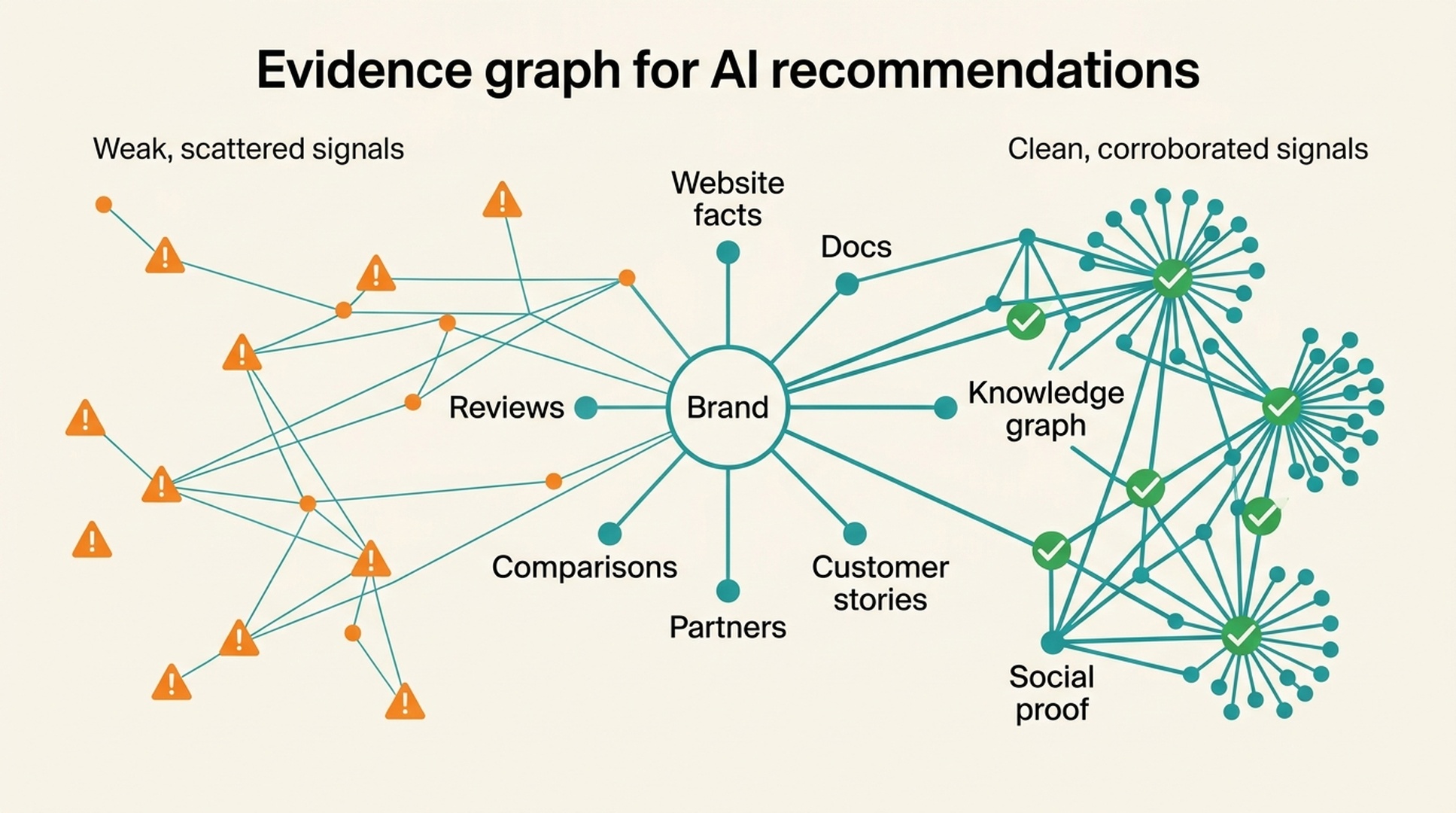
AI recommendation visibility depends on corroborated evidence around the brand, not only on the homepage.
The new bragging rights dashboard
The old executive slide said: "We have 42 page-one rankings."
The better 2026 slide says:
Question | Metric to report |
|---|---|
Are we present when buyers ask for recommendations? | Recommendation share across buyer prompts |
Are we cited or only mentioned? | Citation share and source URLs |
Are we described correctly? | Attribute accuracy score |
Are we appearing in the right comparison set? | Competitor co-mention map |
Are AI visits converting differently? | Assisted pipeline, engaged sessions, demo starts, or revenue per AI-referred visit |
Which evidence moved the answer? | New citations, source changes, answer changes after content updates |
This does not replace SEO reporting. Keep rankings, indexed pages, organic sessions, leads, and revenue. But add an AI visibility layer above them.
The reason is simple: a buyer can be influenced before analytics sees a session. If the AI answer recommends three vendors and you are not one of them, your CRM will not record a lost opportunity. Your search dashboard may still look fine.
What to do this month
If you want a practical starting point, do this in four weeks.
Week 1: build the buyer prompt set. Interview sales, support, and product marketing. Pull real phrases from demos, comparison calls, customer objections, and internal search logs.
Week 2: run the baseline. Test the prompts in the AI systems your market uses. Capture answers, citations, recommendations, and wrong claims. Use a simple spreadsheet before buying a complex dashboard.
Week 3: repair the evidence. Pick the five prompts where absence hurts most. Improve the related pages, source clarity, comparison content, documentation, and third-party proof.
Week 4: re-run and review. Look for movement, but do not overreact to one answer. AI responses vary. Measure patterns across prompt clusters and repeated runs.
For a faster first pass, use an AI search visibility audit workflow or a tool such as Auspia's AI Search Visibility Checker when you need a structured snapshot: https://auspia.ai/tools/ai-search-visibility-checker
Auspia take
"Clicks are legacy" is a useful provocation, but it is too final. Clicks still matter because businesses run on visits, trials, demos, revenue, and retention.
The better rule is this: clicks are no longer the first proof of demand. In AI search, demand may be shaped inside an answer before a user chooses whether to visit your site. That makes citation share, recommendation share, and brand accuracy early-warning metrics for future pipeline.
The ultimate flex in 2026 is not abandoning Google. It is being present in the answer layer before the click, then being useful enough to earn the click when the buyer is ready.
FAQ
Is AI citation share the same as SEO ranking?
No. SEO ranking measures where a page appears in traditional search results. AI citation share measures how often a brand or source appears inside generated answers across a defined prompt set.
Should teams stop tracking clicks?
No. Keep tracking clicks, conversions, and revenue. The point is to add upstream visibility metrics because AI answers can influence buyers before a website session begins.
Which AI platforms should we test?
Start with the platforms your buyers use. For many B2B teams, that means ChatGPT, Perplexity, Gemini, Copilot, and Google AI search surfaces. Ecommerce and local teams may also need shopping assistants, marketplace assistants, and voice interfaces.
How many prompts are enough for a baseline?
A useful first baseline can start with 25 to 50 prompts. The prompts should represent real buyer situations, not random keywords. Expand only after the first set produces decisions you can act on.
Can we guarantee that AI systems cite our brand?
No. You can improve eligibility by making brand facts, evidence, comparisons, documentation, and third-party references easier to retrieve. You cannot force an AI system to cite you every time.
Author: Ethan Marlowe, GEO Measurement Lead Across 500+ Prompts at Auspia. Ethan writes about prompt tracking, citation reporting, visibility dashboards, and AI answer quality checks for growth teams.