Direct answer
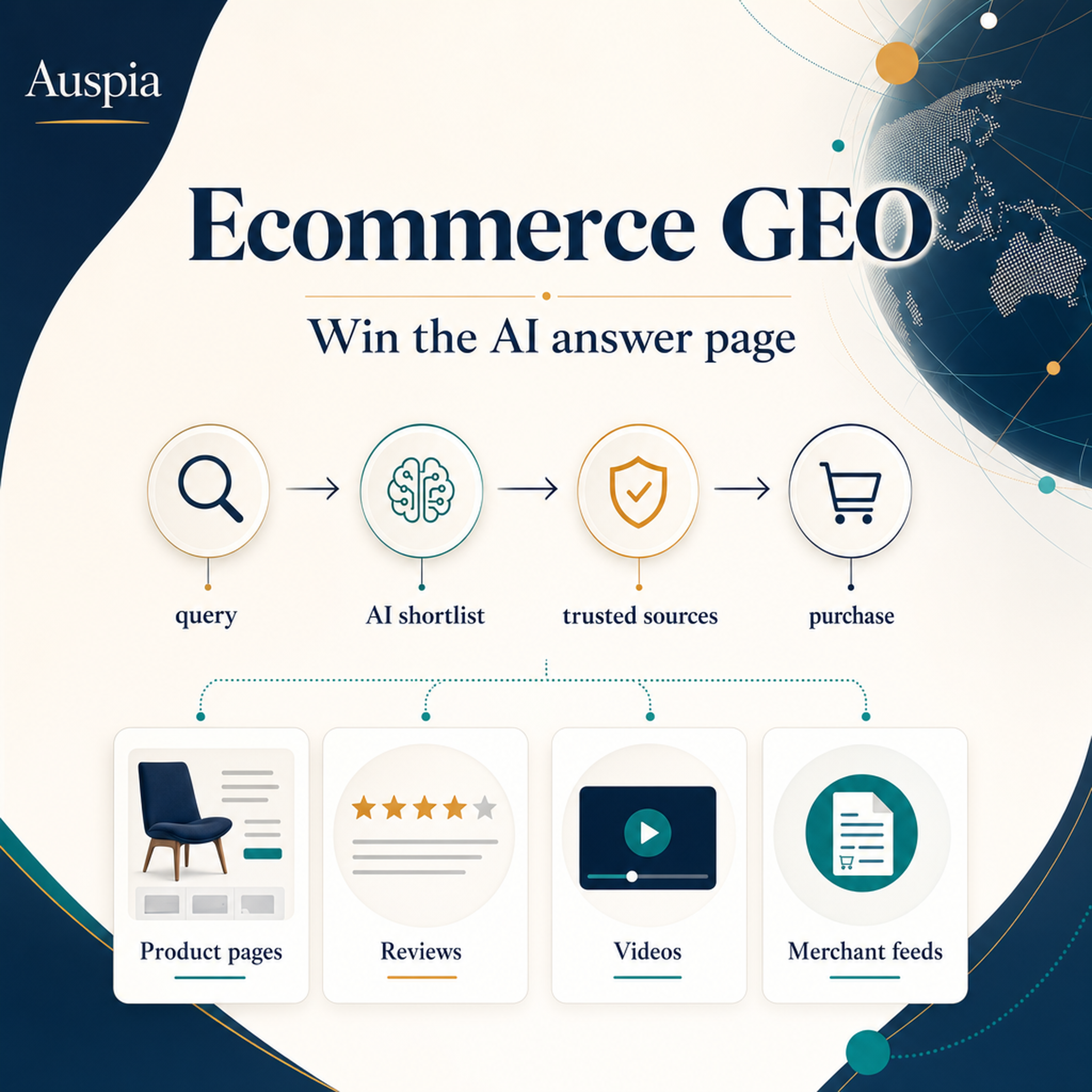
Ecommerce GEO is the work of making products easy for AI answer engines to understand, compare, cite, and recommend when a shopper asks a buying question. For global sellers, the new shelf is no longer only Amazon search results, Google rankings, retail media placements, TikTok videos, or marketplace category pages. It is also the answer generated by Google AI Overviews, ChatGPT, Perplexity, Gemini, Copilot, shopping assistants, and retailer AI tools.
The practical goal is simple: when a customer asks, "Which moisturizer is best for sensitive skin?", "What laptop should I buy for video editing?", or "Which cordless vacuum works well for pet hair?", your product should appear in the AI's shortlist with the right proof, the right positioning, and the right source references.

The new ecommerce shelf is inside AI answers
For years, ecommerce teams competed for a familiar set of surfaces: search result pages, marketplace rankings, sponsored product slots, creator content, comparison articles, retail media placements, and social feeds.
AI commerce changes that path.
A shopper no longer has to search, open ten tabs, read reviews, compare specs, and then decide. Increasingly, the shopper can ask a conversational system for a recommendation. The AI then decomposes the need, compares product attributes, references third-party sources, weighs reviews, and produces a shortlist.
That is a different kind of shelf.
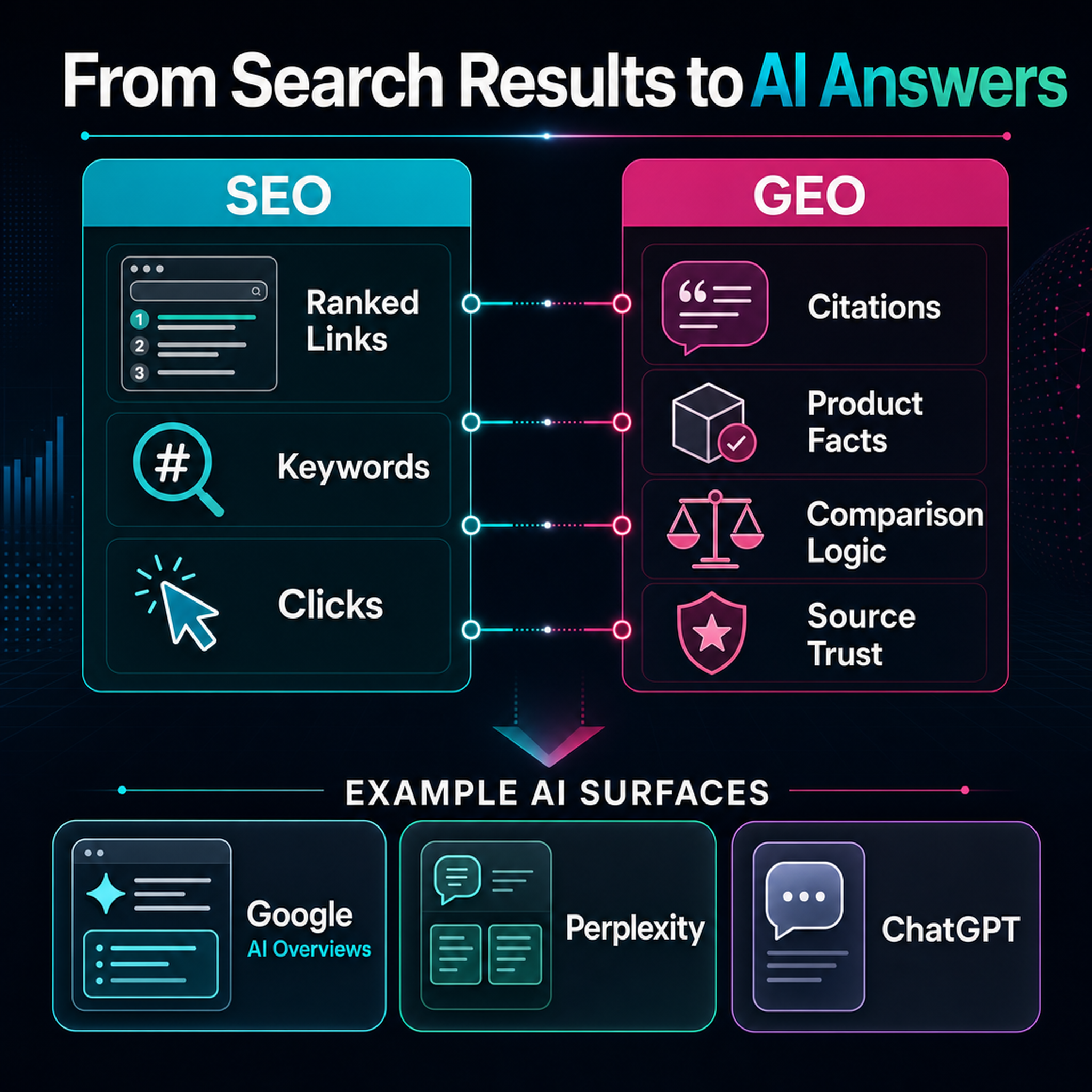
On the old shelf, visibility meant being ranked, placed, or promoted. On the AI answer shelf, visibility means being understood well enough to become part of the recommendation logic.
For ecommerce sellers, GEO can be defined as the process of improving the probability that a product, brand, or merchant is correctly understood, cited, and recommended in AI-generated shopping answers.
Why GEO is becoming a real ecommerce entry point
The commercial value of ecommerce GEO is not just exposure. It is entry into the decision chain at the moment a buyer expresses intent.
A query like "best running shoes for flat feet and marathon training" is not casual browsing. It contains budget, use case, constraints, risk, and likely purchase intent. The same is true for questions such as:
- "Which sunscreen is best for oily skin and no white cast?"
- "What is the best monitor for a MacBook Pro under $500?"
- "Which baby stroller folds easily for city apartments?"
- "Is the Dyson V15 worth it compared with Shark?"
In these moments, AI systems are not only retrieving information. They are shaping the candidate set.
This matters globally because major discovery environments are converging around answer-first interfaces. Google is adding AI answers to search. Perplexity presents source-backed answers. ChatGPT and Gemini are becoming shopping research assistants. Amazon, Shopify, Walmart, Instacart, Klarna, and other commerce platforms are experimenting with AI-powered product discovery and guided buying.
The implication for sellers is clear: ecommerce traffic is moving from "rank for the keyword" toward "become a trusted answer candidate."
AI recommendations are not neutral lists
AI shopping answers do not come from nowhere. They are shaped by the sources the system can access, the content it trusts, the product data it can parse, the reviews it can summarize, and the commercial ecosystem around the assistant.
A Google AI Overview may lean on indexed pages, merchant feeds, review pages, product schema, and high-authority publishers. Perplexity often makes source selection visible and may cite product reviews, Reddit threads, brand sites, and specialist media. ChatGPT-style assistants may combine web results, structured product information, known brand entities, and user context. Retailer assistants may favor catalog data, inventory availability, price, reviews, fulfillment speed, and marketplace performance signals.
For sellers, this means GEO is not finished when you publish one blog post. You need to answer three operational questions:
GEO question | Why it matters | Example action |
|---|---|---|
Which AI surfaces can recommend my category? | Different AI systems rely on different sources and commerce integrations. | Test buying questions in Google AI Overviews, Perplexity, ChatGPT, Gemini, Amazon, and retailer search assistants. |
Which sources influence those answers? | AI systems often repeat the claims, comparisons, and review patterns found in trusted sources. | Map citations from brand pages, marketplaces, YouTube reviews, Reddit discussions, Wirecutter-style reviews, and retailer pages. |
Can AI extract my real recommendation reason? | Vague copy is hard to cite; structured proof is easier to reuse. | Turn product benefits into use cases, specs, contraindications, comparisons, FAQs, and evidence-backed claims. |
If AI cannot clearly answer why your product is a good fit, it has little reason to include you in the shortlist.
Different product categories need different GEO strategies
Ecommerce GEO is not one playbook for every category. AI needs different evidence depending on how shoppers make decisions.
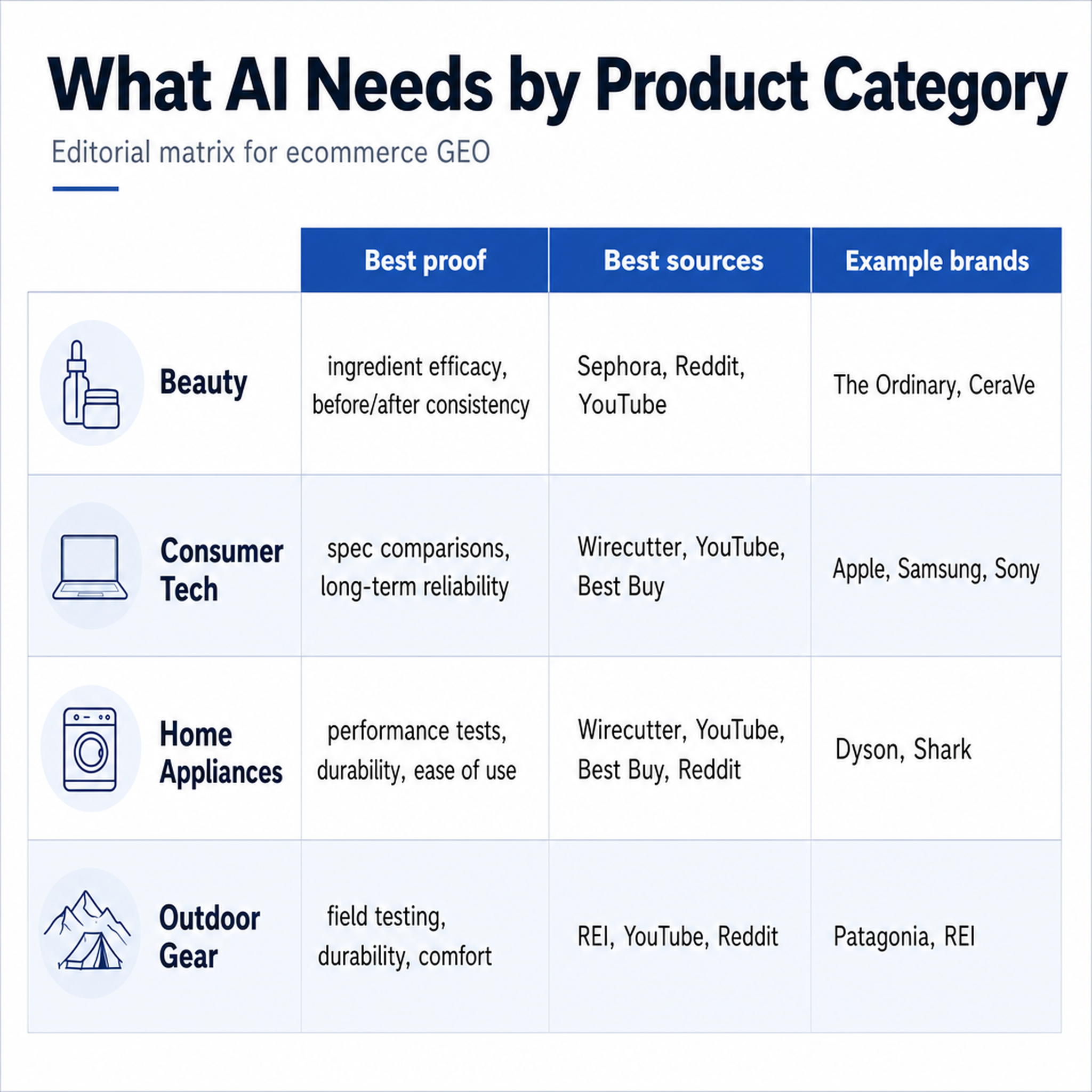
Beauty and personal care need fit, ingredients, proof, and constraints. A skincare brand should not rely on vague claims like "clean," "premium," or "viral." AI needs to understand the skin type, active ingredients, expected results, usage period, sensitivity concerns, and credible review patterns. Global examples include The Ordinary, CeraVe, La Roche-Posay, Sephora reviews, dermatologist explainers, YouTube routines, and Reddit discussions.
Consumer technology needs specs plus scenarios. A laptop, smartphone, camera, or monitor is not recommended only because it has strong numbers. AI needs to connect specifications to use cases: video editing, gaming, battery life, travel, photo quality, AI features, repairability, and budget. Useful sources include official product pages, comparison tables, Best Buy reviews, expert reviews, YouTube benchmarks, and long-form technology media.
Home appliances need performance, maintenance, and long-term experience. A vacuum, air purifier, coffee machine, or washing machine needs more than a feature list. AI has to understand noise, cleaning power, filter cost, durability, ease of maintenance, pet-hair performance, warranty, and owner satisfaction. Sources such as Wirecutter, Consumer Reports-style reviews, Reddit, YouTube tests, retailer reviews, and brand support pages all help build confidence.
Outdoor gear needs field proof. Products such as backpacks, tents, trail shoes, jackets, and sleeping bags are judged by comfort, weather performance, weight, durability, fit, and real use conditions. AI is more likely to recommend products when brand claims are supported by specialist retailers, field tests, user reviews, and clear sizing or use-case guidance.
What ecommerce sellers should do now
1. Build an AI-readable product knowledge base
Your product information should be structured as facts, not slogans. Include:
- target customer and use case;
- core specs and measurable attributes;
- category-specific benefits;
- limitations, fit boundaries, and contraindications;
- comparison alternatives;
- proof sources;
- common questions and objections;
- review themes and support information.
For example, "best for pet owners in small apartments because it handles hair on hard floors, stores vertically, and has washable filters" is more useful to an AI answer than "powerful cleaning for modern homes."
2. Create content around decision chains, not just keywords
Traditional SEO often starts with keyword volume. Ecommerce GEO should start with buyer questions.
A beauty brand should build content around skin type, ingredient tolerance, routine order, visible results, and comparison against alternatives. A consumer tech brand should explain use cases, benchmarks, trade-offs, and compatibility. A home appliance seller should explain maintenance, replacement parts, durability, noise, and real household scenarios.
The question is not "Can this page rank?" The question is "Can an AI system extract a trustworthy recommendation reason from this page?"
3. Build a multi-source trust layer
One product page is not enough. AI systems look for repeated, consistent evidence across sources.
A global ecommerce GEO footprint may include:
- official product pages with schema markup and clear specs;
- Amazon, Walmart, Target, Best Buy, Sephora, or category marketplace listings;
- Shopify product pages and collection pages;
- YouTube demonstrations and expert reviews;
- Reddit and community discussions where appropriate;
- independent review sites and specialist publishers;
- comparison pages that explain trade-offs honestly;
- support pages, manuals, warranty pages, and FAQ pages.
The objective is not to manipulate AI. It is to make the real product evidence easier to find, verify, and reuse.
4. Monitor answers, not only rankings
Ecommerce teams should add AI answer monitoring beside SEO rank tracking and marketplace analytics.
A simple GEO tracking sheet should include:
Prompt type | Example prompt | What to record |
|---|---|---|
Category recommendation | "Best cordless vacuum for pet hair under $400" | Which brands appear, which sources are cited, what reasons are given. |
Comparison | "Dyson V15 vs Shark Stratos for apartments" | Whether the comparison is accurate and whether your product's strengths are mentioned. |
Constraint-based query | "Best moisturizer for sensitive skin with retinol alternative" | Whether AI understands ingredient fit, warnings, and target user. |
Problem-solving query | "How do I choose an air purifier for wildfire smoke?" | Whether your category content appears as trusted guidance. |
Purchase readiness query | "Where should I buy a reliable espresso machine with warranty?" | Whether retailer, fulfillment, support, and warranty signals appear. |
This monitoring tells you something keyword ranking cannot: whether AI sees your product as a credible answer.
GEO ultimately competes for AI trust assets
In AI commerce, brand equity is being recalculated.
Traditional brand equity includes awareness, repeat purchase, search demand, marketplace rating, creator coverage, and shelf position. AI adds a new layer: can answer systems repeatedly understand and recommend you for the right buying situations?
That asset is not built by a single campaign. Paid media can create bursts of demand, but it does not automatically create AI trust. AI trust comes from consistent product facts, structured pages, trustworthy third-party sources, clear comparisons, credible reviews, and category-specific evidence.
For ecommerce sellers, GEO is not a new content trick. It is an entry-point migration:
Old ecommerce competition | AI commerce competition |
|---|---|
Win the keyword ranking | Become the answer candidate |
Optimize for clicks | Optimize for citations and recommendation reasons |
Push generic claims | Publish verifiable product facts |
Track position | Track answer inclusion and accuracy |
Depend on one channel | Build a source ecosystem |
The sellers that move first will have a compounding advantage. Their products will be easier for AI to parse, easier to compare, easier to cite, and easier to recommend.
Auspia takeaway
The strongest ecommerce GEO program starts with one uncomfortable audit: ask the AI systems your customers already use the buying questions that matter most. If your product does not appear, or if it appears with the wrong reason, the problem is usually not the AI. The problem is that your product evidence is scattered, vague, or trapped in formats AI cannot confidently reuse.
Auspia's recommended sequence is:
- collect 30 to 50 high-intent buying prompts for your category;
- test them across Google AI Overviews, Perplexity, ChatGPT, Gemini, and relevant marketplace assistants;
- map which competitors and sources appear;
- rebuild product pages, comparison content, FAQ pages, and third-party source coverage around the missing proof;
- repeat the monitoring monthly.
In the answer-page era, ecommerce growth belongs to brands that can turn product truth into machine-readable trust.
FAQ
What is ecommerce GEO?
Ecommerce GEO is the process of optimizing product and brand information so AI answer engines can understand, cite, compare, and recommend products in response to shopping questions.
How is GEO different from ecommerce SEO?
Ecommerce SEO focuses on ranking pages in search results. Ecommerce GEO focuses on whether AI systems can extract trustworthy product facts, cite relevant sources, and include a product in generated recommendations.
Which ecommerce categories need GEO the most?
Categories with complex decisions, high comparison behavior, or fragmented reviews need GEO most. Examples include beauty, consumer technology, home appliances, baby products, health and wellness, outdoor gear, home improvement, and B2B equipment.
What should sellers do first?
Start by testing real buying prompts in AI systems. Record whether your brand appears, what sources are cited, which competitors are recommended, and whether the recommendation reasons are accurate. Then improve the product facts, comparison content, review footprint, and structured data that AI can use.
Can small ecommerce brands compete in AI answers?
Yes, but not by copying big-brand awareness tactics. Smaller sellers can compete by publishing clearer use-case pages, stronger product evidence, credible third-party reviews, detailed comparisons, and well-structured product information that AI systems can understand.