Direct Answer
The next B2B traffic shift is not simply from Google rankings to AI rankings. It is from visible search journeys to a darker discovery layer where buyers ask answer engines, compare vendors inside AI interfaces, and form shortlists before they ever visit your site.
That is why GEO, or generative engine optimization, cannot be treated as a light extension of SEO. SEO asks, "Can we rank and win the click?" GEO asks, "Can AI systems understand, trust, and cite us when the buyer asks for a recommendation?"
For growth teams, the practical implication is clear: your website still matters, but it is no longer the only asset being evaluated. AI systems also read third-party reviews, analyst commentary, public documentation, community discussions, partner pages, author profiles, structured data, and repeated entity signals across the open web.
Why This Matters Now
The old search funnel was visible enough to manage. A buyer searched a keyword, saw a results page, clicked a few links, filled a form, and appeared in your analytics.
The new funnel is less observable. A buyer can ask an AI system to compare vendors, summarize tradeoffs, check complaints, build a shortlist, and draft internal requirements. Your brand may be included, ignored, misdescribed, or compared against a competitor before the buyer touches your owned channels.
Several public signals point in the same direction:
- Pew Research Center found that users were less likely to click traditional links when a Google AI summary appeared, with click behavior falling from 15% of visits without an AI summary to 8% with one.
- A 2026 measurement study of Google AI Overviews found that cited domains can differ materially from classic first-page rankings, which means traditional rank is not a reliable proxy for AI-answer inclusion.
- AI-native discovery tools are becoming research companions, not just novelty interfaces. Buyers increasingly expect summarized answers, vendor comparisons, and source-backed recommendations.
The issue is not that SEO is dead. The issue is that SEO alone no longer covers the full surface where buying decisions are shaped.
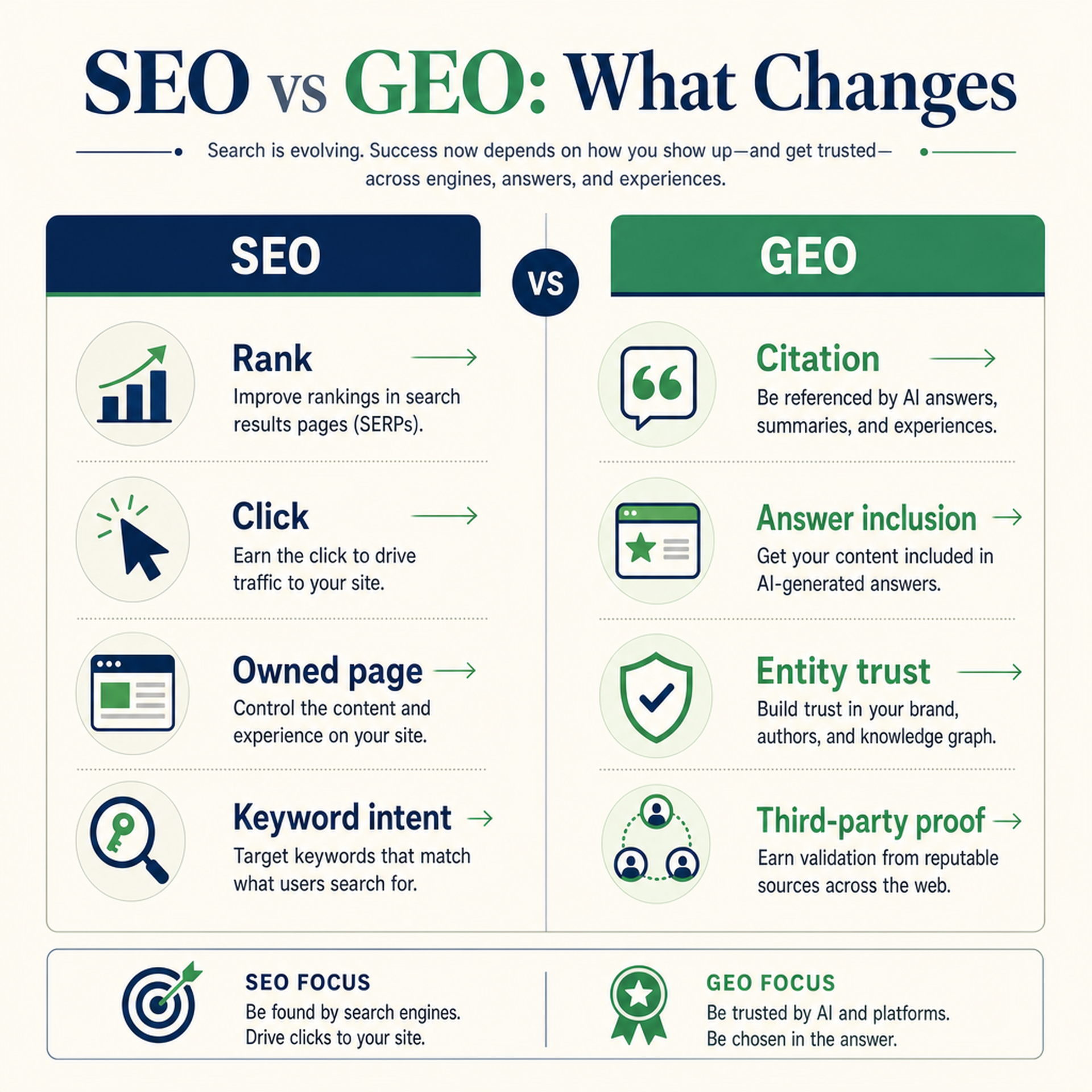
SEO And GEO Are Solving Different Problems
Many teams make the expensive mistake of treating GEO as "SEO content rewritten for AI." That misses the core change.
SEO is mostly a distribution problem: create the best page for a query, make it crawlable, earn authority, improve ranking, and convert the visitor after the click.
GEO is a trust-and-selection problem: create enough clear, consistent, verifiable evidence that an AI system can include your brand in an answer with confidence.
Dimension | SEO Focus | GEO Focus |
|---|---|---|
Main goal | Rank on a search results page | Be included and cited in AI-generated answers |
Primary unit | Page and keyword | Entity, claim, source, and context |
Success signal | Impressions, rank, clicks, conversions | Answer inclusion, citation quality, share of AI recommendations |
Content shape | Search-intent page | Answer-ready knowledge, comparisons, proof, documentation |
Authority source | Backlinks and topical authority | Entity consistency, source credibility, third-party validation |
Risk | Ranking but losing clicks | Being absent, misrepresented, or uncited in AI answers |
This is why keyword density, generic blog production, and shallow AI rewrites do not create a GEO moat. AI systems need something stronger: stable entities, clear claims, structured evidence, and corroboration from sources beyond your own site.
The Dark Funnel: Where Brand Control Gets Weaker
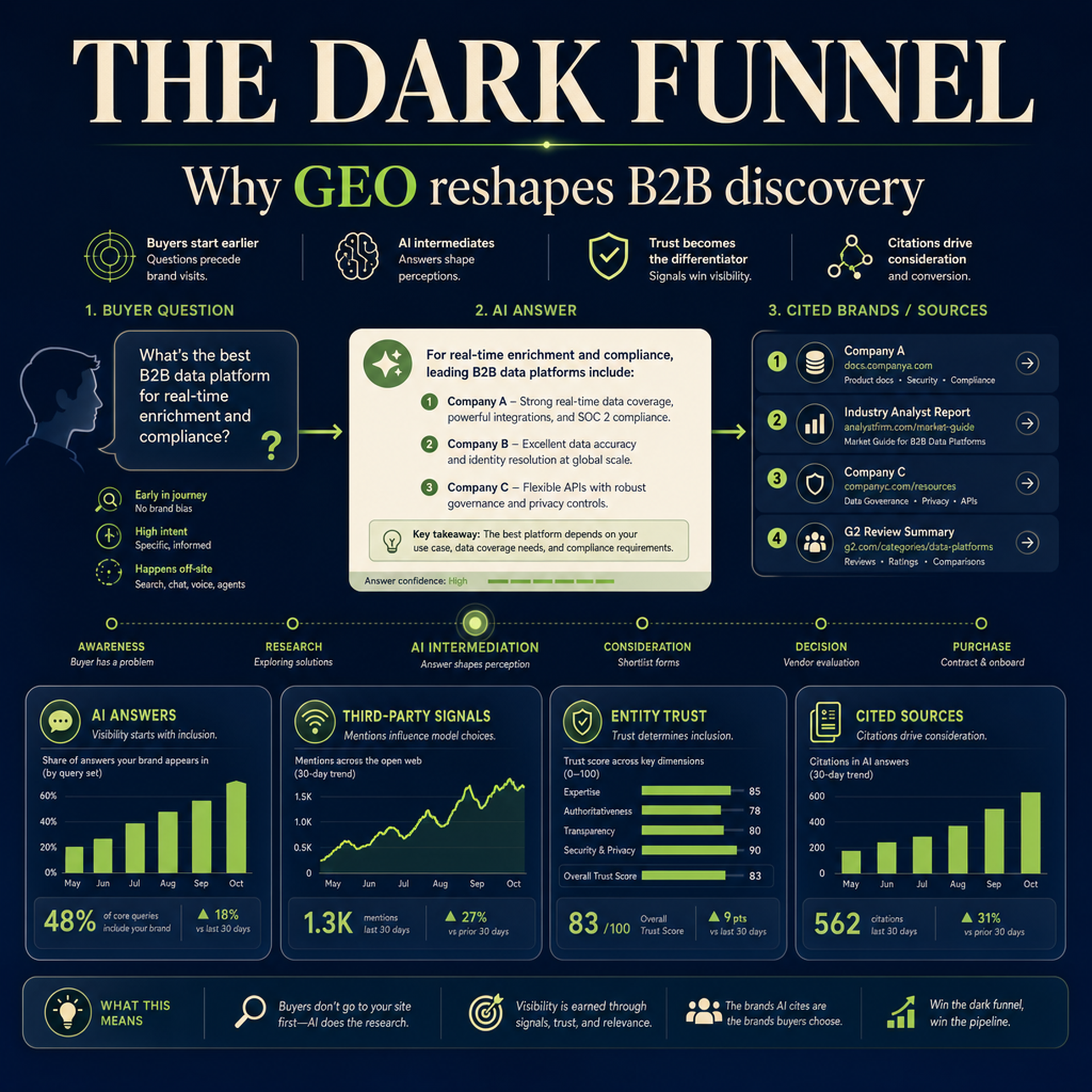
The dark funnel is the part of buyer discovery that happens before your analytics can see the buyer.
In the classic funnel, marketing teams could influence many touchpoints directly: ads, landing pages, SEO pages, email, webinars, sales calls, and retargeting.
In the AI-mediated funnel, the buyer may never start with your site. They may ask questions such as:
- "Which vendors are best for B2B content automation?"
- "Compare these three platforms for a mid-market SaaS team."
- "Which company has stronger proof for AI search optimization?"
- "What are the risks of choosing this vendor?"
- "Summarize user complaints and analyst opinions."
The answer engine then composes a response from whatever it can retrieve and trust. That may include your docs, but it may also include review sites, Reddit threads, analyst pages, partner listings, podcast transcripts, press coverage, changelogs, schema markup, public case studies, and competitor comparison pages.
For CMOs, the conclusion is uncomfortable but useful: reputation, PR, analyst relations, community presence, documentation quality, customer proof, and content architecture are no longer separate from search visibility. They are part of the AI visibility stack.
What Most Teams Get Wrong
The first mistake is measuring only traffic. AI discovery may reduce clicks while increasing influence. If a buyer chooses a vendor after reading an AI answer, the original source may not receive the visit, but the source still shaped demand.
The second mistake is optimizing only the homepage and blog. AI systems need consistent evidence across the whole entity network: product pages, comparison pages, author bios, docs, schema, reviews, profiles, social proof, third-party mentions, and knowledge-base content.
The third mistake is publishing content that sounds confident but lacks extractable facts. A page can be well-written for humans and still be weak for AI systems if it does not state who the product is for, what it does, how it differs, what evidence supports the claim, and where the information can be verified.
The fourth mistake is expecting a 90-day campaign to solve a 12-month infrastructure problem. GEO rewards consistency. You need repeated, credible signals across multiple environments, not a one-time content sprint.
A Practical 12-Month GEO Infrastructure Plan
Auspia's view is that GEO should be managed like infrastructure. The work is editorial, technical, and reputational at the same time.
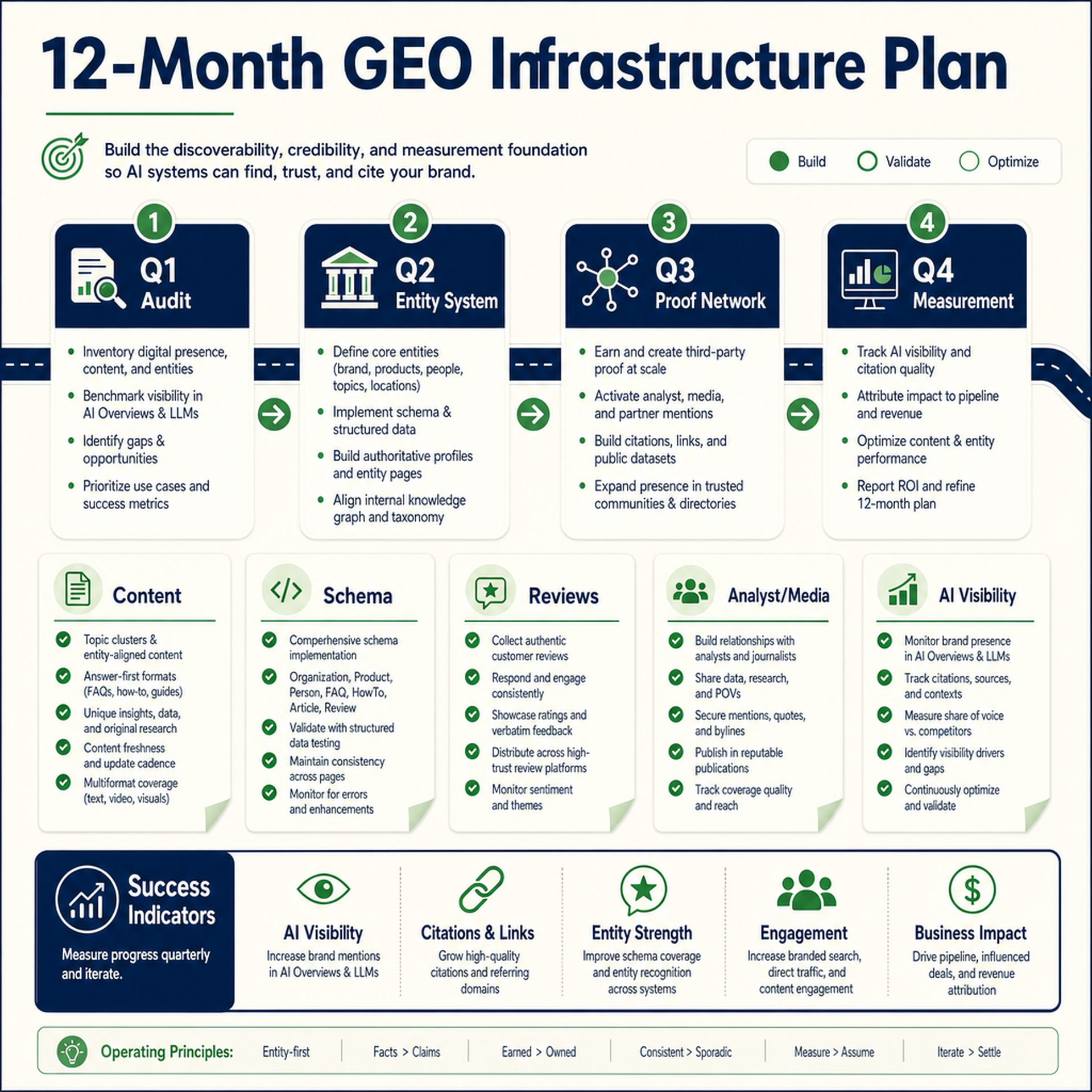
Q1: Audit Your AI Visibility Baseline
Start by testing the questions buyers actually ask. Do not only test your brand name. Test category, problem, comparison, pricing, risk, and alternative queries.
Create a prompt library such as:
- "Best tools for [use case]"
- "Compare [your brand] vs [competitor]"
- "What are the limitations of [your brand]?"
- "Which companies help with [problem]?"
- "What should a buyer know before choosing [category]?"
Track whether your brand appears, which sources are cited, whether the answer is accurate, and which competitors appear more often.
Q2: Build An Entity System
Your brand should be easy for machines to identify. That means names, descriptions, categories, people, products, and claims should be consistent across your website and trusted profiles.
At minimum, align:
- organization schema and product schema;
- author and expert profiles;
- product descriptions across pages;
- comparison language;
- documentation and help-center terminology;
- about page, contact page, and social profiles;
- repeated definitions for your core category.
If different pages describe your company in different ways, AI systems have to reconcile the conflict. Consistency reduces ambiguity.
Q3: Expand Third-Party Proof
Owned content is necessary, but not sufficient. Answer engines look for corroboration. That means the strongest GEO programs deliberately build proof outside the main website.
Useful proof sources include:
- customer reviews with specific use cases;
- partner directories and marketplace profiles;
- analyst commentary and industry reports;
- guest articles and expert interviews;
- public case studies with constraints and outcomes;
- community discussions where practitioners explain real workflows;
- comparison pages from credible third parties.
The goal is not to manufacture fake mentions. The goal is to make real evidence easier to find, quote, and verify.
Q4: Measure Inclusion, Accuracy, And Business Impact
GEO measurement is still immature, but teams can track practical signals today.
Metric | What It Tells You | How To Use It |
|---|---|---|
Answer inclusion | Whether AI systems mention your brand for target prompts | Track by prompt cluster and market |
Citation quality | Which pages or domains support the answer | Improve weak source pages and proof assets |
Entity accuracy | Whether answers describe your product correctly | Fix inconsistent claims and missing context |
Competitor co-mentions | Which alternatives appear with you | Identify positioning gaps |
AI referral traffic | Which AI platforms send visits | Treat as directional, not complete attribution |
Assisted pipeline | Whether prospects mention AI discovery | Add intake fields and sales notes |
The objective is not to prove every influenced dollar perfectly. The objective is to build a feedback loop that shows where AI systems trust you, where they ignore you, and where they misunderstand you.
The Auspia Take
GEO is not a replacement for SEO. It is the next layer of visibility management.
The brands that win will not be the ones that publish the most AI-generated articles. They will be the ones that make their expertise easiest to understand, verify, cite, and compare across the whole buyer journey.
That changes the content brief. A strong GEO brief should ask:
- What buyer question does this asset answer directly?
- Which entity or product should the AI system understand better after reading it?
- What evidence supports the main claim?
- Which third-party sources can corroborate the claim?
- What structured data or internal links make the page easier to interpret?
- What answer snippet should this page be eligible to supply?
In other words, the job is no longer just "publish a page." The job is to build a machine-readable, human-trustworthy evidence system.
What Teams Should Do This Week
If you are early, do not start with a massive content calendar. Start with a visibility audit and a proof map.
- Pick 20 buyer questions that matter commercially.
- Test those questions in Google AI Overviews, ChatGPT, Perplexity, and any AI tools your customers use.
- Record whether your brand appears, how it is described, and what sources are cited.
- Compare the cited sources against your owned pages, reviews, docs, and third-party mentions.
- Fix the obvious gaps: missing definitions, weak comparison pages, inconsistent product descriptions, thin proof, absent schema, and outdated documentation.
- Turn the findings into a 12-month roadmap instead of a one-off content sprint.
The window is still open because most organizations have not operationalized GEO yet. But the window is not static. As answer engines learn which sources to trust in each category, early evidence networks can compound.
FAQ
Is GEO just SEO with a new name?
No. SEO focuses on ranking pages and earning clicks. GEO focuses on helping AI systems understand, trust, include, and cite your brand in generated answers. The two disciplines overlap, but they optimize for different visibility surfaces.
Should we stop investing in SEO?
No. Strong technical SEO, crawlable content, useful pages, internal linking, and authoritative sources still help. The mistake is assuming classic SEO metrics fully describe AI discovery.
What is the fastest way to start GEO?
Start with a prompt-based visibility audit. Test category, comparison, problem, and brand-risk questions. Then map which sources AI systems cite and which claims they get wrong.
Do third-party mentions matter for GEO?
Yes. AI systems often rely on corroborating signals outside your owned site. Reviews, analyst references, partner pages, credible media, community discussions, and public documentation can all influence how your brand is represented.
How long does GEO take to show results?
Expect months, not weeks. GEO is closer to building a durable knowledge and proof infrastructure than running a short campaign. Teams should plan in quarterly stages and measure inclusion, accuracy, citations, and influenced pipeline.