The short version
Blogs are still worth doing after AI search. They just have a different job now.
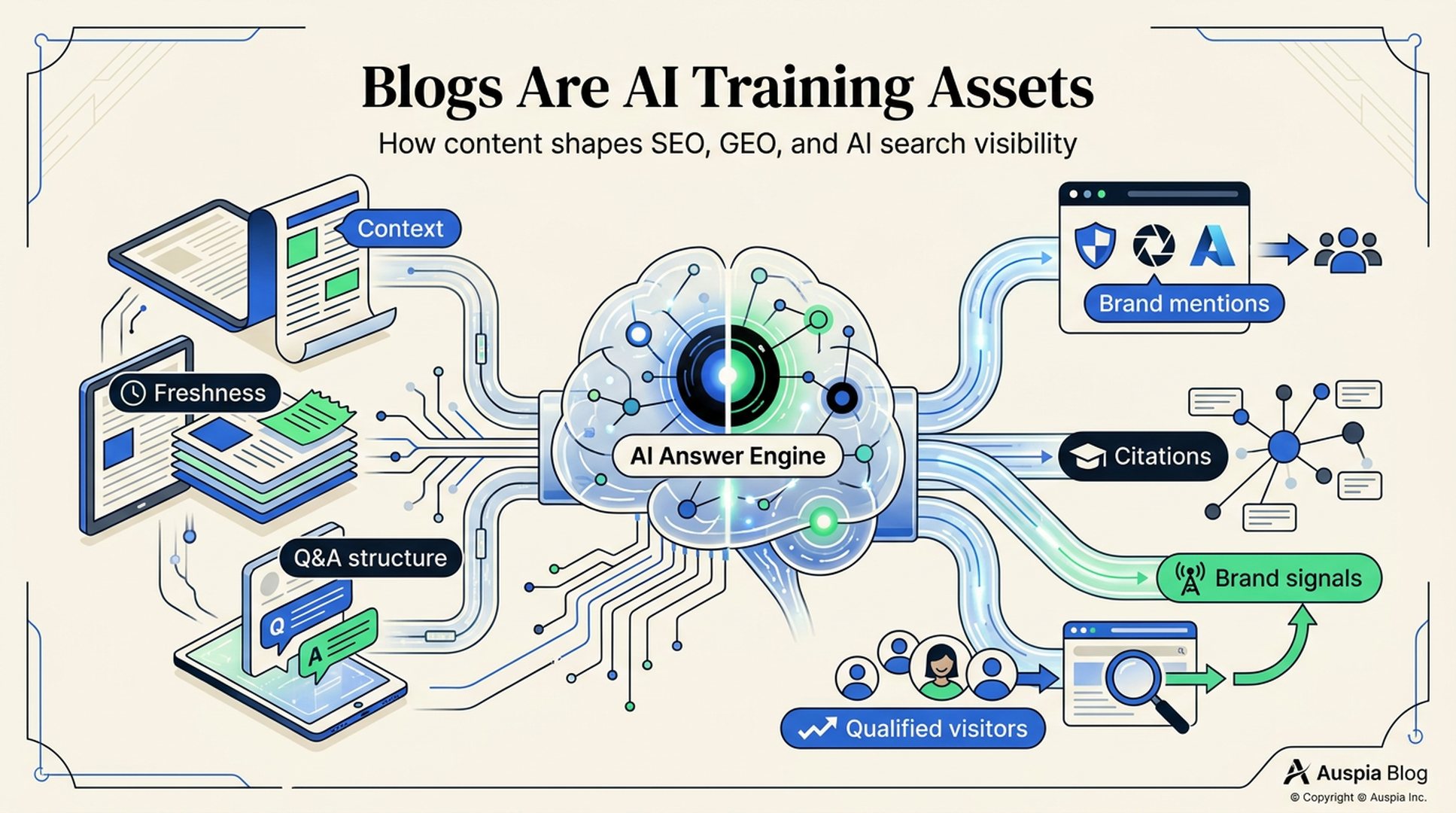
In classic SEO, a blog post was mainly a traffic entry point. It ranked in Google, earned a click, and moved the visitor toward a product, demo, signup, or sale. That job still matters, but AI search adds another one: your blog teaches answer engines what your company does, who you serve, what you know, and when your brand should be mentioned.
A blog is no longer only a page for Googlebot or a human reader. It is also a structured context asset for ChatGPT, Google AI features, Perplexity, Claude, Bing Copilot, and other answer systems.
The wrong response is to cut the blog budget because clicks are harder to win. The better response is to rebuild the blog around buyer questions, fresh facts, Q&A structure, original proof, external brand signals, and trend tracking.
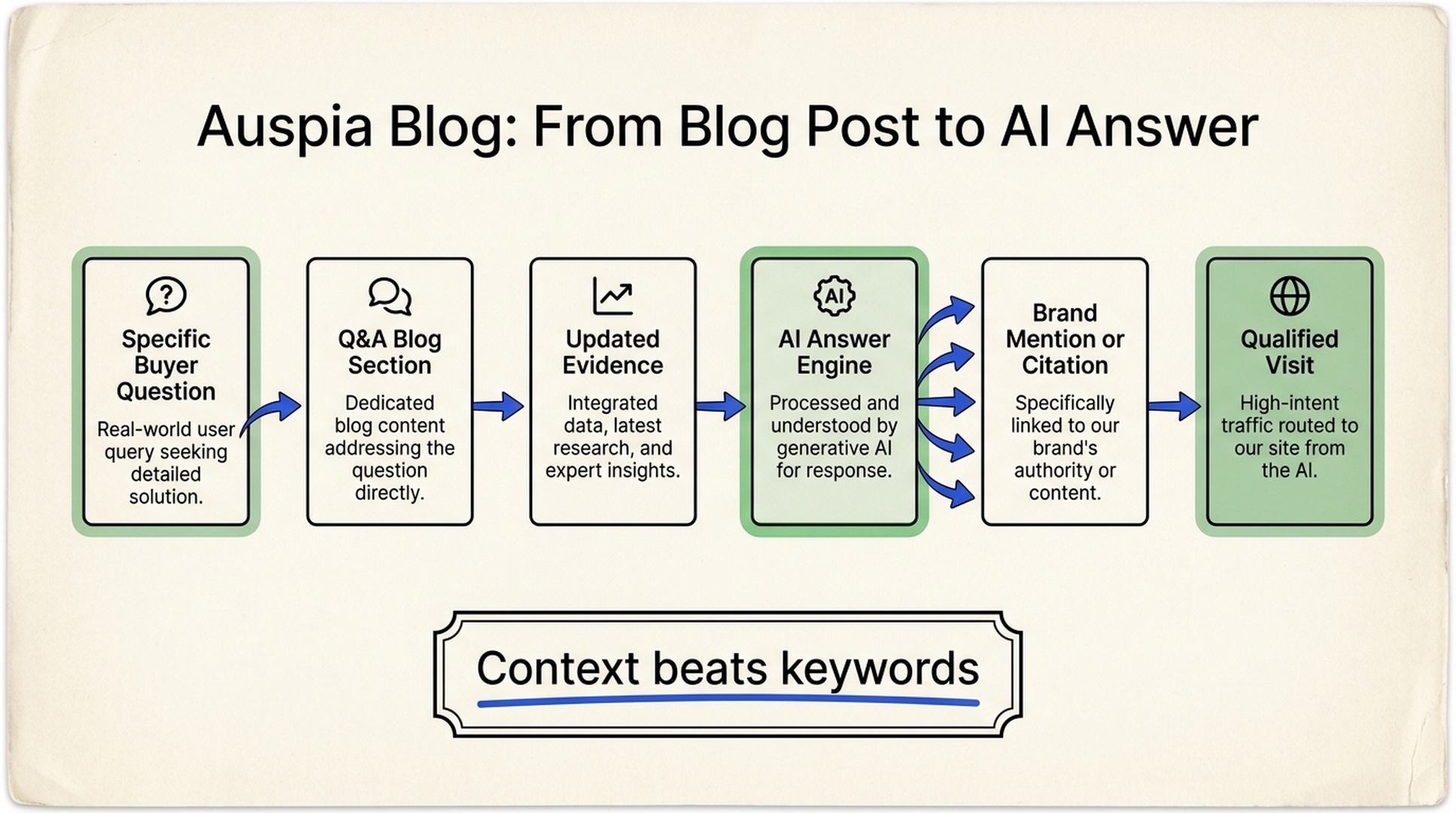
Caption: In AI search, a useful blog post is not just content. It is context that helps answer engines understand when to mention your brand.
Why people think blogs are dying
The fear is understandable. A user asks an AI system a detailed question and gets a complete answer without clicking ten blue links. Google also keeps adding more AI-assisted search experiences. For many informational queries, the first click is no longer guaranteed.
So marketers look at declining organic clicks and make a quick conclusion: blogs are dead.
That conclusion is too simple.
Blogs are losing some of their old role as the default first click for broad informational searches. But they are gaining a new role as source material for AI answers, brand understanding, product comparisons, and long-context buyer research.
When a prospect asks, "Which tool should a small B2B SaaS team use to monitor AI search visibility?" the answer engine needs context. It needs pages that explain the category, compare use cases, answer objections, show proof, and clarify who the product is for.
A good blog does that better than a thin homepage.
The blog has become AI training material
The phrase "training material" does not mean your post is literally added to a model's training set the moment you publish it. It means your content becomes material that retrieval systems, search indexes, crawlers, citation systems, and AI answer engines can use to understand your brand and the topic around it.
A blog can teach AI systems:
- What your product or service does.
- Which customer segments you serve.
- Which problems you are credible on.
- How your product differs from alternatives.
- What price, policy, feature, or workflow information is current.
- Which pages should support a recommendation or citation.
This matters because AI answers are contextual. Users do not always type short keywords anymore. They ask complete, messy questions.
A classic search might be: "best CRM."
An AI-search prompt might be: "I run a 15-person B2B sales team across the US and Europe. We need a CRM that supports outbound, multi-currency pipeline reporting, and simple onboarding. Which options should I compare?"
That prompt is not a keyword. It is a scenario. A generic "best CRM software" article is less useful than content that clearly explains use cases, team size, workflow fit, pricing constraints, integrations, and tradeoffs.
AI search rewards context, not keyword stuffing
The old blog playbook often started with a keyword list. Pick a term, write a title, add related phrases, publish the post, build links, and wait.
That is not enough for AI search.
Answer systems need passages that can answer specific questions. They look for clarity, structure, recency, credibility, and fit. The best blog content now reads less like a keyword article and more like a well-organized buyer conversation.
Instead of writing:
- Best project management software
- CRM pricing
- AI SEO tools
Write pages that match real scenarios:
- Which project management software fits a remote agency with client approvals?
- What CRM costs are easy to miss during the first year?
- How should a SaaS company monitor brand visibility in ChatGPT and Google AI answers?
Specificity helps humans. It also helps AI systems understand where your answer belongs.
Structure the page like a sequence of questions
AI answer systems are built around questions and answers. Your blog should make those answers easy to identify.
That does not mean every heading has to be awkward. It means the page should follow the reader's real decision path.
Weak headings:
- Overview
- Best practices
- Pricing
- Conclusion
Better headings:
- What changed after AI search?
- Which blog posts are still worth updating?
- How should a pricing article be written for AI answers?
- What external signals help AI trust a brand?
After each heading, answer directly in the first one or two sentences. Then add the nuance, examples, caveats, and links.
FAQ sections also matter, even if they should not be treated as a magic schema trick. Google has changed how FAQ rich results appear over time, and most sites should not rely on FAQ markup as a shortcut. But the FAQ format itself is still valuable because it gives machines and people a clean question-answer block.
The practical rule: write FAQs because they answer real questions, not because you hope for a rich result.
Freshness matters more than most teams think
AI answers can be harmful when they repeat old information. Outdated pricing, old feature lists, retired integrations, changed refund policies, or old market claims can mislead a buyer at the exact moment they are close to converting.
A blog refresh should not mean changing the publish date and adding a sentence. Real updates include:
- Replacing old data.
- Adding current examples.
- Updating product screenshots or workflows.
- Clarifying changed pricing or packaging.
- Removing claims that are no longer true.
- Adding a visible "last updated" date when appropriate.
- Expanding the article around new buyer questions.
For AI search, freshness is not just an SEO maintenance task. It is brand accuracy protection.
If your content is stale, answer engines may learn the stale version of your company.
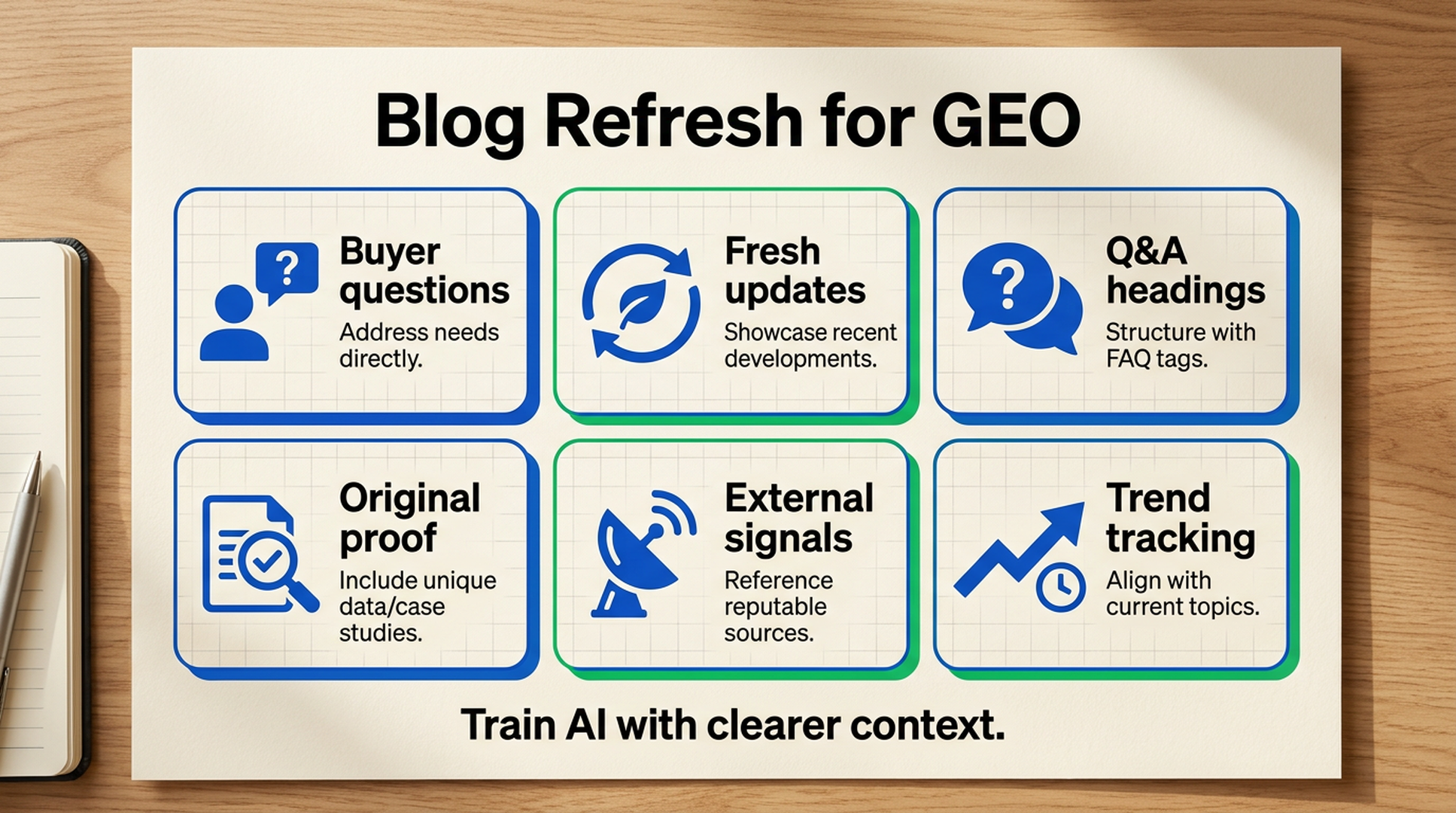
Caption: Blog refreshes should make content clearer, fresher, more specific, and easier for AI answer systems to use.
Links still matter, but they are not the whole GEO story
Backlinks still matter for classic SEO. Authority is not gone.
But AI search visibility is not always predicted by the same backlink profile that wins a traditional ranking battle. An answer engine may prefer a page because a passage is clearer, newer, more specific, or better aligned with the user's scenario.
This is good news for smaller companies.
A small brand may not have the strongest domain in the market, but it can still create highly specific content that answers a narrow buyer question better than a broad publisher or generic competitor page.
The opportunity is not to ignore authority. The opportunity is to build content that is specific enough to be useful.
Good GEO-ready blog content usually has:
- A direct answer near the top.
- Specific use cases instead of broad claims.
- Original proof, such as screenshots, benchmarks, customer examples, or firsthand experience.
- Clear product, pricing, or workflow details.
- Internal links to the most relevant product or solution page.
- External confirmation from credible platforms when possible.
AI does not only read your website
A blog is important, but it is not the whole brand signal.
AI answer systems also learn from external sources: social platforms, forums, video transcripts, review sites, partner pages, communities, directories, news sites, and public documentation. If your brand only exists on your own website, the answer engine has fewer independent signals to work with.
For many companies, the practical external platforms are LinkedIn, YouTube, Reddit, GitHub, review sites, marketplaces, or niche communities. The right mix depends on the business.
A B2B SaaS company may use LinkedIn for founder POVs, YouTube for product walkthroughs, and review platforms for customer proof. A developer tool may need GitHub, documentation, community discussions, and technical comparison posts. An ecommerce brand may need YouTube reviews, product guides, marketplace consistency, and user-generated content.
Do not treat this as spam distribution. Low-quality posts on community platforms can backfire. The goal is external consensus: real people and credible pages confirming what your brand is good at.
AI visibility should be measured as a trend
Traditional SEO trained teams to ask: "Where do we rank today?"
AI search needs a different mindset. Answers are dynamic. The same prompt can produce different wording, sources, and brand mentions across time, model, region, and user context.
So do not obsess over one screenshot.
Track trends:
- How often is your brand mentioned across a fixed prompt set?
- Which pages get cited or summarized?
- Which competitor appears beside you?
- Which questions never trigger your brand?
- Which external sources influence the answer?
- Are mentions improving over 30, 60, and 90 days?
A single miss is not a disaster. A long-term absence across your core buyer questions is a problem.
A practical blog plan for AI search
If you already have a blog, do not start by publishing 50 new posts. Start with the pages that already matter.
Step 1: list buyer questions, not just keywords.
Collect questions from sales calls, demos, support tickets, customer interviews, product reviews, communities, and AI prompts. Write them as full questions, not two-word keywords.
Step 2: update five high-value posts.
Start with pricing explainers, comparison articles, solution pages, use-case guides, customer story pages, and FAQ-style articles. These are close to purchase decisions and easier for AI systems to use in recommendations.
Step 3: rewrite headings as questions.
Make each section answer a real buyer concern. Put the direct answer first, then explain.
Step 4: add proof.
Use screenshots, product details, customer examples, benchmarks, or method notes. Do not rely only on generic advice.
Step 5: refresh facts and show recency.
Update old pricing, feature lists, product names, policies, market facts, and examples. If the article is materially updated, show a visible last-updated date.
Step 6: build one external signal loop.
Pick one platform your buyers actually use. Publish useful demos, posts, answers, or discussions there. Do not try to do every platform at once.
Step 7: monitor AI visibility monthly.
Create a fixed prompt list around buyer scenarios. Check whether your brand, competitors, and pages appear. Measure direction, not one-off screenshots.
What not to do
Do not turn every post into a generic "ultimate guide."
AI search is full of broad summaries. You win by being specific.
Do not publish AI-generated volume without judgment.
Scale without specificity becomes noise. A large blog that says nothing new may hurt more than it helps.
Do not rely only on FAQ schema.
FAQ content is useful when the questions are real. Schema alone will not make a weak page credible.
Do not ignore old pages.
An outdated page can teach AI systems the wrong version of your brand.
Do not treat GEO as separate from business reality.
If your product positioning is unclear, your blog cannot fix everything. Content works best when the product, customer, proof, and distribution are aligned.
Auspia take
Blogs are not dead. Bad, vague, stale blogs are becoming less useful.
The new blog job is to create clear context for humans, search engines, and AI answer systems. That means buyer questions, fresh updates, Q&A structure, original proof, external brand signals, and trend-based measurement.
The work is not complicated in theory, but it can be tedious to manage manually. If you want to automate SEO and GEO without mastering every technical detail, use Auspia.ai. Auspia helps teams audit content, find SEO/GEO gaps, monitor AI-search visibility, and prioritize intelligent fixes automatically.
FAQ
Are blogs still useful after AI search?
Yes. Blogs are still useful, but their role has expanded. They can earn classic search traffic and also help AI systems understand, mention, summarize, or cite your brand.
Should every blog post be written as a FAQ?
No. The whole article does not need to be a FAQ. But important sections should answer real questions clearly, and a concise FAQ block can help both readers and machines understand the page.
How often should blog posts be updated for GEO?
Review important posts monthly or quarterly, depending on how fast the topic changes. Pricing, product comparisons, tool lists, regulations, and AI-search topics need more frequent updates than evergreen definitions.
Do backlinks still matter for AI visibility?
They still matter for authority and classic SEO, but AI visibility also depends on clarity, freshness, specificity, structure, and external brand signals across the web.
What should I measure besides organic clicks?
Track brand mentions in AI answers, cited pages, competitor co-mentions, branded search demand, qualified referral visits, and whether your visibility improves across a fixed prompt set over time.
Sources and further reading
- Google Search Central: AI features and your website in Search: https://developers.google.com/search/docs/fundamentals/ai-search
- Google Search Central: Creating helpful, reliable, people-first content: https://developers.google.com/search/docs/fundamentals/creating-helpful-content
- Google Search Central: FAQPage structured data: https://developers.google.com/search/docs/appearance/structured-data/faqpage