Executive summary
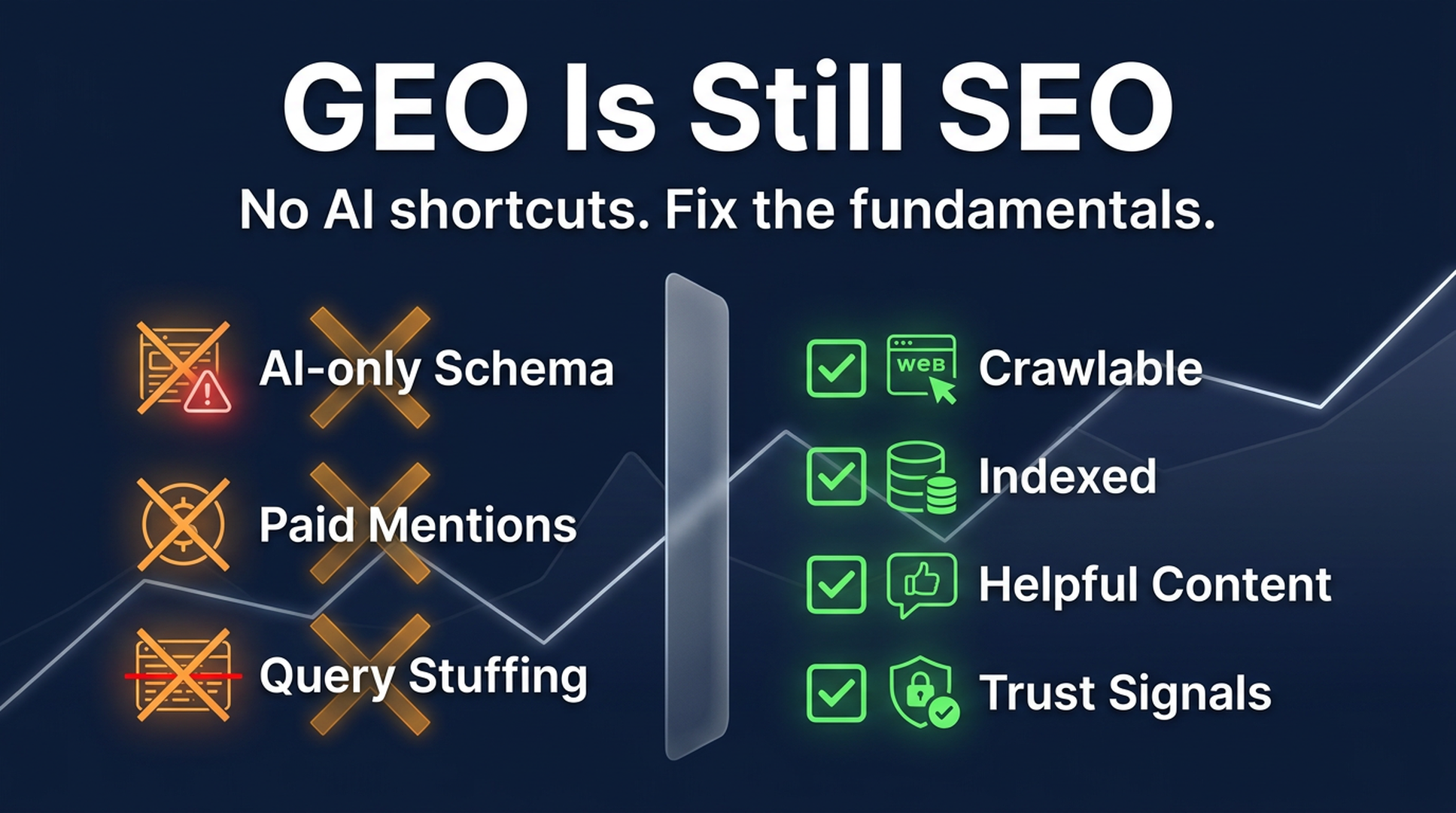
GEO is not a separate magic layer that sits above SEO. For Google Search, the safer reading of Google's own AI features guidance is blunt: if a page cannot be crawled, indexed, understood, trusted, and useful in normal Search, it has little reason to appear as a supporting link in AI Overviews or AI Mode.
That does not mean AI search changes nothing. It changes the shape of queries, the type of pages that get surfaced, and the value of original experience. But the work is still familiar: technical SEO, helpful content, clear entities, internal links, structured data that matches the page, strong images or videos where they help, and real reputation signals outside your own site.
The shortcut economy around GEO is getting noisy. Be careful with anyone selling AI-only schema, AI-only content rewrites, paid citation packages, or "24-hour AI visibility" promises. Most of that is either normal SEO with a new label or a risk you do not need.
What Google actually says about AI search visibility
Google's Search Central documentation on AI features says site owners can use the same foundational SEO best practices for AI features that they use for Google Search overall. It also says that, to be eligible as a supporting link in AI Overviews or AI Mode, a page must be indexed and eligible to appear in Search with a snippet. Google describes no extra technical requirement for AI features.
That one point should reset the conversation.
AI Overviews and AI Mode may use different models and techniques. Google also describes query fan-out, where related searches across subtopics and sources help build an AI response. But the source pool still depends on pages Google can discover, index, and evaluate.
So the practical question is not "What secret GEO tag do we add?" The better question is "Would Google already trust this page enough to use it when a query gets more complex?"
For Auspia readers, that distinction matters. GEO is useful as a working label for AI search visibility. It becomes dangerous when people treat it as permission to ignore SEO fundamentals.
Five GEO tactics teams should treat with suspicion
Tactic | Why it sounds attractive | Why it is risky or overstated | Better move |
|---|---|---|---|
AI-only metadata files | It feels like giving AI crawlers a clean instruction sheet | Google does not list a special AI file as a requirement for AI Overviews or AI Mode | Keep robots.txt, sitemap, canonical tags, and indexability clean |
Chunking every page for AI | It sounds technical and modern | Google can understand pages with multiple sections; arbitrary fragmentation can hurt reading quality | Use clear headings, summaries, tables, and scannable sections for people |
Rewriting content for every AI query variant | It promises broader coverage | Near-duplicate pages can create thin content and keyword cannibalization | Build one strong intent-matched page with examples and direct answers |
Buying AI mentions or citations | It promises authority without waiting | Paid mention schemes can look like link manipulation or fake reputation building | Earn real mentions through useful research, case studies, partnerships, and PR |
AI-specific schema markup | It sounds like a hidden ranking lever | Structured data should match visible page content and serve supported search features | Use schema accurately, not as a fake AI citation trigger |
Some of these tactics may have legitimate adjacent uses. For example, a well-maintained llms.txt file can be useful for certain AI crawler or documentation workflows outside Google Search. But that is different from claiming it is required for Google's AI features.
The part most GEO advice gets wrong
A lot of GEO advice starts with the output: "How do we get quoted by AI?"
That is backwards.
Start with the source quality. AI search systems need pages that can survive more complex, multi-step questions. Generic content usually fails here because it has no edge. A page that says "seven tips for choosing software" is easy to replace. A page that compares real onboarding constraints for a 50-person SaaS team, explains where each tool breaks, includes screenshots, and names the trade-offs is much harder to replace.
That is the difference between filler and source material.
The same logic applies to ecommerce, B2B services, agencies, local businesses, and SaaS. AI-friendly content usually has at least one of these traits:
- first-hand experience that competitors cannot copy overnight
- clear examples with named products, markets, or situations
- original data, even if the dataset is small and clearly explained
- a useful comparison that admits trade-offs
- expert review from a real person with a visible background
- images, screenshots, diagrams, or videos that help verify the claim
None of this is new. It is just more visible now because AI answers punish shallow pages quickly.
What still works for GEO because it already worked for SEO
Here is the unglamorous playbook.
First, make sure Google can access the page. Check robots.txt, noindex tags, canonical tags, blocked scripts, CDN rules, and sitemap hygiene. If a page is not crawlable or indexable, the GEO conversation is over.
Second, make important content available as text. Do not bury the only useful explanation inside an image, video, or accordion that search systems struggle to parse. Use visuals, but support them with written context.
Third, build pages around intent, not keyword variants. AI Mode-style queries can be longer and more exploratory, but they still have intent. A good page answers the core question, the follow-up questions, and the comparison points without creating twenty near-duplicate pages.
Fourth, strengthen internal links. Google specifically points site owners back to findability through internal links. If your strongest guide never links to the product page, case study, or diagnostic tool that should rank, you are wasting authority.
Fifth, use structured data accurately. Schema is not a magic citation button. It is a way to describe visible content for supported search experiences. Fake or mismatched markup is a trust problem.
Sixth, build reputation outside your own site. Brand mentions, reviews, media coverage, community references, partner pages, and expert citations help systems and humans understand that your entity is real. This is not "AI PR hacking." It is normal trust building.
If you want to audit the technical part first, Auspia's Robots.txt AI Crawler Checker can help you spot crawler access issues before you spend time rewriting pages.
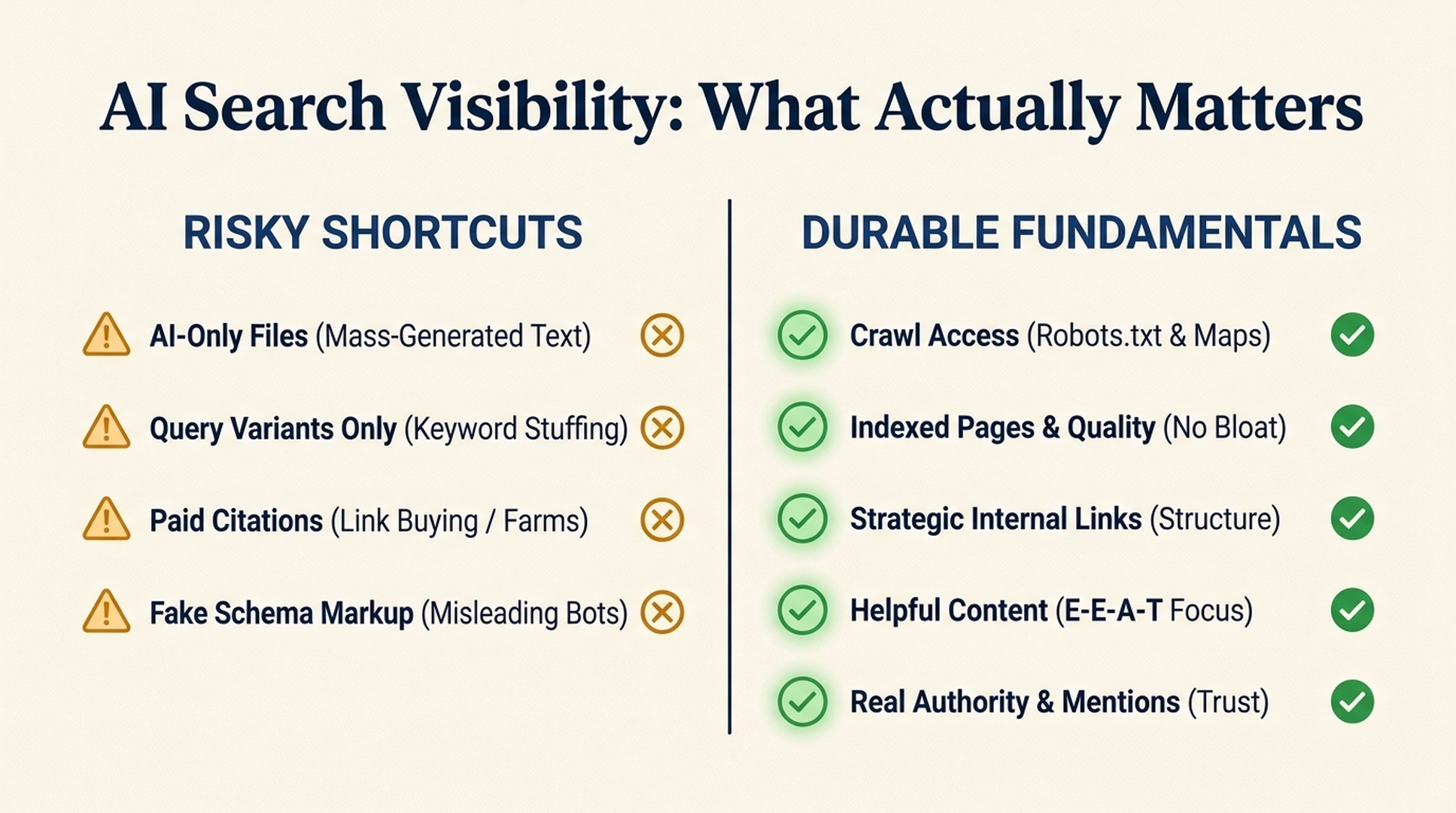
Caption: Most AI search visibility work starts with standard SEO controls: crawlability, indexability, internal links, helpful content, and trust signals.
How to make a page more likely to be useful in AI answers
Do not write for a robot. Write for a reader who is asking a layered question and does not want fluff.
A practical page structure looks like this:
- Start with a direct answer in the first few paragraphs.
- Define the main entity or concept in plain language.
- Add a table when comparison matters.
- Include real examples, not invented generic scenarios.
- Explain constraints and exceptions.
- Show evidence: screenshots, process notes, data, customer patterns, expert review, or source links.
- Add an FAQ only when the questions are genuinely different.
- Link to the next useful action.
For example, a weak page says: "Our platform helps companies improve AI search visibility with advanced optimization."
A stronger page says: "We tested 40 non-brand SaaS queries across Google AI Overviews, Perplexity, and ChatGPT browsing. The pages cited most often had one thing in common: they named the problem clearly, compared alternatives, and included proof from outside the vendor's own site."
The second version gives a system something to work with. More important, it gives a human a reason to trust the page.
A simple GEO audit for 2026
Use this audit before buying any GEO course, tool, or citation package.
Question | If the answer is no | Fix first |
|---|---|---|
Is the page indexed and eligible for a snippet? | It is unlikely to appear as a supporting AI link | Technical SEO and Search Console diagnostics |
Does the page answer the query directly? | It may be skipped for clearer sources | Rewrite the opening and section headings |
Does the page include first-hand detail? | It looks interchangeable | Add examples, screenshots, process notes, data, or expert input |
Is the content easy to find internally? | Authority may not flow to the page | Add contextual internal links from relevant pages |
Does structured data match visible content? | Trust and eligibility can suffer | Clean up schema and remove unsupported claims |
Do third parties mention or reference the brand? | Entity trust may be weak | Build real partnerships, PR, reviews, and citations |
Is there a conversion path after the answer? | Visibility may not become revenue | Add tool, audit, demo, comparison, or checklist CTA |
Auspia's AI Search Visibility Checker is useful after this baseline work, not instead of it. Visibility checks make more sense when the pages being tested are technically sound and worth citing.
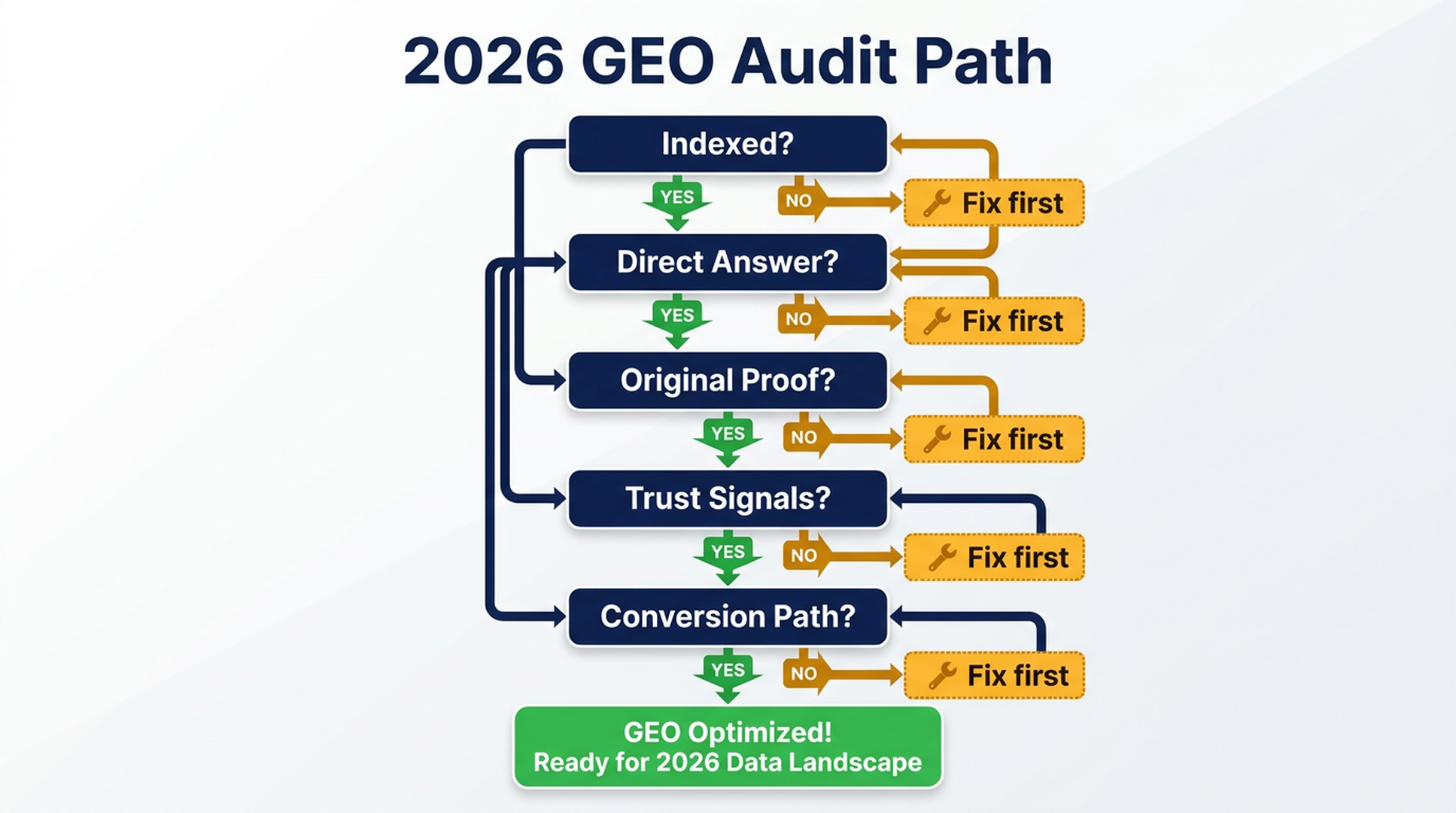
Caption: A good GEO audit does not stop at citations. It checks whether visibility can turn into trust and revenue.
The trap: treating GEO as a separate department
Here is where teams get into trouble.
They create an SEO backlog, a content backlog, a PR backlog, and then a new GEO backlog. Each one has different owners, different tools, and different dashboards. Within a month, nobody knows which page matters most.
That is a management problem, not an algorithm problem.
A better operating model is to add AI visibility questions to the existing SEO workflow:
- When auditing technical SEO, check whether AI-relevant pages are crawlable and indexable.
- When planning content, ask whether the page has original experience or merely repeats common advice.
- When building internal links, prioritize pages that answer high-intent AI-search questions.
- When doing PR, think about entity clarity and third-party evidence, not just referral traffic.
- When reporting results, separate classic organic traffic, AI-feature appearances where available, assisted conversions, and brand search lift.
This keeps the work grounded. GEO becomes an extension of search strategy, not a shiny distraction.
Auspia take
The phrase "GEO is SEO" is a little too neat, but it is directionally right for Google. The work that qualifies a page for AI search visibility is mostly the work that made it a strong search result in the first place.
The difference is emphasis. In 2026, average content has less room to hide. Pages need clearer answers, stronger proof, better entity signals, and more genuine experience. Technical shortcuts cannot replace that.
If someone sells you a GEO tactic, ask one question: would this improve the page for a real searcher if AI Overviews disappeared tomorrow?
If the answer is yes, it is probably good SEO. If the answer is no, be careful.
FAQ
Is GEO the same as SEO?
For Google Search, GEO is best understood as an extension of SEO. Google's AI features guidance points site owners back to foundational SEO practices and says there are no additional technical requirements for appearing as a supporting link in AI Overviews or AI Mode.
Do I need llms.txt to appear in Google AI Overviews?
Google's AI features documentation does not list llms.txt as a requirement. For Google Search visibility, focus first on crawlability, indexability, robots.txt, sitemaps, internal links, and helpful content. llms.txt may have separate uses for some AI crawler workflows, but it should not replace SEO fundamentals.
Does schema help with AI citations?
Structured data helps Google understand eligible page features when it matches visible content and follows Google's policies. It should not be treated as an AI citation switch. Use schema accurately for supported content types.
What is the fastest legitimate GEO improvement?
Fix pages that already rank, already answer a valuable question, but have weak structure. Add a direct answer, improve headings, include examples, strengthen internal links, and make the page easier to cite. That is usually faster than creating new AI-targeted pages from scratch.
What should B2B teams prioritize for AI search visibility?
Prioritize pages with commercial intent and proof: comparison pages, use-case guides, case studies, pricing explainers, implementation guides, and expert-led content. Generic thought leadership is easier for AI systems to ignore.