Executive summary
AI marketing in 2026 is no longer a question of whether a brand should try GEO. The better question is where AI touches the buying journey, how short that journey is, and whether the brand has enough trustworthy information for AI systems to use.
The practical rule is simple: the shorter the conversion path, the faster AI can change outcomes. A media site, software trial, education provider, local service, or direct-response ecommerce brand should move quickly. A jewelry, apparel, healthcare, B2B enterprise, or store-heavy business still needs to act, but the work is more patient: clean product data, rebuild knowledge assets, train staff, and connect AI to owned channels before expecting full automation.
GEO is the visible layer. AEO, agent-ready workflows, CRM intelligence, sales enablement, and store operations are the deeper system.
Why AI marketing looks different in 2026
For years, brand marketing was built around two familiar behaviors: people searched with keywords, then clicked through a list of pages. That habit still exists, but it is no longer the only path.
In 2026, more users describe a problem in natural language and expect an answer, a shortlist, or a next step. They ask things like:
- "What should I buy if my skin reacts badly in dry weather?"
- "Which project management tool works for a 12-person agency?"
- "What should I check before choosing a local HVAC company?"
- "Can you compare two running shoes for knee pain?"
These are not tidy keywords. They are situations, doubts, constraints, and preferences. A brand that only publishes category pages and promotional copy gives AI systems very little to work with.
This is why GEO has become urgent. The goal is not to manipulate AI answers. The goal is to make brand, product, service, and proof assets easier for answer engines to find, parse, verify, and cite.
GEO is about being visible, understandable, and believable
Traditional SEO asks, "Can we rank for this query?" GEO asks a different set of questions:
- Can an AI system identify what the brand does?
- Can it match products or services to real user situations?
- Can it verify the facts from more than one reliable source?
- Can it explain why this brand belongs in an answer?
- Can it avoid confusing outdated, inconsistent, or thin content with current truth?
That is a harder problem than adding a few keywords to a page.
AI answer systems tend to favor content with clear structure, entity consistency, verifiable claims, real user intent coverage, and external trust signals. A product page with vague copy like "premium quality for every lifestyle" is weak. A page that explains materials, use cases, safety constraints, comparison criteria, availability, return terms, customer questions, and third-party validation is much stronger.
The same applies to brand reputation. If the official site says one thing, review platforms say another, marketplaces show old product names, and social profiles use inconsistent descriptions, AI systems receive a messy entity record.
That mess becomes the answer.
The 2026 AI marketing stack
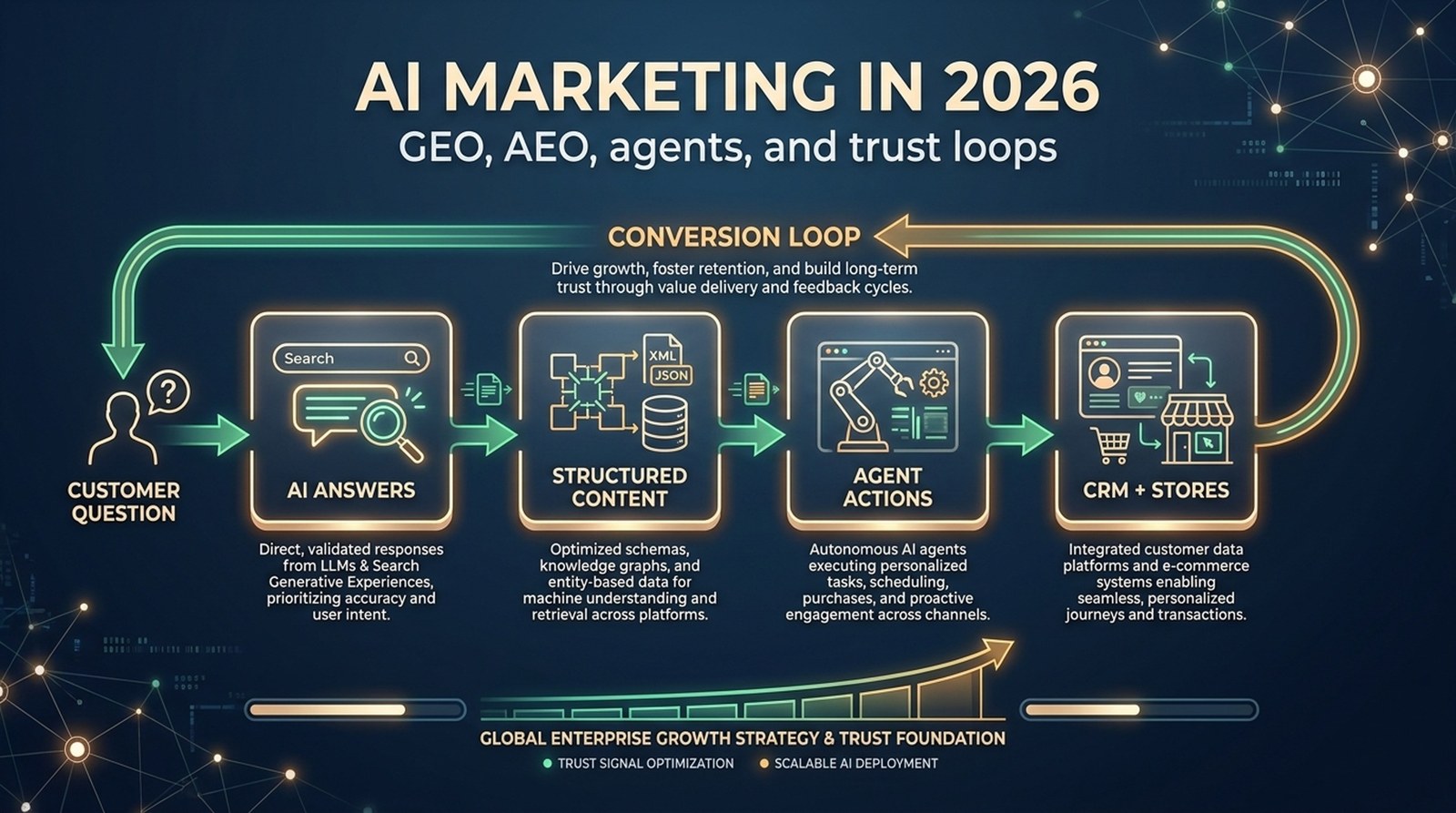
GEO is only the top of the system. A more useful 2026 model has four layers.
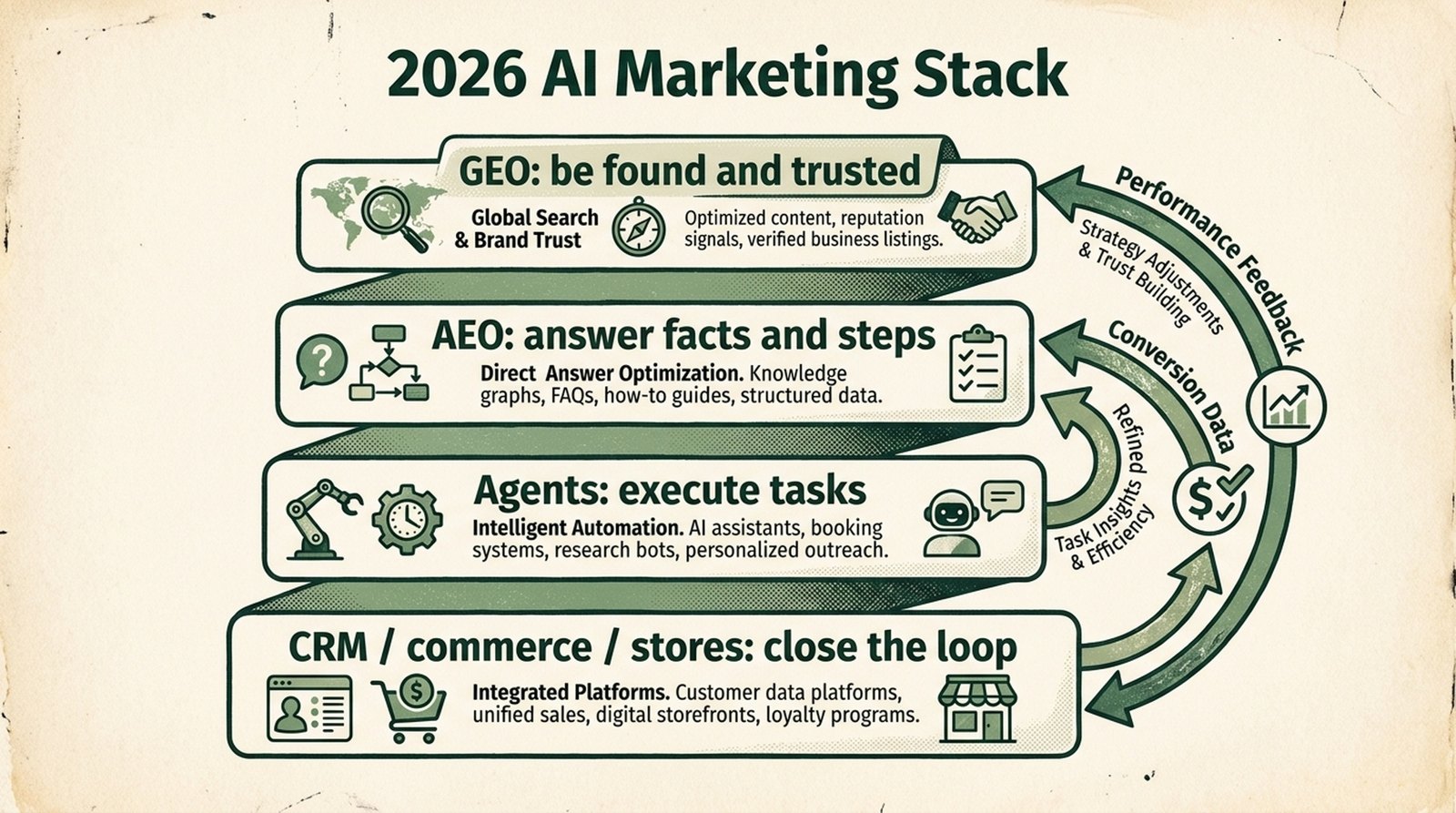
Caption: GEO is the discovery layer. AEO, agents, and CRM or store systems turn visibility into action.
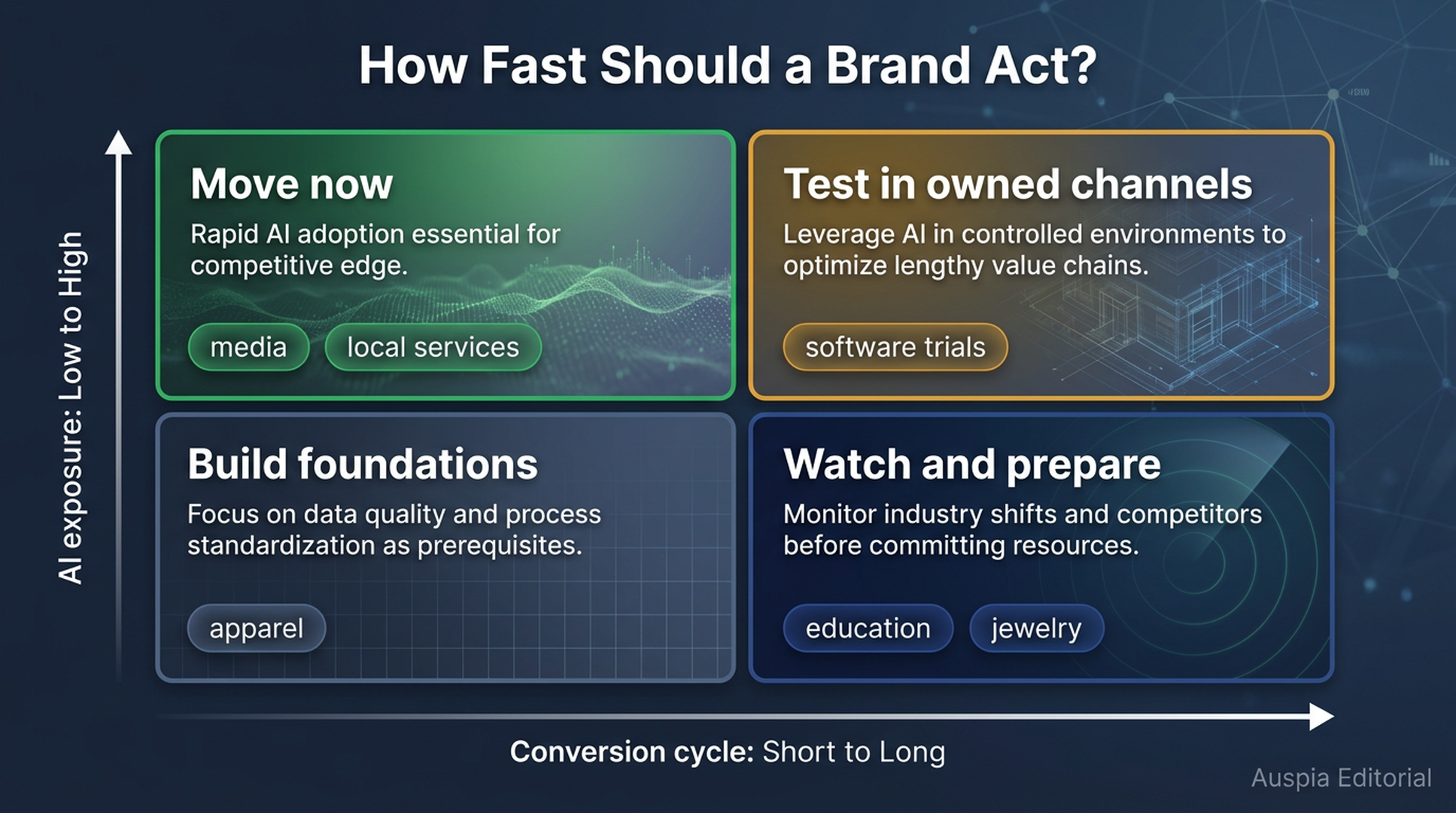
Caption: Short buying cycles with high AI exposure need faster action. Longer cycles need foundation work before automation.
Layer | What it solves | Brand assets required |
|---|---|---|
GEO | Can AI find, understand, and trust the brand? | Structured pages, entity consistency, sourceable claims, reviews, comparison assets |
AEO | Can AI extract direct answers, facts, steps, and eligibility rules? | FAQs, how-to guides, policy pages, schema, definitions, decision criteria |
Agent readiness | Can an AI agent take useful action for the user? | APIs, booking flows, product feeds, availability data, support rules, consent controls |
CRM and commerce loop | Can the brand turn AI-assisted intent into revenue and retention? | Customer data, lifecycle logic, personalization rules, sales scripts, service workflows |
The mistake is treating GEO as a content campaign. It is closer to information infrastructure.
AEO is the next step after GEO
GEO helps a brand appear in AI-generated answers. AEO helps the brand become the answer for factual, procedural, and decision-support questions.
A user may ask:
- "Does this software support SOC 2 reporting?"
- "How do I return an item bought online?"
- "What size should I choose if I am between two measurements?"
- "What documents do I need before booking a consultation?"
These questions do not need a poetic brand story. They need direct, reliable answers.
For AEO, brands should build pages and blocks that answer high-certainty questions in plain language. That usually means:
- one answer per section;
- explicit eligibility, pricing, delivery, support, and warranty rules;
- updated dates where the policy changes often;
- comparison tables where the decision depends on criteria;
- schema markup where appropriate;
- internal links from answer pages to the next conversion step.
AEO is not a replacement for GEO. It is the operational sibling. GEO earns visibility. AEO reduces friction once the user starts asking for specifics.
Agent-ready marketing is where the real shift begins
The next stage is not just "AI mentions my brand." It is "AI can help the user do something with my brand."
That could mean an agent compares plans, checks availability, books a demo, creates a shopping list, starts a return, schedules a store appointment, or routes a support case. For this to work, the brand needs more than blog posts. It needs clean systems.
Agent-ready marketing requires:
- product and service data that machines can read;
- rules for what an agent may and may not do;
- clear handoff from AI to human staff;
- consent and privacy controls;
- live inventory, pricing, booking, or support data where relevant;
- measurement that separates AI-assisted discovery from AI-assisted conversion.
This is where many brands slow down. The content team may be ready for GEO, but the CRM, commerce, data, legal, and operations teams are not yet connected.
That is normal. It is also why 2026 AI marketing should be planned as a cross-functional system, not a side project inside content.
Short conversion loops need faster action
Some industries feel AI pressure earlier because the buying journey is short. If a user can move from question to choice to purchase in one session, AI answers can influence demand quickly.
Examples include:
- software trials and self-serve SaaS;
- online courses and education products;
- affiliate, media, and review sites;
- local services with urgent intent;
- health, beauty, and consumer products with clear use cases;
- travel activities, bookings, and simple reservations.
For these brands, waiting a year is risky. They should audit AI answer visibility now, rebuild high-intent pages, add comparison and decision assets, and test whether ChatGPT, Gemini, Perplexity, Google AI Mode, and other answer surfaces describe them accurately.
Auspia's practical starting point is to run an AI Search Visibility Checker, collect the prompts where the brand should appear, then map missing citations back to missing or weak source assets.
Longer conversion loops still need foundation work
A long buying journey does not mean AI is irrelevant. It means AI is less likely to replace the full path immediately.
Consider jewelry, apparel, enterprise software, medical services, insurance, franchise retail, or high-consideration B2B services. The customer may research through AI, but purchase still depends on taste, trust, compliance, human advice, financing, logistics, or in-person experience.
For these brands, the 2026 priority is not full automation. It is foundation work:
- rebuild product and service knowledge bases around real customer questions;
- standardize brand facts across the website, marketplaces, listings, reviews, and sales material;
- train sales and support teams with AI-assisted scripts and retrieval tools;
- turn expert knowledge into structured answer pages;
- connect online discovery with store, call center, or sales follow-up;
- monitor whether AI systems misstate pricing, policies, locations, or product fit.
Long-cycle brands can move with more patience, but they should not confuse patience with inaction.
What most teams get wrong
The first mistake is using AI only to generate more content. More pages do not help if the facts are vague, duplicated, or unsupported.
The second mistake is chasing mentions without fixing the source of truth. If the website, review profiles, marketplace listings, and help center disagree, GEO work becomes fragile.
The third mistake is skipping the conversion loop. A brand may win an AI mention, but if the landing page is thin, the sales script is inconsistent, or the support answer contradicts the AI summary, trust breaks quickly.
The fourth mistake is treating every industry the same. A direct-response education brand and a luxury retailer should not use the same AI roadmap. Their conversion loops, risk tolerance, and customer trust requirements differ.
Auspia's 2026 action plan
Start with a simple audit.
- List 30 prompts a real customer might ask before buying.
- Test those prompts across major AI answer surfaces.
- Record whether the brand appears, how it is described, and which sources are cited.
- Flag incorrect, missing, outdated, or unsupported claims.
- Map each gap to a source asset: website page, FAQ, comparison guide, review profile, marketplace listing, support doc, or structured data.
- Fix the source asset before trying to scale content.
- Add AEO blocks for factual questions and agent-ready data for transactional steps.
- Re-test monthly, because answer surfaces change quickly.
Teams that already have strong content operations can go deeper by building prompt libraries, citation dashboards, answer-change logs, and CRM attribution for AI-assisted journeys.
A practical readiness checklist
Use this checklist before spending heavily on GEO or AI marketing tools.
Question | Why it matters |
|---|---|
Do we have one current source of truth for brand, product, service, pricing, and policy facts? | AI systems punish inconsistency more than teams expect. |
Do our pages answer situation-based questions, not just category keywords? | Users ask AI about needs and constraints. |
Can third-party sources verify our claims? | AI answers lean on corroboration. |
Do we have direct answers for policy, sizing, eligibility, support, and comparison questions? | This is where AEO improves extraction. |
Can an agent safely take the next step, such as booking, quoting, routing, or checking availability? | Visibility matters less if no action is possible. |
Do sales, support, and store teams use the same facts as the website? | Human follow-up must reinforce the AI-assisted journey. |
The real goal is still trust
AI changes where discovery happens and how decisions are shaped. It does not change the job of marketing.
Brands still need to earn trust, explain value, reduce risk, and make the next step feel safe. GEO can help a brand become visible in AI answers. AEO can help it become easier to quote. Agents can remove friction. CRM and store systems can make the experience feel personal.
But none of that works if the underlying information is weak.
The brands that benefit most in 2026 will not be the ones that publish the most AI-generated content. They will be the ones that make their knowledge, proof, operations, and customer experience legible to both machines and people.
FAQ
Is GEO still worth investing in during 2026?
Yes, if customers use AI systems during discovery or comparison. GEO is most valuable when paired with source-of-truth cleanup, structured content, third-party proof, and ongoing AI answer monitoring.
How is AEO different from GEO?
GEO focuses on brand visibility and trust in AI-generated answers. AEO focuses on direct extraction of facts, steps, policies, and decision criteria. Strong AI marketing needs both.
Which brands should move fastest on AI marketing?
Brands with short conversion cycles and high AI exposure should move fastest. This includes self-serve software, online education, local services, review-led commerce, and media businesses. Long-cycle brands should still build foundations now.
Can AI agents replace sales or support teams?
In some simple workflows, agents can handle parts of the journey. For high-trust or complex purchases, agents are better used to prepare information, route requests, train staff, and reduce repetitive work.
What should a team do first?
Start with 30 real customer prompts, test how AI systems answer them, and identify which missing or inaccurate answers can be fixed by better source assets. That is more useful than publishing a large batch of generic AI content.