The short answer
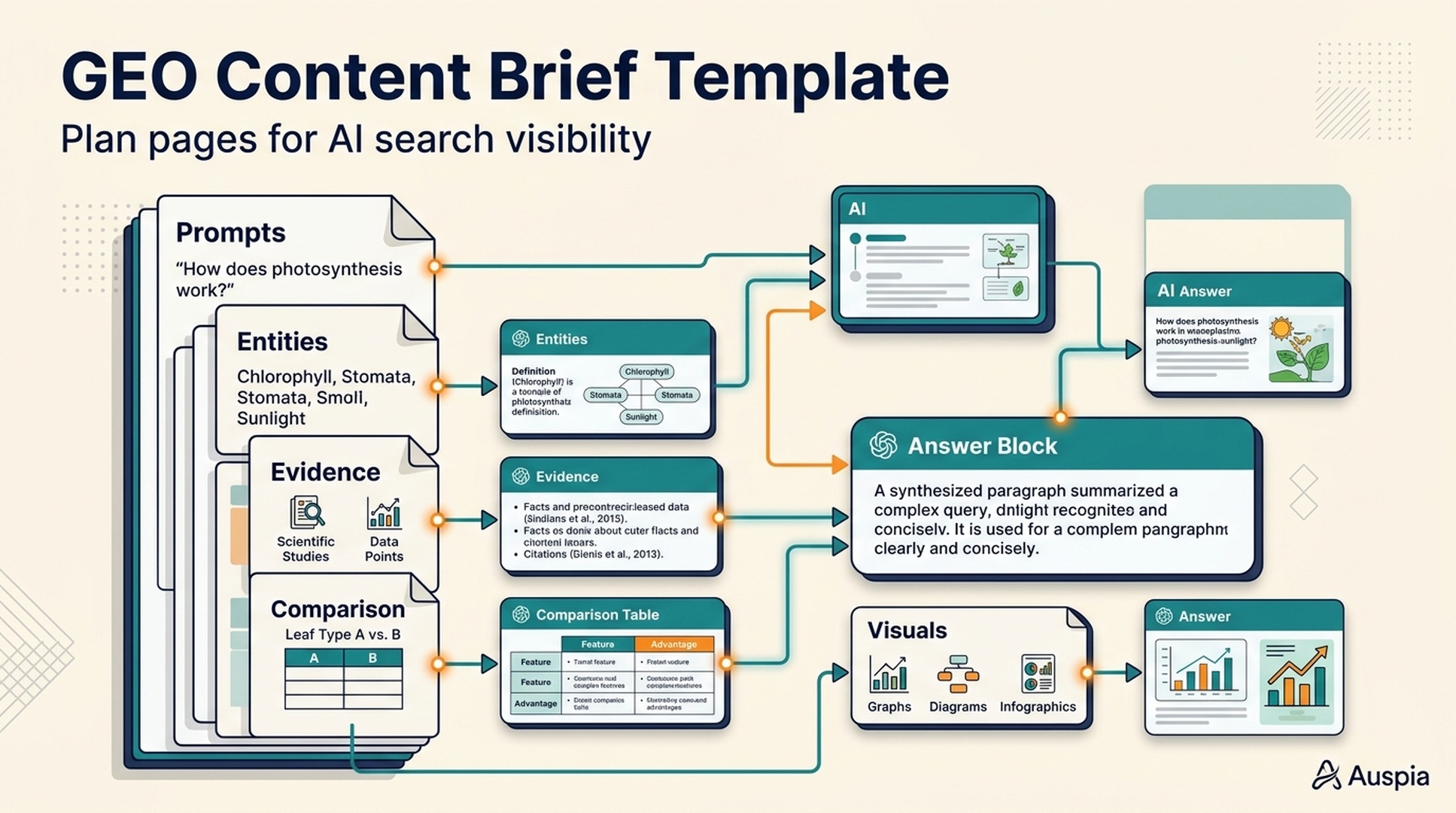
A GEO content brief is a writing brief designed for AI search visibility, not only traditional rankings. It tells the writer which prompts the page should answer, which entities must be clear, which evidence should support the claims, which comparison angles matter, and how the page should be structured so AI answer systems can extract useful information.
A normal SEO brief often focuses on a target keyword, secondary keywords, search intent, SERP competitors, headings, and word count. A GEO brief still uses those signals, but adds a different layer: answer extractability, brand/entity clarity, citation readiness, prompt coverage, and comparison context.
Use this template when you want a page to help humans and AI systems understand your brand, product, category, or point of view more clearly.
Why a normal SEO brief is not enough for GEO
Traditional SEO briefs are useful. They help content teams align a page with search demand, competitor pages, and ranking patterns. But AI answer systems do not behave exactly like search result pages.
A page can rank and still be hard for ChatGPT, Perplexity, Gemini, or Google AI-style answers to summarize. A page can have keywords and still fail to explain the entity, the claim, the evidence, or the comparison clearly.
For GEO, the brief needs to answer additional questions:
- What should an AI answer system understand after reading this page?
- Which user prompts should this page support?
- Which brand, product, category, and competitor entities must be clear?
- Which claims need proof?
- What short answer should be easy to extract?
- Which table, checklist, or example would make the answer more reusable?
- What should this page not claim?
The job of the GEO brief is to remove ambiguity before the writer starts.
The GEO content brief template
Copy this structure into your content workflow.
1. Page objective
Write one sentence explaining why the page exists.
Example:
Create a practical guide that helps B2B content teams build a prompt-based ChatGPT GEO measurement workflow.
The objective should be specific enough that a reviewer can reject off-topic sections.
2. Primary prompt cluster
List the AI prompts the page should help answer.
Example:
- how to measure ChatGPT visibility
- how to track whether my brand appears in AI search
- what is a GEO prompt library
- how do I score AI answer visibility
- tools for measuring ChatGPT mentions
This is different from a keyword list. Prompts should sound like real questions or requests a buyer might give to an AI assistant.
3. Search keyword set
Add the traditional SEO layer.
Include:
- primary keyword
- secondary keywords
- related queries
- search intent
- likely SERP page types
- competitor pages to review
The keyword set keeps the page discoverable in search engines. The prompt cluster keeps it useful for AI answers.
4. Audience and buying stage
Define who the page is for.
Use a simple format:
Field | Answer |
|---|---|
Audience | SEO leads, content managers, growth teams |
Company type | B2B SaaS, agencies, ecommerce, local services |
Maturity | beginner, intermediate, advanced |
Buying stage | problem aware, solution aware, vendor comparison |
Desired next action | run an audit, download a template, compare tools, book a demo |
Without this section, writers often create generic content that does not support a real decision.
5. Entity requirements
Name the entities that must be clear.
For a GEO article, entities often include:
- brand name
- product name
- category name
- audience
- competitors or alternatives
- related platforms
- frameworks
- metrics
- people or organizations, if relevant
For each entity, specify the preferred wording.
Entity | Preferred wording | Avoid |
|---|---|---|
GEO | Generative Engine Optimization, AI search visibility optimization | vague "AI SEO magic" phrasing |
ChatGPT | ChatGPT-style AI answer systems when discussing broad behavior | claiming all AI systems work the same |
Auspia | AI search visibility and GEO workflow platform | generic AI growth platform |
Entity requirements prevent category drift and brand confusion.
6. Answer block
Every GEO-ready page should include a short answer near the top.
Brief instruction:
Include a 3-5 sentence answer block that directly answers the primary prompt, defines the topic, explains why it matters, and states what the reader should do next.
This block helps humans scan the page and gives AI systems a clean summary to extract.
7. Evidence requirements
List what proof the writer needs before making claims.
Evidence can include:
- product screenshots
- customer examples
- benchmark data
- documentation
- public case studies
- third-party mentions
- expert quotes
- original tests
- before/after examples
- templates or checklists
Also list unsupported claims to avoid.
Example:
Claim | Evidence required | If missing |
|---|---|---|
"Improves ChatGPT visibility" | prompt tracking before/after data | say "designed to help measure and improve" |
"Best tool" | independent comparison or criteria | avoid absolute claim |
"Works for all industries" | broad evidence across verticals | narrow to supported use cases |
A GEO brief should protect the article from overclaiming.
8. Comparison context
AI answers often compare options. Add comparison guidance even if the page is not a pure comparison page.
Include:
- what this topic is often confused with
- alternatives the reader may consider
- when this approach is a good fit
- when it is not a good fit
- what tradeoffs matter
Example:
Compare | Difference to clarify |
|---|---|
SEO brief vs GEO brief | SEO briefs target rankings; GEO briefs add prompts, entities, evidence, and answer extraction |
Keyword research vs prompt mapping | keyword research shows search demand; prompt mapping shows AI recommendation behavior |
Content optimization vs entity optimization | content optimization improves a page; entity optimization clarifies the brand across sources |
This helps the page appear in explanation and comparison prompts.
The page structure section
A GEO brief should not prescribe headings mechanically, but it should define the role of each section.
Use this structure:
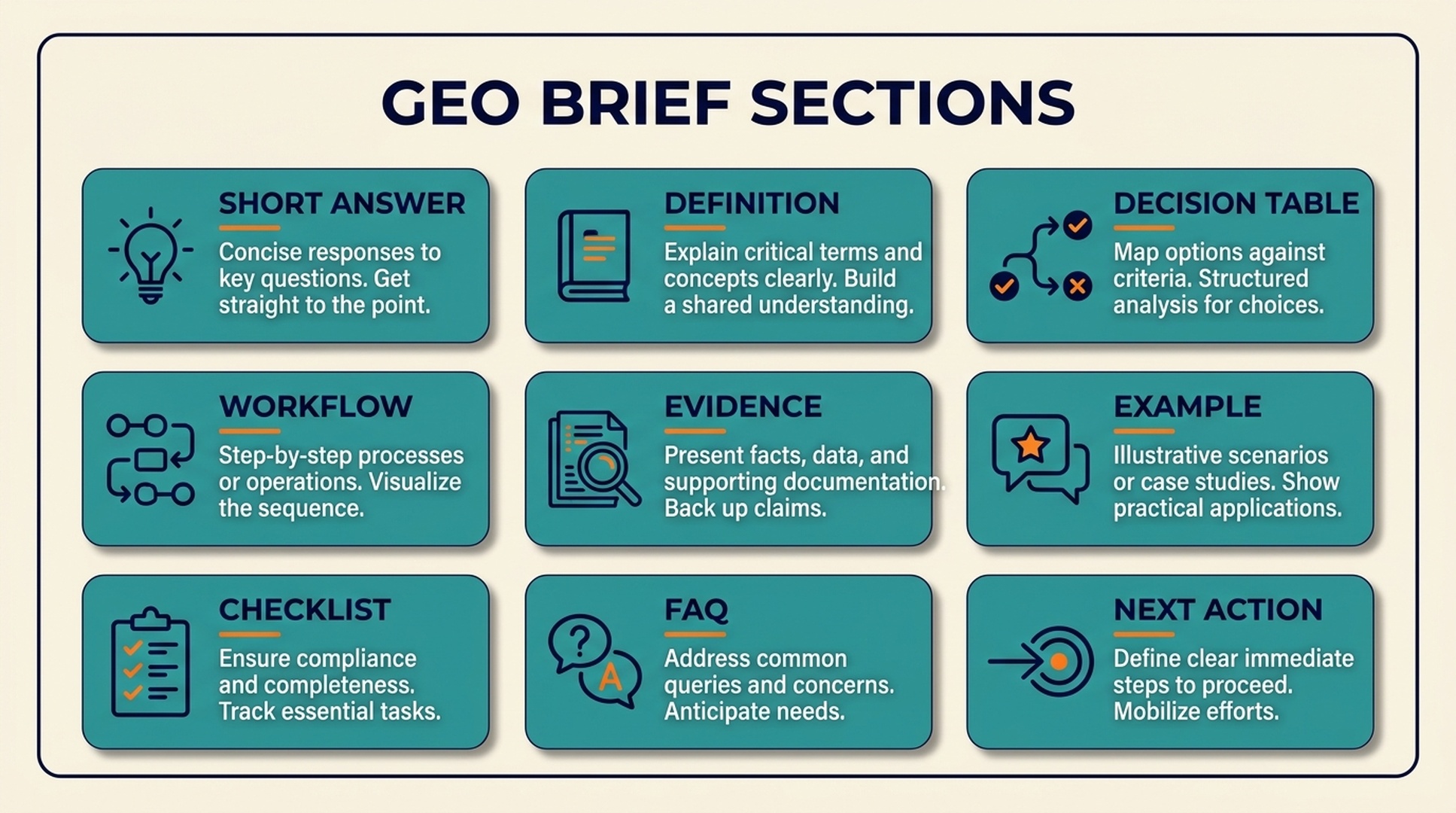
Section role | What it should do |
|---|---|
Short answer | Directly answer the main prompt |
Definition or context | Explain the concept without jargon |
Decision table | Help the reader compare options or choices |
Workflow | Show how to do the task |
Evidence block | Support key claims |
Example | Make the concept concrete |
Checklist | Turn advice into action |
FAQ | Answer real follow-up questions |
Byline / author note | Clarify editorial responsibility |
The exact headings can change. The information roles should not be skipped.
Visual requirements for a GEO-ready article
A page built for AI search should still be useful for humans. Visuals help the page become easier to understand, link to, and reference.
Add visual instructions to the brief:
- one information-rich cover image with the article's core concept
- one workflow diagram or process map
- one matrix, scorecard, checklist, or table
- alt text that describes the visual's information, not just decoration
- captions that explain why the visual matters
For example:
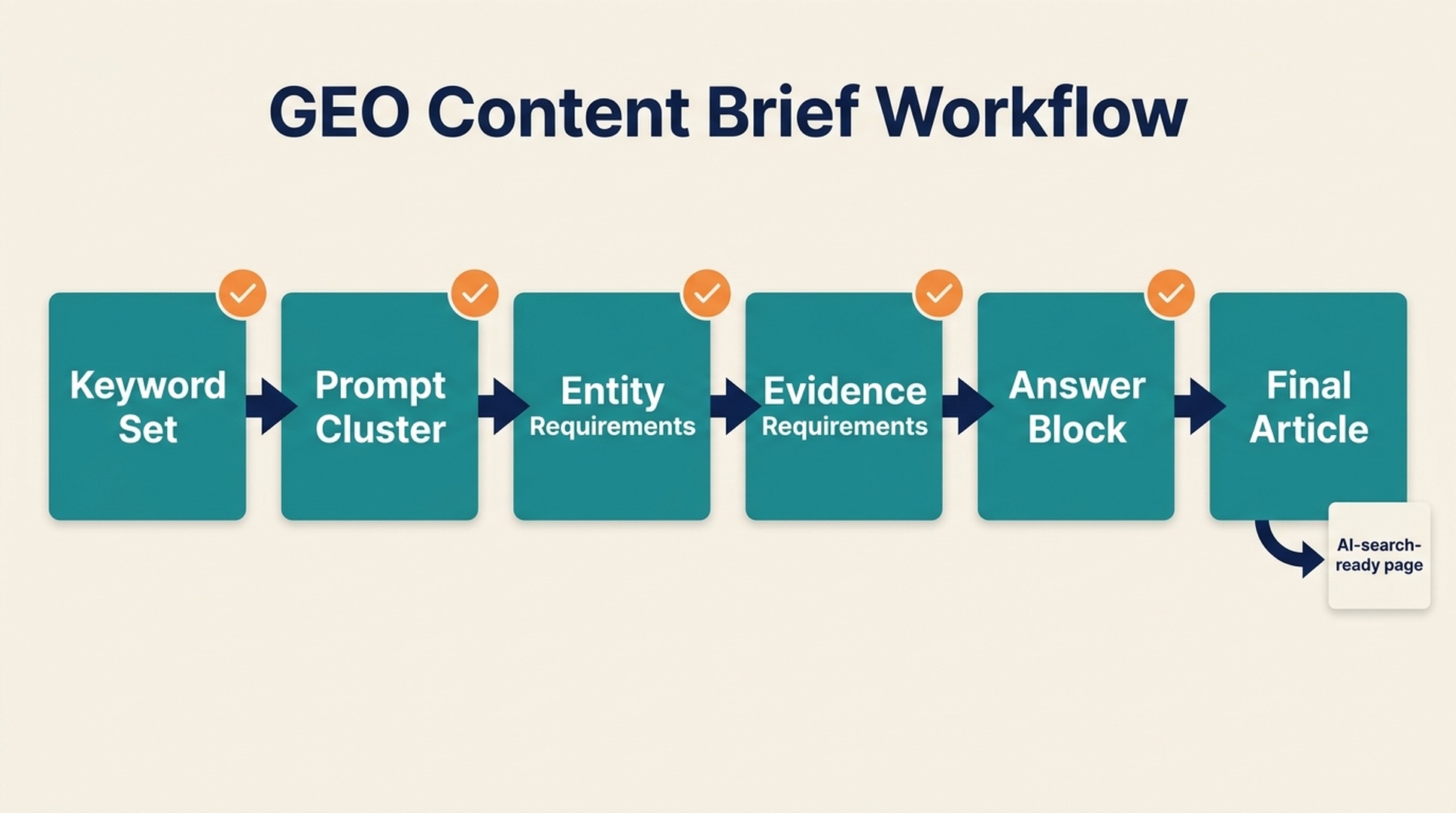
Create a workflow diagram showing how keyword research, prompt mapping, entity requirements, evidence requirements, and answer blocks become a final GEO article.
Do not ask for generic hero images. They rarely improve understanding.
Internal link and conversion path
A GEO brief should define where the reader should go next.
Possible next actions:
- read a related guide
- run an AI search visibility audit
- compare a tool
- download a template
- inspect a technical setup
- view a case study
Keep it natural. One strong internal link is usually better than five forced links.
For example, if the article teaches prompt-based visibility planning, a natural next link is an AI search visibility checker, because the reader can test the problem the article describes.
Reviewer checklist before publishing
Use this checklist before approving the article.
Check | Pass? |
|---|---|
The first section answers the main prompt clearly | |
The primary prompt cluster appears naturally in the article | |
Brand and category entities are consistent | |
Claims are supported or softened | |
The article includes a useful table, workflow, or checklist | |
Comparison context is included | |
The article avoids keyword stuffing | |
The CTA matches the reader's intent | |
Every image has descriptive alt text | |
FAQ questions are real and non-duplicative |
If the article fails more than two checks, revise it before publishing.
A filled example brief
Here is a compact example for a GEO article about measuring ChatGPT visibility.
Brief field | Example |
|---|---|
Page objective | Teach content teams how to measure whether their brand appears in ChatGPT-style answers |
Primary prompt cluster | how to measure ChatGPT visibility; ChatGPT brand mention tracking; GEO prompt library |
Primary keyword | how to measure ChatGPT visibility |
Audience | SEO leads and content managers at B2B SaaS companies |
Entity requirements | ChatGPT, GEO, AI search visibility, brand mentions, prompt library, Auspia |
Evidence requirements | prompt examples, scoring model, sample dashboard, limitations |
Comparison context | rank tracking vs prompt tracking; SEO reporting vs GEO reporting |
Required visual | prompt scoring dashboard or workflow diagram |
Next action | run a visibility check or build a 25-prompt baseline |
This level of detail is enough to guide a writer without turning the article into a rigid template.
Common mistakes
Mistake 1: treating prompts as keywords
Prompts are not just longer keywords. A prompt often includes a task, context, comparison, and desired output. Capture that structure in the brief.
Mistake 2: skipping entity requirements
If the writer does not know the preferred category, product description, or competitor language, the article may introduce brand confusion.
Mistake 3: asking for evidence after the draft is done
Evidence should be planned before writing. Otherwise the article may need major revisions to remove unsupported claims.
Mistake 4: using the same outline for every article
GEO content still needs layout variety. A definition article, comparison article, template article, and diagnosis article should not all have the same section order.
Mistake 5: publishing without measurement
A GEO article should be tested after publishing. Run the target prompts again and see whether the page changes answer quality over time.
FAQ
What is a GEO content brief?
A GEO content brief is a planning document that helps writers create pages for AI search visibility. It includes prompts, entities, evidence, answer blocks, comparison context, visual requirements, and traditional SEO inputs.
How is a GEO brief different from an SEO brief?
An SEO brief focuses on search demand and ranking structure. A GEO brief adds AI prompt coverage, entity clarity, answer extractability, evidence requirements, and recommendation context.
Do I still need keywords in a GEO brief?
Yes. Keywords still matter for search discovery. The difference is that keywords are not enough by themselves. Add prompt mapping and entity requirements so the page can support AI answers too.
Who should own the GEO brief?
Usually an SEO lead, content strategist, or growth marketer owns the brief. Subject matter experts should review evidence, claims, and entity language before publishing.
Can this template be used for product pages?
Yes. For product pages, put more emphasis on category clarity, use cases, comparisons, proof, integrations, and conversion paths. The same GEO brief structure still applies.
Author: Clara Bennett, 10-Year Content Strategy Practitioner at Auspia. Clara writes about editorial systems, topic maps, repeatable content operations, and SEO/GEO production workflows.