The practical answer
ChatGPT citations are not something you can force, but you can make your content easier for AI answer systems to reference. The most citation-ready pages are clear, specific, crawlable, evidence-backed, and easy to quote or summarize. They answer one question directly, identify the entities involved, support claims with proof, and avoid vague marketing language.
For ChatGPT GEO, the goal is not just to get mentioned. A stronger goal is to become the page an AI answer can use when it needs a definition, comparison, workflow, statistic, example, or source of evidence.
This article explains how to build citation-ready content for AI answers without turning your site into a pile of robotic FAQ pages.
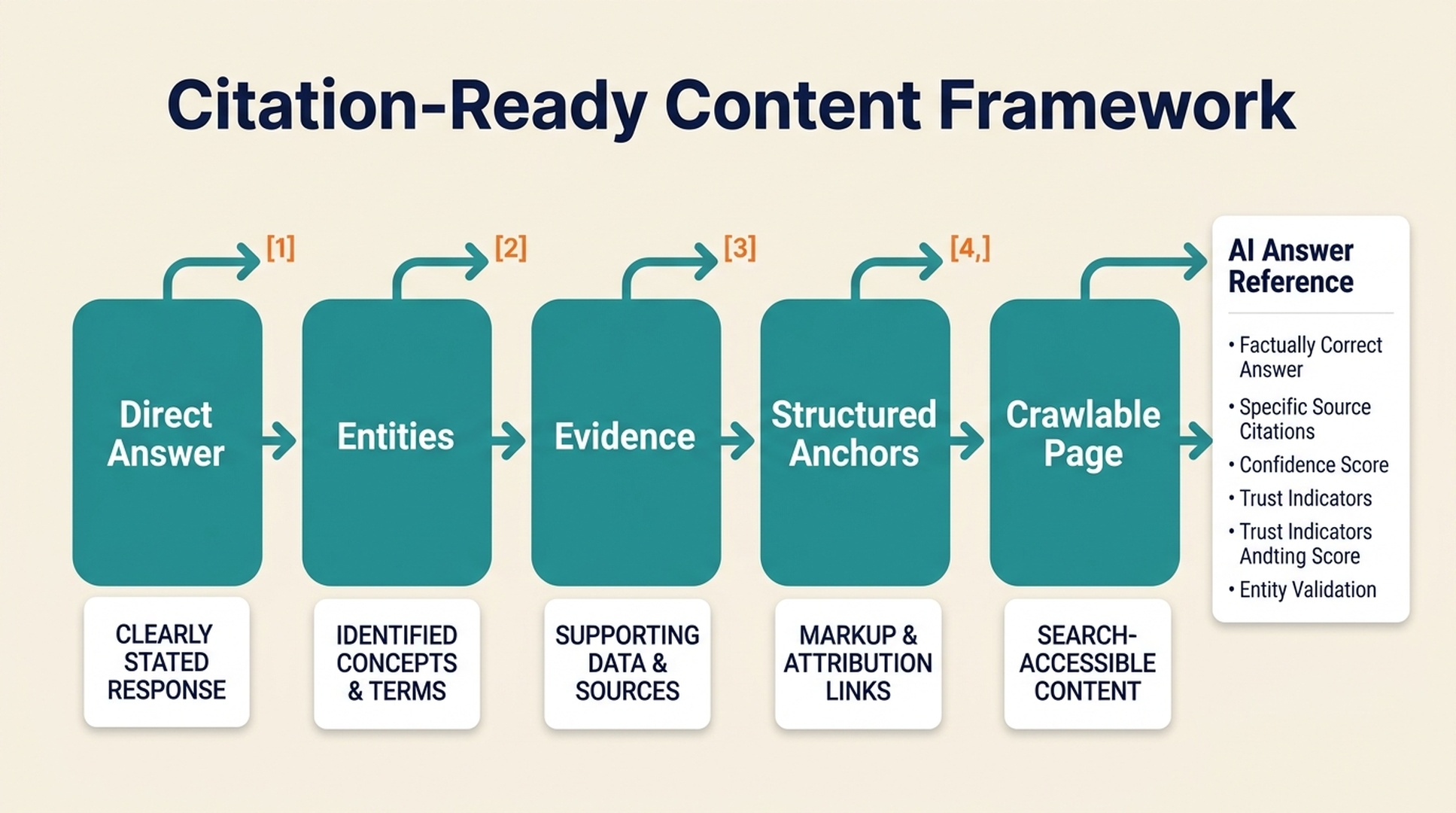
What "citation-ready" means
Citation-ready content is content that an AI answer system can confidently use as a supporting source.
That usually means the page has:
- one clear topic
- a direct answer near the top
- named entities and definitions
- evidence or examples
- visible publication or update context
- crawlable HTML text
- useful tables, lists, or steps
- clear authorship or editorial responsibility
- links to related proof pages
A page is less citation-ready when it hides the answer behind slogans, uses vague claims, buries the important facts in images, or mixes too many topics together.
Think of citation readiness as source usability. If a human researcher would struggle to find the claim, an AI system may also struggle to use the page.
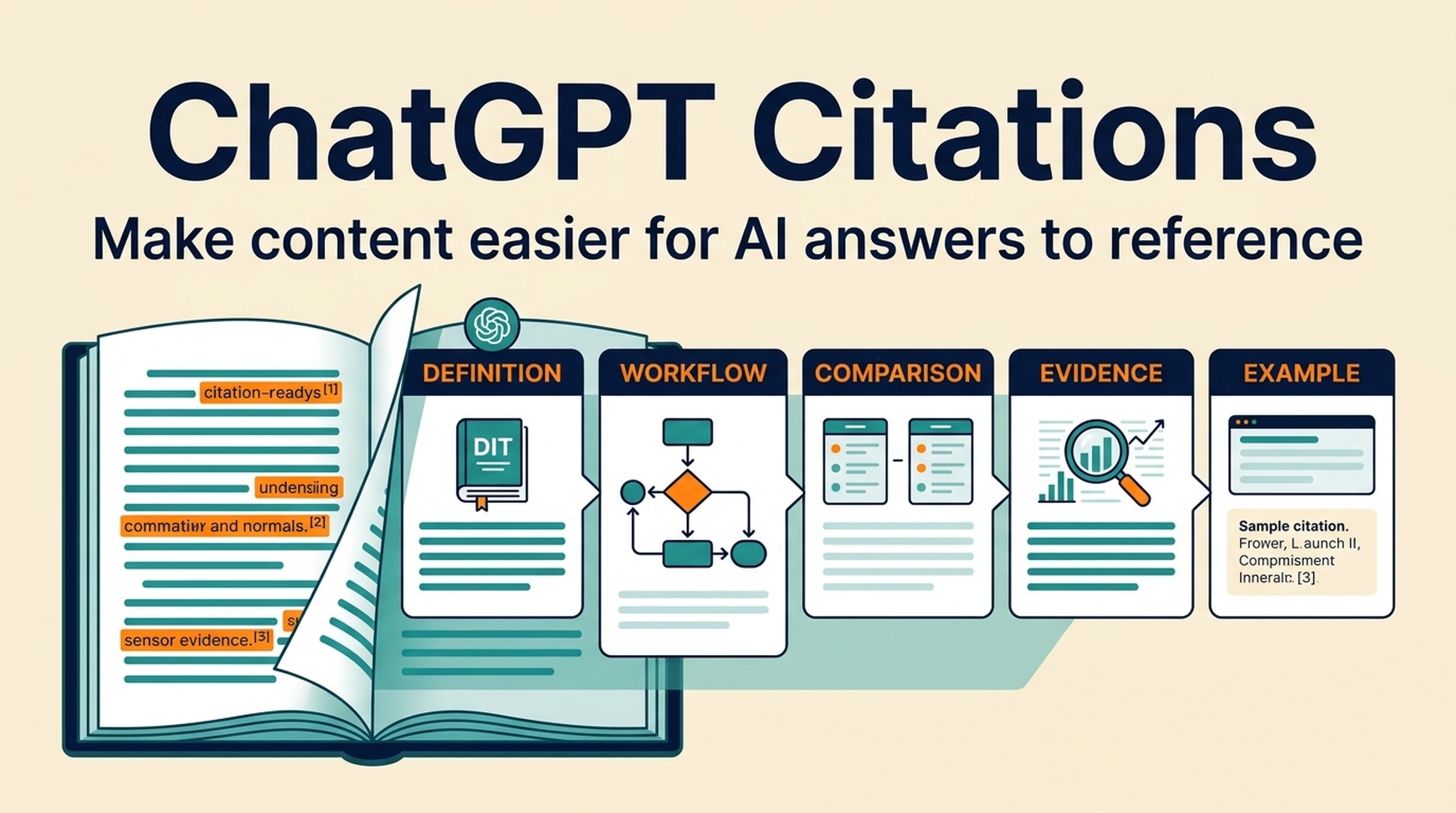
The five citation jobs AI answers need
AI answers cite or reference pages for different reasons. A page should know which job it is trying to do.
Citation job | What the AI answer needs | Best page type |
|---|---|---|
Definition | Explain what something means | glossary, explainer, category page |
Workflow | Show how to do a task | playbook, checklist, template |
Comparison | Clarify tradeoffs | comparison page, alternatives page |
Evidence | Support a claim | case study, benchmark, research page |
Example | Make an idea concrete | teardown, example library, product walkthrough |
Do not ask one page to do all five jobs. Pick the primary citation job and structure the page around it.
Start with a claim inventory
Before rewriting content, list the claims your page makes.
Examples:
- GEO helps brands improve AI search visibility.
- Prompt libraries help teams measure ChatGPT visibility.
- Comparison pages help AI systems understand market alternatives.
- Third-party evidence strengthens brand entity signals.
Then ask: which claims are worth being cited?
For each important claim, add:
Claim | Proof needed | Page asset |
|---|---|---|
ChatGPT visibility can be measured through recurring prompts | scoring model and prompt examples | measurement guide |
Brand entity clarity affects AI descriptions | entity audit checklist and examples | entity optimization guide |
Third-party evidence improves recommendation context | source inventory and examples | evidence playbook |
A citation-ready page does not make every claim louder. It makes the important claims easier to verify.
Put the answer where AI systems can find it
Many pages fail because they make the reader work too hard.
For AI answers, write the core answer in the first section. A good answer block should include:
- the direct answer
- the definition or scope
- why it matters
- one practical next step
Example:
A GEO content brief is a planning document that helps writers create pages for AI search visibility. It includes prompts, entities, evidence, answer blocks, comparison context, and traditional SEO inputs. Use it when a page needs to be understood by both human readers and AI answer systems.
That paragraph is easy to summarize. It states what the thing is, what it includes, and when to use it.
A weak version would be:
In today's fast-changing AI landscape, forward-thinking teams need smarter ways to unlock visibility and future-proof their content strategy.
That may sound polished, but it is not source material.
Make entities explicit
AI answers often need to understand relationships between entities: brand, category, product, competitor, platform, audience, method, and metric.
Use precise entity language:
Instead of | Use |
|---|---|
AI platform | AI search visibility platform |
optimize content | improve answer extractability and brand visibility in AI search |
users | SEO leads, content managers, and growth teams |
tools | ChatGPT, Perplexity, Gemini, Google AI Overviews, and AI answer systems |
better results | more accurate mentions, stronger recommendation context, and clearer citations |
Entity clarity helps the page become more useful as a reference.
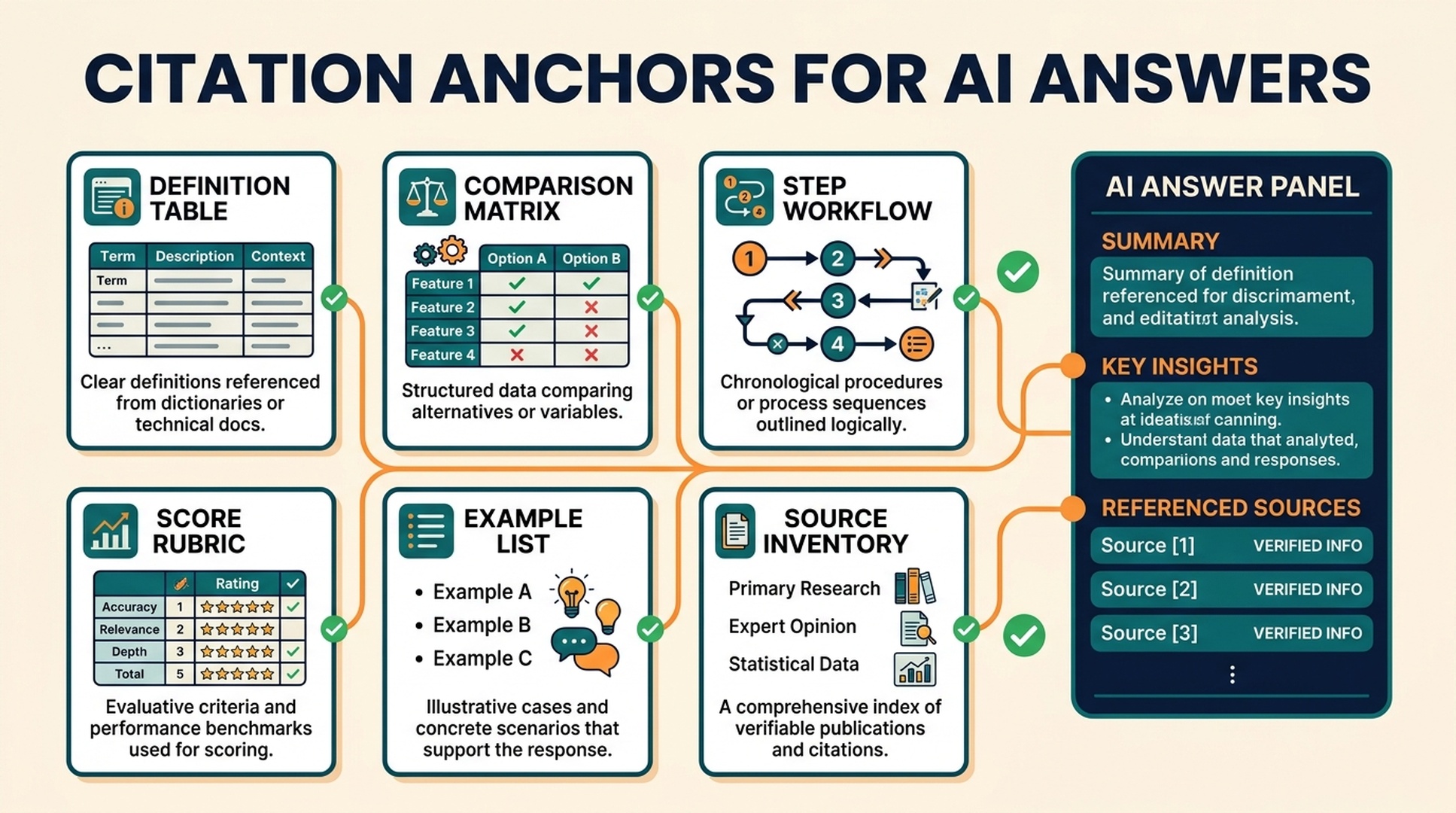
Use tables and lists as citation anchors
Tables, checklists, and short lists are useful because they create structured information blocks. They help humans scan and make it easier for AI systems to extract relationships.
Good citation anchors include:
- definition tables
- comparison matrices
- step-by-step workflows
- scoring rubrics
- example lists
- mistake lists
- checklists
- source inventories
For example, a 0-5 scoring rubric for ChatGPT visibility is more reusable than a long paragraph saying "track quality over time."
Support claims with visible evidence
Citation-ready content needs proof close to the claim.
Evidence can be:
- a public case study
- a documented workflow
- an original benchmark
- a before/after example
- a screenshot
- a template
- a source inventory
- a comparison table
- a clear limitation statement
Weak content says:
This method improves AI visibility.
Stronger content says:
Use a recurring prompt library to measure AI visibility. Track whether the brand is absent, mentioned incorrectly, mentioned vaguely, accurately described, recommended with context, or recommended with evidence.
The stronger version gives a method an AI answer can explain.
Add freshness and editorial context
AI answers and search systems often need to decide whether a page is current enough to reference.
Add visible signals:
- publication date when relevant
- updated date for evergreen guides
- author or editorial byline
- methodology notes for research pages
- limitations for tests and benchmarks
- version notes for templates
Do not fake freshness. If the page is evergreen, update it when facts, tools, screenshots, or recommendations change.
Keep the page crawlable
Citation-ready content should be accessible as HTML text.
Avoid putting the only useful information inside:
- images with no text equivalent
- PDFs with no HTML summary
- videos without transcripts
- gated assets
- interactive widgets that do not render server-side
- carousels that hide key facts
- screenshots without captions
If you publish a report or tool, create a crawlable summary page that explains the findings and links to the full asset.
Build source paths, not isolated pages
One page can be useful. A connected source path is stronger.
For example:
- Definition page: What is ChatGPT GEO?
- Workflow page: How to run a ChatGPT GEO audit
- Template page: GEO content brief template
- Evidence page: Third-party evidence for ChatGPT GEO
- Measurement page: How to measure ChatGPT visibility
Together, these pages create a source cluster. They reinforce the same entities and give AI answers multiple reference points.
Use internal links carefully. Link where it helps the reader continue the task. For example, after explaining prompt-based visibility, a natural next step is an AI search visibility checker.
A citation-readiness checklist
Use this before publishing a strategic GEO page.
Check | Pass? |
|---|---|
The page has one primary topic | |
The first section answers the main question directly | |
Important entities are named clearly | |
Claims are supported with evidence or softened | |
The page includes a table, checklist, workflow, or rubric | |
The content is crawlable as HTML text | |
Images have alt text and captions | |
The page links to related proof or context pages | |
The article avoids vague marketing claims | |
The page has visible editorial context |
If a page fails several of these, it may still rank, but it is less useful as a citation source.
Common mistakes
Mistake 1: writing for impressions instead of reference value
A high-traffic page is not automatically a good source. Citation-ready pages need clarity, proof, and structure.
Mistake 2: making unsupported claims
AI answers need reasons. If your page claims a method works, show the workflow, data, case, example, or limitation.
Mistake 3: hiding the answer in design
Beautiful pages can fail as sources when the core answer is trapped in animation, images, video, or generic hero copy.
Mistake 4: mixing too many topics
A page that tries to define GEO, compare tools, pitch a product, summarize a case study, and explain technical setup may be hard to cite for any one purpose.
Mistake 5: ignoring updates
Old screenshots, outdated platform names, and stale claims weaken trust. Refresh strategic pages when the market changes.
FAQ
Can I guarantee ChatGPT will cite my page?
No. You cannot guarantee citations. You can improve the chance that your page is useful as a reference by making it clear, crawlable, specific, evidence-backed, and easy to summarize.
What pages are most likely to be cited by AI answers?
Pages that define concepts, explain workflows, compare options, present evidence, or provide concrete examples are generally more citation-ready than vague landing pages.
Do backlinks matter for ChatGPT citations?
Backlinks can help discovery and authority, but citation readiness also depends on the page itself: clarity, structure, evidence, freshness, crawlability, and relevance to the prompt.
Should I add FAQ sections to every page?
No. Add FAQs only when they answer real follow-up questions. A stronger citation anchor might be a table, scoring rubric, workflow, or example depending on the topic.
Is citation-ready content different from SEO content?
It overlaps with good SEO content, but the emphasis is different. Citation-ready content is built to be referenced: it gives AI answers clear definitions, evidence, comparisons, examples, and structured information.
Author: Isabel Grant, Researcher of 2,000+ AI Citation Patterns at Auspia. Isabel writes about citation earning, source quality, retrieval behavior, and evidence systems for AI search visibility.