The SaaS answer
ChatGPT SEO for SaaS is the work of making your product easy for AI answer systems to understand, compare, and recommend when buyers ask category, problem, alternative, integration, and use-case questions. It overlaps with traditional SEO, but the goal is different: you are not only trying to rank a page. You are trying to earn a place in the answer set when a buyer asks, "What tools should I consider?"
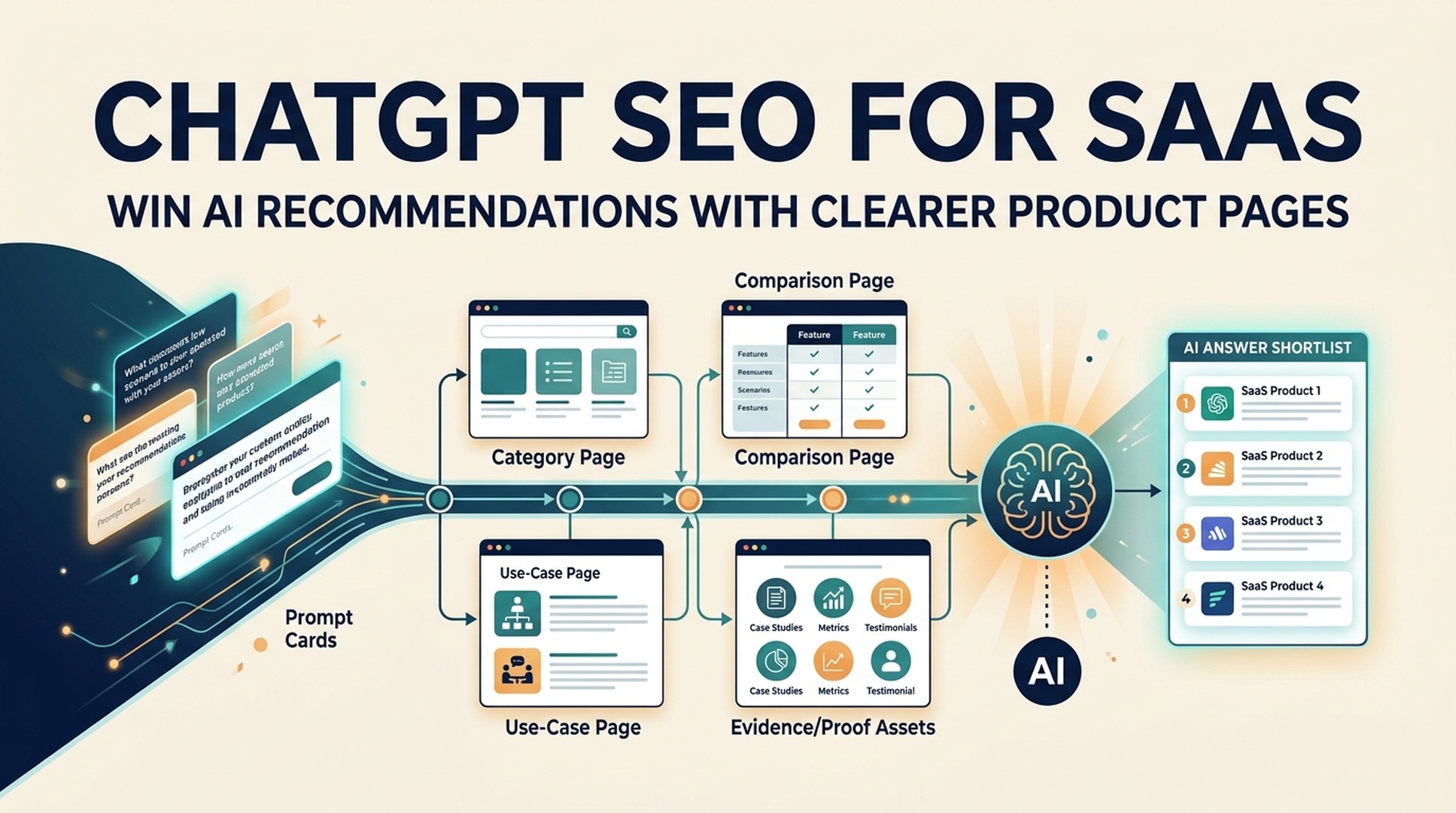
For SaaS teams, ChatGPT GEO usually comes down to five assets: a clear product entity, category pages, comparison pages, use-case pages, and public evidence. If those assets are thin or inconsistent, ChatGPT may mention better-documented competitors even when your product is a strong fit.
The playbook is simple: map the prompts buyers ask, build pages that answer those prompts directly, support claims with evidence, and measure whether AI systems describe the product accurately over time.
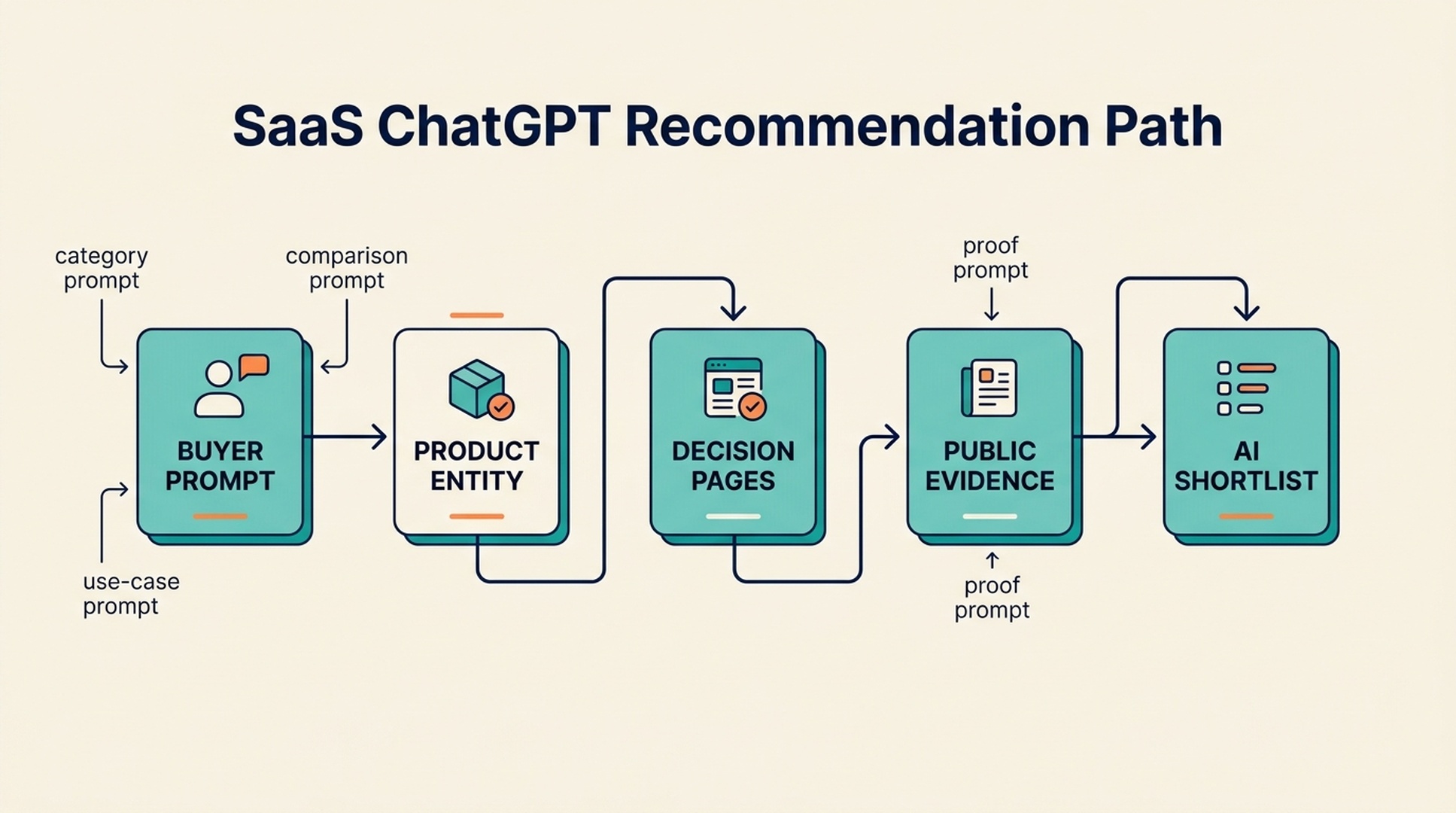
Where SaaS visibility breaks in ChatGPT
SaaS websites often look polished but still fail AI recommendation tests. The common problem is not design. It is missing decision context.
A buyer does not usually ask ChatGPT for your homepage. They ask questions like:
- What are the best tools for tracking AI search visibility?
- What are alternatives to Semrush for GEO?
- Which platforms help content teams measure ChatGPT mentions?
- What software should a B2B SaaS team use for content briefs?
- What is the difference between AEO, GEO, and SEO tools?
If your site only says "AI-powered growth platform," ChatGPT has to infer your category, audience, use case, competitors, and proof. That inference often favors companies with clearer pages.
The SaaS visibility gap usually appears in one of four places:
Gap | What ChatGPT cannot easily answer | Page that usually fixes it |
|---|---|---|
Category gap | What kind of product is this? | category or solution page |
Fit gap | Who is it for and when should it be used? | use-case page |
Comparison gap | How is it different from alternatives? | comparison page |
Proof gap | Why should anyone believe the claim? | case study, reviews, examples, or benchmarks |
Before creating another blog post, check whether these four gaps exist.
Build a prompt map before building pages
SaaS GEO work should start from prompts, not keywords alone. Keywords tell you what people search. Prompts tell you how buyers ask for a recommendation, explanation, or shortlist.
Create a prompt map with five clusters.
1. Category prompts
These prompts ask for tools or platforms in a market.
Examples:
- best GEO tools for SaaS companies
- tools for measuring ChatGPT visibility
- AI search optimization platforms
- software for answer engine optimization
Category prompts need pages that define the category and show where your product fits.
2. Problem prompts
These prompts start with a pain point.
Examples:
- why is ChatGPT not mentioning my brand?
- how do I track AI search visibility?
- how do content teams optimize for AI answers?
Problem prompts need educational pages that diagnose the issue and show a workflow.
3. Comparison prompts
These prompts compare options.
Examples:
- Auspia vs traditional SEO tools
- alternatives to [competitor]
- GEO tool vs SEO tool
- ChatGPT visibility checker vs rank tracker
Comparison prompts need honest tradeoff pages. If you avoid comparisons, AI systems may rely on competitors or third-party summaries.
4. Use-case prompts
These prompts name a team, workflow, or scenario.
Examples:
- GEO workflow for content teams
- AI search reporting for executives
- ChatGPT SEO for B2B SaaS
- content brief automation for SEO teams
Use-case prompts need pages that show the audience, inputs, workflow, and outcome.
5. Evidence prompts
These prompts ask whether a method works.
Examples:
- examples of GEO audits
- AI search visibility case study
- how to measure brand mentions in ChatGPT
- prompt tracking benchmark
Evidence prompts need examples, templates, public workflows, and case-style assets.
The SaaS GEO page stack
A SaaS website does not need hundreds of AI search pages. It needs a clear stack of decision pages.
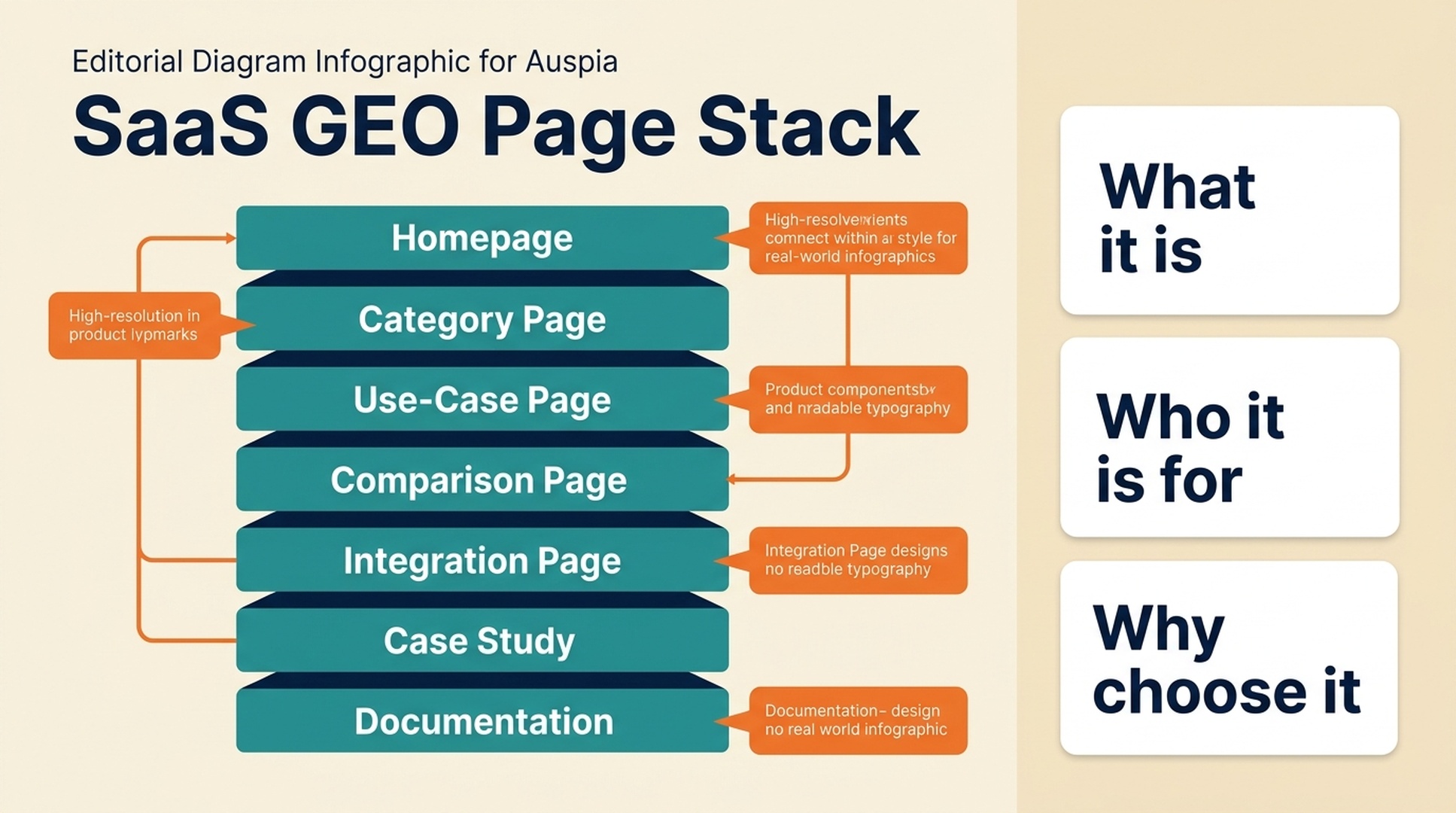
Page type | Primary job | What to include |
|---|---|---|
Homepage | define the product entity | category, audience, core use case, proof links |
Category page | place the product in a market | definition, buyer problems, alternatives, selection criteria |
Use-case page | show who the product helps | audience, workflow, before/after, examples |
Comparison page | explain tradeoffs | competitor context, fit/not-fit, feature differences |
Integration page | connect product to ecosystem | supported tools, workflow, data flow |
Case study | provide proof | problem, action, outcome, caveats |
Template/tool page | demonstrate expertise | reusable artifact, examples, next steps |
Documentation | prove product depth | features, setup, limitations, support detail |
The homepage is rarely enough. ChatGPT-style answers need market context and evidence. That context usually lives across the page stack.
Write SaaS pages so AI systems can extract the answer
The page structure matters. SaaS pages often bury the useful answer below slogans, animated sections, and vague benefit blocks.
For ChatGPT SEO, each decision page should answer these questions near the top:
- What is this product or page about?
- Who is it for?
- What problem does it solve?
- When should someone choose it?
- What alternatives or adjacent tools exist?
- What proof supports the claim?
A strong use-case opening might look like this:
Auspia helps B2B SaaS content teams track whether their brand, products, and comparison pages appear in ChatGPT-style answers. Teams use it to build prompt libraries, audit brand descriptions, and prioritize GEO content updates.
A weak opening might look like this:
Unlock smarter growth with AI-powered insights for the future of content.
The second version sounds polished, but it gives ChatGPT almost nothing concrete to reuse.
Comparison pages are not optional anymore
Many SaaS teams avoid comparison pages because they feel aggressive. For ChatGPT GEO, that creates a data gap.
AI recommendation prompts are comparative by nature. A buyer wants a shortlist, tradeoffs, alternatives, and fit guidance. If your own site does not explain those differences, the answer may come from review sites, competitor pages, or old listicles.
A useful comparison page should include:
- who each option is best for
- where the products overlap
- where they differ
- pricing or packaging caveats when public
- integration differences
- support or workflow differences
- a "choose this if" section
- a "do not choose this if" section
The point is not to claim you are better for everyone. The point is to make your position legible.
Evidence that helps SaaS brands get recommended
For SaaS, evidence should be close to the buying workflow. Broad credibility signals are useful, but AI answers often need specific reasons.
Useful evidence includes:
- public product documentation
- customer stories or anonymized workflow examples
- review profiles with accurate category language
- integration pages with real setup details
- benchmark posts or research summaries
- templates that show domain expertise
- comparison tables with clear fit guidance
- third-party mentions in category-relevant resources
The best evidence connects a claim to a use case. "Trusted by modern teams" is weak. "Used by content teams to track 50 recurring AI search prompts across brand, category, and competitor queries" is stronger because it names the workflow.
A 14-day SaaS ChatGPT GEO sprint
Use this sprint if you need a practical starting point.
Days 1-2: run the prompt baseline
Create 25 prompts across category, problem, comparison, use-case, and evidence clusters. Run them in the AI systems you care about. Record:
- whether your brand appears
- where it appears in the answer
- whether the description is accurate
- which competitors appear
- what proof or sources are mentioned when available
Days 3-4: fix product entity clarity
Update your homepage, about page, product page, and public profiles so they repeat the same category, audience, and use-case facts.
Days 5-7: publish one category or use-case page
Pick the prompt cluster with the clearest buying intent. Publish one page that answers the prompt directly and includes comparison context.
Days 8-10: publish one comparison asset
Create an alternatives page, product-vs-product page, or category comparison page. Keep it fair. Add fit guidance.
Days 11-12: add proof
Attach evidence to the pages: examples, screenshots, templates, customer workflows, documentation links, or review/profile links.
Days 13-14: rerun the prompt baseline
Run the same prompts. Do not expect instant miracles. Look for smaller improvements first: more accurate descriptions, clearer category association, and fewer competitor-only answers.
A simple scoring model for SaaS GEO
Use this model monthly.
Score | Meaning | Example |
|---|---|---|
0 | Invisible | brand is not mentioned in relevant prompts |
1 | Mentioned incorrectly | brand appears but category or use case is wrong |
2 | Mentioned vaguely | brand appears but description lacks fit or proof |
3 | Mentioned accurately | brand category and use case are correct |
4 | Recommended with context | brand appears in a relevant shortlist with tradeoffs |
5 | Recommended with evidence | brand appears with accurate proof, sources, or examples |
Do not optimize only for score 5. Moving from 0 to 3 is already meaningful because it means AI systems understand the product better.
What SaaS teams should avoid
Avoid these traps:
- creating generic "AI SEO" blogs that never connect to product use cases
- publishing comparison pages that are obviously biased or unsupported
- using different product categories across homepage, docs, and profiles
- hiding documentation behind forms
- making claims that reviews, examples, or customer stories do not support
- measuring only traffic while ignoring AI answer accuracy
- chasing every AI platform before fixing the core website entity
The strongest SaaS GEO work usually looks boring from the outside: clearer pages, better examples, stronger evidence, cleaner comparisons, and repeated measurement.
FAQ
Is ChatGPT SEO different from SaaS SEO?
Yes. Traditional SaaS SEO focuses heavily on ranking pages in search results. ChatGPT SEO or GEO focuses on whether AI answer systems can understand, compare, and recommend the product in response to buyer prompts. The two overlap, but the measurement is different.
What is the first page a SaaS company should create for ChatGPT GEO?
Start with the highest-intent gap. If buyers do not understand your category, create a category page. If competitors dominate recommendations, create a comparison page. If the product is misunderstood, fix the homepage and product entity first.
Do SaaS comparison pages help ChatGPT visibility?
They can. Comparison pages give AI systems clearer market context, alternatives, fit guidance, and differentiators. They work best when they are accurate, specific, and supported by evidence.
How often should SaaS teams measure ChatGPT visibility?
Monthly is a good starting point. Use the same prompt library, scoring rules, and competitor set each time. Weekly checks can be useful during a launch or major content sprint.
Can a small SaaS brand appear in ChatGPT recommendations?
Yes, but it needs clear positioning and evidence. Small brands often lose because they are under-documented, not because the product is weak. A focused page stack and third-party evidence trail can improve the chance of being considered.
Author: Caleb Brooks, SaaS SEO Strategist for 100+ Product-Led Pages at Auspia. Caleb writes about SaaS pages, product-led SEO, comparison content, and buyer journeys for AI search visibility.