Insight
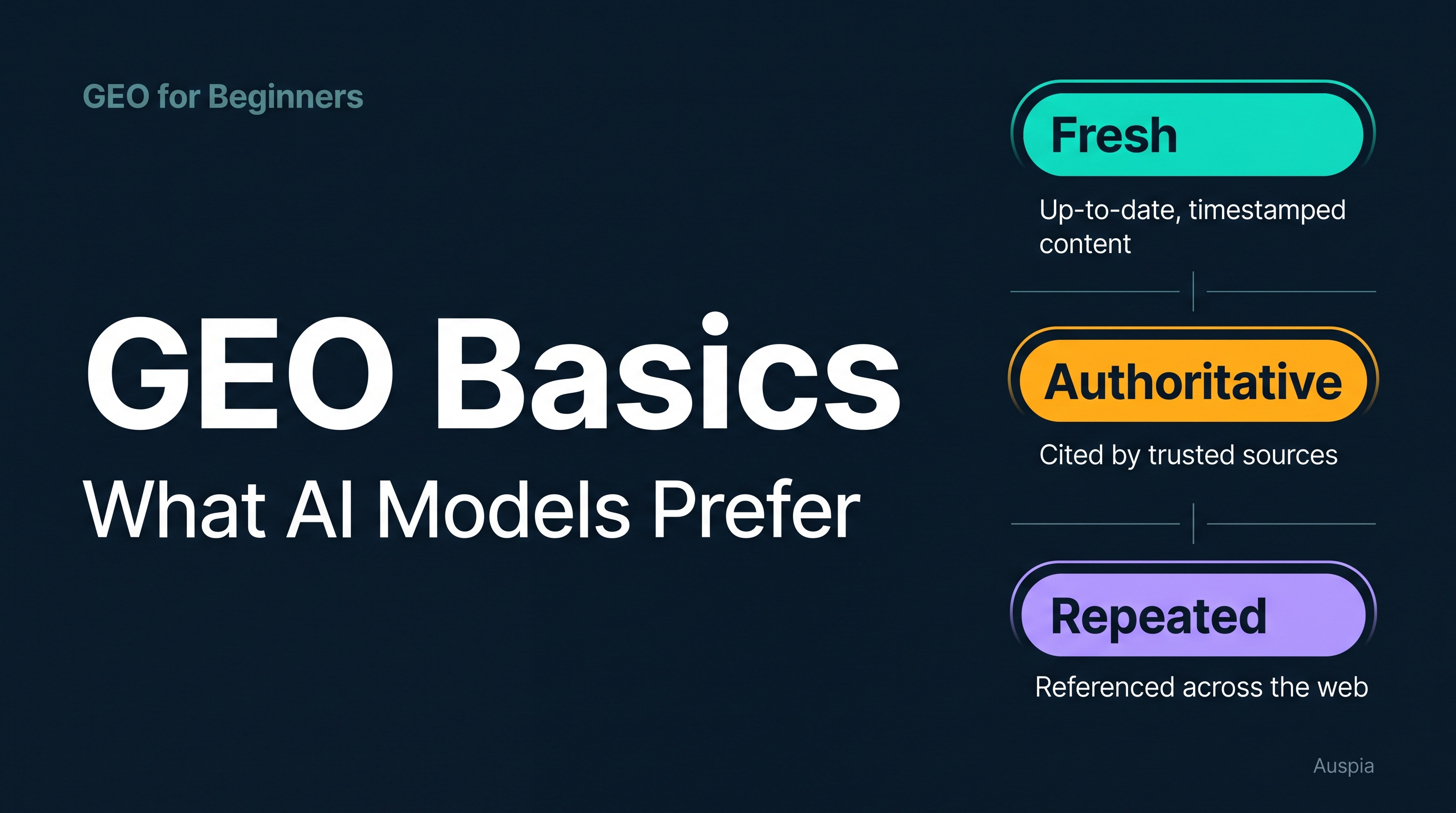
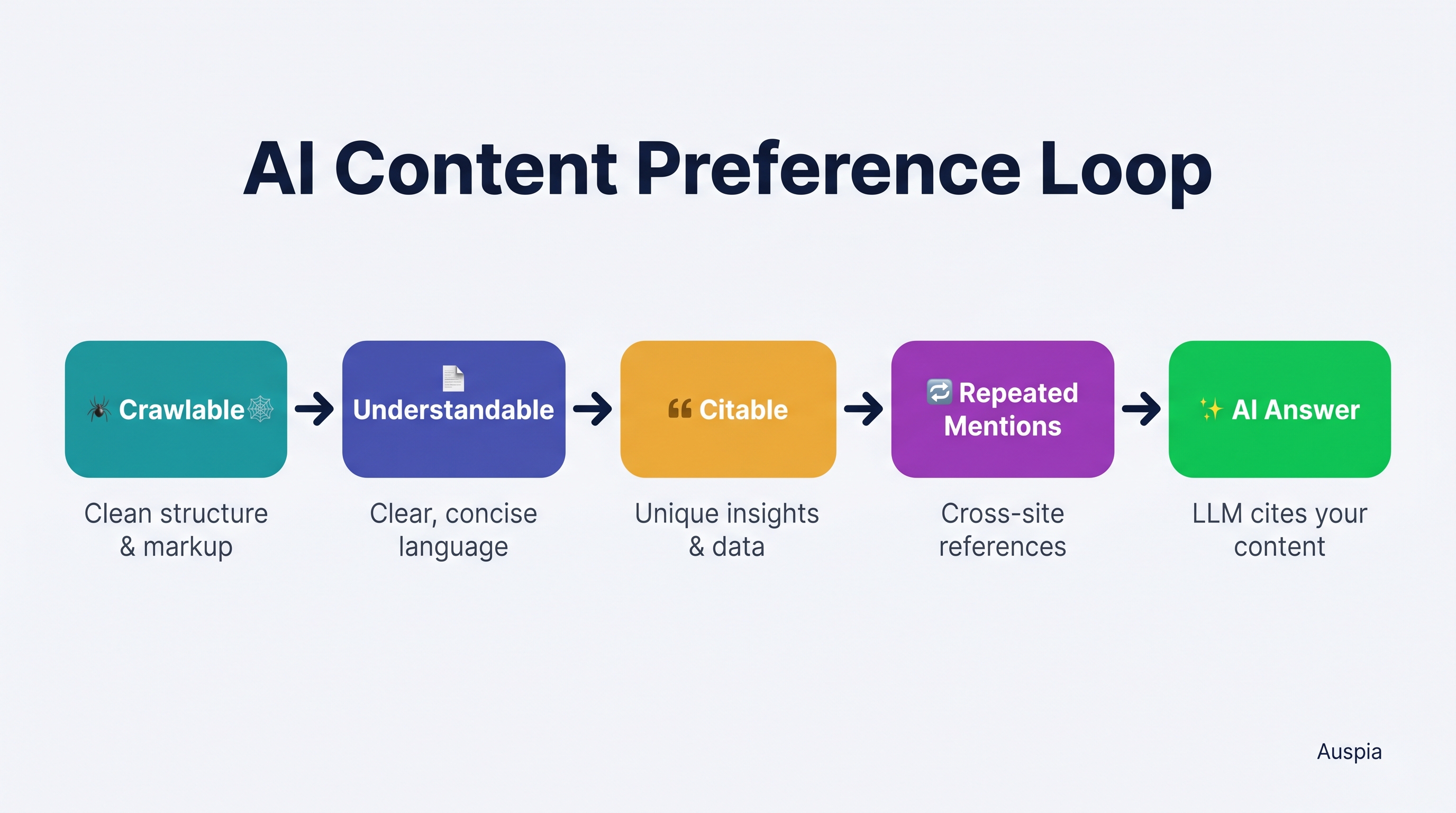
AI models prefer content they can find, parse, trust, and reuse. That is the practical starting point for GEO, or Generative Engine Optimization. If a page is blocked from crawlers, vague about its sources, buried in marketing copy, or duplicated only on one weak page, it is harder for an AI answer system to use it with confidence.
For beginners, the pattern is simple:
AI preference | What it means in practice | What to publish |
|---|---|---|
Freshness | The information looks maintained and current | Updated guides, dated benchmarks, changelogs, recent examples |
Authority | The content has a credible source, clear expertise, and verifiable claims | Original data, expert explanations, cited evidence, transparent methodology |
Repetition | The same entity facts and useful claims appear consistently across trusted surfaces | Consistent brand facts, third-party mentions, profiles, reviews, documentation |
This does not mean "write for robots." It means making useful human content easier for retrieval systems and answer engines to trust. The best GEO content still reads clearly to a buyer, an analyst, or a customer. It just removes the ambiguity that makes AI systems skip it.
What GEO is trying to change
Traditional SEO asks, "Can we rank when someone searches this keyword?" GEO asks a different question: "When someone asks an AI system for advice, comparison, a shortlist, or a definition, can the system confidently include us or cite us?"
That difference matters because AI answers often compress the research journey. A user may ask ChatGPT, Perplexity, Gemini, or Google AI features for a recommendation and never open ten blue links. If your content is absent from the sources those systems can retrieve, understand, and cite, you may lose visibility before the user reaches your site.
The referenced Chinese article makes a useful beginner point: AI answer visibility is shaped by freshness, source authority, and repeated exposure across platforms. Auspia's view is more conservative: those are useful signals, but they work only when the underlying content is accurate, crawlable, specific, and aligned with real user intent.
Pattern 1: AI models prefer fresh, maintained information
Freshness does not mean changing a date and calling the page updated. AI systems need clues that the content still reflects the current market, product, policy, or workflow.
A page about "best AI search tools" from 2023 is risky because the category changes quickly. A page about "what is GEO" is more stable, but it still benefits from current examples, current AI platforms, and clear update notes.
Good freshness signals include:
- A visible "last updated" date when the content changes materially.
- Current examples from active platforms, not discontinued tools or old screenshots.
- A changelog for product, pricing, policy, or benchmark pages.
- Re-tested data, not recycled claims from older posts.
- Clear removal of obsolete advice.
Freshness is especially important for content about AI search behavior, crawler controls, schema, platform documentation, and ranking or citation tests. These areas can change month to month.
A beginner example
Weak version:
"AI tools are changing how people search. GEO is important for every business."
Better version:
"As of June 2026, a B2B software buyer may ask AI systems for a shortlist such as 'best SOC 2 automation tools for a 200-person SaaS company.' A GEO-ready page should answer the shortlist criteria directly: company size, compliance scope, integrations, pricing model, proof points, and limitations."
The second version gives the model usable context. It names the audience, scenario, category, and criteria.
Pattern 2: AI models prefer authoritative, verifiable sources
AI systems are cautious when a claim looks unsupported. A page can be well-written and still be weak for GEO if it makes broad claims without evidence.
Authority can come from several places:
Authority signal | Why it helps | Example |
|---|---|---|
First-party expertise | Shows the source has direct knowledge | Product documentation, engineering notes, implementation guides |
Original data | Gives answer systems something specific to cite | Survey results, benchmark data, prompt test outcomes |
Named methodology | Makes the claim inspectable | "We tested 500 prompts across 5 platforms" |
External references | Connects your claim to known sources | Standards, official docs, research papers, industry reports |
Clear authorship | Reduces anonymous-content risk | Author role, editorial review, update owner |
This is where many beginner GEO programs go wrong. They produce generic "AI-friendly" articles but avoid the hard work: collecting evidence, documenting methods, and saying exactly where the information came from.
For official platform behavior, rely on primary sources when possible. Google Search Central explains how site owners can manage how content appears in Google's AI experiences and how crawler/snippet controls apply. OpenAI also documents its crawlers, including how publishers can identify or manage access for OpenAI systems. These are better references than second-hand social posts when you are making technical recommendations.
Pattern 3: AI models prefer repeated, consistent entity facts
A single page can help, but one page rarely builds the whole picture. AI systems learn and retrieve from patterns across the web. If your company description, product category, pricing language, locations, leadership, and use cases vary across pages and profiles, you create entity confusion.
Repeated exposure does not mean spam distribution. It means consistent, useful facts appearing in places where a human would also expect to verify them:
- Your homepage, about page, product pages, docs, and help center.
- Review platforms and marketplace profiles.
- Partner pages, integrations, case studies, podcasts, webinars, and guest articles.
- Author pages and expert profiles.
- Structured data where it genuinely matches page content.
For a GEO beginner, the easiest win is a brand fact sheet. Write one canonical version of the company description, category, target audience, product benefits, proof points, integrations, and limitations. Then make sure public pages do not contradict it.
The three-part content test: crawlable, understandable, citable
Before asking whether AI models "like" your content, run this test.
1. Is it crawlable?
If important content is blocked, hidden behind scripts, loaded only after interaction, or excluded by robots rules, answer systems may not be able to use it.
Check:
- Can search and AI crawlers access the page where appropriate?
- Is the main content visible in server-rendered HTML or a reliably rendered page?
- Are canonical URLs clear?
- Are snippets and previews allowed where needed?
- Are important pages linked internally?
Auspia has a practical tool for this step: the Robots.txt AI Crawler Checker can help teams inspect whether AI-related crawlers are likely to access key paths.
2. Is it understandable?
Models do better with content that has explicit structure. They should not have to infer the whole answer from a clever introduction.
Use:
- Direct definitions near the top.
- Short answer blocks.
- Comparison tables.
- FAQ sections for real questions.
- Product specs and limitations.
- Schema when it accurately describes the page.
3. Is it citable?
Citable content gives an AI answer something precise to reuse. Generic claims are hard to cite. Specific facts, tables, steps, and measurements are easier.
Citable examples:
- "The benchmark covered 1,200 prompts across ChatGPT, Perplexity, Gemini, and Google AI Overviews."
- "The checklist includes 18 crawlability checks grouped by robots, rendering, internal links, and structured data."
- "The product integrates with HubSpot, Salesforce, Slack, and Google Search Console."
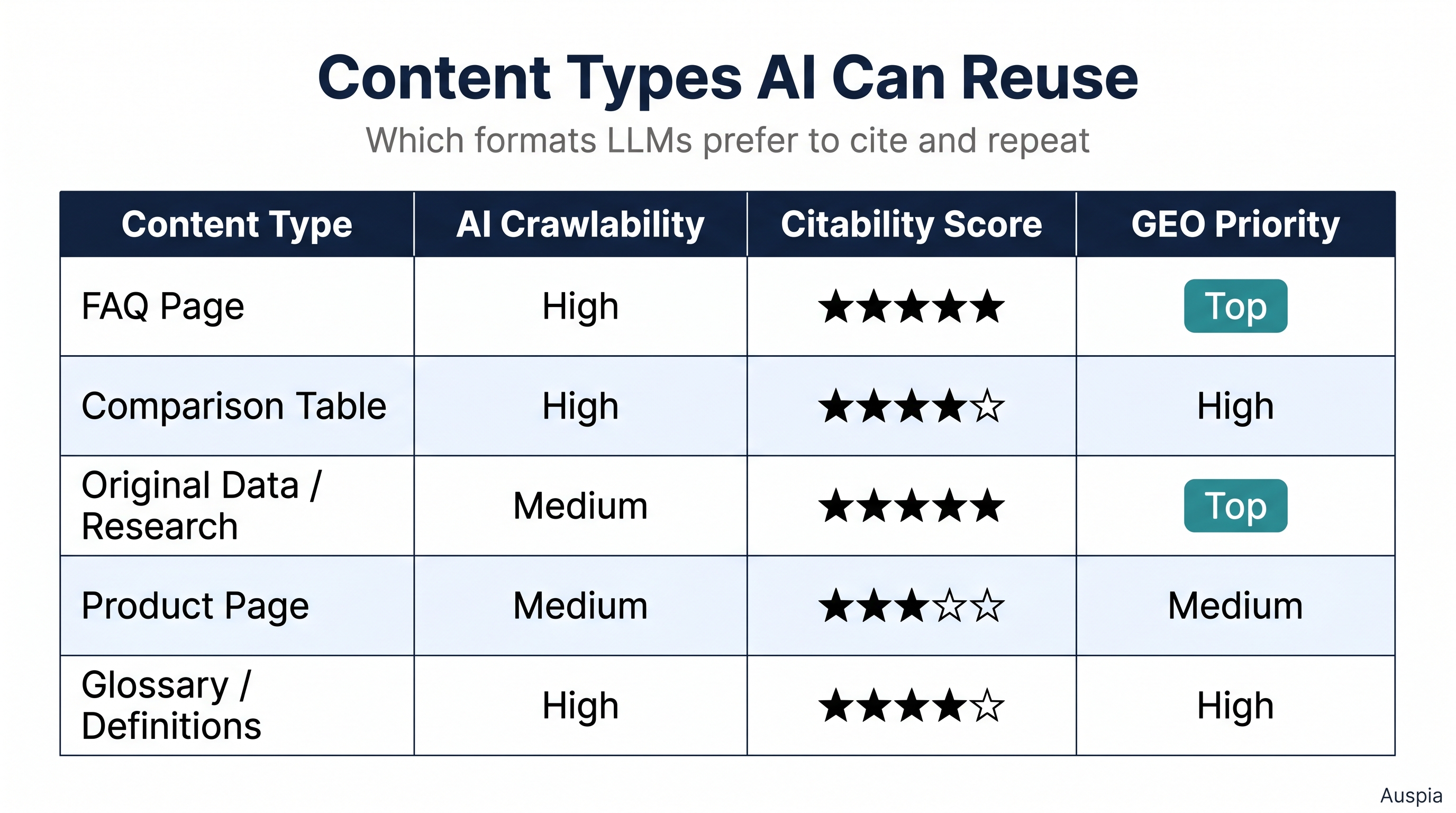
Content types AI systems can reuse
Different content formats serve different GEO jobs. A glossary may help definitions. A comparison table may help recommendations. Original data may help citations.
Content type | Best GEO use | Common mistake | Better version |
|---|---|---|---|
FAQ | Answer extraction | Writing fake questions no one asks | Use real sales, support, and search questions |
Comparison table | Shortlist and evaluation prompts | Only comparing yourself against weak alternatives | Include criteria, trade-offs, and fit |
Original data | Citation earning | Publishing numbers without methodology | Explain sample, date, method, and limits |
Product page | Recommendation prompts | Hiding details behind vague benefits | State audience, integrations, use cases, limits |
Glossary | Definitions and entity clarity | Writing thin dictionary entries | Add examples, related terms, and when to use it |
A practical beginner workflow
Use this when improving one important page.
- Pick one prompt cluster. Start with a real question, such as "What are the best GEO tools for B2B SaaS?" or "How do I make my website citable by AI search?"
- Map the answer criteria. List what an AI answer would need: category, audience, pros and cons, evidence, pricing, integrations, and limitations.
- Rewrite the page opening. Give the direct answer in the first 150 words.
- Add a comparison or checklist. Make the content extractable instead of purely narrative.
- Add proof. Include original examples, screenshots, data, or a transparent methodology.
- Fix crawlability. Check robots rules, rendering, internal links, and canonical signals.
- Align entity facts. Make the same product and company facts consistent across your site and trusted profiles.
- Test prompts monthly. Use a fixed prompt list and record whether the page, brand, or claim appears in AI answers.
For ongoing measurement, try Auspia's AI Search Visibility Checker to see where brand visibility gaps appear across answer-style queries.
What not to do
GEO is still young, and that makes it easy to sell bad shortcuts. Avoid these moves:
- Do not mass-publish thin AI articles just to create volume.
- Do not claim "guaranteed AI recommendations." No serious operator can promise that across platforms.
- Do not stuff pages with unnatural question variants.
- Do not block the crawlers you expect to retrieve your content.
- Do not create fake citations, fake reviews, or fake third-party mentions.
- Do not treat social reposting as a substitute for source quality.
The goal is not to trick a model. The goal is to become a safer, clearer source for a model to use.
Quick checklist
Before publishing a GEO page, ask:
- Does the first section answer the main question directly?
- Is the page accessible to the crawlers and search systems you care about?
- Are claims supported by examples, data, documentation, or clear reasoning?
- Are tables, lists, and FAQ blocks easy to extract?
- Does the page explain who the advice is for and who it is not for?
- Are product and brand facts consistent with the rest of the web?
- Is there a plan to update the page when the market changes?
- Are you tracking AI answer visibility with a repeatable prompt list?
FAQ
What is GEO in simple terms?
GEO, or Generative Engine Optimization, is the practice of making content easier for AI answer systems to discover, understand, trust, and cite. It overlaps with SEO, but the target is not only a search ranking. The target is inclusion in AI-generated answers, summaries, recommendations, and citations.
Do AI models only prefer authoritative websites?
No. Authority helps, but smaller brands can still earn visibility with specific, well-structured, original content. A niche benchmark, a clear implementation guide, or a strong comparison table can be more useful than a generic article from a large site.
Is freshness more important than authority?
It depends on the topic. Freshness matters more for fast-changing categories, product comparisons, AI platform behavior, legal updates, pricing, and market data. Authority matters more for definitions, technical guidance, medical or financial topics, and claims that require trust.
How many platforms should I publish on?
Start with your own site first. Then expand to a few credible surfaces where your buyers already look for validation: documentation hubs, partner pages, review platforms, marketplaces, podcasts, or industry publications. More platforms are not automatically better if the content is low quality or inconsistent.
How do I measure whether GEO is working?
Build a fixed prompt library, test it on the AI platforms that matter to your buyers, and track brand mentions, citation URLs, answer position, sentiment, and accuracy over time. Also watch assisted conversions, branded search lift, referral traffic from AI answer engines, and sales calls that mention AI-assisted research.
Author: Priya Nair, LLM Content Optimization Researcher, 700+ Prompts Studied at Auspia. Priya writes about LLM-ready content, answer synthesis, and practical ways to make pages clearer for AI retrieval systems.