Executive summary
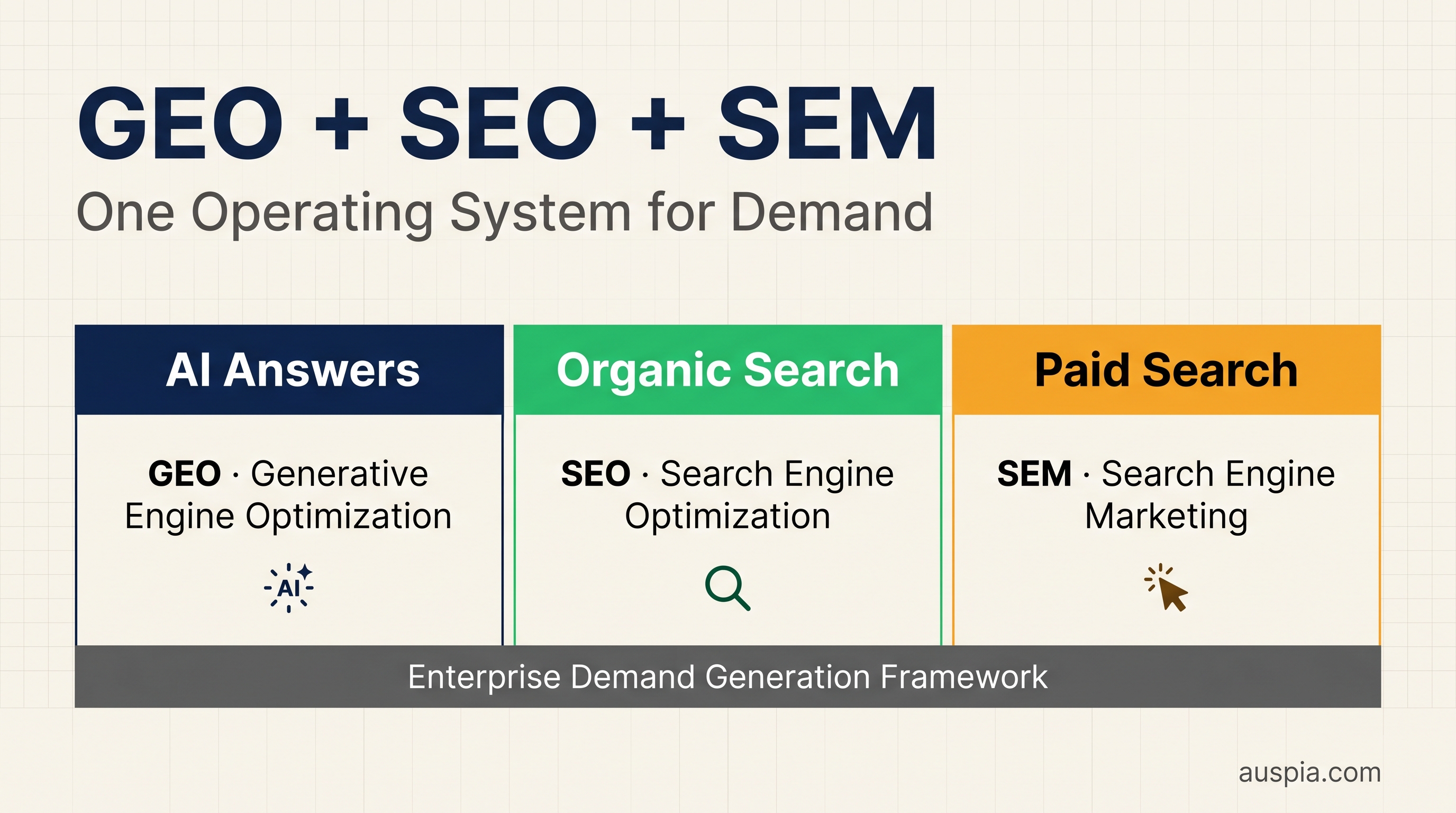
GEO, SEO, and SEM should not fight for the same line item. In an enterprise marketing system, they do different jobs at different moments of the buyer journey.
GEO helps a brand appear inside AI-generated answers and recommendations. SEO helps buyers find, validate, and compare information in organic search. SEM gives teams controlled visibility when the buyer is ready to click, evaluate, or buy. The practical question is not "which one replaces the others?" It is: how do we make the three channels share signals, pages, budgets, and measurement?
This article builds on a useful point from Reanod's Chinese-language discussion of GEO, SEO, SEM, and brand marketing: GEO is not a replacement for older marketing work. It is a new layer that sits on top of the search and demand system. Auspia's view is slightly stricter: if GEO is managed as a separate campaign, it becomes expensive noise. If it is connected to SEO pages, SEM intent data, brand entity work, and answer-ready content, it becomes a compounding asset.
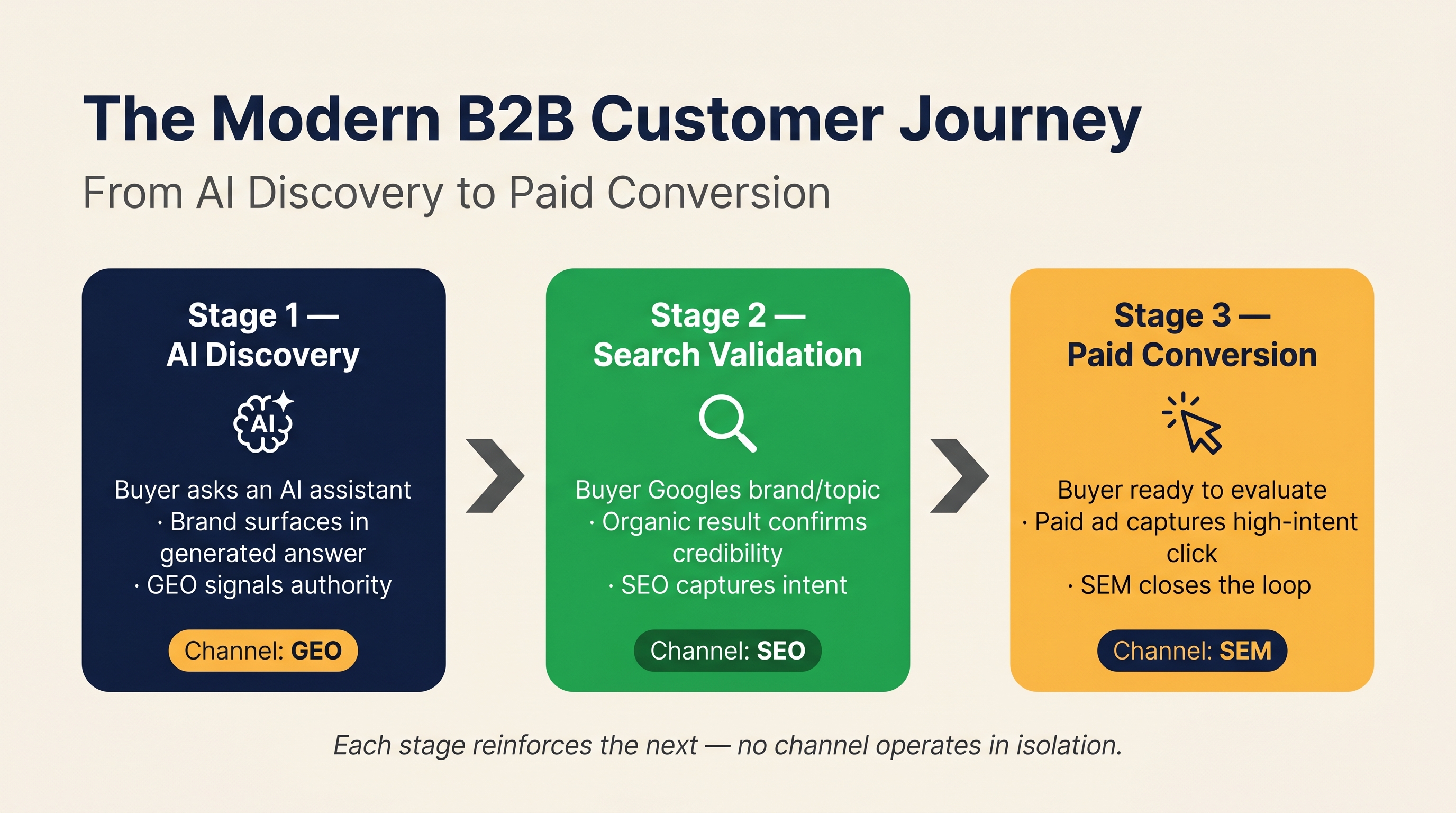
The short answer: GEO creates AI trust, SEO creates searchable proof, SEM creates controlled demand capture
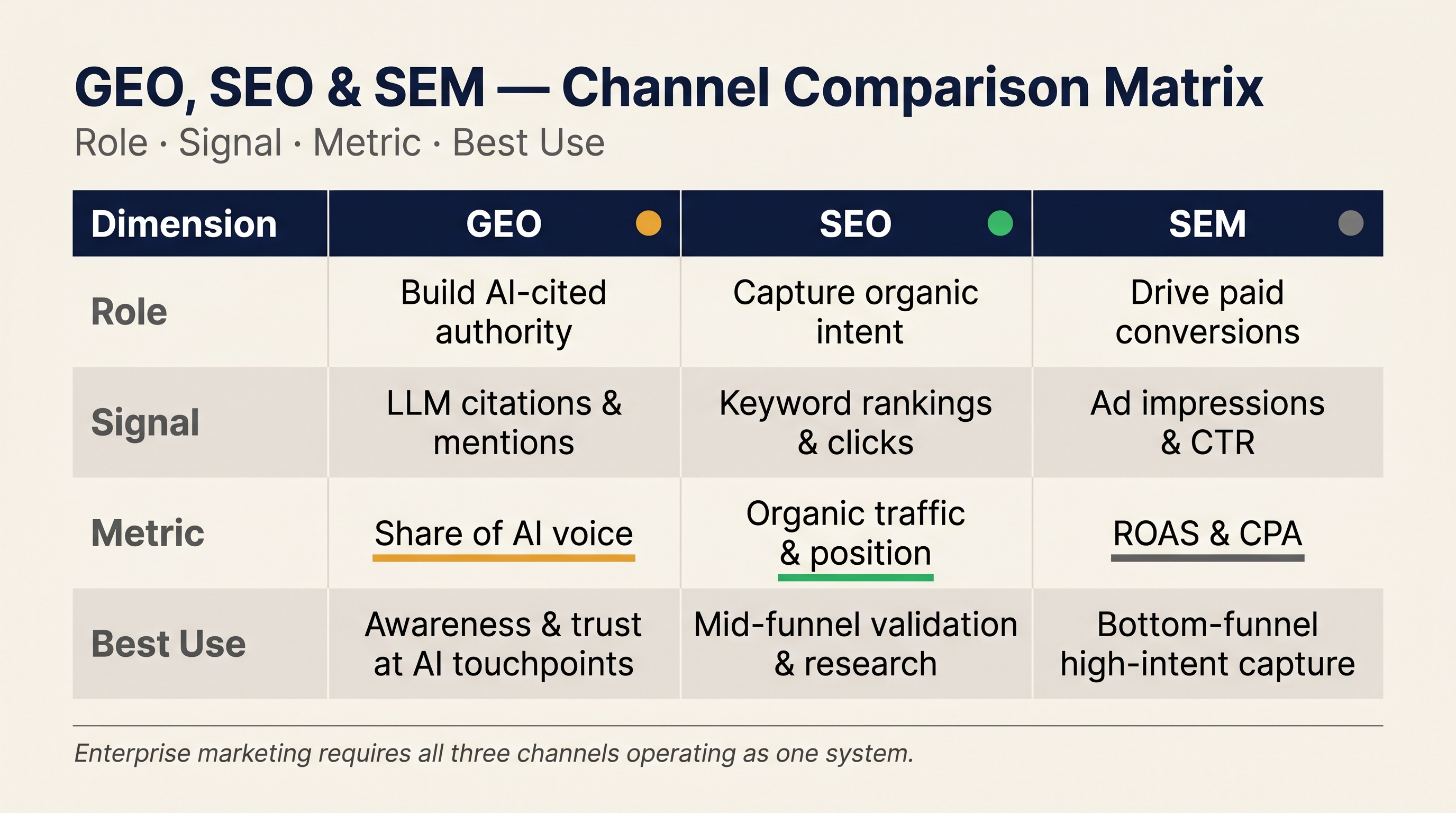
For most enterprise teams, the cleanest division of labor looks like this:
Channel | Primary job | Main surface | Useful metrics | Best use |
|---|---|---|---|---|
GEO | Get cited, mentioned, or recommended in AI answers | ChatGPT, Perplexity, Gemini, Google AI experiences, answer engines | Share of AI voice, citations, brand mentions, recommendation position | Early discovery, category education, shortlist influence |
SEO | Rank and earn organic traffic from search engines | Google Search, Bing, vertical search, organic listings | Rankings, clicks, impressions, qualified organic sessions, assisted conversions | Research, comparison, proof, long-tail demand |
SEM | Buy visibility for high-intent queries and audiences | Paid search ads, shopping ads, remarketing, landing pages | CTR, CPC, CPA, ROAS, conversion rate, pipeline | Launches, competitive capture, seasonal demand, conversion tests |
SEO has a long-established public playbook. Google's own Search Central guidance still starts with making useful, accessible, well-structured content that search engines can crawl and understand. SEM is also explicit: advertisers use paid search campaigns to show ads against relevant searches and pay for measurable traffic or conversion outcomes. GEO is newer and messier. It depends on whether AI systems can understand your brand, trust your pages, retrieve your facts, and summarize you accurately.
That difference matters. A page can rank well in search and still fail inside an AI answer if it lacks clear definitions, brand facts, concise evidence, or quotable explanations. A paid search campaign can convert well today and still teach the organization nothing about how AI systems describe the brand tomorrow.
Why enterprises get the relationship wrong
The usual mistake is budget politics. SEO teams hear GEO and worry that years of technical and content work will be treated as old infrastructure. Paid media teams hear GEO and worry that leadership will move spend into a channel with softer attribution. Brand teams hear GEO and think it belongs to content, not them.
That framing is backward.
GEO needs SEO because AI systems still rely heavily on retrievable web content, structured brand facts, and pages that explain the topic clearly. GEO needs SEM because paid search data reveals which queries have commercial pressure, which messages convert, and which landing pages actually move buyers. GEO also needs brand work because AI answers compress a brand into a few sentences. If those sentences are inconsistent across the web, the model has no clean story to repeat.
The better operating model is shared infrastructure:
- Use SEO pages as durable evidence assets that AI systems and human buyers can both read.
- Use SEM query and conversion data to prioritize which GEO topics deserve content investment.
- Use GEO monitoring to find where AI answers omit, misdescribe, or under-rank the brand.
- Use brand entity work to make company facts, product categories, use cases, pricing context, and proof points consistent.
Where GEO fits in the buyer journey
A modern B2B buyer may not begin with a blue-link search result. They might ask an AI assistant: "Which tools help a SaaS company measure AI search visibility?" or "What should I compare before choosing an enterprise SEO platform?" The answer may mention a few categories, brands, risks, and next steps before the buyer ever reaches a search engine.
That is the GEO moment. The buyer is forming a shortlist before your analytics platform records a visit.
Then comes the SEO moment. The same buyer searches the brand, category, competitor comparisons, reviews, integration details, pricing, and implementation questions. Organic pages need to prove the claims that the AI answer introduced.
Finally, SEM can catch high-intent demand: competitor queries, category terms, retargeting, demo-intent searches, and landing page tests. Paid search should not be the only source of demand, but it is still useful when timing, control, and message testing matter.
The sequence is rarely perfect. Buyers bounce between AI answers, search results, social proof, ads, review sites, and sales conversations. Still, the pattern is clear enough: GEO influences the first mental shortlist, SEO supports evaluation, and SEM captures or accelerates the conversion path.
The operating model: one content system, three outputs
Treat every important commercial topic as a three-channel asset, not a one-channel page.
Start with the topic cluster. For example, a company selling AI search analytics might choose "AI search visibility measurement" as a priority theme. The SEO version of that theme needs a crawlable guide, comparison pages, glossary pages, internal links, schema, and examples. The GEO version needs concise definitions, answer blocks, brand facts, prompt coverage, citation-worthy evidence, and clear claims that an AI system can safely summarize. The SEM version needs landing pages, ad copy, negative keywords, conversion paths, and tests against buyer intent.
The same research should feed all three.
A practical workflow:
- Map the buyer questions. Include Google queries, AI prompts, sales objections, support questions, and competitor comparison language.
- Build the evidence page. Make it useful for humans first: definitions, examples, evaluation criteria, limitations, screenshots, and FAQ.
- Add answer-ready structure. Put the direct answer near the top, use tables, state facts plainly, and cite sources where possible.
- Launch paid tests only where intent is proven. Use SEM to test messaging, pain points, and landing page offers.
- Measure all three layers. Track organic rankings and clicks, paid conversion economics, and AI answer visibility.
- Feed the findings back into the content. If AI answers miss a product capability, clarify the page. If paid search converts on a phrase, add organic and GEO support for that phrase.
Budgeting: do not rob one channel blindly
There is no universal split. A startup with no organic footprint may need more SEO foundation before GEO can work. A mature B2B company with strong rankings may need to shift more effort into AI answer monitoring, brand entity cleanup, and citation earning. An ecommerce or high-CPC category may keep SEM as the main conversion lever while using SEO and GEO to reduce dependence on paid clicks over time.
A simple enterprise allocation rule works better than a fixed percentage:
Situation | Budget move |
|---|---|
Organic traffic is weak and pages are thin | Build SEO foundations before scaling GEO claims |
Rankings are strong but AI answers ignore the brand | Add GEO audits, answer-ready page updates, and third-party evidence work |
Paid search CPA is rising | Use SEO/GEO content to pre-educate buyers and improve landing page quality |
Brand is often mentioned incorrectly by AI tools | Invest in entity consistency, about pages, product facts, and source cleanup |
New category launch | Run SEM tests for message-market fit, then turn winners into SEO and GEO assets |
The point is not to cut SEM because GEO sounds new. The point is to stop funding isolated channels that do not learn from each other.
What to measure when the three channels work together
Channel dashboards are useful, but they miss the cross-channel effect. Enterprise teams should keep the channel metrics and add a few shared metrics.
For GEO, track whether target prompts mention the brand, whether answers cite your pages or third-party sources, where the brand appears in recommendation lists, and whether the description is accurate. For SEO, track rankings and clicks, but also track whether the pages answer the questions buyers ask in AI tools. For SEM, track CPA and ROAS, but also monitor which ad messages deserve to become evergreen content.
Auspia teams usually start with a shared scorecard:
Layer | Question to answer | Example metric |
|---|---|---|
AI visibility | Are we present when buyers ask AI for options? | Brand mention rate across target prompts |
Citation quality | Are we cited for the right reasons? | Citation count by page and source type |
Organic validation | Can buyers verify the claim in search? | Ranking and CTR for validation queries |
Paid capture | Can we convert high-intent demand efficiently? | CPA, ROAS, landing page conversion rate |
Message consistency | Do AI answers, organic pages, and ads describe us the same way? | Misdescription count and corrected pages |
This is where tools help. A manual prompt check is fine for a small site, but enterprises need repeatable tracking. Auspia's AI Search Visibility Checker can help teams inspect how a brand appears in AI-style answers, while the Website SEO Score Checker is useful for finding technical and on-page issues that weaken the SEO foundation.
Common mistakes
The first mistake is treating GEO as PR distribution. Publishing the same promotional paragraph across low-quality sites does not build a trustworthy AI source footprint. AI systems need clear, corroborated, retrievable facts.
The second mistake is keeping GEO away from technical SEO. If key pages are blocked, slow, thin, poorly structured, or unclear, the brand is harder for both search engines and AI systems to interpret.
The third mistake is using SEM as a permanent crutch. Paid search is excellent for control and speed, but it gets expensive when the brand has no organic proof layer and no AI visibility at the top of the journey.
The fourth mistake is measuring only last-click conversions. GEO often changes the shortlist before a website visit. SEO often validates a claim before a demo request. SEM often closes demand that other channels warmed up. Last-click reporting makes each team defend its own corner instead of improving the system.
A 30-day action plan
Week 1: choose 20 commercial prompts and 20 search queries that matter to the business. Include category, comparison, problem, and purchase-intent language.
Week 2: audit the pages that should answer those prompts and queries. Check crawlability, headings, direct answers, tables, product facts, proof points, author or company clarity, and internal links.
Week 3: update the highest-value pages. Add concise answer blocks, stronger evidence, clearer product language, FAQ sections where useful, and comparison tables. Do not stuff keywords. Make the page easier to quote.
Week 4: connect paid learning. Pull the top converting SEM queries and ad messages. Decide which ones need organic support, which ones need GEO-ready explanations, and which ones should remain paid-only because they are too narrow or too competitive.
After 30 days, repeat the measurement. The goal is not to "finish GEO." The goal is to create a loop where AI visibility, organic search, and paid search keep improving the same demand system.
FAQ
Is GEO replacing SEO?
No. GEO changes where discovery happens, but it still depends on many SEO-adjacent assets: crawlable pages, clear information architecture, helpful content, entity consistency, and external evidence. SEO remains the foundation for searchable proof.
Is SEM still worth it if AI answers reduce search clicks?
Yes, but the job changes. SEM is strongest when teams need control, speed, testing, and bottom-funnel capture. If AI answers reduce some informational clicks, paid search should focus more carefully on commercial intent, remarketing, and conversion paths.
Which channel should an enterprise fix first?
Fix the weakest foundation first. If the site cannot be crawled or the content is thin, start with SEO. If AI tools misdescribe the brand, start with GEO and entity cleanup. If the team needs immediate pipeline while content work matures, use SEM carefully and learn from the query data.
What is the simplest way to make content work for both SEO and GEO?
Put the direct answer near the top, use clear headings, explain the category in plain language, include comparison tables, state brand facts consistently, and support claims with sources. That helps search engines, AI systems, and human buyers.
Sources and further reading
- Reanod, "GEO and traditional SEO/SEM/brand marketing: replacement or coexistence?" https://www.reanod.com/waimaoyingxiao/3282.html
- Google Search Central, "SEO Starter Guide." https://developers.google.com/search/docs/fundamentals/seo-starter-guide
- Google Ads Help, "About Search campaigns." https://support.google.com/google-ads/answer/1722122
- Aggarwal et al., "GEO: Generative Engine Optimization." https://arxiv.org/abs/2311.09735
Author: Maya Ellison, 12-Year GEO Strategy Researcher at Auspia. Maya writes about AI search visibility, brand entity clarity, and practical GEO operating systems for growth teams.