Quick answer
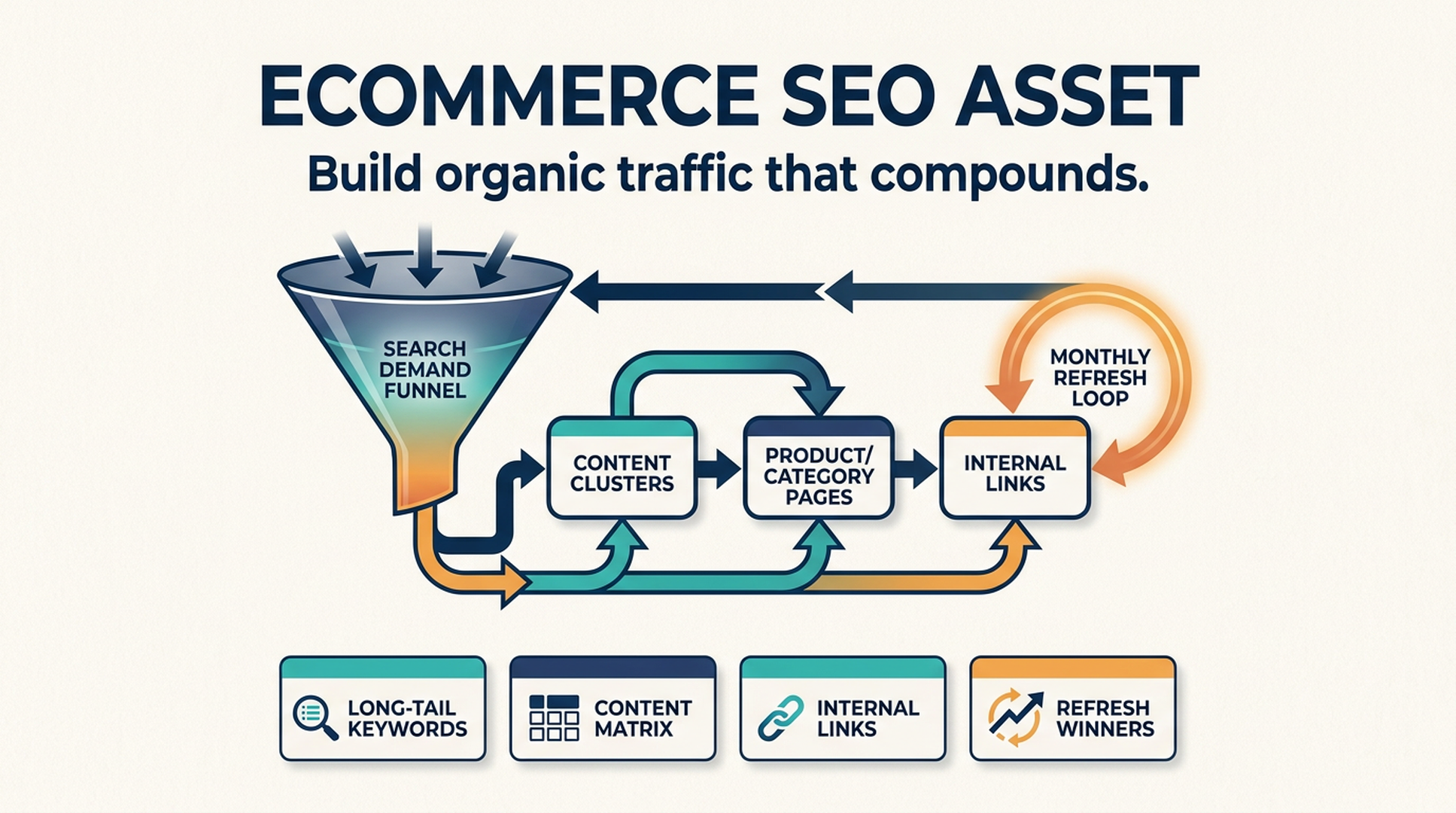
An ecommerce site can use SEO to build a traffic asset, but only if it treats content like a product line, not a side project. The practical path is: find low-competition long-tail keywords, publish useful category and problem-solving content, connect those pages with internal links, earn authority over time, and refresh the winners before they decay.
Paid ads rent attention. SEO builds pages that can keep working after the campaign budget is gone. That does not mean SEO is free or fast. It means the work compounds if you build it as a system.
Why ecommerce teams should not rely only on paid traffic
Most ecommerce operators start with ads because ads give feedback quickly. Launch a campaign, test the creative, watch the conversion rate, scale what works. That is useful.
The problem is that paid traffic can become the whole business model. Cost per click rises. Creative fatigue shows up. A platform policy change or tracking issue can flatten a good week. The store becomes strong at buying visits but weak at owning demand.
SEO solves a different problem. It captures people who are already searching:
- "best running shoes for flat feet"
- "how to choose a linen duvet cover"
- "ceramic vs stainless steel dog bowl"
- "small apartment standing desk ideas"
These are not random readers. They are buyers, researchers, comparison shoppers, and repeat problem-solvers. If your pages answer those searches better than the generic marketplace pages, you earn a shot at traffic that does not reset to zero every morning.
Auspia's view is blunt: SEO is not a blog calendar. It is inventory for search demand.
Step 1: stop chasing giant keywords first
The fastest way to waste six months is to start with a huge keyword like "office chair," "supplements," "pet food," or "running shoes." Those keywords look attractive because the volume is high. They are also crowded with marketplaces, review publishers, legacy brands, and affiliate sites with years of authority.
A new or mid-sized ecommerce site usually needs a smaller doorway.
Long-tail keywords are better starting points because they carry context:
Broad keyword | Better long-tail target | Why it is easier to win |
|---|---|---|
office chair | best office chair for lower back pain under 300 | Clear buyer problem and budget |
yoga mat | non slip yoga mat for hot yoga beginners | Specific use case and audience |
cat toys | best cat toys for indoor cats that get bored | Strong problem angle |
linen sheets | linen sheets for hot sleepers | Clear benefit and comparison intent |
standing desk | standing desk for small apartment bedroom | More precise buying situation |
The goal is not to stay small forever. The goal is to collect qualified traffic while your site earns topical authority. Small wins create data. Data tells you which categories deserve bigger bets.
Step 2: map keywords to page types
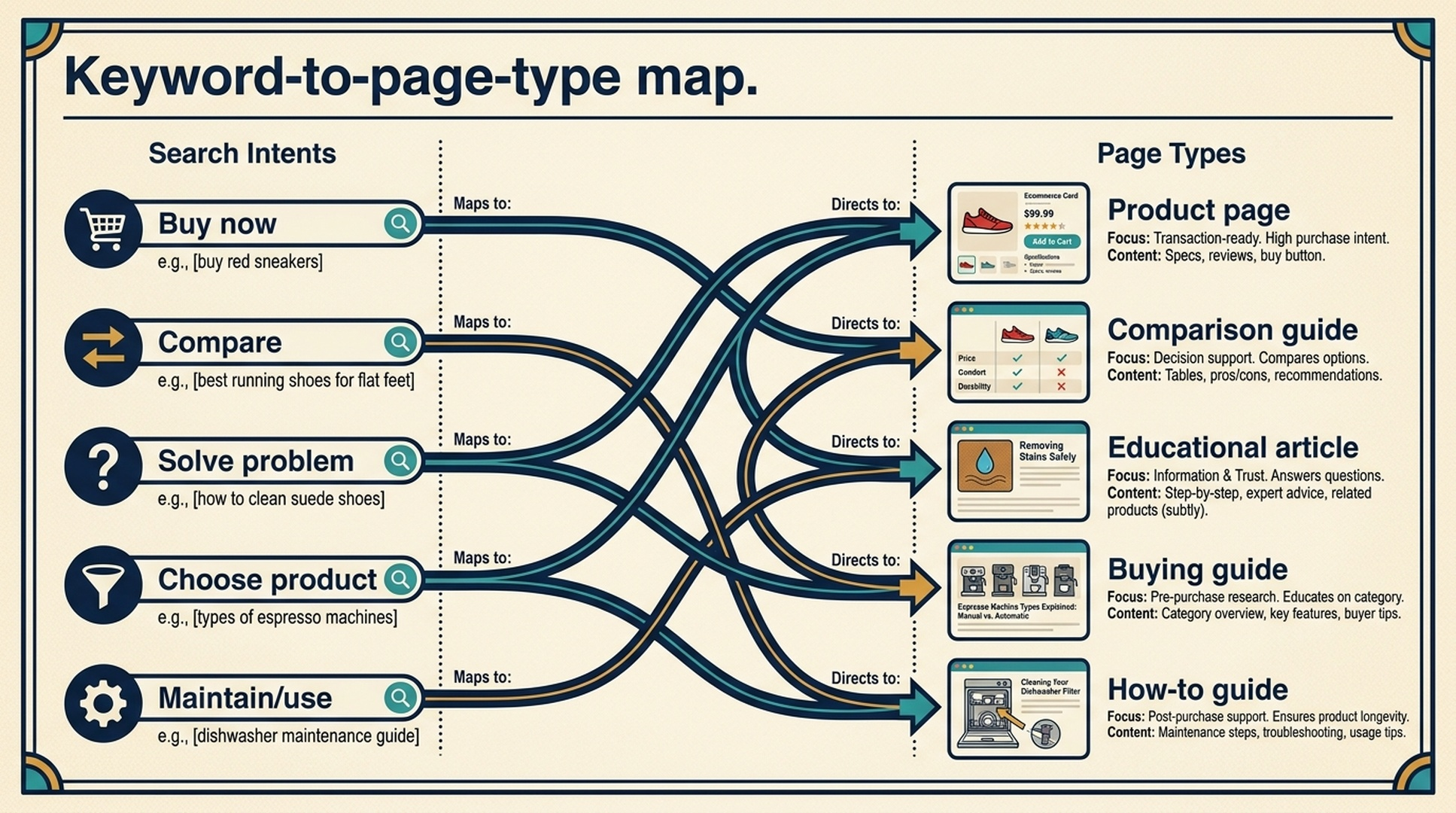
A common mistake is turning every keyword into a blog post. Ecommerce SEO needs several page types working together.
Some keywords need a category page. Some need a buying guide. Some need a comparison page. Some need a product page with better copy. If you pick the wrong page type, even a well-written article can underperform because it does not match the searcher's job.
Use this simple mapping:
Search intent | Example query | Best page type | Conversion role |
|---|---|---|---|
Buy now | "linen duvet cover queen" | Product or collection page | Direct sale |
Compare options | "linen vs cotton duvet cover" | Comparison guide | Move buyer toward a category |
Solve a problem | "why does my duvet feel hot" | Educational article | Capture early demand |
Choose a product | "best duvet cover for hot sleepers" | Buying guide | Recommend products with context |
Maintain or use | "how to wash linen duvet cover" | How-to guide | Support trust and repeat visits |
This matters for AI search too. Answer engines tend to pull from pages that make the question, entity, answer, and evidence easy to understand. A messy product page trying to answer five different intents is harder to cite than a clean guide with direct sections.
Step 3: use AI to scale drafts, not to replace judgment
AI can help ecommerce teams produce content faster. It can turn a keyword set into a brief, draft FAQ answers, compare product attributes, rewrite meta descriptions, and create outlines for clusters.
But AI-only content is usually thin in the places that matter. It says the correct thing without proving that a real person touched the category.
For ecommerce SEO, every important page needs some form of real input:
- Product experience: sizing notes, materials, durability, edge cases, returns data
- Customer language: review phrases, support tickets, objections, pre-sale questions
- Comparison detail: when product A is better than product B
- Original photos or diagrams: fit, use cases, measurements, examples
- Brand point of view: what you refuse to recommend and why
AI is good at structure. Humans are good at taste, judgment, and uncomfortable details. You need both.
A useful workflow looks like this:
- AI builds the keyword brief and page outline.
- The ecommerce team adds product facts, customer objections, and internal data.
- AI drafts the first version.
- A human editor cuts fluff, adds examples, and checks claims.
- The final page gets internal links, schema, metadata, and a conversion block.
If the page could have been written by any store in the category, it is not finished.
Step 4: build a content matrix, not a pile of posts
Ten articles rarely change an ecommerce business. A content matrix can.
Pick one commercial category and build around it. For example, a store that sells pet products might create a cluster around indoor cat enrichment:
Cluster layer | Page examples | Purpose |
|---|---|---|
Hub page | Indoor cat enrichment guide | Own the broad topic |
Buying guides | Best toys for bored indoor cats; best puzzle feeders for cats | Capture product-selection intent |
Comparisons | Wand toys vs puzzle toys; automatic laser toys vs treat puzzles | Help shoppers choose |
Problem pages | Why is my indoor cat destructive?; how to tire out an indoor cat | Capture early problem searches |
Product support | How to clean cat puzzle toys; how to introduce a puzzle feeder | Build trust after purchase |
This structure gives Google and AI answer systems a clearer picture of what your site knows. It also gives readers natural next steps. A problem page can point to a comparison. A comparison can point to a buying guide. A buying guide can point to a collection page.
One page is a bet. A cluster is a system.
Step 5: make pages easy for search engines and answer engines to parse
Content quality is not enough if the page is hard to understand. Ecommerce sites often bury useful answers under scripts, tabs, vague headings, thin product descriptions, or filters that search engines cannot crawl well.
At minimum, check these items:
- The title includes the main query naturally.
- The H1 is clear and not duplicated across many pages.
- H2 sections answer distinct questions.
- Product and category pages have useful copy, not only grids.
- Images include descriptive alt text.
- Pages load quickly on mobile.
- Canonical tags are correct.
- Internal links point to related guides, collections, and products.
- Schema matches the page type and visible content.
For AI search readiness, add one more rule: make the answer extractable. If a section answers "linen vs cotton for hot sleepers," say the answer directly before adding nuance. Do not make the reader or the model infer it from six paragraphs of vague advice.
Auspia tools can help here. Start with the Website SEO Score Checker to catch technical and on-page gaps, then use the AI Search Visibility Checker to review whether important pages are easy for answer engines to understand.
Step 6: use internal links like a product recommendation system
Internal links are not decoration. They move authority, clarify topic relationships, and help shoppers continue the buying journey.
A simple pattern works well:
- Problem article links to the guide that solves the problem.
- Buying guide links to the relevant collection and two or three products.
- Comparison page links to both alternatives and explains who each one fits.
- Product page links back to use-case guides, care guides, and size guides.
- Hub page links to every important subtopic in the cluster.
Avoid turning every paragraph into a link farm. Use links where the next click is genuinely useful.
For example, a page about "standing desk for small apartment bedroom" can link to:
- A buying guide for compact standing desks
- A comparison of crank vs electric desks
- A collection page for desks under a specific width
- A setup guide for cable management in small rooms
That is a content network. It is also a better shopping experience.
Step 7: earn authority without chasing spammy backlinks
Backlinks still matter, but ecommerce teams often approach them badly. Buying low-quality links or swapping links with unrelated sites may create short-term movement, but it can also damage the site.
Better link assets usually come from content that has a reason to be cited:
- Original data from customer surveys
- Size charts or calculators
- Material care guides
- Comparison tables that are more useful than competitor pages
- Visual explainers or teardown posts
- Expert interviews, especially in health, fitness, finance, or safety-adjacent categories
For a cookware brand, a useful guide to pan materials can earn links. For a pet brand, a vet-reviewed enrichment checklist has a better shot than another generic "best cat toys" post. For a furniture brand, a room measurement calculator may attract more natural links than a coupon page.
Authority follows usefulness more often than volume.
Step 8: review, refresh, and monetize the winners
SEO pages do not stay fixed. Rankings move, products change, competitors copy, search intent shifts, and AI answer systems start summarizing parts of the buying journey.
Set a monthly review routine:
What to check | What to do |
|---|---|
Pages gaining impressions but low clicks | Rewrite titles and descriptions |
Pages with traffic but weak sales | Add product modules, comparison tables, or clearer CTAs |
Pages losing rankings | Refresh examples, update product availability, improve sections |
Pages ranking for unexpected queries | Add new sections or spin out supporting pages |
Pages with AI search potential | Add direct answers, clear entities, citations, and schema |
This is where SEO becomes an asset instead of a publishing treadmill. The best pages deserve maintenance. A guide bringing qualified traffic should not sit untouched for a year while the team publishes new articles nobody asked for.
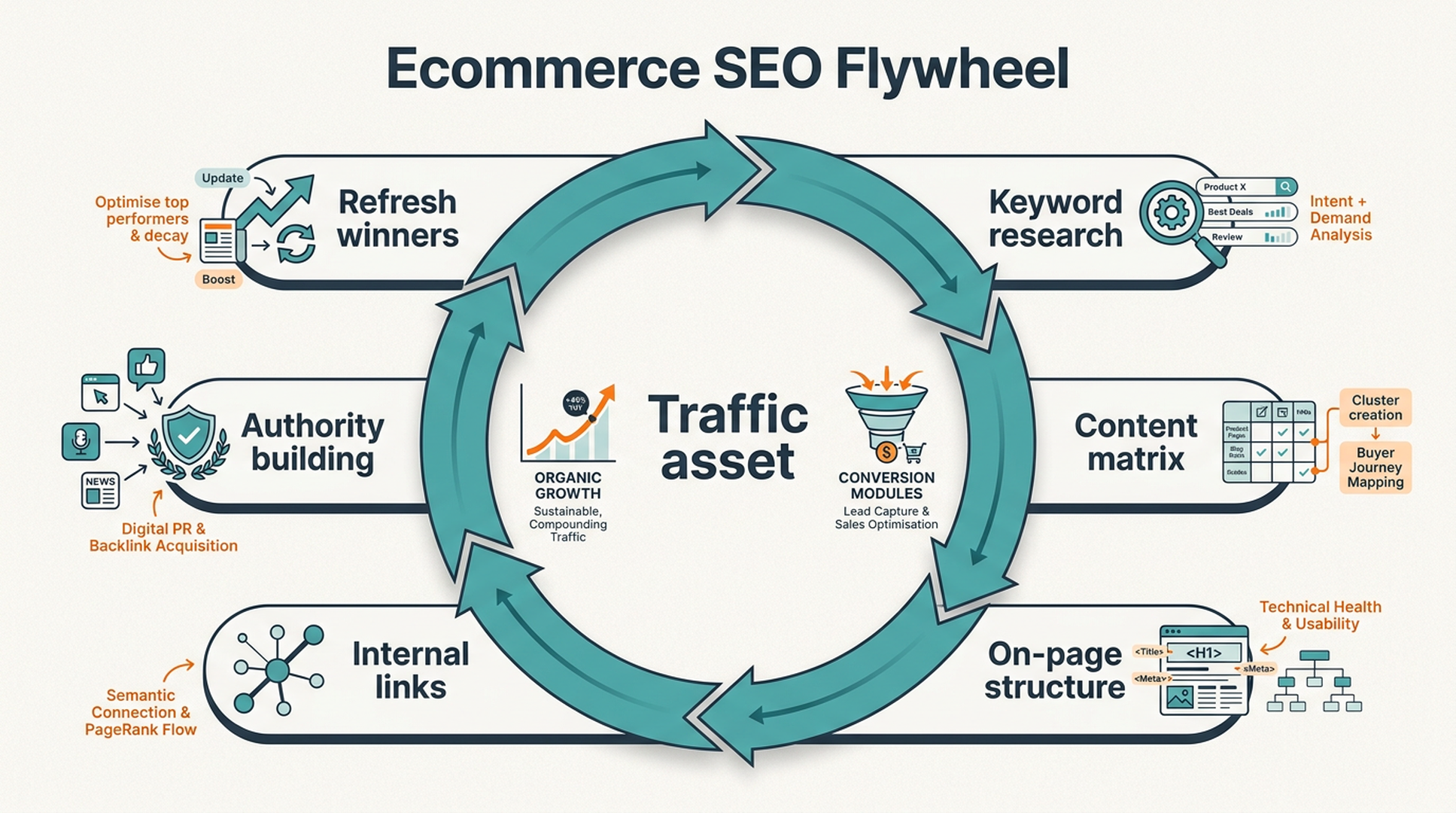
A realistic 12-month path
SEO growth rarely feels impressive at the start. That is normal.
A reasonable path for a focused ecommerce category might look like this:
Stage | Timeframe | What usually happens | What to focus on |
|---|---|---|---|
Foundation | 0-3 months | Pages are indexed, traffic is small, data is noisy | Publish the first cluster and fix technical issues |
Early traction | 3-6 months | Long-tail rankings appear, some pages get impressions | Improve titles, add internal links, expand winners |
Compounding | 6-12 months | A few guides and category pages begin driving steady traffic | Refresh winners, build links, add conversion modules |
Asset phase | 12 months+ | Clusters support each other and traffic becomes more predictable | Scale clusters and defend top pages |
There are exceptions. Some sites move faster because they already have authority. Some move slower because the category is brutal or the technical foundation is weak. But the pattern is usually the same: quiet early work, small wins, then compounding if the team keeps improving the right pages.
Common mistakes that slow ecommerce SEO
The mistakes are boring, but they are expensive.
Teams publish articles before fixing indexability. They chase broad keywords before owning long-tail intent. They write informational posts with no path to products. They use AI drafts without adding real product experience. They treat internal links as an afterthought. They publish new content while older winners decay.
The biggest mistake is impatience. SEO is slow in the beginning because trust has to be earned. But slow does not mean passive. Every week should produce one of four things: a new page, a better page, a stronger link, or a cleaner technical foundation.
The Auspia ecommerce SEO checklist
Use this checklist before scaling content production:
- Choose one commercial category to build first.
- Find 30-100 long-tail keywords with clear buyer or problem intent.
- Map each keyword to the right page type.
- Build one hub page and a cluster of guides, comparisons, and how-to pages.
- Add product experience, customer language, and real examples to AI-assisted drafts.
- Link pages together based on the buyer journey.
- Add structured data only when it matches visible content.
- Review performance monthly and refresh pages that show traction.
- Add conversion blocks to pages that already get qualified traffic.
- Keep paid ads running where they work, but use SEO to reduce total dependence on rented traffic.
FAQ
How many articles does an ecommerce site need for SEO?
There is no magic number. A focused cluster of 30 useful pages can beat 100 disconnected posts. Start with one category, cover the main buyer questions, and expand from pages that show impressions or sales-assisted traffic.
Should ecommerce SEO focus on product pages or blog content?
Both. Product and collection pages capture buying intent. Guides, comparisons, and how-to articles capture research and problem-solving intent. The pages should link to each other naturally.
Can AI write ecommerce SEO content?
AI can draft and structure content, but it needs human input: product facts, customer objections, photos, comparisons, and brand judgment. Pure AI content usually feels generic and is easy to copy.
How long does ecommerce SEO take?
For a new or low-authority site, expect 3-6 months before meaningful long-tail traction and 6-12 months before stronger compounding. Existing authority, technical quality, and category competition can change the timeline.
Is SEO still worth it if ads already work?
Yes, if the business plans to last. Ads are useful for testing and scaling. SEO gives the site a chance to own demand, lower blended acquisition cost, and build pages that keep attracting qualified visitors over time.