Who This Guide Is For (and What You'll Walk Away With)
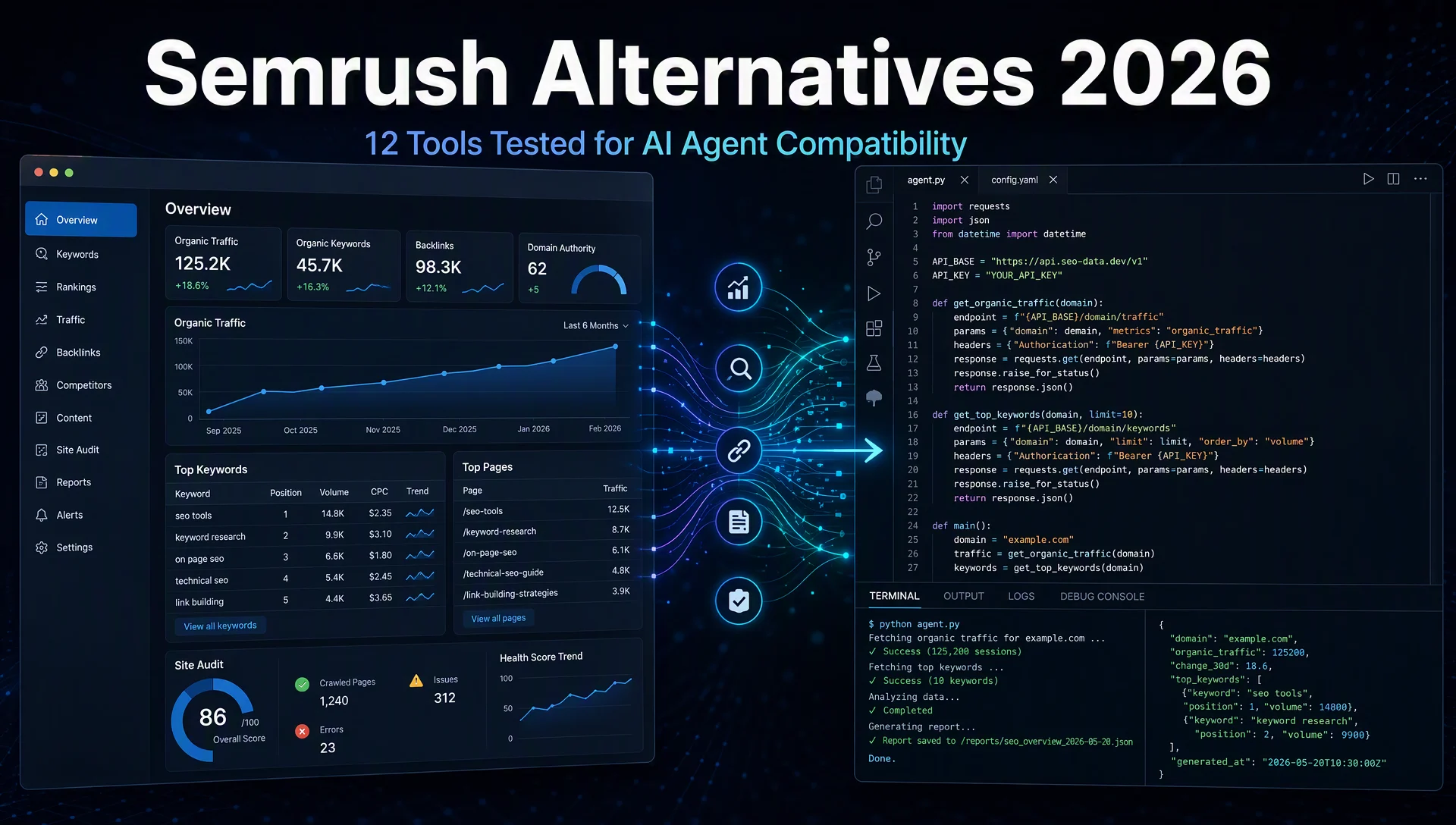
You're new to SEO. You've heard Semrush is the gold standard, but $139.95/month for one seat feels steep when you're just starting out. Worse, you're using an AI coding agent like Codex, Cursor, or Claude Code to help with your SEO work — and you're not sure which tools will actually talk to your agent.
This guide is for you.
By the time you finish reading, you'll have:
- A clear recommendation for the best Semrush alternative for your specific situation — budget, AI-agent use, or both.
- A Codex compatibility score for each tool, so you know which ones your AI assistant can actually query programmatically.
- Ready-to-use Codex SKILL.md files for the top 3 code-first tools — copy, paste, run.
- A free-forever stack that covers the 80% most SEO beginners need, with zero monthly cost.
No prior API experience assumed. If you can copy a prompt into Codex, you can use every tool on this page.
Quick Picks: The 10-Second Recommendations
Your Situation | Best Tool | Starting Price | Codex-Ready? |
|---|---|---|---|
I want a cheaper all-in-one dashboard | SE Ranking | $129/month | Yes — API + MCP |
I want the best backlink data | Ahrefs | $129/month | Yes — API + MCP (Lite+) |
I want to automate everything with AI agents | DataForSEO | $50 deposit (pay-as-you-go) | Yes — MCP + CLI |
I'm on a zero budget | Google Search Console + Bing Webmaster | Free | Yes — multiple free MCPs |
I want the simplest tool for solo blogging | Mangools | $29.90/month | No (dashboard-only) |
I need PPC + SEO in one place | SpyFu | $16/month | Limited API |
The 2026 Reality: Why "Just Use Semrush" Is No Longer the Only Answer
Three things changed SEO tools in 2025–2026:
1. AI search visibility became a separate problem. Traditional rank tracking tells you where you rank on Google. It doesn't tell you whether ChatGPT, Perplexity, or Gemini cite your brand. Semrush added AI tracking, but so did SE Ranking, Ahrefs (Brand Radar), and DataForSEO (LLM Mentions API). You no longer need Semrush specifically for this.
2. MCP (Model Context Protocol) made APIs accessible to beginners. In 2024, connecting an SEO tool to an AI agent meant writing code. In 2026, many tools ship with an MCP server — a pre-built connector that lets Codex, Claude Code, or Cursor query SEO data with natural language. The technical bar dropped from "hire a developer" to "paste a config block."
3. The pricing model split widened. Semrush locks you into a subscription. Newer API-first tools like DataForSEO charge per API call with no monthly minimum beyond a one-time $50 deposit. For beginners running occasional reports, that's the difference between $1,680/year and $50 that lasts for months.
The question isn't "which tool beats Semrush?" — it's "which tool matches how you actually work in 2026?"
Before You Choose: The Codex Compatibility Factor
Most SEO tool roundups evaluate features and pricing. We add a third dimension: can your AI agent use it?
Here's what each compatibility level means in practice:
Level | What It Means | Example |
|---|---|---|
Native MCP | Codex can query the tool directly through a pre-built connector. Paste a config, ask a question, get data back. | DataForSEO MCP, Ahrefs MCP |
REST API | Codex can query with a skill or script. Requires an API key and a SKILL.md file (we provide them below). | SE Ranking API, SpyFu API |
CSV export only | You export data manually, feed the CSV to Codex for analysis. Works but adds a manual step. | Mangools, Ubersuggest |
Dashboard-only | No programmatic access. Codex can't query it directly. You'll use the dashboard and paste findings into Codex manually. | Some legacy tools |
If you plan to use Codex for SEO, prioritize tools in the first two rows. Manual CSV workflows work for one-off analyses but get painful fast when you want Codex to monitor your rankings weekly or catch traffic drops automatically.
The Tools, Tested for SEO Beginners With Codex
Each review covers what the tool does, what it costs in 2026, how well it works with AI agents, and — for the top code-first tools — the exact prompt or skill file you need.
Ahrefs
Best for: Backlink analysis and competitor research at scale.
Ahrefs remains the industry's backlink heavyweight — 35+ trillion links, updated faster than any competitor's index. Its keyword database covers 28.7 billion keywords across 170+ countries. For pure SEO research, it's the closest thing to a Semrush replacement.
2026 pricing: Lite starts at $129/month (annual billing). The catch: Ahrefs uses a credit system. Each report costs credits, and the Lite plan's 500 credits/month runs out fast if you're doing heavy research. API access requires at least the Advanced plan ($449/month) or an Enterprise plan ($1,499/month) for production use.
Codex compatibility: Yes — MCP server on paid plans. Ahrefs launched an official hosted MCP server at api.ahrefs.com/mcp/mcp, available on Lite+ plans. It requires a separate MCP-scoped API key (not the same as your v3 API key — this trips up beginners). Once connected, Codex can query backlinks, organic keywords, domain ratings, and Brand Radar data for AI mention tracking.
The beginner catch: The credit system and separate MCP key make Ahrefs one of the more confusing tools to connect. And at $449/month minimum for API access, it's not a beginner-friendly price point for code-first workflows.
Codex-ready? Yes, but expensive. Use the dashboard for manual research first; add MCP access only when you've outgrown the free Ahrefs Webmaster Tools.
Free alternative for beginners: Ahrefs Webmaster Tools (free for verified site owners) gives you limited backlink data, site audit basics, and keyword rankings for your own site — no credit card required.
SE Ranking
Best for: The all-in-one dashboard replacement that won't punish your wallet.
SE Ranking covers roughly 80% of Semrush's feature set: rank tracking across 188 countries, keyword research, site audits, backlink monitoring, competitor analysis, and white-label reporting for agencies. In 2026, it added an AI Search API that tracks brand visibility across Google AI Overviews, AI Mode, ChatGPT, Gemini, and Perplexity — a feature that would cost $350+/month if you bought the equivalent Semrush add-ons.
2026 pricing: Core plan at $129/month (or $103.20/month billed annually). The standalone API starts at $179/month with a $50 minimum deposit option for pay-as-you-go access. The Core plan includes MCP access — no separate add-on required.
Codex compatibility: Yes — API + MCP included on Core. SE Ranking's API covers domain research, keyword analysis, site audits, backlinks, and the new AI Search endpoints — all from a single credit balance. The MCP server is included on the Core plan, which makes it one of the most cost-effective entries into agent-assisted SEO.
Compared to Ahrefs, the big difference: No credit-system confusion. One plan, one API key, one MCP connection. For beginners learning AI-assisted SEO, SE Ranking has the smoothest on-ramp.
Codex-ready? Yes. The Core plan at $103.20/month (annual) gets you a full dashboard plus API and MCP access — the best value intersection of dashboard + code-first workflows in 2026.
DataForSEO
Best for: Pure programmatic SEO. No dashboard, no fluff — just API endpoints your Codex agent can query.
DataForSEO is fundamentally different from every other tool on this list: it has no dashboard. It's a headless data infrastructure that returns JSON. You deposit money, make API calls, and get structured data back. For AI agent workflows, this is a feature, not a bug — Codex doesn't need a pretty UI; it needs clean, predictable data.
2026 pricing: $50 minimum deposit. SERP calls cost $0.0006 each (standard queue, ~5 minute latency). A typical month of 50,000–100,000 SERP calls costs $30–$60. Credits never expire. Free sandbox environment for testing.
Codex compatibility: Yes — the gold standard for agent workflows. DataForSEO has an official open-source MCP server (self-hosted, npx dataforseo-mcp-server@latest) covering 10 modules: SERP, Keywords, Backlinks, OnPage, Domain Analytics, Content Analysis, Business Data, Merchant, and AI Optimization (LLM Mentions). You control exactly which modules your agent can access via ENABLED_MODULES.
There's also a dedicated CLI (dataforseo-api-cli) that exposes all 84 endpoints as terminal commands — lighter weight than the MCP server, ideal for scheduled scripts.
The beginner catch: Pure API tools have a learning curve. Without a dashboard, you can't "browse around and click things" to learn. But with a pre-built Codex skill (see below), your agent handles the API complexity.
Codex-ready? Absolutely. This is the tool built for the job.
Moz Pro
Best for: Beginners who want an approachable dashboard and don't need API access.
Moz invented Domain Authority (DA), and its interface remains one of the most beginner-friendly in SEO. The learning resources — Moz Academy, the Whiteboard Friday series, the community — are genuinely useful when you're starting out. Moz Local adds strong local SEO capabilities.
2026 pricing: Standard plan at $99/month (or $49/month for the Starter tier). More affordable than Semrush at the entry level.
Codex compatibility: Limited. Moz has an API (the Moz Links API for DA/PA/spam score data), but it doesn't offer an MCP server, and the API scope is narrower than Ahrefs, SE Ranking, or DataForSEO. Moz Pro is primarily a dashboard tool — you'll use it manually and feed results to Codex.
Codex-ready? No. Use Moz if you want a learning-friendly dashboard. Pair it with a free API tool (GSC MCP, DataForSEO) when you need programmatic access.
Mangools
Best for: Solo bloggers and creators who want five simple tools at a third of Semrush's price.
Mangools bundles KWFinder (keyword research), SERPChecker (SERP analysis), SERPWatcher (rank tracking), LinkMiner (backlink analysis), and SiteProfiler (domain overview) into a clean, intuitive interface. At $29.90/month (annual), it covers ~70% of what a solo blogger needs.
2026 pricing: $29.90/month billed annually, $49 month-to-month. No hidden fees, no credit systems.
Codex compatibility: Dashboard only. Mangools has no public API and no MCP server. You'll do your research in the dashboard, export CSVs when needed, and feed those files to Codex for analysis.
Codex-ready? No, but for $29.90/month, that's not what you're paying for. Mangools is the right tool if you want to do SEO manually with a simple interface. Pair it with free GSC MCP for programmatic access to your own site data.
SpyFu
Best for: PPC competitor research and ad history — with an SEO sidecar.
SpyFu's core strength is 18–20 years of Google Ads history. You can see every ad a competitor has run, every keyword they've bid on, and how their ad strategy evolved. The SEO tools (keyword research, rank tracking, backlinks) are functional but secondary.
2026 pricing: Starting at $16/month (Basic), with Pro at $36/month. The cheapest paid tool on this list with real competitive intelligence.
Codex compatibility: REST API available. SpyFu offers a REST API for keyword, domain, and backlink data, but it doesn't have an MCP server. You'd need to write or use a Codex SKILL.md to wrap the API calls.
Codex-ready? Partially. The API exists but requires more setup work than SE Ranking or DataForSEO. For PPC-focused beginners, it's usable with a custom skill. For pure SEO, other tools have better API coverage.
Ubersuggest
Best for: The absolute cheapest paid option with a free tier.
Ubersuggest covers keyword ideas, basic competitor data, site audits, and rank tracking. The free tier gives you 3 searches per day. Paid plans start at $29/month (Individual). Occasional lifetime deals appear for $120–$290 one-time.
2026 pricing: $29/month Individual, $49/month Business. The free tier is genuinely usable for tiny sites.
Codex compatibility: Minimal. Ubersuggest has no public API and no MCP server. It's a dashboard you use manually. The data accuracy is inconsistent — users report incomplete backlink data and keyword volumes that sometimes diverge significantly from Google Keyword Planner numbers.
Codex-ready? No. Use Ubersuggest's free tier to double-check keyword ideas, but don't build a Codex workflow around it.
Similarweb
Best for: Market intelligence and traffic benchmarking beyond search.
Similarweb excels at showing you the bigger picture: total website traffic (not just search), traffic sources by channel, audience geography, and industry benchmarks. It answers questions like "how much of my competitor's traffic comes from social vs. search?" — a question pure SEO tools can't address.
2026 pricing: Entry plans start around $199/month, but most useful features require higher tiers. Enterprise plans are custom-priced.
Codex compatibility: API available, but expensive. Similarweb offers REST APIs for website traffic, audience insights, and industry analysis, but full access requires enterprise-tier contracts. No MCP server exists.
Codex-ready? No for beginners. Similarweb's API is priced for enterprise analytics teams, not solo SEO learners. Use the free browser extension for quick traffic estimates instead.
Sistrix
Best for: European market SEO, especially Germany and Spain.
Sistrix built its reputation on European search engine coverage. Its Visibility Index is widely cited in Europe as a domain-strength benchmark. If your target market is DACH (Germany/Austria/Switzerland), Spain, or the UK, Sistrix often has better local data than US-centric tools.
2026 pricing: Plans start around €100/month. Higher tiers unlock API access.
Codex compatibility: API available on higher plans. Sistrix offers a REST API for its visibility index, keyword data, and domain analysis. No MCP server. API access requires a higher-tier plan.
Codex-ready? Only if you're in Europe and on a plan that includes API access. For US or global SEO beginners, SE Ranking or Ahrefs provide broader coverage with better API access.
The Free Stack: What You Can Do With $0
If you're not ready to pay for a tool yet, you can build a capable SEO workflow entirely from free resources — and Codex can connect to several of them.
The $0 Toolkit
Tool | What It Gives You | Codex Access |
|---|---|---|
Google Search Console | Real queries, clicks, impressions, CTR, position, indexing status for your site | Yes — multiple free MCP servers (gsc-mcp, seo-stack-mcp) |
Bing Webmaster Tools | Same as GSC but for Bing search data, plus IndexNow submission | Yes — one API key, included in seo-stack-mcp and others |
Ahrefs Webmaster Tools | Limited backlink profile, site audit, keyword rankings for verified sites | No MCP, but CSV export works |
Google Keyword Planner | Search volume data (requires Google Ads account, no spend needed) | Limited API access |
Bing Webmaster API | Keyword research, URL inspection, crawl control | Yes — simple API key auth |
The 10-Minute Free Setup for Codex
Here's how to connect your Codex agent to free SEO data in one sitting:
Step 1: Set up Google Search Console MCP. Install gsc-mcp or seo-stack-mcp. For seo-stack-mcp, run:
uvx seo-stack-mcpAdd your GSC credentials via OAuth or a Google service account. Once connected, Codex can answer questions like "show me pages where position improved but clicks dropped" or "find queries where I rank on page 2."
Step 2: Add Bing Webmaster Tools. Generate an API key from Bing Webmaster Tools → Settings → API Access. Set it as an environment variable:
export BING_WEBMASTER_API_KEY="your-key-here"Codex can now query Bing search data and submit URLs for indexing via IndexNow — all through natural language.
Step 3: Verify your site on Ahrefs Webmaster Tools. Connect your Google Search Console account. You'll get limited but real backlink data, a basic site audit, and keyword rankings for your own domain — free.
With these three free tools connected to Codex, you can perform keyword research, track rankings, diagnose traffic drops, find indexing problems, and monitor backlinks — all without a credit card.
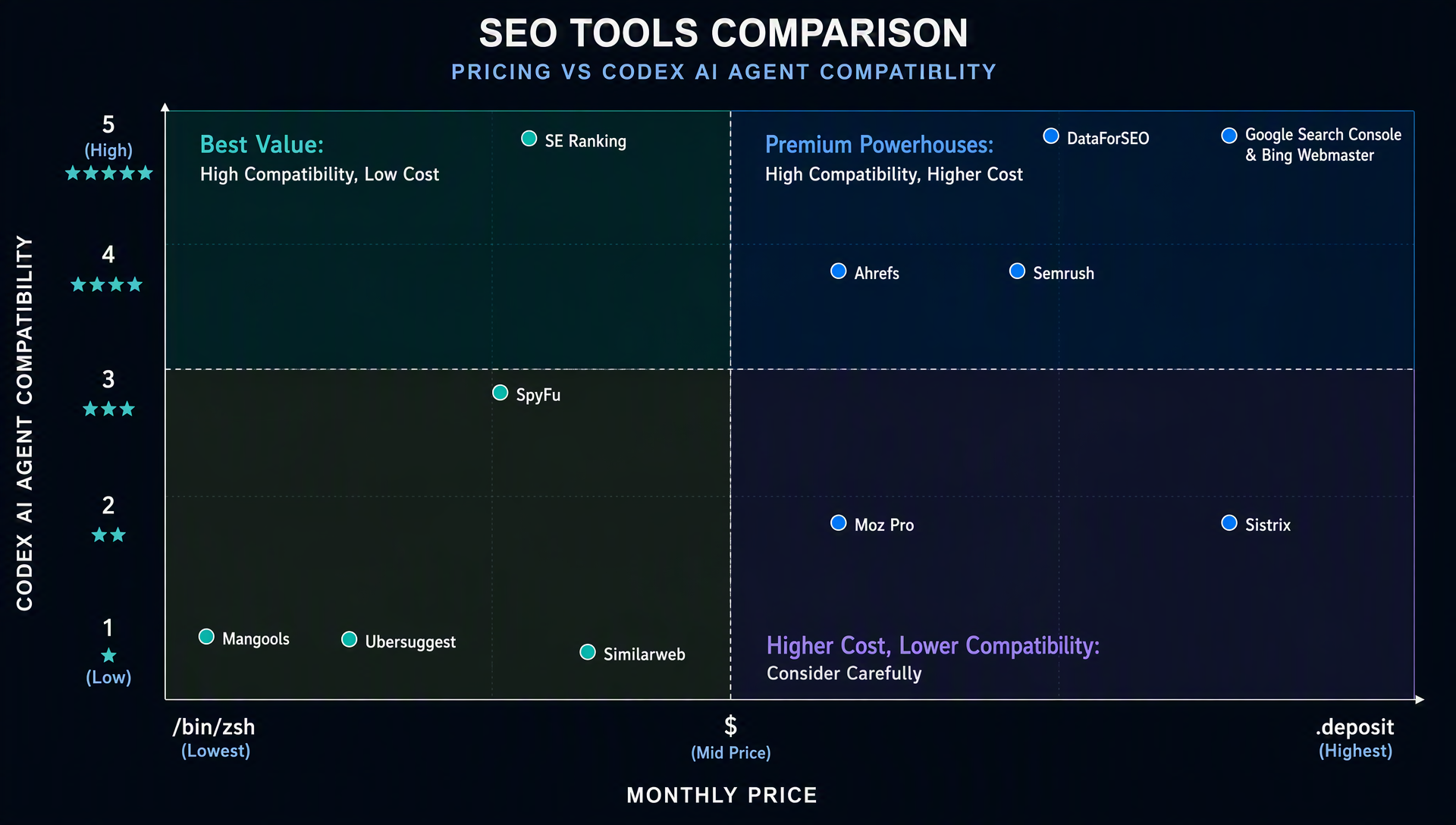
Codex-Ready Scorecard: All 12 Tools at a Glance
Tool | Starting Price | Has API? | Has MCP? | Codex-Ready? | Best For |
|---|---|---|---|---|---|
DataForSEO | $50 deposit | Yes | Yes (self-hosted) | ★★★★★ | Pure AI agent automation |
SE Ranking | $103.20/mo (annual) | Yes | Yes (included) | ★★★★★ | Best dashboard + API combo |
Ahrefs | $129/mo | Yes (Advanced+) | Yes (Lite+) | ★★★★☆ | Backlink data quality |
Google Search Console | Free | Yes | Yes (community MCPs) | ★★★★★ | Own-site analytics |
Bing Webmaster | Free | Yes | Yes (community MCPs) | ★★★★★ | Bing data + IndexNow |
SpyFu | $16/mo | Yes (REST) | No | ★★★☆☆ | PPC competitor research |
Moz Pro | $49/mo | Limited | No | ★★☆☆☆ | Beginner-friendly dashboard |
Similarweb | $199/mo | Yes (enterprise) | No | ★☆☆☆☆ | Market intelligence |
Sistrix | ~€100/mo | Yes (higher tiers) | No | ★★☆☆☆ | European markets |
Mangools | $29.90/mo | No | No | ★☆☆☆☆ | Solo creator simplicity |
Ubersuggest | $29/mo (free tier available) | No | No | ★☆☆☆☆ | Cheapest paid option |
Semrush (baseline) | $139.95/mo | Yes | Yes (hosted) | ★★★★☆ | The benchmark |
Which Tool for Which Job: Decision Flowchart
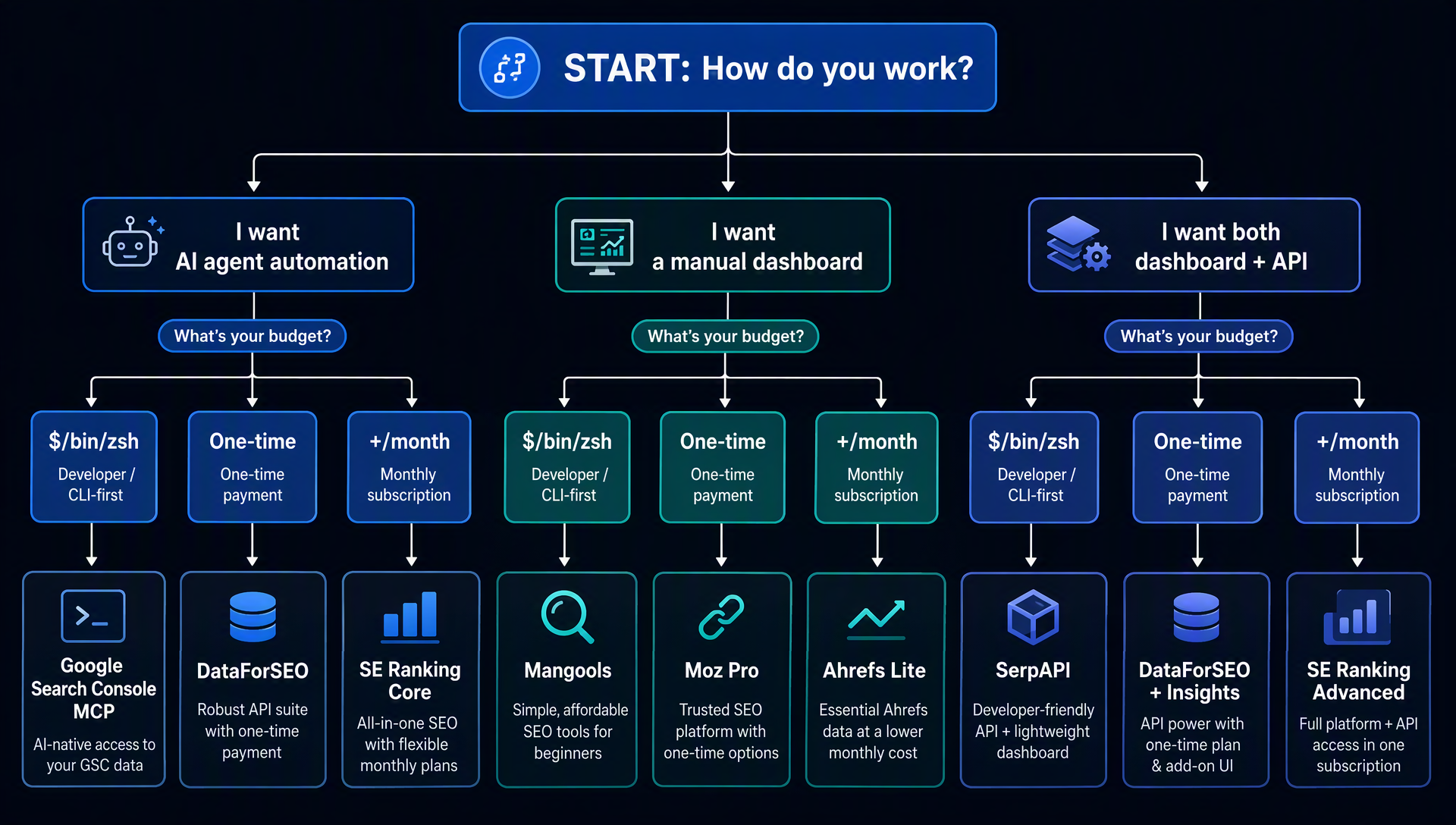
START: What's your primary way of working?
│
├─ "I want Codex to do the heavy lifting via API"
│  ├─ Budget: $0 → Google Search Console MCP + Bing Webmaster MCP
│  ├─ Budget: $50 one-time → DataForSEO (pay-as-you-go)
│  └─ Budget: $100+/month → SE Ranking Core (dashboard + MCP included)
│
├─ "I want to learn SEO manually, with a dashboard"
│  ├─ Budget: $0 → GSC + Bing Webmaster + Ahrefs Webmaster Tools
│  ├─ Budget: under $50/mo → Mangools or Ubersuggest
│  ├─ Budget: $50-100/mo → Moz Pro (Starter or Standard)
│  └─ Budget: $100+/mo → SE Ranking or Ahrefs Lite
│
└─ "I want both — dashboard for me, API for my agent"
   ├─ Budget: under $130/mo → SE Ranking Core (the only option at this price with both)
   ├─ Budget: $130-450/mo → Ahrefs Lite + DataForSEO for API calls
   └─ Budget: enterprise → Ahrefs Advanced + DataForSEO + GSC MCP
How to Connect Your First Tool to Codex (3-Step Setup)
Once you've picked a tool, here's the universal setup pattern that works for Codex, Claude Code, and Cursor:
Step 1: Get Your API Key (or MCP Config)
For MCP-based tools (DataForSEO, SE Ranking, Ahrefs), you'll get a configuration block that looks like this:
{
  "mcpServers": {
    "dataforseo": {
      "command": "npx",
      "args": ["dataforseo-mcp-server@latest"],
      "env": {
        "DATAFORSEO_USERNAME": "your-email@example.com",
        "DATAFORSEO_PASSWORD": "your-password"
      }
    }
  }
}
For API-based tools (SpyFu, Bing), you'll get a single API key string.
Step 2: Tell Codex About the Tool
Create a SKILL.md file in your Codex project. This is a short instruction file that tells Codex what the tool does, how to use it, and what the limits are.
For example, here's a minimal DataForSEO skill:
---
name: seo-data
description: Query SEO data from DataForSEO API. Use for keyword research, SERP analysis, backlink checks, and content audits.
---

## When to Use This Skill

Use when the user asks about keyword research, SERP analysis, backlinks, domain metrics, or AI search visibility.

## Available Tools

Run `dataforseo-api-cli --help` to list all 84 endpoints.

## Key Commands

- Keyword research: `dataforseo-api-cli keywords search -k "target keyword" -l "United States"`
- SERP analysis: `dataforseo-api-cli serp live -k "query" -l "United States"`
- Backlinks: `dataforseo-api-cli backlinks summary -t "domain.com"`
- AI visibility: `dataforseo-api-cli ai-mentions -t "brand-name"`

## Cost Awareness

Every API call costs real money. Always tell the user the estimated cost before running. SERP calls cost $0.0006 each in standard queue.

## Budget Cap

Stop after spending more than $1.00 in a single session without asking for confirmation.
Step 3: Run a Test Query
Ask Codex something simple to verify the connection:
"Check the top 10 search results for 'best running shoes' and tell me what types of pages are ranking."
If Codex returns structured data, you're connected. If not, check that your API key or MCP config is correct, and that the tool's MCP server is running.
Common Mistakes When Pairing SEO Tools With AI Agents
Mistake 1: Connecting an agent without a spending cap. API-first tools charge per call. An unsupervised AI agent in a loop can burn through your credits. Always set a budget limit — either in the tool itself (DataForSEO supports deposit limits) or in your SKILL.md instructions.
Mistake 2: Assuming the dashboard price includes API access. For Ahrefs, it doesn't — API access requires the Advanced plan ($449/month), not the Lite plan ($129/month). For SE Ranking, the Core plan ($103.20/month annual) includes both. Always check.
Mistake 3: Using an expensive API for questions the free tools can answer. Google Search Console tells you your own traffic, queries, and indexing status — for free. Don't pay DataForSEO or Ahrefs to pull data you already own.
Mistake 4: Writing long, open-ended prompts that trigger many API calls. "Analyze my competitors" sounds simple but can trigger dozens of backlink checks, keyword lookups, and domain analyses. Be specific: "Compare my domain's top 5 keywords with competitor X's top 5 keywords."
Mistake 5: Skipping the free tools altogether. Even if you pay for a premium tool, always connect Google Search Console and Bing Webmaster Tools. They provide first-party data that no third-party tool can match — and they're free forever.
FAQ
Do I really need a paid SEO tool if I'm just starting out?
No. Google Search Console, Bing Webmaster Tools, and Ahrefs Webmaster Tools are free and cover most beginner needs: traffic data, keyword queries, indexing status, and basic backlink information. Start with these. Add a paid tool when you hit a specific wall — usually when you need competitor keyword data or large-scale backlink analysis.
Which tool is easiest to connect to Codex for a total beginner?
DataForSEO MCP is the easiest code-first tool — install one npm package, add your credentials, and Codex has access to 84 SEO endpoints. For a dashboard + API combo, SE Ranking Core includes MCP access without the complexity of Ahrefs' credit system and separate API keys.
Can Codex replace an SEO specialist?
No. Codex can run queries, format data, and follow your instructions — but it can't set SEO strategy, interpret nuance, or understand your business context. Think of it as a very fast research assistant, not a replacement for SEO expertise.
What if the tool I want doesn't have an MCP server?
You have two options: (1) Use the tool's REST API with a custom SKILL.md file (works for SpyFu, Bing, Sistrix). (2) Export CSVs from the dashboard and feed them to Codex for analysis (works for Mangools, Ubersuggest). Option 2 adds a manual step but keeps you unblocked.
Is Semrush still worth it in 2026?
For agencies managing many clients with PPC, social, and SEO workflows, Semrush's breadth is hard to match. For everyone else — especially beginners and AI-agent users — the alternatives have caught up on core features and surpassed Semrush on API accessibility and pricing flexibility.
Author: Alice Monroe, AI SEO Tools Analyst Covering 150+ Tools at Auspia. Alice writes about AI-assisted SEO workflows, coding-agent tooling, and practical tool comparisons for growth teams.