The short version
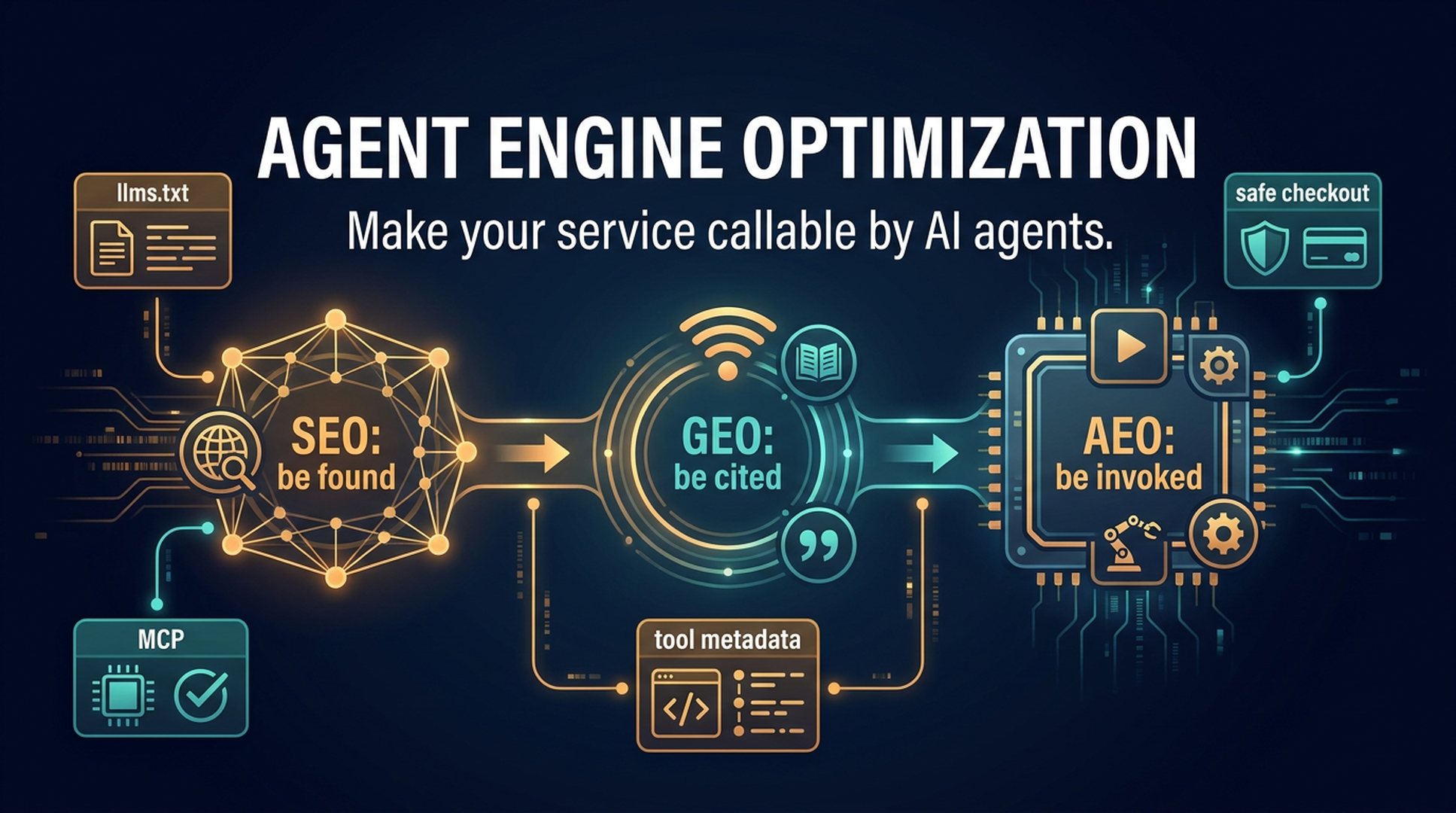
Agent Engine Optimization, or AEO, is the work of making a brand's services usable by AI agents. SEO helps people find a page. GEO helps AI systems cite a source. AEO helps an agent discover a service, decide it is safe to use, call the right tool, and finish a task for the user.
That last step matters because many buying journeys are moving from "search, click, compare" to "ask an assistant to handle it." A user may still set the goal, but the agent increasingly handles research, filtering, booking, quoting, renewal, or purchase execution.
AEO is not a replacement for GEO. It sits on top of it. If GEO builds the trust layer, AEO turns that trust into a task path.
Why this matters now
For years, marketing teams optimized for the person holding the mouse. The whole funnel assumed a human would search, scan result pages, open tabs, compare claims, and click a call to action.
AI agents change that behavior. In an agent-led journey, the human may only say:
- "Find a compliant expense tool for a 40-person remote team."
- "Book a family-friendly hotel near the conference venue."
- "Compare the three safest portable power stations for winter outages."
- "Renew the plan if the price did not increase by more than 10%."
Those prompts do not look like old keywords. They are task briefs. The agent has to decompose the request, gather evidence, choose tools, check constraints, and often ask for final permission before acting.
That creates a new marketing question: can your service be selected by software that does not care about your hero copy?
SEO, GEO, and AEO are three different battles
The easiest way to separate the three is to ask what each one tries to win.
Discipline | What it tries to win | Primary audience | Typical asset | Main metric |
|---|---|---|---|---|
SEO | Ranking and clicks | Search users | Pages, links, technical SEO | Rank, CTR, organic sessions |
GEO | Mention and citation | AI answer systems | Structured explanations, evidence, entity pages | AI visibility, citation share, answer accuracy |
AEO | Invocation and task completion | AI agents | Tools, APIs, schemas, permissions, agent docs | Agent calls, successful tasks, agent-sourced revenue |
SEO asks: can a search engine rank this page?
GEO asks: can an AI answer system trust and cite this information?
AEO asks: can an agent use this service without guessing?
That is the real shift. AEO is less about writing another article and more about reducing uncertainty for a machine that is about to take action.
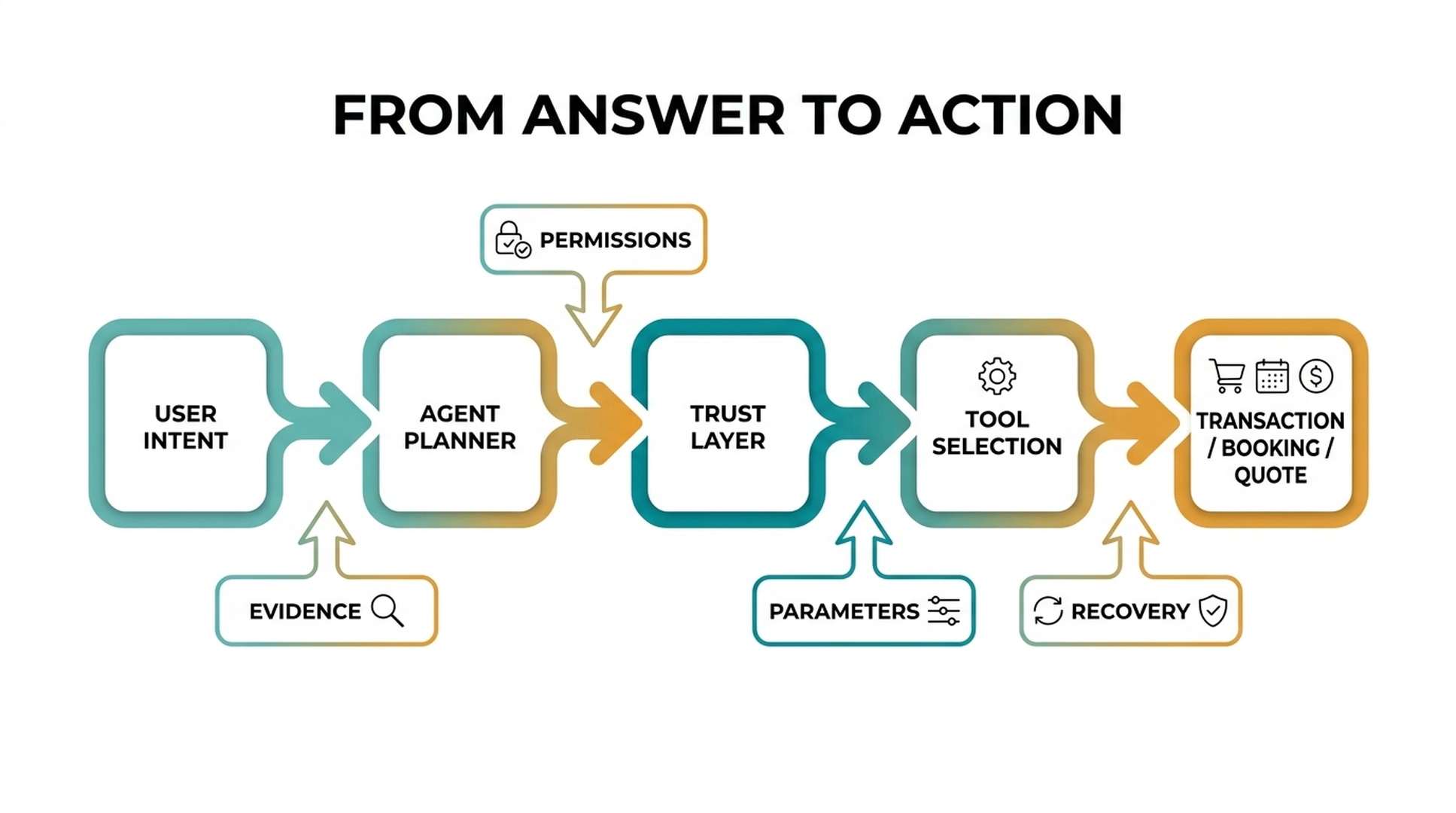
Caption: AEO begins after the answer. The agent has to translate intent into a safe, executable task path.
The difference between being cited and being used
A brand can win a citation and still lose the transaction.
Imagine a user asks an AI assistant: "What is the best way to ship fragile ceramic products across the US?" A GEO-ready logistics company may be cited because its guide explains packaging, insurance, and carrier constraints clearly. That is useful.
But if the user then says, "Create a shipment for 12 boxes from Austin to Portland and use the best insured option," the agent needs something else:
- service coverage by location
- package rules and constraints
- pricing or quote endpoints
- insurance parameters
- pickup scheduling
- identity, payment, and permission flows
- cancellation and recovery rules
A blog post cannot carry that whole job. AEO fills the gap between trusted explanation and reliable execution.
The four layers of AEO readiness
A practical AEO program has four layers. Most companies already own pieces of these layers, but they are scattered across marketing, product, engineering, legal, support, and sales operations.
1. Discoverable
The agent must be able to find the service and understand what it does. This starts with clear public pages, product documentation, structured data, entity consistency, and agent-readable navigation.
Useful assets include:
- a clear product and service taxonomy
- schema markup where it helps comprehension
- API and integration documentation
- pricing and eligibility rules that do not hide critical constraints
llms.txtor equivalent agent-facing documentation that points models toward the right resources
Do not treat discoverability as a pile of keywords. Agents need service boundaries. What can this company do? For whom? In which regions? Under what constraints?
2. Trustworthy
Agents are conservative when the task involves money, data, safety, or compliance. If your claims are vague, stale, or impossible to verify, a cautious agent should avoid you.
Trust signals include:
- dated, maintained documentation
- source-backed claims
- transparent policies
- security and privacy notes
- third-party validation where relevant
- consistent entity information across your site, directories, docs, and support material
This is where GEO still matters. If the web already contains clean, corroborated information about the brand, the agent has less reason to treat the service as a risky unknown.
3. Callable
Callable means the service can be invoked in a predictable way. In software terms, this may mean APIs, webhooks, MCP servers, function-calling tools, or app actions. In business terms, it means the agent can complete a useful step without improvising.
Good callable services have:
- explicit input parameters
- validation rules
- predictable outputs
- permission boundaries
- human confirmation points for sensitive actions
- useful errors instead of dead ends
- idempotent or reversible steps where possible
The Model Context Protocol has pushed more teams to think in this direction because it gives agents a standard way to discover and call external tools. OpenAI's Apps SDK also reflects the same broader movement: AI products are becoming environments where external services can expose structured actions, not just web pages.
AEO teams should follow these standards, but the principle is older than any single protocol. Machines prefer clean contracts.
4. Measurable
If an agent calls your service, you need to know what happened. Which tool was invoked? Which intent triggered it? Did the task succeed? Did the user confirm or abandon? Did the agent hit a policy or parameter failure?
AEO measurement should include:
- tool discovery events
- agent call volume
- task success rate
- parameter validation failures
- permission denials
- quote-to-conversion rate
- agent-sourced revenue or pipeline
- support tickets caused by agent interactions
This is where many early AEO programs will fail. They will expose a tool, see a few calls, and call it a strategy. That is not enough. AEO needs the same operating discipline that paid search and SEO eventually developed: logs, cohorts, attribution, and iteration.
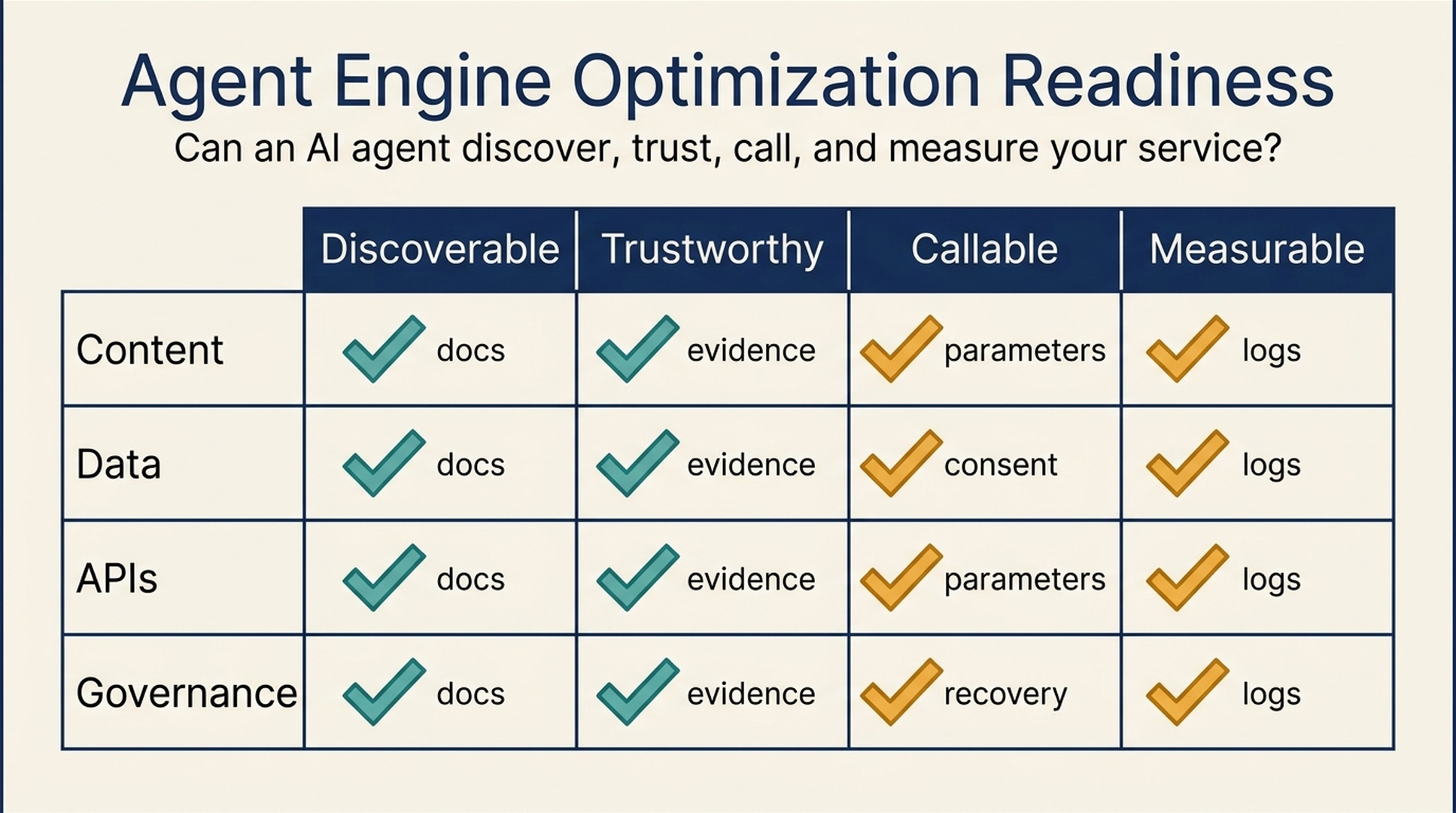
Caption: AEO is not one asset. It is a readiness system across content, data, APIs, and governance.
What AEO looks like by business model
The work looks different depending on what the agent is trying to do.
Business type | Agent task | AEO asset to prioritize | Failure to avoid |
|---|---|---|---|
SaaS | Compare plans and start a trial | Plan metadata, integration docs, provisioning flow | Agent recommends the wrong tier because limits are unclear |
Ecommerce | Pick and buy a product | Product feed, inventory, returns, compatibility data | Agent buys an incompatible item |
Local services | Book an appointment | Availability, service area, pricing rules, booking API | Agent cannot confirm time, price, or location |
B2B services | Request a quote | Qualification schema, case evidence, contact routing | Agent sends unqualified leads or misses required fields |
Travel | Build an itinerary | Real-time availability, cancellation rules, preferences | Agent selects options that violate user constraints |
Financial services | Evaluate and apply | Eligibility rules, disclosures, consent flow | Agent triggers a regulated action without proper consent |
The pattern is the same: move from persuasive content to executable clarity.
A 90-day AEO workflow
AEO can sound huge, but the first version should be narrow. Pick one high-intent task and make it easy for an agent to complete safely.
Days 1-15: choose one task
Do not start with "optimize the whole brand for agents." That is too vague. Choose a task with clear business value and repeatable structure.
Good first tasks:
- generate a product recommendation
- request a quote
- book a demo
- check eligibility
- compare plans
- find replacement parts
- start a return
- schedule a service visit
The task should have known inputs, a useful output, and a measurable conversion event.
Days 16-30: map the agent decision path
Write down what an agent must know before it can act.
For a quote request, that might include company size, region, use case, urgency, integration needs, budget range, and permission to share contact details.
For ecommerce, it may include compatibility, dimensions, delivery date, return policy, warranty, and user preference tradeoffs.
This map usually exposes the truth: your website may explain the product well, but it does not expose enough structured detail for action.
Days 31-50: clean the trust layer
Update the content and documentation that agents will use as evidence. Remove contradictions. Add dates. Make policies explicit. Link claims to sources. Create concise pages for product facts, service coverage, pricing boundaries, compliance notes, and support rules.
If your brand has not invested in AEO or GEO basics yet, this is where to start. A callable tool attached to messy facts just creates faster confusion.
Days 51-75: expose the callable layer
Now create the action surface. Depending on the business, this might be:
- an API endpoint
- an MCP server
- a structured form with stable fields
- an app action
- a partner feed
- a quote calculator
- an eligibility checker
- a booking endpoint
Keep the first interface boring. Boring is good. Boring means the agent can understand it.
Days 76-90: instrument and test
Run test prompts against the flow. Use different phrasings, constraints, and edge cases. Log each failure.
Test for:
- missing parameters
- ambiguous outputs
- unsafe actions
- bad defaults
- outdated claims
- hidden eligibility rules
- poor recovery after errors
- cases where human confirmation is required
Then publish the lessons internally. AEO should become an operating loop, not a one-off integration project.
Common mistakes
The first mistake is treating AEO as a content trick. More articles may help the trust layer, but they do not make a service callable.
The second mistake is exposing too much too quickly. An agent should not receive every internal action just because an API exists. Start with narrow, low-risk tasks and expand after you understand behavior.
The third mistake is hiding constraints. Humans tolerate some ambiguity. Agents do not. If a service is unavailable in certain regions, requires manual approval, has a minimum order size, or cannot support certain use cases, say so in a machine-readable way.
The fourth mistake is ignoring consent. AEO without permission design becomes risky fast. Any action involving payment, personal data, legal commitments, regulated advice, or irreversible changes needs explicit confirmation.
The fifth mistake is measuring only traffic. Agent-led journeys may not generate normal sessions. You need event-level tracking for discovery, invocation, task completion, and revenue.
Auspia take
AEO will not replace SEO or GEO. It will punish teams that treat them as separate silos.
Search visibility still matters because people and agents both need sources. GEO matters because agents need trusted facts before action. AEO matters because the business outcome moves from "the brand was mentioned" to "the brand was used."
For most teams, the practical next step is simple: audit one conversion path and ask whether an AI agent could complete it without guessing. If the answer is no, the blocker is probably not copywriting. It is missing structure, missing trust evidence, missing parameters, or missing permissions.
That is the work.
AEO readiness checklist
Use this checklist before exposing any agent-facing action:
- The service has a clear description, audience, region, constraints, and eligibility rules.
- The agent can find maintained documentation and policy pages.
- Claims are supported by evidence or clearly labeled as company claims.
- Required inputs are named, typed, and validated.
- Outputs are predictable and easy to parse.
- Sensitive steps require user confirmation.
- Errors explain what the agent should do next.
- Logs show discovery, invocation, success, failure, and conversion events.
- Ownership is clear across marketing, product, engineering, legal, and support.
FAQ
Is AEO the same as Answer Engine Optimization?
No. In this article, AEO means Agent Engine Optimization. Answer Engine Optimization focuses on being selected in answer results. Agent Engine Optimization focuses on being discovered and used by an AI agent that is trying to complete a task.
Does AEO replace GEO?
No. GEO is part of the trust layer for AEO. If an agent cannot verify who you are, what you offer, and whether your claims are reliable, it has less reason to call your service.
Do small companies need AEO?
Yes, but they should start small. A local clinic, ecommerce store, SaaS startup, or agency does not need a full agent platform on day one. It needs one clean task path: booking, quoting, eligibility, comparison, replacement, support, or purchase.
What is the first AEO asset to build?
Start with an agent-readable service page or documentation page that explains what the service does, who it is for, required inputs, constraints, pricing boundaries, policies, and the next action. Then decide whether the action needs an API, form, MCP server, or partner integration.
How should AEO success be measured?
Track agent discovery, tool invocation, task success rate, permission drop-off, validation errors, conversion rate, and agent-sourced revenue or pipeline. Traditional traffic metrics are not enough because many agent journeys may not look like normal website sessions.