The short version
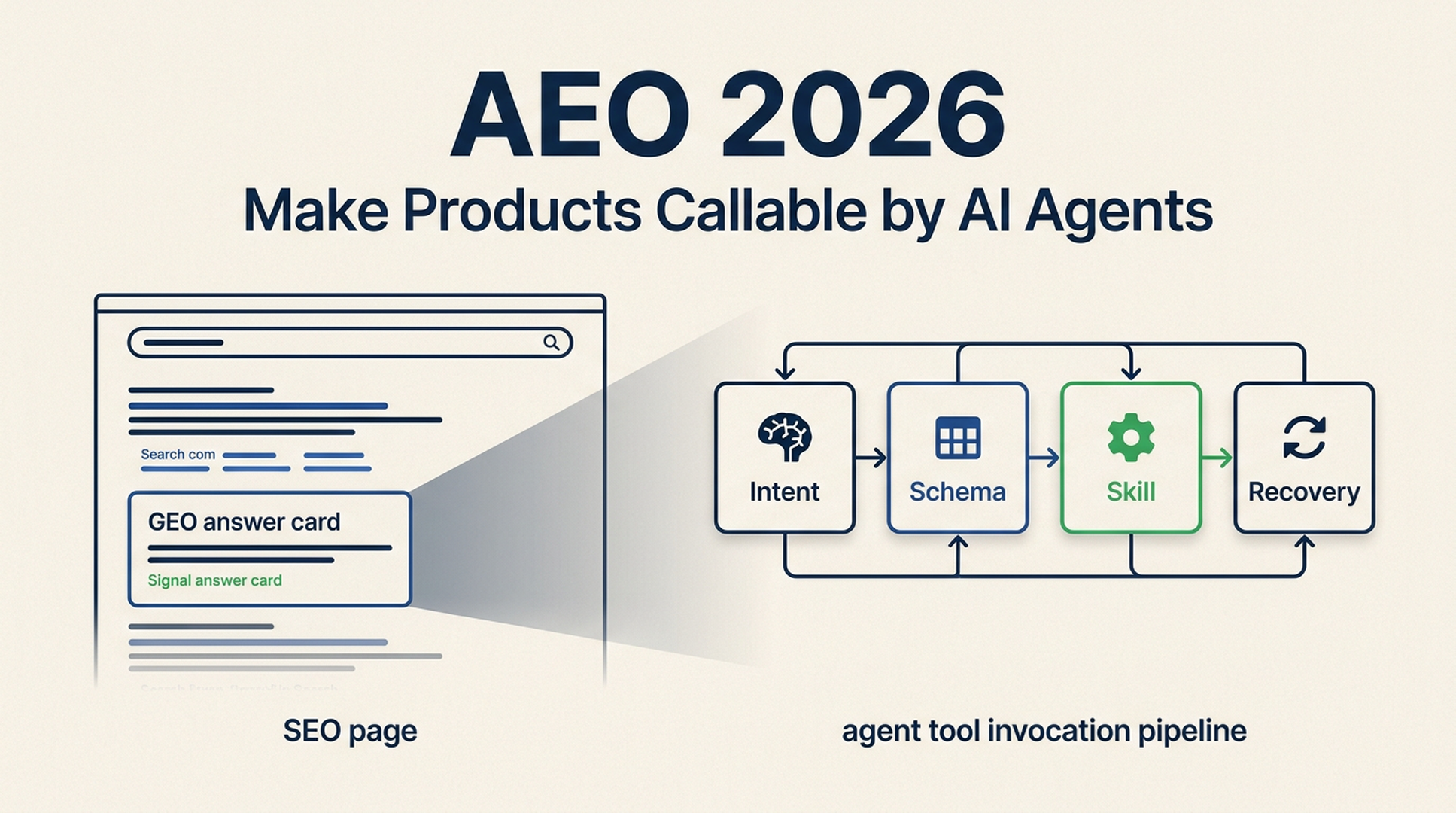
AEO, or Agent Engine Optimization, is the next layer after SEO and GEO. SEO helps people find pages. GEO helps answer engines quote or summarize your content. AEO helps AI agents choose your product, call the right capability, complete a task, and recover when something goes wrong.
That distinction matters in 2026 because agents are moving from chat boxes into work loops. OpenAI's Agents SDK describes agents as models equipped with instructions and tools, with guardrails, handoffs, sessions, tracing, and MCP support built into the runtime. The Model Context Protocol now gives AI applications a standard way to connect to files, databases, tools, and workflows. Claude Code skills show another pattern: a compact description tells the agent when to load a deeper instruction bundle, scripts, templates, and resources.
So the traffic question changes. It is no longer only, "Can an AI answer mention us?" The better question is, "When an agent is asked to solve this problem, can it safely hire our service for the job?"
Caption: AEO turns a brand from a page an AI can mention into a capability an agent can select, call, verify, and reuse.
Why the old traffic model is cracking
The web was built around humans looking at screens. Search results, landing pages, comparison posts, pricing tables, demo forms, banners, and retargeting all assumed the same basic loop: a person sees something, clicks, reads, and decides.
Agents do not behave that way.
An agent that books a meeting, reconciles a spreadsheet, checks vendor options, generates a campaign, or updates a CRM record does not want a beautiful homepage first. It wants an exact action path. It needs to know what your service can do, which parameters are required, what the failure modes are, what permissions are needed, and how to confirm that the result is correct.
This does not make websites useless. It makes them incomplete. In many workflows the website becomes the fallback interface, not the primary interface. The primary interface is the agent-facing layer around your product: metadata, API descriptions, MCP servers, skills, schemas, docs, auth flows, examples, and recovery messages.
That is the practical reason AEO deserves its own name. It is not just a rebrand of GEO. GEO optimizes the answer layer. AEO optimizes the execution layer.
SEO, GEO, and AEO are different jobs
The terms often get mixed together, which causes bad strategy. A team publishes long explainers, calls that "AEO," and then wonders why no agent can actually use the product.
Here is the cleaner split.
Layer | Main audience | Optimization target | What success looks like | Common failure |
|---|---|---|---|---|
SEO | Human searchers | Rankings, snippets, clicks | A user finds and visits a page | The page ranks but does not convert |
GEO | AI answer systems | Entity clarity, citation readiness, answer extraction | An AI answer mentions or cites the brand | The brand is mentioned but not chosen for action |
AEO | AI agents | Tool selection, task execution, recovery, trust | An agent calls the right capability and completes the job | The agent sees the product but cannot use it safely |
AEO is where marketing, product, docs, security, and engineering collide. A content team cannot solve it alone. A developer platform team cannot solve it alone either, because agents still need positioning, intent fit, examples, and trust signals.
The real AEO battleground is task ownership
A user may ask an agent: "Find a reliable tool to audit our AI search visibility and prepare a prioritized fix list." In a search world, that user might compare ten tabs. In an agent world, the agent may narrow options, choose a tool, run the audit, summarize the gaps, and propose next actions before the user ever sees a pricing page.
That makes the valuable unit of competition smaller than a website visit. It is the task.
For an AEO team, the goal is to own a well-defined task in the agent's plan. Not vaguely "be visible for AI search." More like:
- audit whether a domain is readable by AI crawlers;
- generate or validate an
llms.txtfile; - check whether a page can be cited by answer engines;
- turn a keyword cluster into a publishable content brief;
- verify whether a product page exposes enough structured data for agent shopping flows.
This is why broad brand copy performs poorly in agent contexts. An agent does not need five paragraphs about your mission. It needs a reason to call you now, for this step, with these inputs.
For Auspia, this is also why tools like the AI Search Visibility Checker, Robots.txt AI Crawler Checker, and LLMs.txt Generator / Checker matter. They map to concrete jobs an agent can understand.
The five-part AEO stack
AEO becomes easier to manage when you stop treating it as a content tactic and start treating it as an agent interface program.
1. Intent map
List the situations where an agent should choose your product. Be narrow. "Use us for marketing" is too vague. "Use us when the user needs to check whether AI crawlers can access a domain before launching an AI search visibility campaign" is useful.
A good intent map includes:
- user goal;
- trigger phrase or task pattern;
- required inputs;
- output the agent should expect;
- cases where the product should not be used;
- safe fallback when the product is not enough.
The negative cases are not a legal footnote. They improve trust. Agents need to know when not to call you.
2. Deterministic capability descriptions
Agents can work with natural language, but vague tool descriptions still waste tokens and create bad calls. A strong capability description tells the agent exactly what the tool does, which arguments it accepts, what it returns, how long it may take, and what errors mean.
Bad description:
Helps brands improve AI visibility.
Better description:
Checks whether a public URL can be accessed by major AI crawlers, reports blocking rules in robots.txt, and returns a prioritized list of crawler access fixes. Does not estimate rankings or guarantee citations.That second version is less exciting to a human. It is far more useful to an agent.
3. Callable surface
The callable surface is the part of your product an agent can actually use: API endpoint, MCP server, browser action, form flow, skill, plugin, or command. The best surface depends on the job.
MCP is useful when the agent needs a standard way to access tools, data, and workflows across clients. Skills are useful when the agent needs procedural knowledge, examples, scripts, and repeatable task logic, not just a single function call. A plain API may be enough for one simple action. A browser flow may be acceptable as a bridge, but it is usually fragile.
The mistake is exposing everything. AEO rewards small, reliable capabilities. One clean tool that does one job well is better than a giant "do marketing" endpoint.
4. Recovery loop
Agents fail. They miss parameters, hit auth problems, choose the wrong variant, or receive ambiguous user instructions. AEO quality shows up in how your system responds.
A weak error says:
{"error":"400 Bad Request"}
A better error says:
{
  "error": "missing_required_input",
  "missing": ["domain"],
  "agent_instruction": "Ask the user for the website domain they want to audit, then retry with domain as a fully qualified hostname.",
  "example": {"domain": "example.com"}
}
That is not just developer ergonomics. It is conversion design for agents.
5. Trust and permission model
AEO without safety will backfire. Agents may read private data, trigger purchases, send messages, change files, or submit forms. The more useful the agent, the more consequential the action.
Your AEO layer should make permissions visible. It should separate read-only checks from state-changing actions. It should provide previews before irreversible steps. It should log what happened. It should support human approval where money, identity, legal commitments, or production systems are involved.
Agents choose reliable tools. Humans approve reliable agents. Trust sits in the middle.
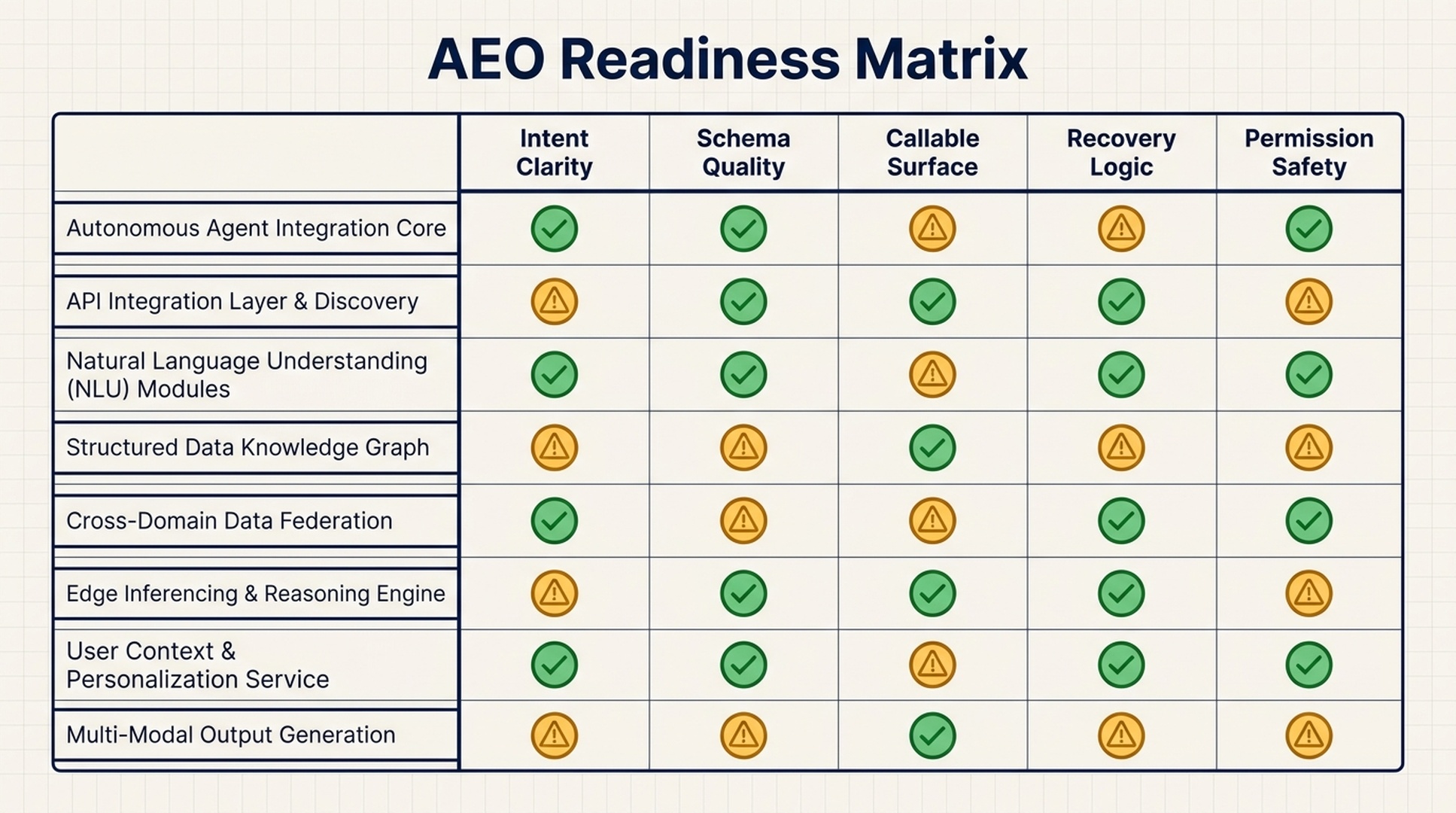
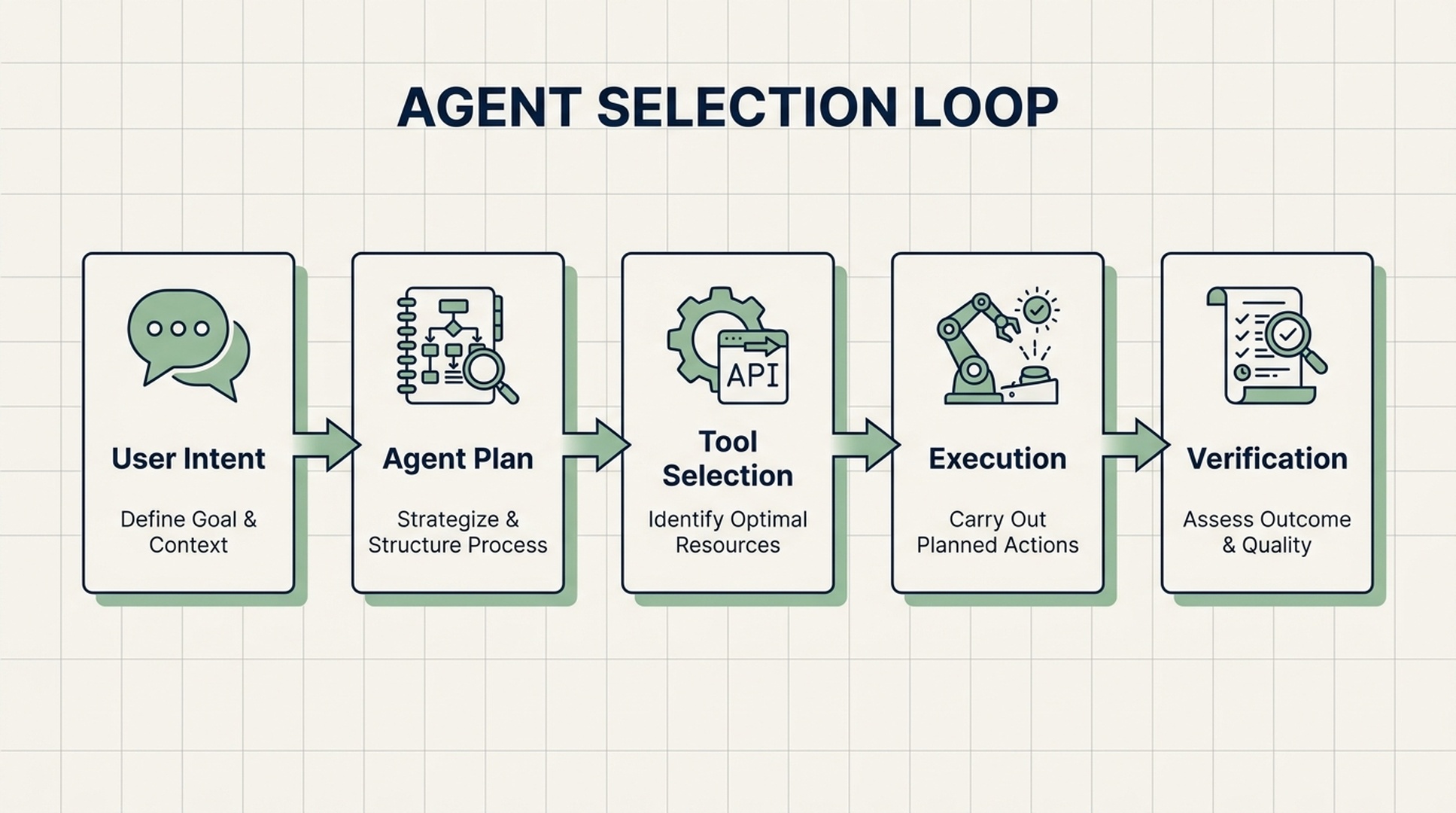
Caption: The quickest AEO audit is to score each capability across intent clarity, schema quality, execution reliability, recovery guidance, and permission safety.
Why skills are becoming an AEO vehicle
The source article this piece is inspired by spends a lot of energy on one point: skills may become the standard packaging layer for agent-ready services. I agree with the direction, with one caveat. Skills will not replace APIs, MCP servers, docs, or apps. They will wrap and coordinate them.
A skill is useful because it can carry operational judgment. It can say, "Use this workflow when the user asks for X, first inspect Y, then call Z, and if the result contains this error, ask this follow-up question." That is different from an API reference. It is closer to a mini operating manual for an agent.
Claude Code's skill documentation shows the basic pattern: every skill has a SKILL.md with frontmatter that helps the agent decide when to use it, plus instructions and optional supporting files. The full content loads when invoked, which keeps the always-on context smaller. That progressive loading pattern fits AEO well because agents cannot afford to read your entire documentation site before every task.
A good AEO skill should include:
- a short description with clear trigger language;
- explicit non-use cases;
- required inputs and validation rules;
- step-by-step execution flow;
- examples of good and bad calls;
- recovery instructions for common errors;
- safety rules and approval thresholds;
- links to the underlying API, MCP server, or product workflow.
The point is not to stuff a skill with every brand message you have. The point is to make a task easy to delegate.
What most teams will get wrong in 2026
The first mistake is treating AEO as another content channel. Publishing an "AI agents guide" does not make your product callable.
The second mistake is over-broad tool descriptions. If your capability can mean anything, an agent will either ignore it or misuse it.
The third mistake is hiding constraints. Humans may tolerate a sales page that avoids hard edges. Agents need hard edges. They need to know regions, limits, prices, latency, supported formats, auth requirements, and failure modes.
The fourth mistake is building one huge integration instead of several atomic capabilities. Agents plan in steps. Give them steps they can compose.
The fifth mistake is ignoring measurement. AEO needs logs: which task triggered the agent, which capability was selected, where execution failed, whether the user approved the action, and whether the final answer used your output.
A practical 2026 AEO checklist
Use this as a first-pass audit for any product, tool, or service page.
Question | Why it matters | Pass condition |
|---|---|---|
Can an agent identify the exact task your product solves? | Agents select tools by intent, not slogans | One sentence names the task, input, output, and limit |
Are inputs and outputs structured? | Agents need schemas to call reliably | Parameters, examples, response fields, and errors are documented |
Is there a callable surface? | Visibility without execution stops at GEO | API, MCP server, skill, plugin, command, or stable form flow exists |
Are non-use cases explicit? | Boundaries prevent wrong calls | The description says when not to use the capability |
Can the system recover from missing info? | Agents need repair instructions | Errors include next action and example retry payload |
Are risky actions permissioned? | Trust affects adoption | Read/write actions are separated and logged |
Can humans verify the result? | Agents still need accountable outputs | The result includes evidence, links, timestamps, or audit trails |
How to start without overbuilding
Do not begin by trying to make your entire company agent-ready. Pick one repeatable task that already has demand and a measurable output.
A simple 30-day AEO sprint could look like this:
- Choose one task where users already ask for help.
- Write the intent map and non-use cases.
- Turn the task into one callable capability with a strict schema.
- Add recovery messages for missing inputs and common failures.
- Package the workflow as a lightweight skill or MCP-accessible tool.
- Test it with three agent prompts: vague request, complete request, and broken request.
- Log failures and rewrite the descriptions before adding new capabilities.
If you already have SEO and GEO content, do not throw it away. Use it as the human and answer-engine layer. Then build the AEO layer underneath it: callable actions, structured metadata, tool descriptions, permissions, and feedback loops.
Auspia take
GEO is still useful. AEO does not cancel it. But GEO alone stops at mention. AEO starts when an agent has to do something.
That is the major 2026 shift. The most valuable traffic may not arrive as a visit at all. It may arrive as an agent call, a tool invocation, a generated report, a crawler access check, or a structured recommendation inside someone else's workflow.
For growth teams, this means the website is no longer the whole conversion surface. Your conversion surface now includes every place an agent can discover, evaluate, call, and verify your product.
Auspia's recommendation is simple: keep building pages that humans and answer engines can understand, but start packaging your highest-value workflows as agent-callable capabilities. If your product cannot be called, it can still be mentioned. In 2026, that may not be enough.
FAQ
What is AEO in 2026?
AEO means Agent Engine Optimization. It is the practice of making a product, service, or workflow discoverable, understandable, callable, and safe for AI agents. It focuses on task execution rather than only search ranking or answer citation.
How is AEO different from GEO?
GEO helps AI answer systems understand and cite your brand. AEO helps AI agents choose and execute your capabilities. GEO is about being included in an answer. AEO is about being selected for a task.
Does AEO replace SEO?
No. SEO still matters for human discovery and durable web presence. GEO matters for answer extraction. AEO adds the execution layer for agents that use tools, APIs, MCP servers, skills, and workflows.
What is the fastest way to improve AEO readiness?
Pick one high-intent task, define the inputs and outputs, create a reliable callable surface, write clear non-use cases, and improve error messages so agents know how to recover from missing or invalid information.
Are skills required for AEO?
No. Skills are one useful packaging format, especially when the agent needs procedural instructions, examples, and recovery logic. Some products may use MCP servers, APIs, plugins, or browser actions instead. The core requirement is agent-callability, not one specific format.
Sources and further reading
- Model Context Protocol documentation: https://modelcontextprotocol.io/docs/getting-started/intro
- OpenAI Agents SDK documentation: https://openai.github.io/openai-agents-python/
- Claude Code skills documentation: https://code.claude.com/docs/en/skills
- Auspia AEO category: https://auspia.ai/blog/category/aeo