The short version
Social SEO in 2026 is not about trying to make Instagram likes or TikTok views act like backlinks. Google has never treated follower counts as a simple ranking switch, and that is still the wrong mental model.
The real opportunity is more practical: social platforms now behave like search engines, and search engines often surface social content when people want fresh opinions, visual proof, product comparisons, tutorials, or community experience. A brand that only optimizes its website leaves a large part of discovery unmanaged.
For growth teams, the job is to make profiles, posts, videos, comments, and community answers searchable, useful, and connected to website assets. Done well, social search SEO can increase branded search, earn referral clicks, improve content ideas, create citation-worthy proof, and help your brand appear in the places people check before they buy.
If you already run SEO, treat social as a discovery layer around it. If you already run social, stop measuring only reach and start measuring search demand, profile discovery, assisted conversions, and content reuse.
What social SEO means in 2026
Social SEO is the practice of optimizing social profiles and social content so people can find your brand through platform search, Google search, and AI-assisted discovery.
That includes obvious work, such as writing a clear YouTube title or adding keywords to a LinkedIn company page. It also includes less obvious work, such as answering a Reddit thread without sounding like a brand bot, adding on-screen text to a TikTok, naming Pinterest boards around real search phrases, or making sure your profiles consistently describe the same entity across the web.
In 2026, social SEO sits at the intersection of five behaviors:
Search behavior | What users want | Where it often happens |
|---|---|---|
How-to search | A quick tutorial or demo | YouTube, TikTok, Google video results |
Opinion search | Real user experience | Reddit, Quora, niche forums, X |
Professional search | Vendor proof and expert context | LinkedIn, YouTube, Google |
Visual search | Ideas, examples, styles, products | Pinterest, Instagram, TikTok |
Local search | Places, reviews, current photos | Google Business Profile, Instagram, TikTok |
The important part is not the platform list. The important part is intent. People choose the surface that feels most trustworthy for the job.
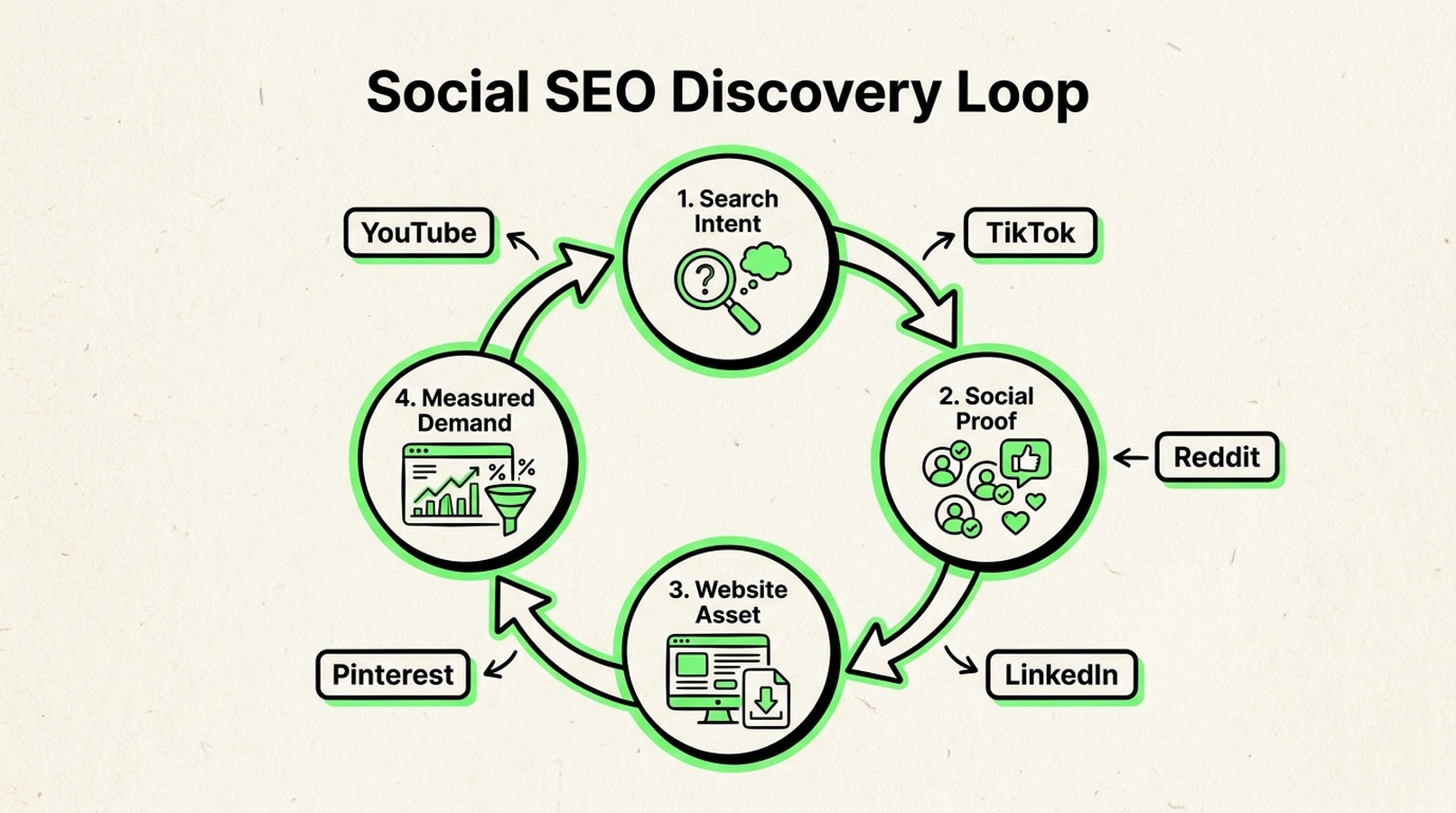
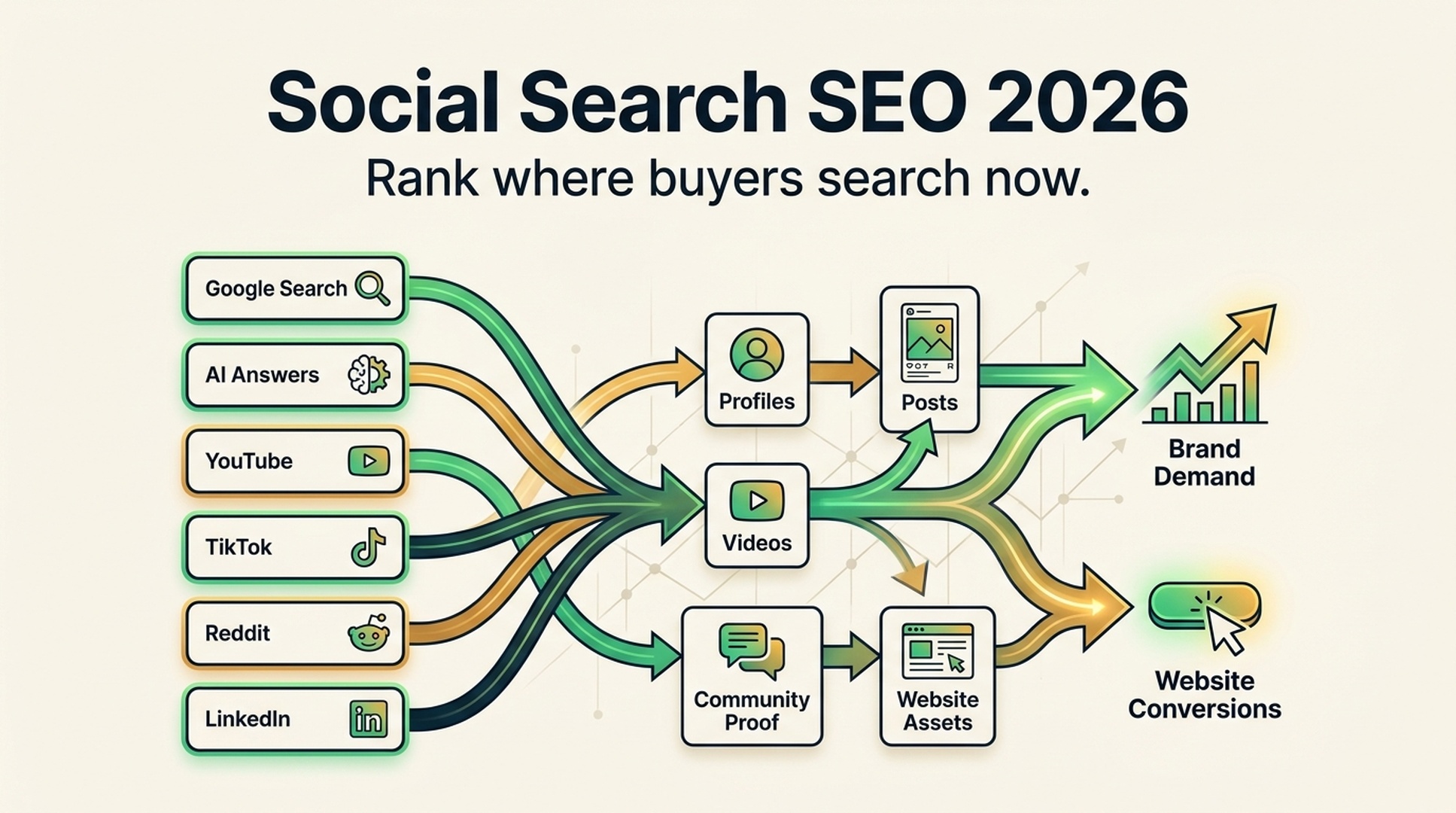
The social SEO discovery loop: start with intent, create proof on the right social surface, anchor it to a website asset, then measure demand rather than vanity reach.
How social activity helps search without being a direct Google ranking factor
Social engagement is not a clean, direct Google ranking factor. A post getting 10,000 likes does not automatically push your website to page one.
But social can still change SEO outcomes in ways that matter:
- It increases branded search when people see you on social and later search your name, product, or category.
- It improves click confidence because users recognize your brand in a search result.
- It helps creators, journalists, partners, and customers discover assets they may later cite or link to.
- It reveals language customers actually use, which can improve keyword targeting and answer-style content.
- It gives your brand public proof: tutorials, comments, examples, screenshots, videos, and discussions that show real activity.
- It can occupy more SERP real estate when Google shows videos, social profiles, Reddit discussions, forum threads, or knowledge panels.
This is why social SEO belongs beside technical SEO, content SEO, and GEO. It does not replace them. It widens the surface area where your brand can be found and understood.
The platforms worth prioritizing
You do not need to optimize every social platform. Most teams should pick two primary surfaces and one support surface. The right choice depends on product type, audience, and content format.
Platform | Best for | 2026 optimization focus |
|---|---|---|
YouTube | Tutorials, reviews, B2B explainers, product demos | Titles, chapters, transcripts, thumbnails, embedded website pages |
TikTok | Fast discovery, local recommendations, visual products | Spoken keywords, on-screen text, captions, creator-led proof |
Community trust, problem research, comparison queries | Useful participation, transparent answers, non-promotional expertise | |
B2B authority, hiring, company validation | Company page clarity, founder posts, documents, comment visibility | |
Lifestyle, local, visual commerce, creators | Profile keywords, alt text, location signals, reels captions | |
Evergreen visual demand | Keyworded boards, pin titles, product links, trend timing | |
Quora | Question-led evergreen traffic | Precise answers, credible examples, light linking |
X | News, founder voice, real-time commentary | Searchable handles, timely posts, expert threads |
Local groups, older demographics, events | Accurate pages, group participation, reviews, location content |
For most B2B companies, the strongest mix is LinkedIn, YouTube, and Reddit. For ecommerce, it is often TikTok, Instagram, Pinterest, and YouTube. For local services, Google Business Profile still comes first, with Instagram, TikTok, Facebook, and local community groups supporting it.
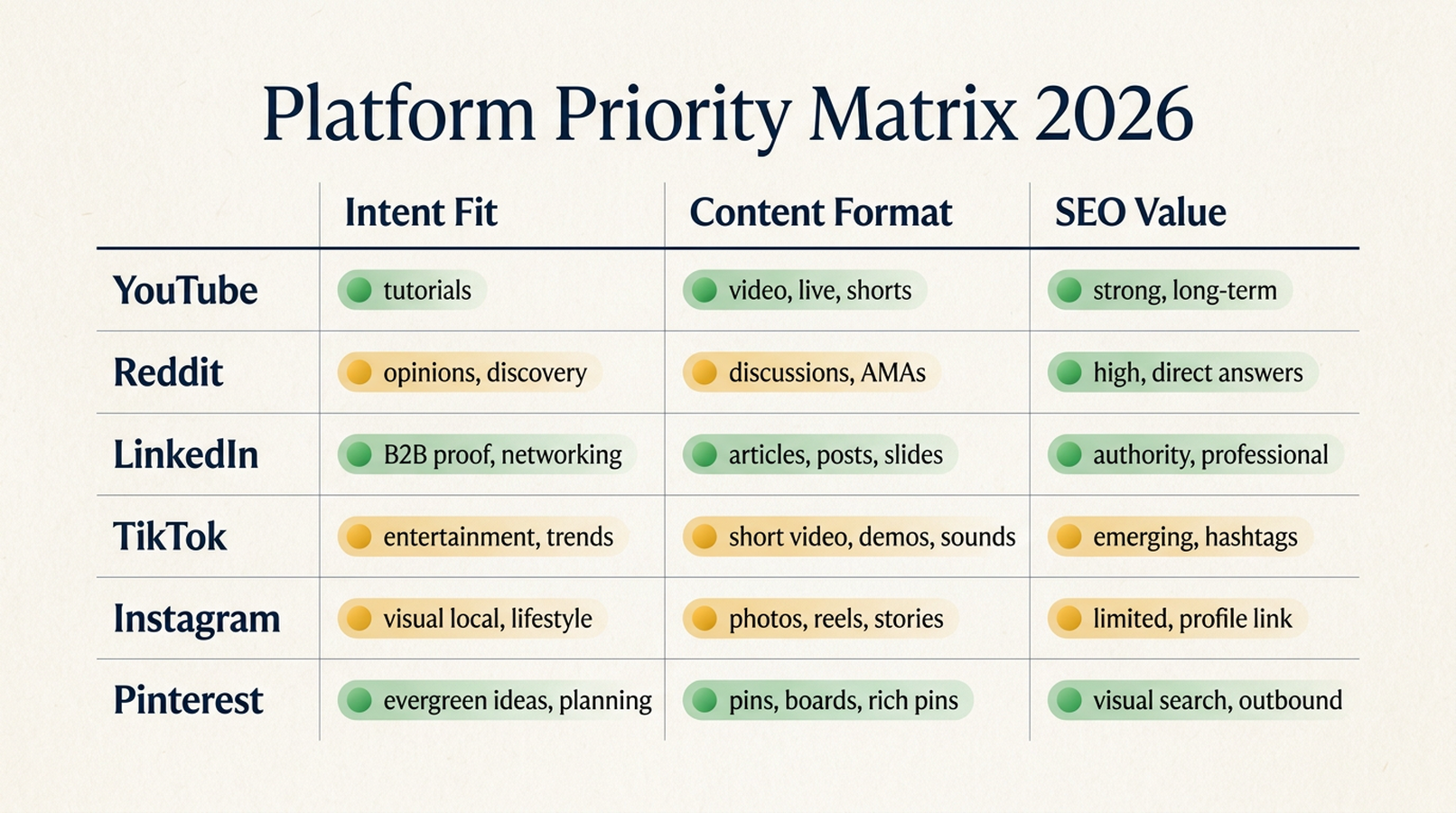
Use platform fit to decide where to invest. The best social SEO channel is the one your buyer already uses for that kind of question.
Platform-by-platform playbook
YouTube: optimize for both YouTube search and Google video results
YouTube is still the cleanest bridge between social content and classic search. A strong YouTube asset can rank inside YouTube, appear in Google video modules, support a blog post, and give sales teams a link they can send to prospects.
A practical YouTube SEO checklist:
- Put the core query in the title without making it awkward.
- Use the first 150 characters of the description to state the answer and audience.
- Add chapters that match sub-questions people search.
- Upload or correct captions so transcripts include the right terms.
- Use thumbnails that communicate the use case, not just a face and a reaction.
- Embed the video on a related website page with supporting text, screenshots, and FAQs.
A common mistake is publishing videos and blog posts as separate campaigns. Pair them. A video can show the workflow; the article can carry the checklist, table, schema, and conversion path.
TikTok: make the algorithm understand the topic
TikTok search is strongest when people want quick recommendations, demos, local ideas, or product impressions. The platform reads more than hashtags. It can use captions, speech, on-screen text, engagement patterns, and user behavior.
To make TikTok content more searchable:
- Say the target phrase naturally in the video.
- Add the phrase as on-screen text early.
- Write captions that include the problem, audience, and location when relevant.
- Use hashtags as classification, not decoration.
- Turn strong comments into follow-up videos.
- Build series around repeated search intent, such as "how to choose," "before you buy," or "mistakes to avoid."
For brands, the hard part is trust. A polished ad usually loses to a specific demo. Show the product, the problem, the limitation, and the result.
Reddit: earn your place before you link
Reddit is increasingly visible in search results because people append "reddit" to queries when they want lived experience. That does not mean brands should flood subreddits with links.
The winning Reddit approach is slower:
- Find subreddits where buyers describe the problem in their own words.
- Read the rules and recent moderation patterns before posting.
- Answer questions with specifics, not slogans.
- Disclose affiliation when relevant.
- Link only when the page genuinely solves the question.
- Track recurring objections and turn them into website content.
If your team cannot participate honestly, do not fake it. Reddit users notice. Use it for research until you have something useful to add.
LinkedIn: treat your company page as an entity page
LinkedIn helps B2B buyers verify whether a company is real, active, and understood by people in their field. It also gives Google and AI systems a consistent public profile to read.
Your LinkedIn page should clearly answer:
- What does the company do?
- Who is it for?
- What category does it belong to?
- Which products, services, or use cases does it support?
- Which employees, founders, and partners are connected to it?
Founder posts and employee posts often outperform company posts, but the company page still matters. Keep the description plain, current, and keyword-aware. Use documents, carousels, and short videos when they help explain complex workflows.
Instagram and Pinterest: optimize the visual layer
Instagram and Pinterest are not only awareness channels. They are search surfaces for style, products, places, food, travel, beauty, home, fitness, events, and local recommendations.
For Instagram, focus on profile naming, bio keywords, alt text, locations, captions, and saved posts. For Pinterest, focus on board structure, pin titles, product links, seasonal timing, and evergreen search phrases.
The rule is simple: if the image cannot be understood without the caption, the platform may struggle too. Add descriptive text where it helps users and machines.
Quora, X, and Facebook: use them with sharper intent
Quora works when the question has durable search demand and your answer is genuinely better than the existing answers. X works when your category is news-driven or expert-led. Facebook works for local businesses, communities, events, and demographics that still rely on groups.
None of these should become a dumping ground for recycled posts. Use each surface for the job it does well.
How to connect social SEO with your website
Social SEO works best when every strong social asset has a home on your website.
A simple operating model:
- Start with one search intent, not one platform idea.
- Create the website asset first if the topic needs depth, or create the social asset first if the topic needs proof.
- Link the two naturally: embed videos, cite community questions, add screenshots, or turn comments into FAQs.
- Use consistent language across the title, profile, caption, article, and call to action.
- Measure assisted impact: branded search, referral clicks, video views from search, profile visits, content conversions, and ranking changes.
This is where tools help. Before building the content cluster, run a quick audit with Auspia's Website SEO Score Checker and check whether the page gives crawlers and AI systems enough context. Then use social content to add proof and distribution around that page.
A 30-day social SEO workflow
Here is a practical plan for a small team.
Week | Work | Output |
|---|---|---|
1 | Map top search intents and social surfaces | 20 query ideas grouped by platform |
2 | Optimize profiles and entity consistency | Updated bios, links, descriptions, handles |
3 | Publish paired assets | 2 website pages, 2 videos, 6 short social posts |
4 | Review search signals and reuse winners | FAQ updates, embedded videos, refreshed titles |
Do not start with a 12-platform calendar. Start with a small loop you can repeat.
Measurement: what to track beyond likes
Likes are easy to report and easy to misunderstand. For social SEO, track signals closer to discovery and demand:
- Platform search impressions where available.
- YouTube traffic source: YouTube search and Google search.
- Profile visits from posts and search.
- Referral traffic from social to website pages.
- Branded search volume and branded query variants.
- SERP appearances for videos, social profiles, forum threads, and image results.
- Assisted conversions after social or video visits.
- New content ideas from comments, questions, and community threads.
If you work on AI search visibility, also track which public profiles and social proof assets appear when AI systems summarize your brand or category. The goal is not to control every answer. The goal is to make the evidence around your brand clearer and easier to cite.
Common mistakes
The first mistake is treating social SEO as hashtag stuffing. Hashtags help classification, but they do not rescue weak content.
The second mistake is copying the same post everywhere. A YouTube title, TikTok caption, LinkedIn document, Reddit comment, and Pinterest pin need different context because users arrive with different expectations.
The third mistake is chasing trends that do not connect to search demand. A viral post with no relationship to your category may bring attention but little compounding value.
The fourth mistake is sending all social traffic to the homepage. Send users to the page that answers the thing they just showed interest in.
The fifth mistake is ignoring entity consistency. Your profiles, website, author bios, product pages, and structured data should describe the same company in the same basic way.
Auspia takeaway
Social SEO in 2026 is less about gaming algorithms and more about making your brand findable wherever people now search.
A good website still matters. Technical SEO still matters. But discovery no longer starts only in a blue-link results page. It starts in videos, creator clips, community threads, professional feeds, local posts, image boards, and AI summaries that stitch those signals together.
The practical move is to connect the system: search intent, social proof, website assets, entity consistency, and measurement. Pick the platforms your buyers actually search. Make the content searchable. Bring the strongest proof back to your site. Repeat the loop every month.
FAQ
Is social media a direct Google ranking factor?
Not in the simple sense. Likes, shares, and follower counts do not automatically raise a page's Google ranking. Social can still help SEO indirectly by increasing branded search, earning attention, creating link opportunities, and helping users trust your result.
Which social platform is best for SEO in 2026?
YouTube is usually the strongest bridge to Google search because video results appear across many queries. Reddit is powerful for opinion and comparison searches. LinkedIn matters for B2B validation. TikTok, Instagram, and Pinterest matter more for visual, local, lifestyle, and ecommerce discovery.
How many platforms should a small team optimize?
Two primary platforms and one support platform is enough for most small teams. Choose based on search intent, not popularity. A B2B SaaS team might choose LinkedIn, YouTube, and Reddit. A local restaurant might choose Google Business Profile, TikTok, and Instagram.
What should I optimize first?
Start with profile clarity and entity consistency. Then optimize one content loop: a website page, a video or social proof asset, and a few platform-native posts that all answer the same search intent.
How does social SEO relate to GEO?
GEO focuses on making your brand and content easier for AI answer systems to understand and cite. Social SEO supports that by creating public evidence: profiles, discussions, videos, examples, and community language that can reinforce your entity and expertise.
Source note
This article was written as an Auspia 2026 playbook inspired by current social SEO discussions, including Semrush's public guide to social media SEO, then rebuilt with Auspia's SEO, GEO, and AI-search perspective.