Quick answer
In 2026, a company website can no longer treat SEO as a few title tags, a plugin, and a weekly blog post. The job is still simple at the core: make pages that answer real questions better than the alternatives. The difference is that those answers now have to work for Google Search, AI Overviews, ChatGPT-style assistants, Perplexity, Bing Copilot, and any crawler or agent that may summarize your page without sending a traditional click.
That means the practical website checklist has changed. You still need crawlable pages, fast loading, clean headings, useful content, image alt text, and internal links. You also need stronger entity signals, concise answer blocks, visible author or company proof, structured comparisons, and pages that can be cited by AI systems without guesswork.
This guide is written for founders, marketers, and small teams that do not want to become technical SEO specialists. If you only remember one thing, remember this: SEO and GEO both reward the same foundation. Be accessible, be specific, be useful, and keep publishing answers your customers already ask for.
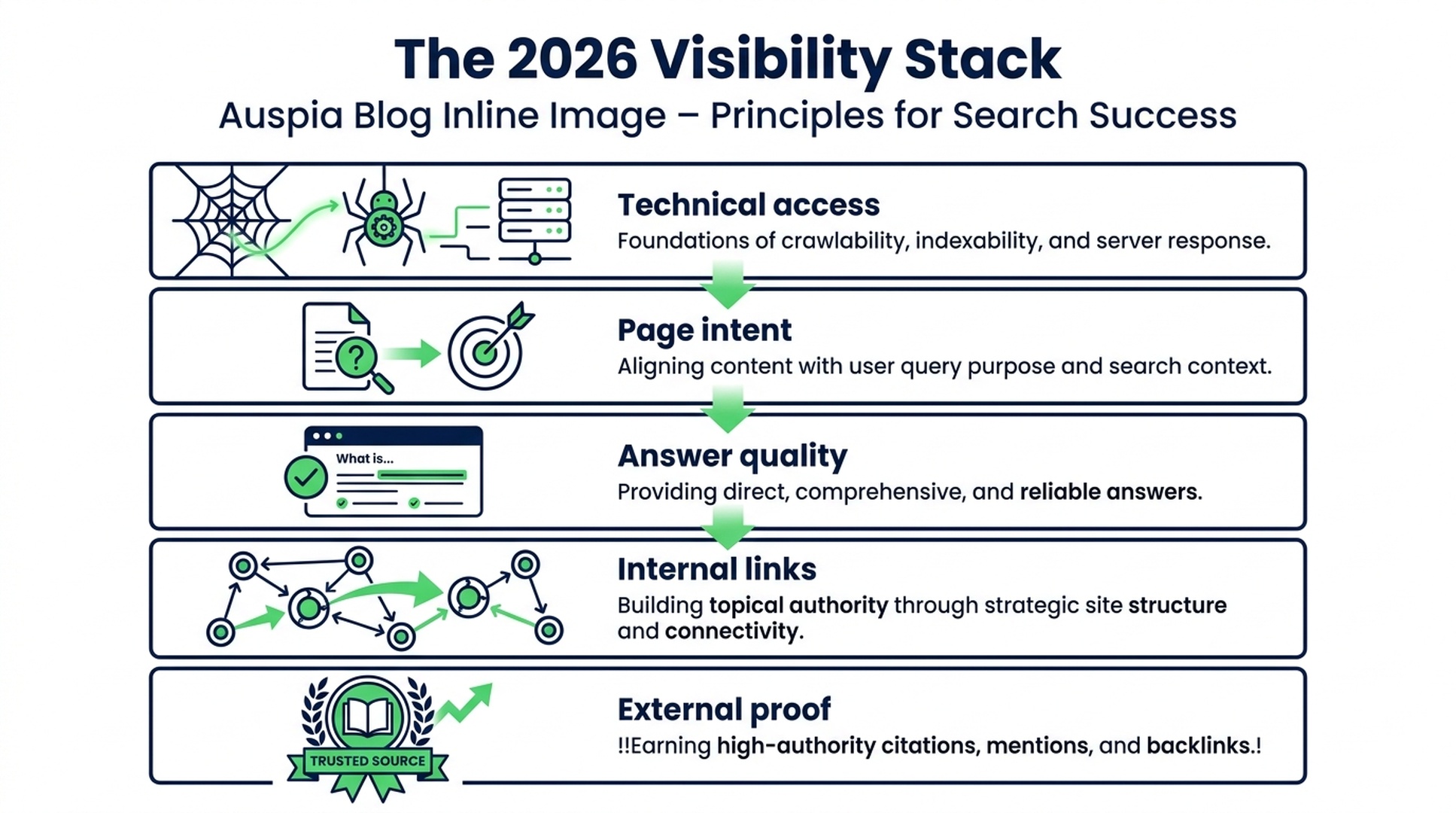
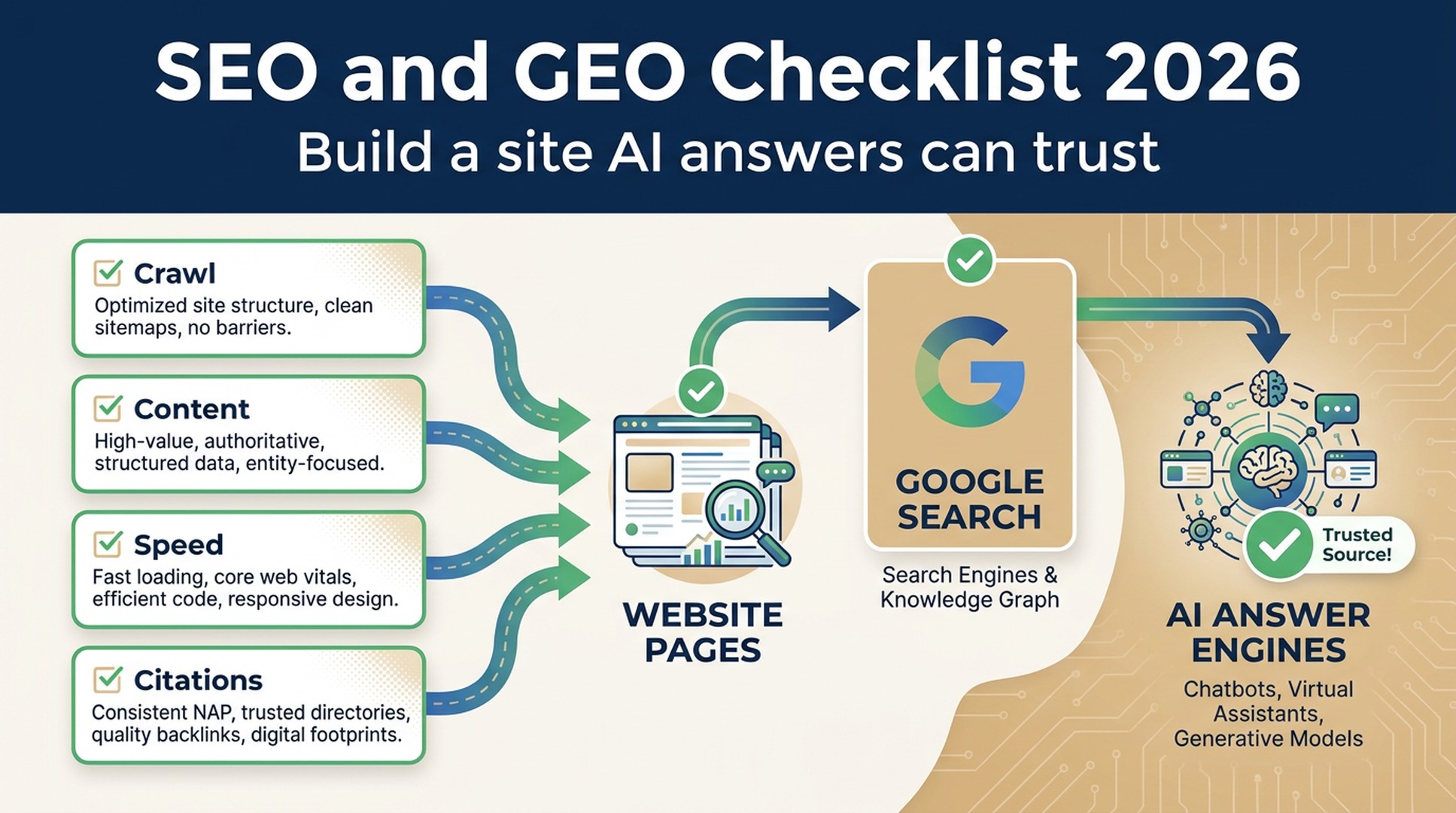
Caption: In 2026, visibility depends on a stack. Technical SEO is only the first layer; AI search also needs answer clarity and proof.
Before optimization: set up the site properly
A lot of SEO problems are created before the first article is published. The site goes live too early, demo content gets indexed, URL rules change after launch, or the team installs five overlapping plugins because every checklist says something different.
Start with the basics.
Area | What to decide | Why it matters in 2026 |
|---|---|---|
Domain | Use a stable brand domain, not a disposable keyword domain | Search engines and AI systems need consistent entity signals |
Hosting | Pick reliable hosting close to your main market, or use a CDN | Slow pages lose both users and crawl efficiency |
CMS or framework | WordPress, Webflow, Shopify, Astro, Next.js, or another stack is fine | The stack matters less than crawlability, speed, and editorial control |
URL structure | Use short, readable slugs and avoid changing them later | URLs become citation targets, internal links, and social references |
Indexing policy | Block unfinished staging pages; open indexing only when real content is ready | First crawls should see your actual brand and service pages, not templates |
If you are building in WordPress, one SEO plugin is enough. Yoast, Rank Math, Slim SEO, All in One SEO, and similar tools can all handle metadata and basic schema. The plugin is not the strategy. It is just a control panel.
For non-WordPress sites, make sure your framework outputs static or server-rendered HTML for important pages, creates clean canonical tags, supports XML sitemaps, and does not hide core content behind client-side scripts that crawlers may miss.
The real goal: become the best answer
Search has always been an answer-matching system. A user has a problem. A search engine, AI answer engine, or shopping assistant tries to return the page, product, or explanation most likely to solve it.
That is why the old phrase "content is king" is both true and incomplete. Content is not valuable because it exists. It is valuable when it answers the query with enough detail, trust, and context that the reader can make a decision.
For example, a cybersecurity company should not publish a vague article called "Why cybersecurity matters." A stronger page would answer a specific buyer question:
- "SOC 2 vs ISO 27001: which certification should a SaaS startup prioritize in 2026?"
- "How much does managed endpoint detection cost for a 50-person company?"
- "What should be included in a vendor security questionnaire response?"
These pages work better because they match real intent. They also give AI systems something concrete to summarize and cite.
Page-level SEO that still matters
The fundamentals have not disappeared. They just matter more because weak pages are now competing against both other websites and generated answers.
Titles and descriptions
Write titles for humans first. Include the main topic naturally, but do not stuff variations into one line.
A weak title:
SEO GEO AEO Guide 2026 Best SEO Optimization AI Search Ranking Tips
A better title:
SEO and GEO checklist for company websites in 2026
The second title is easier to read, easier to share, and clearer for a search result. Meta descriptions work the same way. They may not always appear exactly as written in Google, but they help define the page's promise.
Headings
Use headings to show the structure of the answer. One H1 for the page title. H2 for main sections. H3 for smaller points. Do not use headings as visual decoration.
A clean heading structure helps readers scan. It also helps answer engines identify which section contains a definition, checklist, comparison, or step.
Image optimization
Images still bring traffic, especially for products, diagrams, ecommerce, local services, real estate, travel, manufacturing, and design-heavy categories.
Use images that add information. Compress them. Use modern formats when possible. Write alt text that describes the content, not a pile of keywords.
Good alt text:
Comparison table showing manual SEO tasks versus automated SEO and GEO workflows.
Bad alt text:
SEO GEO best SEO AI SEO tool 2026 ranking traffic growth.
Internal links
Internal links tell users and crawlers which pages are related. They also help distribute authority across your site.
Do not overdo it. Two or three useful links are better than twenty forced links. For example, if you mention technical audits, link to a relevant checker. If you mention GEO, link to a deeper GEO guide or tool. If you mention automation, link to your tools page only when it fits the reader's next step.
What changed in 2026: GEO is now part of SEO
GEO, or generative engine optimization, is the practice of making your content easier for AI answer systems to understand, trust, and cite. It is not a replacement for SEO. It is a layer on top of the same foundation.
A page built only for classic SEO might focus on ranking for one keyword. A page built for SEO plus GEO answers the keyword, explains the entity relationships around it, uses clear evidence, and includes passages that can stand alone inside an AI answer.
Here is the practical difference:
Traditional SEO question | GEO question |
|---|---|
Can Google crawl and index this page? | Can an AI system understand the answer without misreading it? |
Does the title include the topic? | Does the page contain a concise answer that can be quoted or summarized? |
Are there internal links? | Do links explain relationships between services, examples, and proof pages? |
Is the content long enough? | Is the content specific enough to be trusted? |
Are we ranking? | Are we appearing, being cited, or being used as source material in AI answers? |
This is where many teams get stuck. They publish more content but do not make the content more answerable. More pages do not help if each page is thin, generic, or hard to verify.
A 2026 website SEO/GEO checklist
Use this checklist before publishing or refreshing any important page.
1. Crawl and index access
- The page returns a 200 status code.
- The page is not blocked by robots.txt or a noindex tag.
- Canonical tags point to the correct URL.
- The page appears in the XML sitemap.
- Important content is visible in the HTML, not only after JavaScript interactions.
2. Search intent
- The page answers one clear primary question.
- The opening section gives a direct answer within the first 150 words.
- The page matches the reader's stage: beginner, comparison, purchase, implementation, or troubleshooting.
- The title and H1 match the actual content.
3. Answer quality
- Definitions are simple and specific.
- Claims include examples, constraints, or evidence.
- Comparisons use tables when the decision is easier to understand visually.
- The page avoids filler introductions and generic conclusions.
4. Entity clarity
- The company, product, service, location, audience, and use case are named clearly.
- Author, team, or company proof is visible where relevant.
- Product pages explain who the product is for and what problem it solves.
- Case studies separate real data from illustrative examples.
5. Internal and external proof
- The page links to related internal pages where the reader naturally needs more context.
- It cites reputable external sources when making factual or current claims.
- It includes examples from real customer questions, sales calls, support tickets, or product use cases.
- It avoids pretending opinion is evidence.
6. Performance and mobile experience
- The page loads quickly on mobile.
- Images are compressed and sized correctly.
- Buttons and navigation work without layout shifts.
- The main content is readable without popups blocking it.
7. AI visibility readiness
- The page includes short answer blocks for common questions.
- It includes FAQ only when the questions are real.
- It uses descriptive alt text and structured tables.
- It can be understood without relying on brand slogans.
- It gives AI systems a reason to cite the page: original explanation, clear comparison, data, workflow, or practical checklist.
Content strategy: use customer questions as your keyword source
Keyword tools are useful, but they are not the only source of content ideas. For company websites, the best topics often come from sales and support.
Ask your sales team for the questions they answer every week. Ask customer success which objections slow down onboarding. Ask product which features are misunderstood. Those questions are usually closer to buying intent than broad keyword lists.
Turn each recurring question into one useful page:
Customer question | Page idea |
|---|---|
"How much does this cost?" | Pricing guide or cost factors page |
"How is this different from X?" | Comparison page |
"Can this work with our stack?" | Integration or implementation guide |
"What should we prepare before using it?" | Readiness checklist |
"Why should we trust your approach?" | Case study, methodology, or proof page |
A small site with 30 strong pages can outperform a bloated site with 300 generic posts. The goal is not to publish endlessly. The goal is to build a library of pages that answer the questions your market already has.
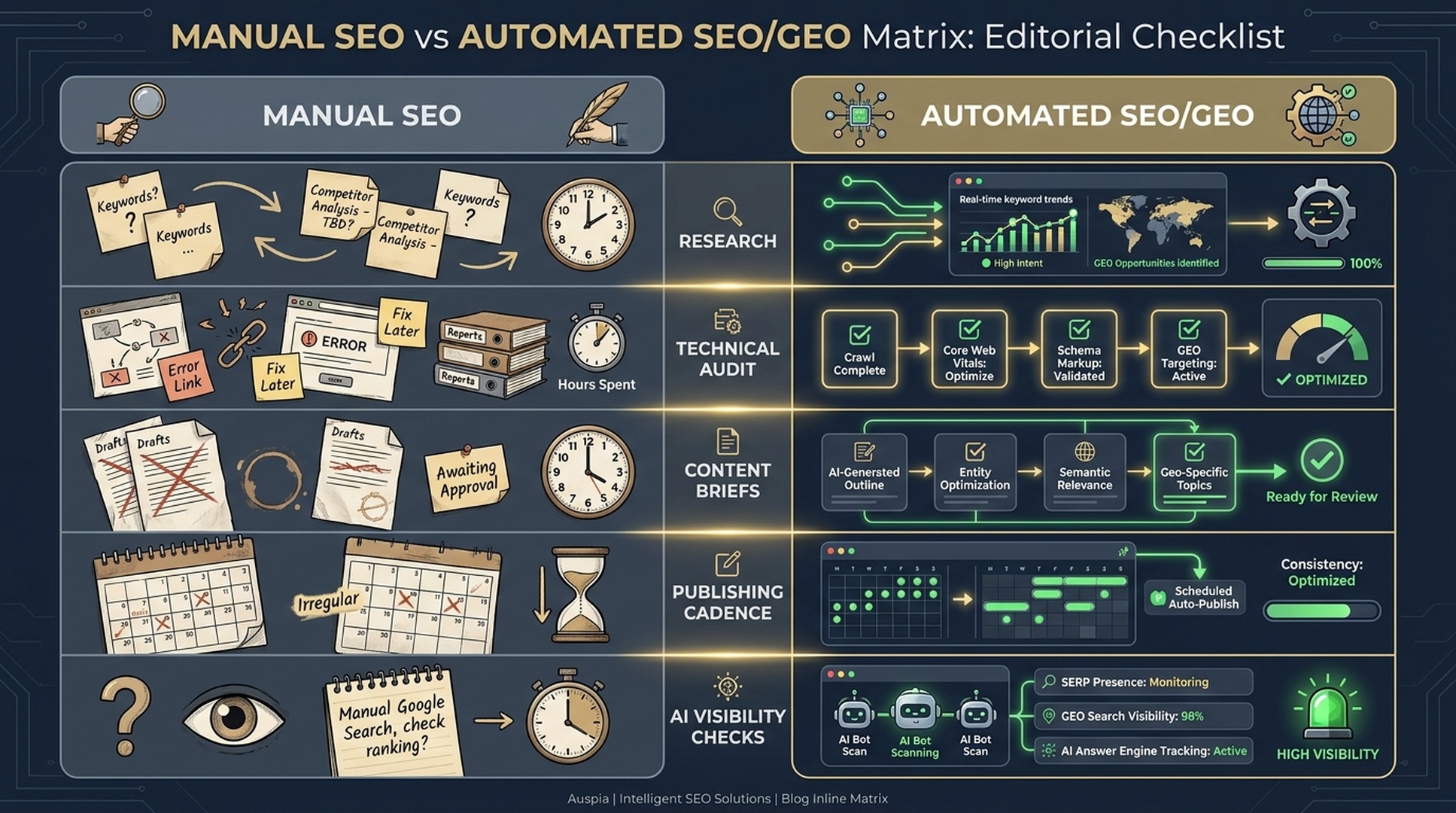
Caption: Manual SEO creates scattered work across research, audits, briefs, publishing, and visibility checks. Automation helps connect the loop.
Off-site signals still count, but relevance beats volume
Backlinks still matter, but low-quality link building is a poor use of time. AI search also makes weak off-site signals easier to ignore. A brand mentioned in relevant industry pages, directories, partner ecosystems, review sites, podcasts, and expert roundups has a stronger footprint than a brand scattered across spammy directories.
Good off-site work looks boring but compounds:
- Publish useful explainers that others can cite.
- Contribute to relevant industry communities without dropping links everywhere.
- Get listed in credible partner, marketplace, and software directories.
- Turn customer stories into pages that mention real industries, use cases, and constraints.
- Keep your company information consistent across public profiles.
If you cannot get high-quality links yet, do not panic. Build the site first. A clear, useful site makes outreach easier later.
Common mistakes to avoid
The first mistake is launching too early. If your site still has template copy, placeholder products, or unfinished service pages, block indexing until the real site is ready.
The second mistake is changing URL structures after pages start earning impressions. If you must change URLs, use proper redirects and update internal links.
The third mistake is treating AI content as a shortcut. AI can help with research, outlines, rewrites, and production speed, but pages still need judgment. Thin automated articles with no examples, no proof, and no buyer insight will not become strong SEO or GEO assets just because they are long.
The fourth mistake is tracking only rankings. In 2026, teams should also watch AI answer visibility, branded search demand, citation appearances, crawl health, conversion pages, and assisted traffic. A page may influence a buyer even when the final click comes from a different channel.
A practical publishing cadence
For a small business site, a realistic cadence is better than an ambitious one that collapses after two weeks.
A simple monthly plan:
Week | Focus | Output |
|---|---|---|
Week 1 | Technical and content audit | Fix crawl, index, metadata, and speed problems |
Week 2 | Customer question content | Publish 2-3 pages based on sales/support questions |
Week 3 | Comparison and proof | Publish one comparison, case, or methodology page |
Week 4 | Refresh and measure | Update old pages, check rankings, check AI visibility, improve internal links |
If you have more resources, increase quality before volume. Better examples, stronger diagrams, cleaner comparisons, and more specific proof usually beat another generic blog post.
Where Auspia fits
Most teams do not fail at SEO because they are lazy. They fail because the work is fragmented. Keyword research lives in one tool. Technical checks live in another. Content briefs are in a document. Publishing happens in the CMS. AI visibility is checked manually, if it is checked at all.
Auspia.ai is built for teams that want SEO, GEO, and AEO to run as an automated growth system, not a pile of disconnected tasks. It can help analyze a website, find technical and content gaps, generate optimization actions, support AI-search visibility workflows, and guide publishing without requiring the team to master every SEO concept first.
The human still decides the business direction. Auspia helps turn that direction into repeatable SEO/GEO execution.
FAQ
Is SEO still worth doing in 2026?
Yes. SEO is still the foundation for discoverability. GEO and AI search optimization add new requirements, but they depend on the same basics: crawlable pages, clear answers, useful content, authority signals, and strong user experience.
What is the difference between SEO and GEO?
SEO focuses on visibility in traditional search results. GEO focuses on being understood, trusted, and cited by generative answer systems. In practice, strong pages should now be built for both.
Do I need a WordPress SEO plugin?
If you use WordPress, one SEO plugin is helpful for metadata, sitemaps, canonical tags, and schema. You do not need multiple SEO plugins. For non-WordPress sites, use the equivalent controls in your CMS or framework.
How often should a company publish new content?
Start with a cadence you can maintain. For many small teams, two to four high-quality pages per month is more useful than daily generic posts. Refreshing existing pages also matters.
Can AI write all of my SEO content?
AI can speed up research, outlines, drafts, and rewrites. It should not replace real examples, product knowledge, customer insight, or editorial judgment. Search engines and AI answer systems still need content that is specific and useful.
How can a non-expert team start with GEO?
Start by making your most important pages easier to quote and summarize. Add direct answers, comparison tables, clear definitions, proof points, FAQs, and internal links. Tools like Auspia can automate much of the audit and execution loop.