Direct answer
B2B GEO works best when it is managed as an operating system, not as a one-off content campaign. The goal is not simply to make an AI assistant recommend your brand once. The larger goal is to make your expertise, product category, use cases, and proof points easy for AI search systems to retrieve, cite, and explain across the buying journey.
A practical B2B GEO program has seven parts:
- Define the questions where AI should understand you.
- Build a content knowledge base from existing assets.
- Map AI answer placements across brand, category, competitor, and implementation prompts.
- Produce answer-ready pages that can be crawled and cited.
- Distribute content where AI retrieval systems can find it.
- Measure mentions, citations, sentiment, and conversion-assisted influence.
- Run a monthly quality loop instead of treating GEO as a launch project.
1. GEO is unusually well suited to B2B
B2B buyers rarely make decisions from one search result. They compare categories, constraints, pricing models, integration risks, security requirements, implementation timelines, and vendor credibility. That means the buying journey is full of questions.
AI search is becoming a natural interface for those questions. A buyer might ask:
- What is the difference between two solution categories?
- Which vendors are credible for a specific use case?
- What should an implementation team prepare before rollout?
- What risks should legal, security, or finance review?
- Which product is better for a mid-market team versus an enterprise team?
Those are not simple keyword searches. They are decision-support prompts. B2B companies already have many of the raw materials AI systems need: case studies, sales decks, product docs, webinars, support answers, implementation notes, benchmark data, and comparison pages.
Auspia perspective: B2B GEO is less about inventing new content from nothing and more about reorganizing existing knowledge so machines and buyers can understand it.
2. Start with a content knowledge base, not a publishing calendar
Many teams begin GEO with a familiar reaction: publish more articles, register more third-party profiles, and ask AI platforms whether the brand appears. Those actions can help, but they are inefficient if the company has not defined its knowledge base.
A B2B GEO knowledge base should answer five questions:
Knowledge layer | What it contains | Why AI systems need it |
|---|---|---|
Entity facts | Brand name, category, audience, markets, product names | Helps AI describe who you are correctly |
Problem map | Customer pains, jobs to be done, buying triggers | Connects your brand to real questions |
Solution proof | Case studies, workflows, integrations, metrics | Gives AI evidence to cite |
Comparison logic | Alternatives, trade-offs, selection criteria | Helps AI answer competitive prompts |
Implementation detail | Setup steps, risks, requirements, timelines | Supports bottom-funnel decision questions |
Do not only audit published blog posts. Look at the whole company knowledge stack:
- Website pages and landing pages.
- Case studies and customer stories.
- Product documentation and release notes.
- Sales enablement decks.
- Webinars, podcasts, and event transcripts.
- FAQs from support, sales, and customer success.
- Original research, benchmarks, or internal data.
The goal is to turn scattered company knowledge into answer-ready assets.
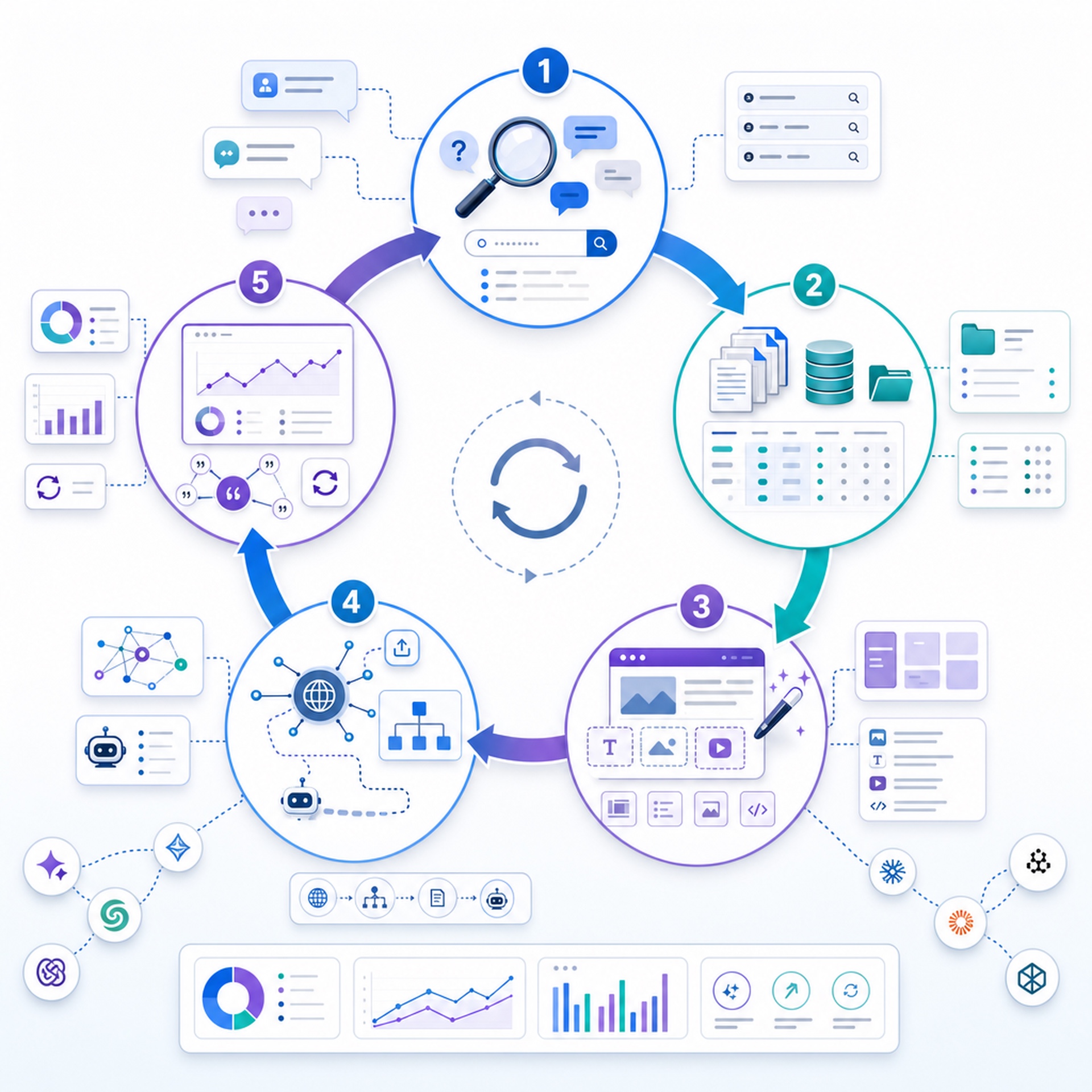
B2B GEO improves when content, distribution, measurement, and refresh work as one operating loop.
3. Strategy comes before content volume
More content does not automatically produce more AI visibility. GEO strategy should define where the brand deserves to appear and what evidence supports that appearance.
Before writing new articles, answer these five strategy questions:
- Which customer questions should AI associate with our expertise?
- Which buying scenarios should trigger our brand, product, or methodology?
- Which category, competitor, and implementation prompts matter most?
- Which existing assets can support AI citations today?
- Which metrics will tell us whether GEO is improving revenue-relevant visibility?
This turns GEO from "publish and hope" into a managed system.
GEO strategy map
Strategy decision | Weak version | Stronger version |
|---|---|---|
Target prompts | "AI should recommend us" | "AI should cite us for these 40 buyer questions" |
Content plan | "Write more GEO posts" | "Fill missing proof for category, comparison, and implementation prompts" |
Distribution | "Post everywhere" | "Prioritize crawlable, reputable, and retrieval-friendly channels" |
Measurement | "Are we mentioned?" | "Are we cited accurately in high-intent answer contexts?" |
Auspia perspective: strategy is the difference between content activity and AI answer influence.
4. The core value is not only recommendation
Many GEO vendors sell recommendation rate because it is easy to understand. But for B2B companies, recommendation is only one outcome.
The deeper value is answer influence.
A buyer may not ask, "Which vendor should I choose?" They may ask:
- How should a B2B team build an AI search measurement workflow?
- What is the difference between SEO, AEO, and GEO?
- What should a marketing team include in a vendor comparison page?
- How do AI engines decide which sources to cite?
- What are the risks of blocking AI crawlers?
If your content shapes those answers, your brand can influence the buying process before a recommendation prompt ever appears.
That is why B2B GEO should measure four layers:
Layer | What to measure | Why it matters |
|---|---|---|
Mention | Whether AI names the brand | Basic entity visibility |
Citation | Whether AI links or attributes your content | Source authority and traffic potential |
Description accuracy | Whether AI explains your positioning correctly | Brand and category control |
Decision influence | Whether your ideas appear in buying criteria | Long-term demand shaping |
5. Map AI answer placements across the buying journey
A strong B2B GEO plan does not chase every prompt. It maps the answer positions that matter.
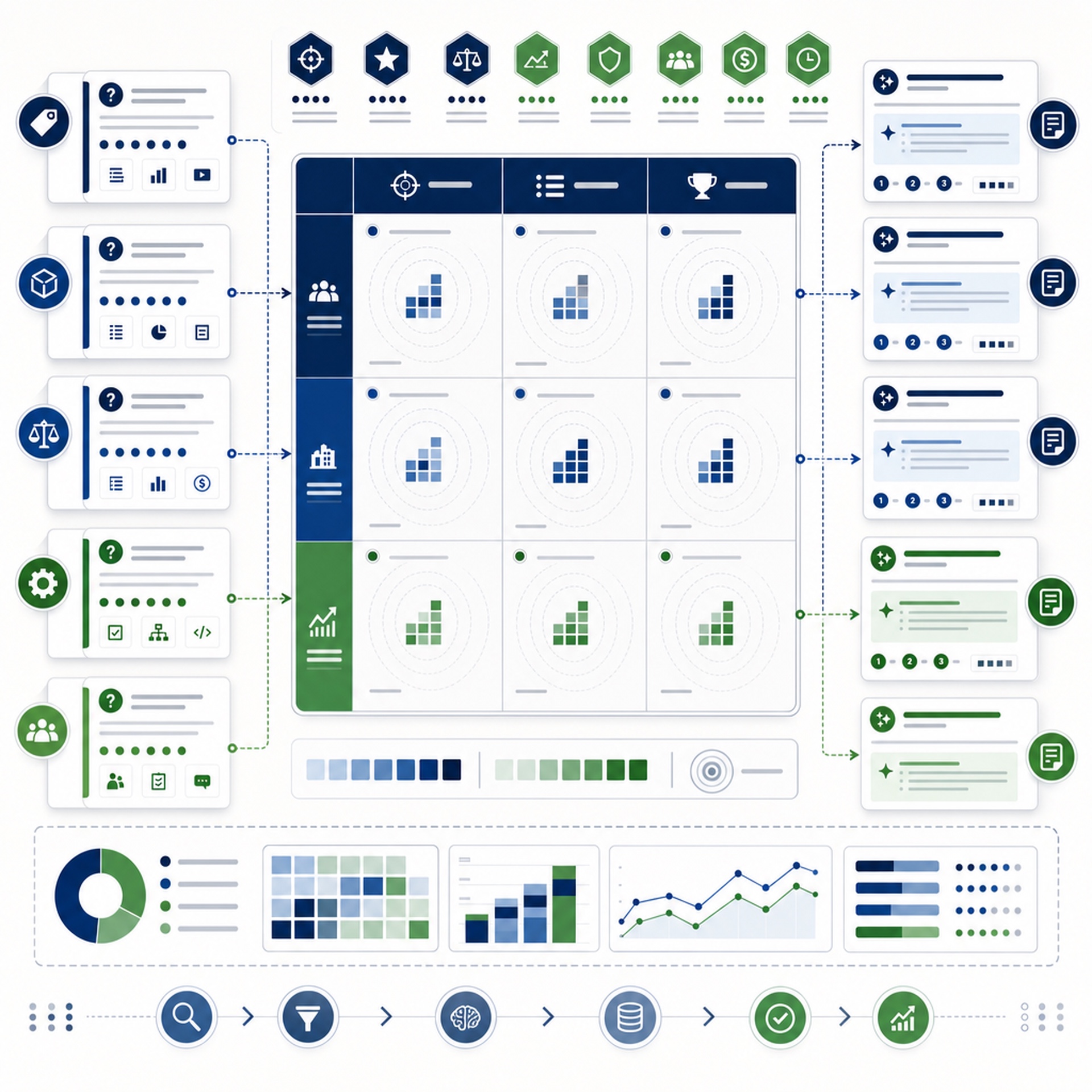
AI answer placement is broader than direct vendor recommendation. Category, comparison, and implementation prompts often shape demand earlier.
Think about five placement zones:
- Brand placement: prompts where AI should describe your company accurately.
- Category placement: prompts where AI explains your product category or methodology.
- Scenario placement: prompts tied to a use case, industry, team size, or workflow.
- Competitor placement: prompts comparing you with alternatives or adjacent tools.
- Implementation placement: prompts about rollout, requirements, risks, and evaluation.
For each zone, define the pages that should be cited. If no strong page exists, that is a content gap.
6. Build the GEO operating loop
GEO is not a one-time project because AI answers change. New competitors publish content. Search indexes update. AI platforms adjust retrieval. Your own product and proof points evolve.
A durable loop has four stages:
Monitor questions and prompts
Maintain a prompt library of buyer questions. Review it monthly. Add new prompts from sales calls, support tickets, community discussions, search data, and AI answer logs.
Produce and refresh content
Create new pages only when there is a clear gap. Often, the better move is to restructure an existing asset: add a definition, comparison table, evidence section, implementation checklist, FAQ, and source links.
Distribute and make accessible
Publish content where it can be crawled and trusted. Your own site should be the source of truth, but reputable third-party profiles, documentation hubs, community answers, and partner pages can reinforce the entity graph.
Evaluate and correct
Check whether AI systems mention, cite, or misdescribe you. If answers are inaccurate, update source pages, strengthen entity consistency, and add clearer evidence.
7. Use a practical scorecard
A GEO report should not stop at "AI mentioned us." Use a scorecard that separates visibility from quality.
Metric | Good sign | Warning sign |
|---|---|---|
Prompt coverage | Brand appears in priority prompts | Visibility only appears in low-intent prompts |
Citation quality | AI cites owned or authoritative pages | AI cites outdated or weak third-party pages |
Description accuracy | Positioning, audience, and use cases are correct | AI confuses category or target customer |
Competitive context | Brand appears in relevant comparison answers | Competitors define the criteria alone |
Content freshness | Cited pages are current and evidence-rich | AI relies on old pages or thin summaries |
Auspia perspective: the best GEO dashboard combines search data, AI answer checks, content quality, and conversion context. Visibility without accuracy can create the wrong demand.
8. Self-test: are you building content or an operating system?
Ask your team these questions:
- Do we know the 30-50 AI prompts that matter most to our buyers?
- Do we have crawlable pages that answer those prompts directly?
- Do our case studies include enough context for AI systems to cite them?
- Do we have comparison pages that explain trade-offs fairly?
- Do we monitor whether AI answers describe us accurately?
- Do we refresh pages when AI answers expose a gap?
If most answers are no, the problem is probably not a lack of articles. The problem is the absence of a GEO operating system.
FAQ
Does B2B GEO replace SEO?
No. B2B GEO depends on SEO fundamentals such as crawlability, indexability, clear page structure, internal links, and credible content. GEO adds a layer focused on AI answer retrieval, citation, and decision influence.
What should a B2B company optimize first?
Start with buyer questions and existing content assets. Identify high-intent prompts, map them to pages, then improve the pages that should become source material.
How many prompts should a team track?
A small program can start with 30-50 prompts across brand, category, competitor, scenario, and implementation questions. Larger teams can expand by region, product line, or buyer persona.
Should every GEO asset be a blog post?
No. Strong GEO assets can include comparison pages, documentation, case studies, research reports, glossary pages, FAQs, and implementation guides.
What is the biggest mistake in B2B GEO?
The biggest mistake is treating GEO as mass publishing. AI systems need clear, verifiable, well-structured source material, not endless generic posts.