Quick Answer
Cyber insurance GEO should not start with generic pages that say a policy protects against cyber risk. Buyers are more specific now. They ask whether ransomware is covered, whether business interruption has limits, whether MFA is required, whether social engineering is excluded, whether compliance frameworks affect underwriting, and what happens during a claim.
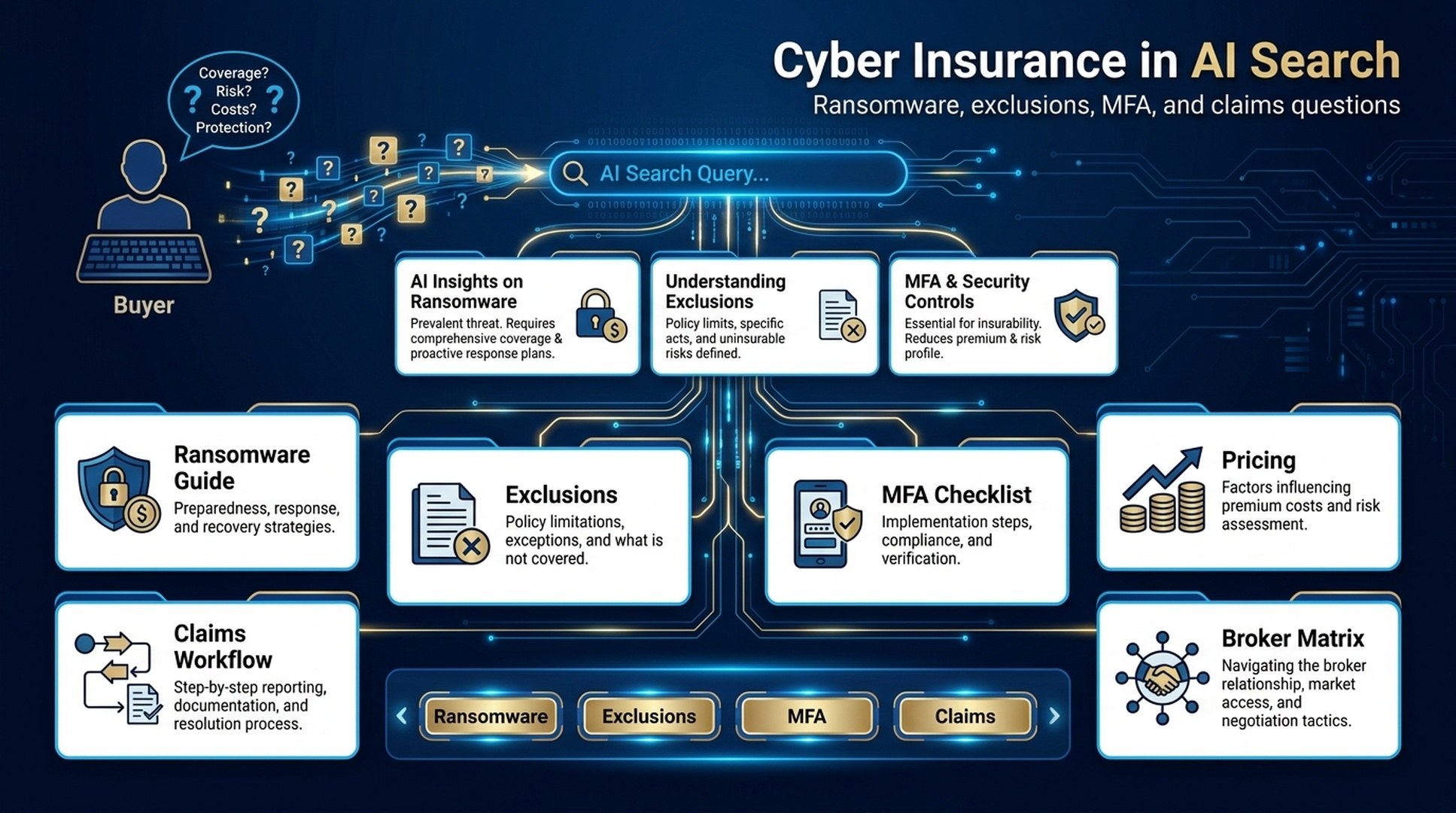
For brokers, insurtech teams, carriers, MSSPs, and security advisors, the best AI Search content usually maps buyer questions to six owner assets:
Buyer question | Best owner asset | Proof AI systems can extract |
|---|---|---|
Will ransomware be covered? | Ransomware coverage guide | Coverage categories, conditions, exclusions, incident response caveats |
What will the policy exclude? | Cyber exclusions explainer | Common exclusions, sublimits, war/systemic risk caveats |
What security controls do underwriters require? | Underwriting readiness checklist | MFA, backups, EDR, patching, incident response, vendor risk |
How much will cyber insurance cost? | Pricing and limit guide | Premium drivers, retention, limits, revenue, industry, control maturity |
What happens during a claim? | Cyber claim workflow page | Notification, breach counsel, forensics, restoration, insurer approval |
Which policy or broker fits us? | Buyer comparison page | Role fit, coverage fit, risk profile, service model, claims support |
The article below gives a practical prompt library and page architecture for earning visibility in AI-assisted cyber insurance research without turning coverage language into unsafe legal advice.
The Buyer Risk Ladder
Cyber insurance buyers climb a risk ladder before they are ready to request a quote. Each rung has different questions and different content needs.
Risk rung | What the buyer is trying to understand | Content job |
|---|---|---|
Exposure | What cyber events could hurt us? | Explain ransomware, data breach, funds transfer fraud, downtime, vendor incidents |
Coverage | What does cyber insurance usually cover? | Separate first-party, third-party, incident response, business interruption, and cyber crime concepts |
Exclusions | What might not be covered? | Explain exclusions, sublimits, waiting periods, warranties, and approval conditions |
Controls | What do underwriters expect? | Map MFA, backups, EDR, patching, access reviews, and incident response to underwriting readiness |
Compliance | Does SOC 2, HIPAA, PCI, or contracts matter? | Show how compliance evidence can support risk conversations without promising approval |
Price | How much limit, retention, and premium make sense? | Explain drivers and tradeoffs with caveats |
Claims | What happens if an attack occurs? | Describe claim notification, counsel, forensics, restoration, and documentation |
Comparison | Which broker, carrier, or platform should we choose? | Provide fit criteria and evaluation questions |
Auspia's recommendation: build answerable insurance education, not disguised quote forms. AI systems need clear definitions, boundaries, and caveats before they can confidently summarize a page.
Why Cyber Insurance GEO Starts With Coverage Boundaries
Cyber insurance is a trust-heavy category because buyers worry about discovering a gap after an incident. A CFO may ask if ransomware payments are covered. A security leader may ask whether MFA is required. A founder may ask if a SOC 2 report lowers premium. A broker may need a plain-English page that explains exclusions without rewriting policy language.
These are not the same intent:
- one buyer is checking insurability;
- one is preparing for underwriting;
- one is comparing brokers;
- one is worried about a claim dispute;
- one is trying to satisfy a customer contract.
Strong GEO content should therefore separate policy education from policy advice. Use plain explanations, but make clear that actual coverage depends on the specific policy wording, endorsements, exclusions, underwriting information, and claims facts.
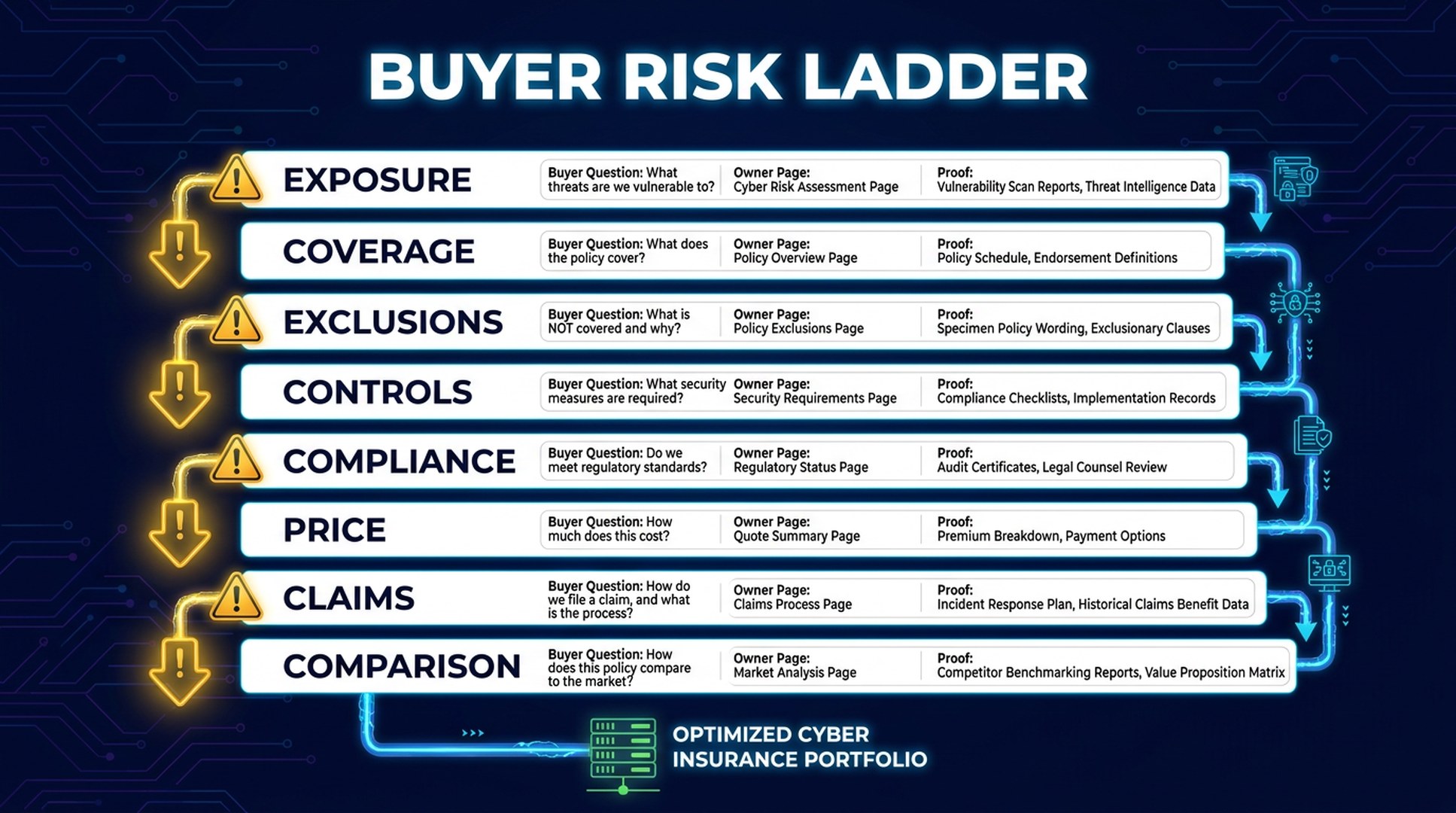
The Buyer Risk Ladder keeps cyber insurance content focused on coverage boundaries, underwriting controls, compliance evidence, claims, and comparison decisions.
The 10 Query Types Cyber Insurance Teams Should Map
Query type | Typical user | Content that earns trust |
|---|---|---|
Coverage basics | Founder, CFO, operations lead | First-party vs third-party guide, coverage glossary |
Ransomware | Security leader, CFO | Ransomware coverage and claim workflow page |
Exclusions and sublimits | Legal, finance, risk manager | Exclusion explainer and policy review checklist |
Underwriting controls | Security team, IT lead | MFA, backup, EDR, patching, incident response checklist |
Compliance and contracts | SaaS, healthcare, finance teams | Compliance evidence guide and contract requirement page |
Pricing and limits | CFO, founder, broker | Premium driver, limit, retention, and industry risk pages |
Claims process | Incident responder, executive | Claim notification and documentation workflow |
Broker and carrier comparison | Buyer committee | Evaluation matrix and service model comparison |
Industry scenario | SaaS, healthcare, ecommerce, manufacturer | Vertical-specific risk and underwriting pages |
AI and emerging risk | Tech company, legal, risk leader | AI risk, deepfake, vendor, and systemic risk explainer |
How To Prioritize Cyber Insurance AI Search Questions
Score prompts by commercial pressure and coverage sensitivity.
Factor | High-value signal | Page implication |
|---|---|---|
Coverage anxiety | Mentions covered, excluded, sublimit, claim, denied | Coverage boundary or exclusion page |
Ransomware urgency | Mentions ransomware, extortion, downtime, recovery | Ransomware coverage and incident workflow |
Underwriting readiness | Mentions MFA, EDR, backups, patching, questionnaire | Readiness checklist or control guide |
Compliance pressure | Mentions SOC 2, HIPAA, PCI, vendor contract, customer requirement | Compliance evidence page |
Pricing intent | Mentions premium, limit, retention, quote, cost | Pricing and quote readiness page |
Comparison intent | Mentions broker, carrier, best, compare, marketplace | Evaluation page or alternative page |
A query with both coverage anxiety and comparison intent should be handled carefully. It is high value, but it also requires the clearest caveats.
100 Cyber Insurance AI Search Questions
Use this as a prompt library, not a list of 100 pages.
Coverage Basics Questions
- What does cyber insurance usually cover for a small business?
- What is the difference between first-party and third-party cyber coverage?
- Does cyber insurance cover data breach response?
- Does cyber insurance cover business interruption after a cyberattack?
- Does cyber insurance cover legal fees after a breach?
- Does cyber insurance cover customer notification costs?
- What is cyber liability insurance in plain English?
- What is the difference between cyber insurance and technology E&O?
- What is cyber crime coverage and how is it different from cyber liability?
- What cyber insurance coverage should a SaaS startup understand first?
Ransomware Questions
- Does cyber insurance cover ransomware attacks?
- Does cyber insurance cover ransomware payments?
- Does cyber insurance cover data restoration after ransomware?
- Does cyber insurance cover business interruption from ransomware?
- What should a company do before contacting its cyber insurer after ransomware?
- Can an insurer deny a ransomware claim?
- What documents are needed for a ransomware insurance claim?
- Does cyber insurance cover ransomware negotiation services?
- Does cyber insurance cover forensic investigation after ransomware?
- What ransomware controls do cyber insurance underwriters expect?
Exclusions And Sublimits Questions
- What are common cyber insurance exclusions?
- What is a cyber insurance sublimit?
- What does a war exclusion mean in cyber insurance?
- Can cyber insurance exclude social engineering fraud?
- Does cyber insurance cover funds transfer fraud?
- What cyber losses are often excluded from policies?
- How do waiting periods work for cyber business interruption?
- What does failure to maintain security controls mean in a cyber policy?
- Can a cyber claim be denied because MFA was not enabled?
- What should buyers ask about exclusions before choosing cyber insurance?
Underwriting Controls Questions
- Is MFA required for cyber insurance?
- Do cyber insurers require endpoint detection and response?
- Do cyber insurers check backup practices?
- What security controls lower cyber insurance risk?
- What questions are on a cyber insurance underwriting questionnaire?
- How should a company prepare for a cyber insurance renewal?
- Does patch management affect cyber insurance underwriting?
- Do underwriters ask about privileged access management?
- Does employee security training matter for cyber insurance?
- How do cyber insurers evaluate incident response readiness?
Compliance And Contract Questions
- Does SOC 2 help with cyber insurance underwriting?
- Does HIPAA compliance affect cyber insurance for healthcare companies?
- Does PCI compliance affect cyber insurance for ecommerce businesses?
- Can customer contracts require cyber insurance?
- What cyber insurance limits do enterprise customers usually request?
- How should SaaS companies prove security controls to cyber insurers?
- Does a security questionnaire help prepare for cyber insurance?
- Does compliance guarantee cyber insurance approval?
- What compliance evidence should be ready before applying for cyber insurance?
- How should a company align cyber insurance with vendor risk management?
Pricing And Limit Questions
- How much does cyber insurance cost for a small business?
- What affects cyber insurance premium?
- How much cyber insurance limit does a company need?
- What is a cyber insurance retention?
- How do revenue and industry affect cyber insurance pricing?
- Does better security lower cyber insurance premiums?
- Why did my cyber insurance renewal premium increase?
- How should a startup budget for cyber insurance?
- What is the difference between a low premium and weak coverage?
- How should buyers compare cyber insurance quotes?
Claims Process Questions
- What happens when a company files a cyber insurance claim?
- Who should be notified first after a cyber incident?
- Does cyber insurance require approved breach counsel?
- Does the insurer choose the forensic firm?
- What should companies document during a cyber incident?
- How fast should a cyber insurance claim be reported?
- What mistakes can hurt a cyber insurance claim?
- Does cyber insurance cover public relations after a breach?
- Does cyber insurance cover regulatory investigations?
- How do cyber claims differ from other business insurance claims?
Broker And Carrier Comparison Questions
- How do I choose a cyber insurance broker?
- What should I ask a broker before buying cyber insurance?
- What is the difference between a cyber insurance broker and marketplace?
- How should I compare cyber insurance carriers?
- What makes a good cyber insurance policy for SaaS?
- What should a broker explain about exclusions?
- How do claims support services differ between cyber insurance providers?
- Should a company use an insurtech platform for cyber insurance?
- What should be in a cyber insurance comparison checklist?
- How do I know if a cyber insurance quote is too limited?
Industry Scenario Questions
- What cyber insurance questions should SaaS companies ask?
- What cyber insurance does a healthcare practice need to understand?
- What cyber insurance matters for ecommerce companies?
- What cyber insurance issues affect manufacturers?
- What cyber insurance should accounting firms consider?
- What cyber insurance should law firms ask about?
- What cyber insurance matters for nonprofits?
- What cyber insurance does a construction company need?
- What cyber insurance questions should schools ask?
- What cyber insurance matters for managed service providers?
AI And Emerging Risk Questions
- Does cyber insurance cover deepfake fraud?
- Does cyber insurance cover AI-generated phishing attacks?
- Does cyber insurance cover vendor software compromise?
- Does cyber insurance cover cloud provider outages?
- How do systemic cyber risk exclusions work?
- Does cyber insurance cover data poisoning or model manipulation?
- How should companies think about AI risk and cyber insurance?
- What new cyber insurance questions are emerging from generative AI?
- How should brokers explain AI-enabled cyber risk to clients?
- What should buyers ask about emerging cyber risks before renewal?
How To Turn Cyber Insurance Questions Into Citation-Ready Pages
Most teams should consolidate these prompts into a focused library of owner pages.
Owner page | Query clusters it should cover | Conversion path |
|---|---|---|
Cyber Insurance Coverage Basics | 1-10 | Quote readiness checklist or broker consult |
Ransomware Coverage Guide | 11-20 | Incident response readiness or policy review |
Exclusions And Sublimits Explainer | 21-30 | Coverage review and comparison checklist |
Cyber Underwriting Controls Checklist | 31-40 | Security readiness assessment |
Compliance Evidence For Cyber Insurance | 41-50 | SaaS, healthcare, ecommerce, or regulated-industry page |
Cyber Insurance Pricing And Limits | 51-60 | Quote request or premium driver assessment |
Cyber Claim Workflow | 61-70 | Claims support service page |
Broker And Carrier Evaluation Matrix | 71-80 | Broker consultation or marketplace comparison |
Industry Cyber Insurance Guides | 81-90 | Vertical landing pages |
Emerging Cyber Risk Guide | 91-100 | Executive risk briefing or renewal prep |
Every page should include a direct answer, caveats, example scenarios, a table, and a safe next step. Avoid implying that a particular claim will be covered without policy review.
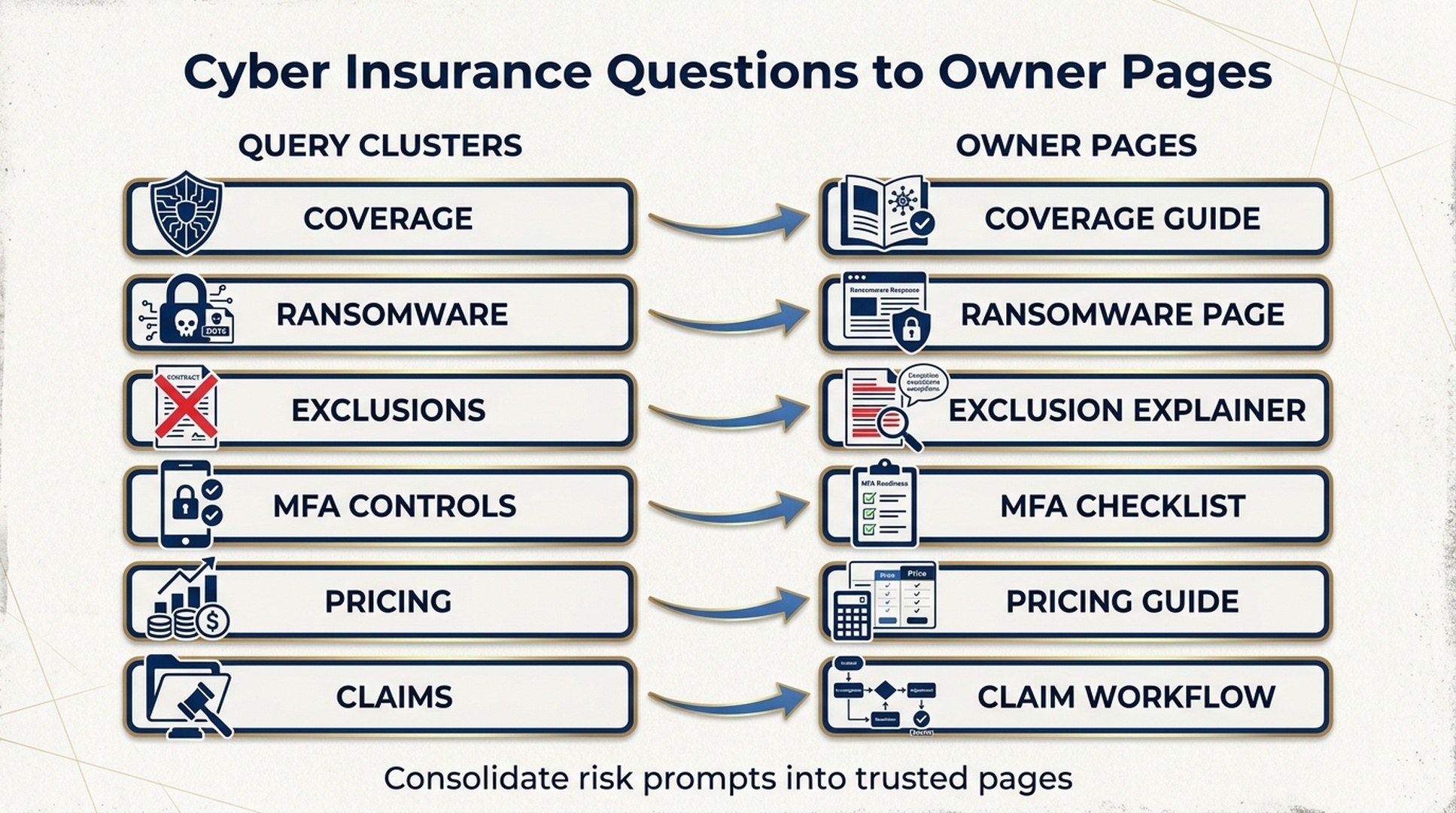
Cyber insurance prompts should consolidate into trusted owner pages rather than thin quote-intent landing pages.
The First 20 Questions To Prioritize
Priority | Question | Best page |
|---|---|---|
1 | Does cyber insurance cover ransomware attacks? | Ransomware Coverage Guide |
2 | Does cyber insurance cover business interruption after a cyberattack? | Coverage Basics |
3 | What are common cyber insurance exclusions? | Exclusions Explainer |
4 | Can a cyber claim be denied because MFA was not enabled? | Underwriting Controls Checklist |
5 | Is MFA required for cyber insurance? | MFA Readiness Page |
6 | What questions are on a cyber insurance underwriting questionnaire? | Underwriting Checklist |
7 | Does SOC 2 help with cyber insurance underwriting? | Compliance Evidence Guide |
8 | Can customer contracts require cyber insurance? | Contract Requirements Page |
9 | How much does cyber insurance cost for a small business? | Pricing Guide |
10 | How much cyber insurance limit does a company need? | Limits Guide |
11 | What happens when a company files a cyber insurance claim? | Claim Workflow |
12 | What mistakes can hurt a cyber insurance claim? | Claim Documentation Page |
13 | How do I choose a cyber insurance broker? | Broker Evaluation Matrix |
14 | How should I compare cyber insurance carriers? | Carrier Comparison Page |
15 | What cyber insurance questions should SaaS companies ask? | SaaS Cyber Insurance Guide |
16 | What cyber insurance does a healthcare practice need to understand? | Healthcare Cyber Guide |
17 | Does cyber insurance cover deepfake fraud? | Emerging Risk Guide |
18 | Does cyber insurance cover AI-generated phishing attacks? | AI Cyber Risk Guide |
19 | How should a company prepare for a cyber insurance renewal? | Renewal Checklist |
20 | What should buyers ask about exclusions before choosing cyber insurance? | Buyer Checklist |
30-Day Execution Plan
Days 1-5: Build The Buyer Question Library
- Pull questions from broker calls, quote forms, security questionnaires, renewals, claims conversations, and sales notes.
- Tag each question by coverage, exclusion, control, compliance, price, claim, and comparison intent.
- Separate policy education from policy-specific advice.
- Identify prompts where third-party publications or competitors currently own the answer.
Days 6-10: Publish Coverage Boundary Pages
- Create the coverage basics page, ransomware guide, and exclusions explainer.
- Add plain-English tables, but include policy-wording caveats.
- Show examples without promising claim outcomes.
- Link to quote readiness and broker consultation pages only where relevant.
Days 11-15: Build Underwriting And Compliance Assets
- Publish the underwriting controls checklist.
- Add MFA, EDR, backup, patching, access control, and incident response readiness guidance.
- Create compliance evidence pages for SaaS, healthcare, ecommerce, and regulated businesses.
- Add a renewal checklist for teams with existing policies.
Days 16-22: Build Pricing, Claims, And Comparison Pages
- Publish the pricing and limits guide.
- Build the claim workflow page.
- Create a broker and carrier evaluation matrix.
- Add buyer checklists that explain what to ask before signing.
Days 23-30: Test AI Visibility And Improve
- Run the first 20 questions across ChatGPT, Perplexity, Gemini, Google AI Overviews, and Bing Copilot.
- Record whether your brand appears, which competitors appear, and what sources are cited.
- Improve pages where AI answers are vague, outdated, or missing caveats.
- Add stronger tables, FAQs, internal links, and scenario examples.
Common Mistakes
Mistake | Why it weakens GEO | Better move |
|---|---|---|
Treating cyber insurance as one generic keyword | Buyers ask about ransomware, exclusions, controls, claims, and price separately | Segment content by risk decision |
Promising coverage too broadly | Actual coverage depends on policy terms and claim facts | Use caveats and explain review steps |
Ignoring exclusions | Buyers worry most about what will not be paid | Build an exclusion and sublimit explainer |
Writing only for quote intent | Many buyers need education before requesting a quote | Build readiness and comparison assets |
Hiding underwriting controls | MFA, backups, and incident response affect buyer readiness | Publish a clear control checklist |
Overusing fear-based ransomware copy | Fear may create clicks but weakens trust | Explain scenarios and next steps calmly |
Ignoring emerging AI risk | Buyers increasingly ask about phishing, deepfakes, vendors, and systemic risk | Add an emerging-risk page with careful boundaries |
FAQ
Is cyber insurance GEO different from cybersecurity SEO?
Yes. Cybersecurity SEO often explains threats, tools, and controls. Cyber insurance GEO needs to connect those threats and controls to coverage, underwriting, exclusions, pricing, claims, and buyer comparison questions.
Should brokers publish cyber insurance advice online?
They can publish educational content, checklists, and buyer questions. They should avoid presenting general content as policy-specific legal, insurance, or claims advice. Actual coverage depends on the policy wording, endorsements, exclusions, underwriting representations, and claim facts.
Which cyber insurance pages should be built first?
Start with coverage basics, ransomware coverage, exclusions and sublimits, underwriting controls, pricing and limits, claim workflow, and broker comparison. These pages cover the questions most likely to affect quote readiness and buyer trust.
Can compliance content help cyber insurance GEO?
Yes, if it is specific. Pages that explain SOC 2, HIPAA, PCI, or customer contract evidence can help buyers understand what to prepare for underwriting. The content should not claim that compliance guarantees approval or premium reduction.
How should cyber insurance teams measure AI Search visibility?
Create a fixed prompt set, test it across AI answer platforms, record brand mentions and cited sources, and review whether answers include accurate caveats. The first 20 questions in this article make a practical starting set.
Auspia Takeaway
Cyber insurance GEO works when it respects the buyer's real anxiety: what is covered, what is excluded, what controls are required, what it costs, what happens during a claim, and which provider can be trusted. If your content only pushes quote forms, AI systems have little to extract. If your pages explain boundaries clearly, they can help both buyers and AI answer systems make better sense of the market.
Author: Grace Miller, AI Search Risk Analyst Tracking 200+ Policy Shifts at Auspia. Grace writes about policy-aware optimization, content risk, and AI Search visibility for sensitive categories.