The Job Of Keyword Research Changes In Alexa GEO
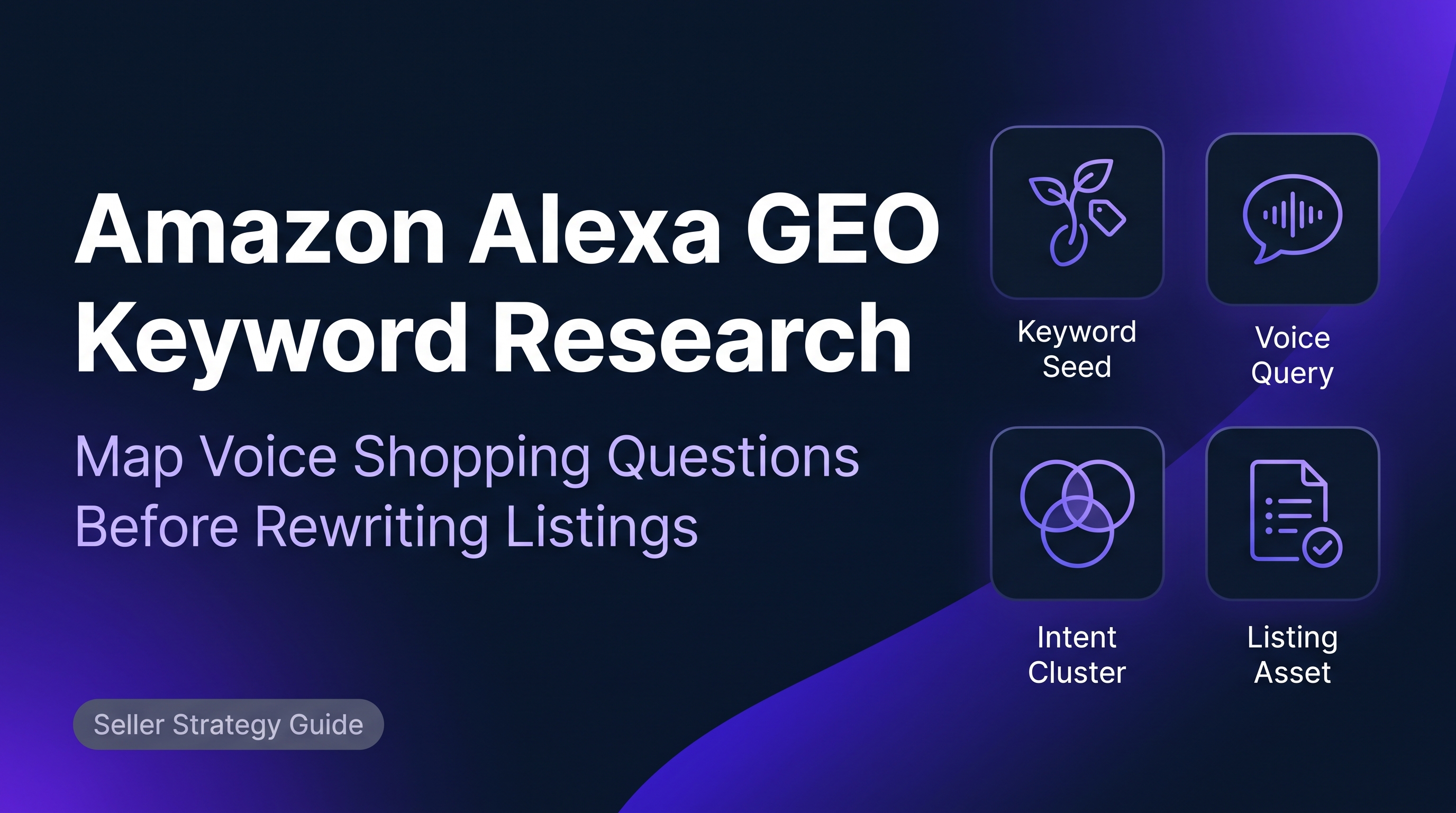
Amazon Alexa GEO keyword research is not about collecting more phrases and pushing them into a product title. It is about translating spoken shopping behavior into a map of buyer questions, then deciding which listing asset should answer each question.
For sellers, the most useful output is not a keyword list. It is an intent map that says: this phrase belongs in the product title, this objection belongs in Q&A, this comparison belongs in A+ Content, this synonym belongs in backend search terms, and this reorder phrase should influence variant naming.
DataForSEO research for this series shows why the map matters. Broad commercial terms such as voice search optimization, amazon seo, amazon product listing optimization, and amazon sponsored products carry much stronger advertiser demand than direct phrases like alexa voice shopping. But direct Alexa terms reveal the behavior layer: shopping lists, app usage, sharing lists, notifications, and voice reorders.
Start With Four Query Buckets, Not One Keyword Dump
A seller who starts with one giant keyword spreadsheet will usually over-optimize the title and under-answer the buyer. For Alexa GEO, split every query into one of four buckets first.
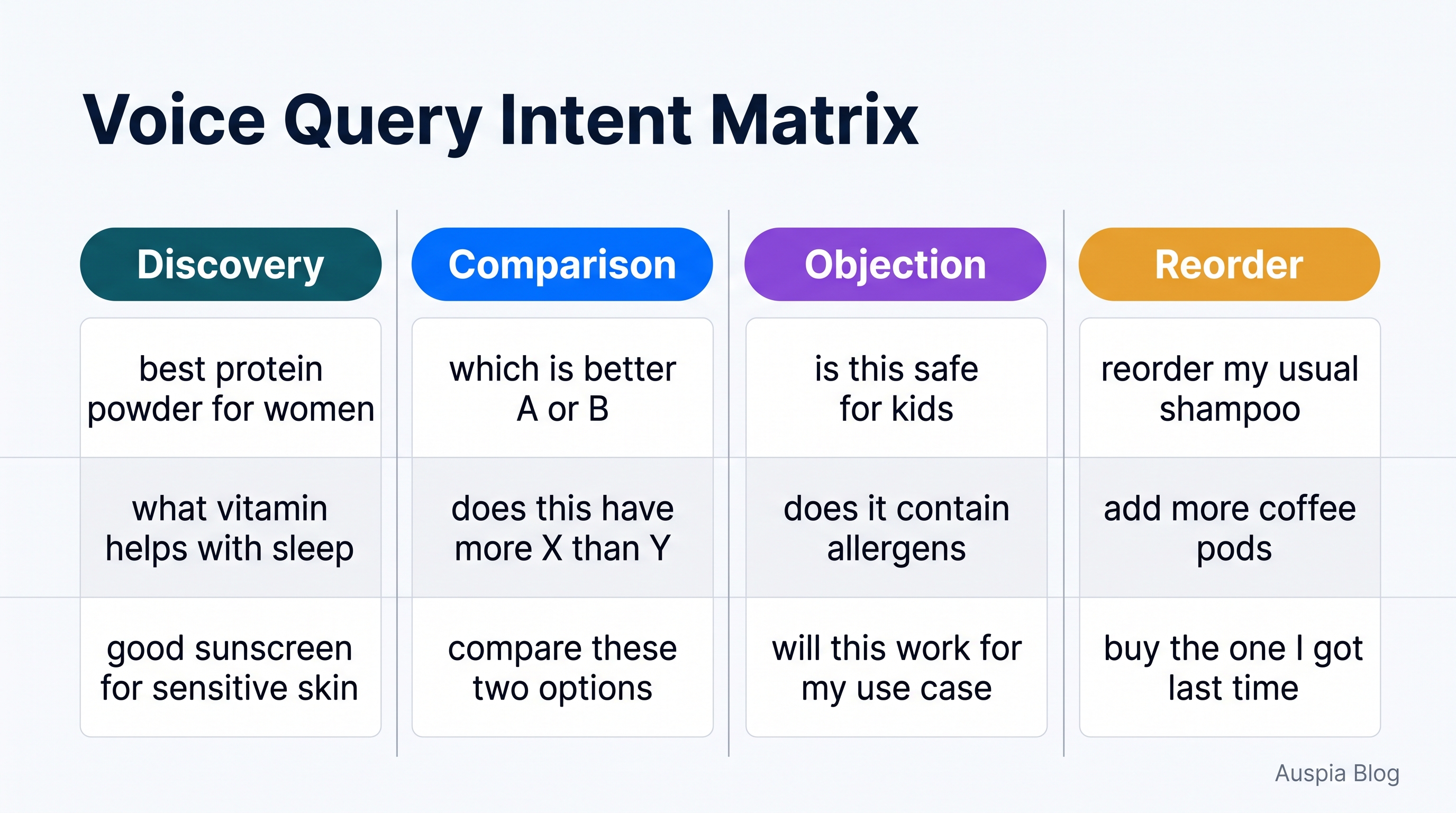
Bucket | What the buyer is trying to do | Example voice-style query | Best seller response |
|---|---|---|---|
Discovery | Find a product for a need | "What should I buy for pet hair on hardwood floors?" | Category terms, use cases, first bullet, hero image |
Comparison | Choose between options | "Which air filter size do I need?" | A+ comparison table, variant guide, compatibility chart |
Objection | Reduce risk before buying | "Is this safe for sensitive skin?" | Q&A, review themes, ingredient/material clarity |
Reorder | Buy again with less effort | "Reorder my usual dishwasher tablets." | Clear variant names, pack-size consistency, subscription cues |
This bucket system prevents repetition. You do not need to repeat the same phrase everywhere. You need each asset to answer the intent it is best suited to answer.
What DataForSEO Signals Tell Us
The keyword data points to two different layers of demand.
First, there is a high-value seller education layer. DataForSEO showed voice search optimization at about 720 monthly searches with CPC around $56.65, voice search marketing at about 90 monthly searches with CPC around $52.18, amazon product listing optimization at about 140 monthly searches with CPC around $28.77, and amazon seo at about 1,000 monthly searches with CPC around $22.87.
Second, there is a practical consumer behavior layer. alexa shopping list and close variants appeared around 1,600 monthly searches, while phrases such as how to share alexa shopping list, voice shopping with alexa, alexa voice shopping, and turn off amazon shopping notifications on alexa showed smaller but specific demand.
Signal type | Example terms | Seller interpretation |
|---|---|---|
High-CPC strategy terms | voice search optimization, voice search marketing | Agencies and sellers pay to understand voice discovery. |
Amazon listing terms | amazon seo, amazon product listing optimization | Sellers still need marketplace search fundamentals. |
Paid search terms | amazon sponsored products | Ads can reveal query language and conversion gaps. |
Consumer behavior terms | alexa shopping list, alexa voice shopping | Shoppers use voice around lists, reminders, reorders, and settings. |
Trust terms | amazon product reviews | Reviews remain a key evidence source for assistant-style decisions. |
The right takeaway: do not chase low-volume Alexa phrases as if they were the whole market. Use them to model behavior, then connect that behavior to larger Amazon SEO and listing-optimization demand.
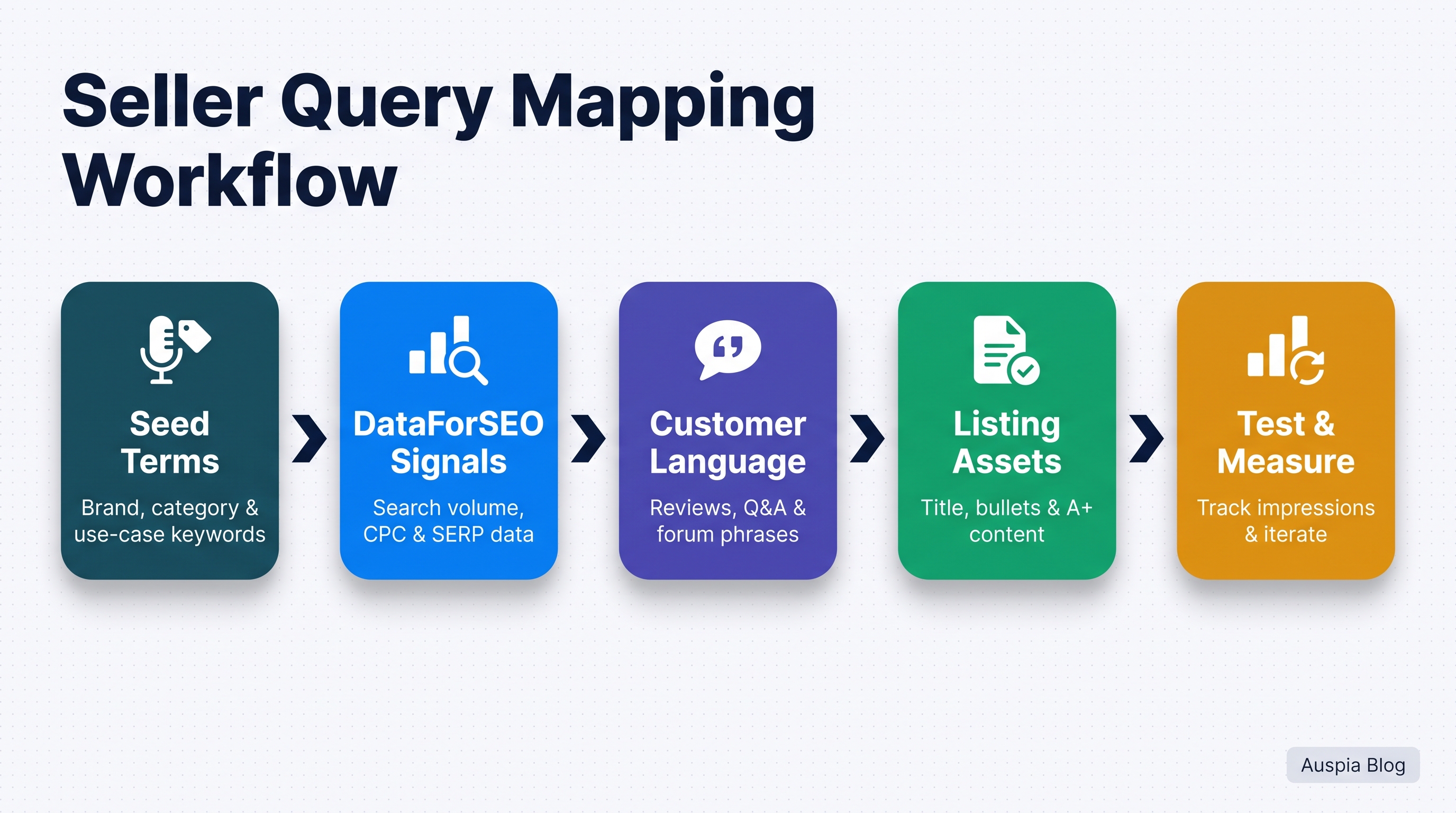
Step 1: Build Seed Terms From The Product, Not The Tool
Before opening any keyword tool, write seed terms in five columns:
Seed column | Examples for a coffee pod seller |
|---|---|
Category | coffee pods, espresso capsules, reusable coffee pods |
Use case | morning coffee, office coffee, strong coffee, decaf coffee |
Attribute | recyclable, dark roast, compatible, bulk pack |
Problem | bitter taste, weak coffee, machine compatibility, freshness |
Reorder language | reorder coffee pods, buy the same pods, add more pods |
This prevents the tool from narrowing your thinking too early. Most sellers start with the category and miss the problem, attribute, and reorder vocabulary that voice queries often include.
Step 2: Pull DataForSEO Suggestions And Sort By Intent
Use DataForSEO keyword suggestions, related keywords, and keyword overview data for your category seeds. Export the keyword, volume, CPC, competition level, and SERP features when available.
Then add three manual columns:
Manual column | Why it matters |
|---|---|
Intent bucket | Discovery, comparison, objection, or reorder |
Buyer wording | Whether the phrase sounds typed, spoken, or both |
Listing destination | Title, bullet, image, A+ Content, Q&A, backend terms, ads test |
The keyword best coffee pods for office might go to discovery. keurig compatible espresso pods might go to title, bullets, and backend search terms. do these pods work with my machine belongs in compatibility content and Q&A. reorder dark roast pods affects product naming and variant clarity.
Step 3: Add Real Customer Language
DataForSEO gives you market demand. Customers give you the phrasing that makes listings more believable.
Pull language from:
- Amazon reviews, especially repeated nouns and complaints.
- Product Q&A, especially compatibility and safety questions.
- Customer support tickets and return reasons.
- Sponsored Products search term reports.
- Competitor listing bullets and review themes.
- Search suggestions inside Amazon and Google.
Do not copy competitors or reviews verbatim. Extract the pattern. If buyers repeatedly say "too strong," "does not fit," "hard to open," or "works with my older model," those phrases reveal content gaps.
Step 4: Decide The Asset Before You Rewrite
The most common Alexa GEO keyword mistake is treating every good phrase as title material. That creates bloated titles and generic bullets.
Use this destination map instead:
Query type | Put it here | Avoid this mistake |
|---|---|---|
Main product category | Title and first bullet | Repeating five category synonyms in the title |
High-value attribute | Title if essential; bullets if supporting | Hiding compatibility only in images |
Use-case query | Bullets, lifestyle image, A+ Content | Making vague claims without context |
Safety or fit concern | Q&A, bullets, detail page content | Leaving objections only to reviews |
Comparison query | A+ Content, comparison chart | Forcing complex comparisons into one bullet |
Reorder phrase | Variant name, pack-size clarity, subscription cue | Using inconsistent names across variants |
Synonym or alternate wording | Backend search terms if relevant | Adding irrelevant spellings or competitor brands |
This is where Amazon's own listing optimization guidance still matters: titles, bullets, descriptions, images, backend search terms, and A+ Content each have different jobs. Alexa GEO simply makes the job assignment stricter.
Step 5: Turn Search Queries Into Spoken Questions
A typed query is often compressed. A spoken query is usually a sentence. Convert your top keywords into natural questions before assigning them.
Typed keyword | Voice-style question | Intent bucket | Listing asset |
|---|---|---|---|
dishwasher tablets hard water | What dishwasher tablets work for hard water? | Discovery | Bullet, image, A+ Content |
fragrance free laundry pods | Are these laundry pods fragrance-free? | Objection | Title if core, bullet, Q&A |
replacement filter model 300 | Does this filter fit model 300? | Objection | Title, compatibility chart, Q&A |
dog wipes sensitive skin | What dog wipes are safe for sensitive skin? | Discovery/objection | Bullet, ingredient section, reviews |
coffee pods bulk | Can I buy these coffee pods in bulk? | Comparison/reorder | Pack-size table, variant names |
reorder shampoo | Can I reorder the same shampoo I bought last time? | Reorder | Variant naming, subscription, pack clarity |
This exercise also improves ads. A Sponsored Products search term report may show converting typed phrases. Turning them into spoken questions helps you find missing content that could improve organic conversion too.
Step 6: Score Each Query Before Acting
Not every keyword deserves a rewrite. Score each query from 1 to 5 across four criteria.
Criterion | Question to ask | High score means |
|---|---|---|
Commercial intent | Does the query suggest a purchase decision? | It can influence revenue. |
Product fit | Does the product genuinely satisfy the query? | The listing can answer without overclaiming. |
Voice likelihood | Would a person naturally say it aloud? | It belongs in Alexa GEO planning. |
Asset gap | Is the answer missing or weak today? | A rewrite may improve conversion. |
Prioritize queries with high product fit and high asset gap. A high-volume term that only loosely fits the product is usually less valuable than a lower-volume question that your product clearly answers.
Step 7: Test With Ads, Experiments, And Listing Metrics
Keyword research becomes useful only when it changes behavior. After updating a listing, monitor:
- Click-through rate from Amazon search and ads.
- Conversion rate by ASIN and variant.
- Sponsored Products search terms and wasted spend.
- Q&A volume and repeated customer questions.
- Review themes and return reasons.
- Repeat purchase rate for replenishable products.
- Performance of title, image, bullet, description, or A+ Content tests where Amazon Manage Your Experiments is available.
A good Alexa GEO keyword map should reduce confusion. If customers keep asking the same pre-purchase question, your listing still has a content gap.
A Practical Template For Sellers
Copy this structure into a spreadsheet for each product family.
Field | Example |
|---|---|
Seed term | air purifier filter replacement |
DataForSEO keyword | air purifier filter for bedroom |
Volume/CPC | Add from DataForSEO export |
Spoken question | What air purifier filter should I use for a bedroom? |
Intent bucket | Discovery |
Product fit | High |
Current asset gap | Bullet does not mention room size |
Destination | Bullet + image callout |
Test | Compare conversion after bullet/image update |
Result | Add after 2-4 weeks |
Run this for 30-50 queries per product family. That is enough to expose patterns without turning the project into an endless keyword dump.
Common Keyword Research Mistakes
Mistake 1: Treating Alexa phrases as the only target. Direct alexa shopping terms are useful, but the larger opportunity often sits in category, listing, review, and voice-search language.
Mistake 2: Confusing volume with priority. A phrase with lower volume but high product fit can be more useful than a broad, high-volume phrase that attracts the wrong buyer.
Mistake 3: Putting every phrase in the title. Titles should clarify the product. They should not become a warehouse for every query variation.
Mistake 4: Ignoring reorder language. For consumables, the phrase a buyer uses the second time may matter more than the phrase used the first time.
Mistake 5: Skipping measurement. If you do not track conversion, search term performance, Q&A, and review themes after the rewrite, you cannot tell whether the query map improved the listing.
FAQ
What is Amazon Alexa GEO keyword research?
It is the process of mapping spoken shopping questions to Amazon listing assets so a product is easier to understand, compare, trust, and reorder in voice or assistant-style shopping journeys.
Should sellers optimize for alexa voice shopping as a keyword?
Usually not as a primary listing keyword unless the product is directly about Alexa or voice shopping. Sellers should use Alexa-related keyword data to understand behavior, then optimize category, use-case, objection, and reorder content.
How many voice questions should one product listing answer?
Start with 15-30 high-fit questions for one product family. Put only the most important category and attribute language in the title. Use bullets, images, A+ Content, and Q&A for the rest.
Can DataForSEO replace Amazon search term reports?
No. DataForSEO is useful for market-level keyword discovery and search demand. Amazon ad search term reports, reviews, Q&A, and listing metrics are needed to understand marketplace behavior and conversion.
What is the best first step for a beginner seller?
Choose one ASIN family, collect 30 queries, sort them into discovery, comparison, objection, and reorder buckets, then assign each query to the right listing asset before rewriting anything.
Auspia Takeaway
Alexa GEO keyword research works when it becomes an operating map. DataForSEO tells you where search demand exists. Customer language tells you how buyers describe the need. Amazon listing assets give you places to answer those needs without stuffing the same keyword everywhere.
For sellers, the question is not "How many Alexa keywords can I add?" The better question is "Which buyer questions are still unanswered, and which asset should answer them?"
Author: Simon Vale, 11-Year Search Intent Researcher at Auspia. Simon writes about buyer queries, SERP patterns, intent mapping, and content alignment for search and AI-assisted discovery.