The Short Version: Voice Search Is No Longer Just an Audio Interface
OpenAI announced GPT-Live on July 8, 2026, and began rolling it out to ChatGPT Voice. The core reporting is reliable: OpenAI's launch post, OpenAI Help Center, and the GPT-Live system card all support the main facts.
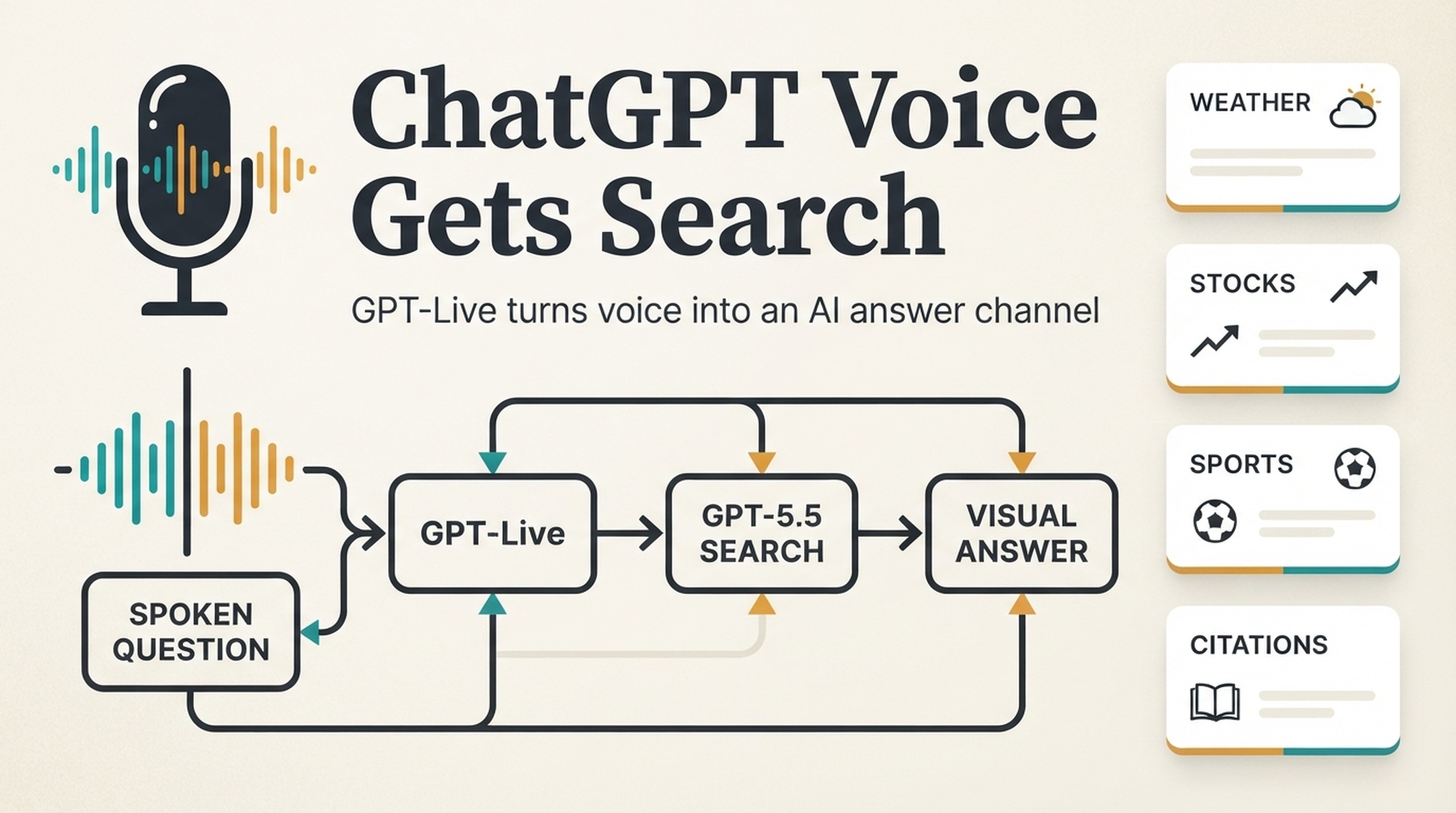
The important part for SEO, GEO, and content teams is not simply that the voice experience sounds more natural. It is that a spoken question can now move into search and reasoning without leaving the voice flow. OpenAI says GPT-Live can delegate questions that require web search, deeper reasoning, or more complex work to a frontier model in the background, with GPT-5.5 used at launch. The Help Center also says Live can use web search and memory, show visual results through supported widgets, and work with text and images when those features are available on the account.
That changes the surface area of AI search. ChatGPT Voice is becoming more than a microphone attached to a chatbot. It is becoming an answer channel that can listen, search, synthesize, speak, and show cards while the user is still in conversation.
For brands, the question gets sharper: if a user does not type, does not scan ten links, and does not obviously click a source, can your page still be found, cited, trusted, and visited?
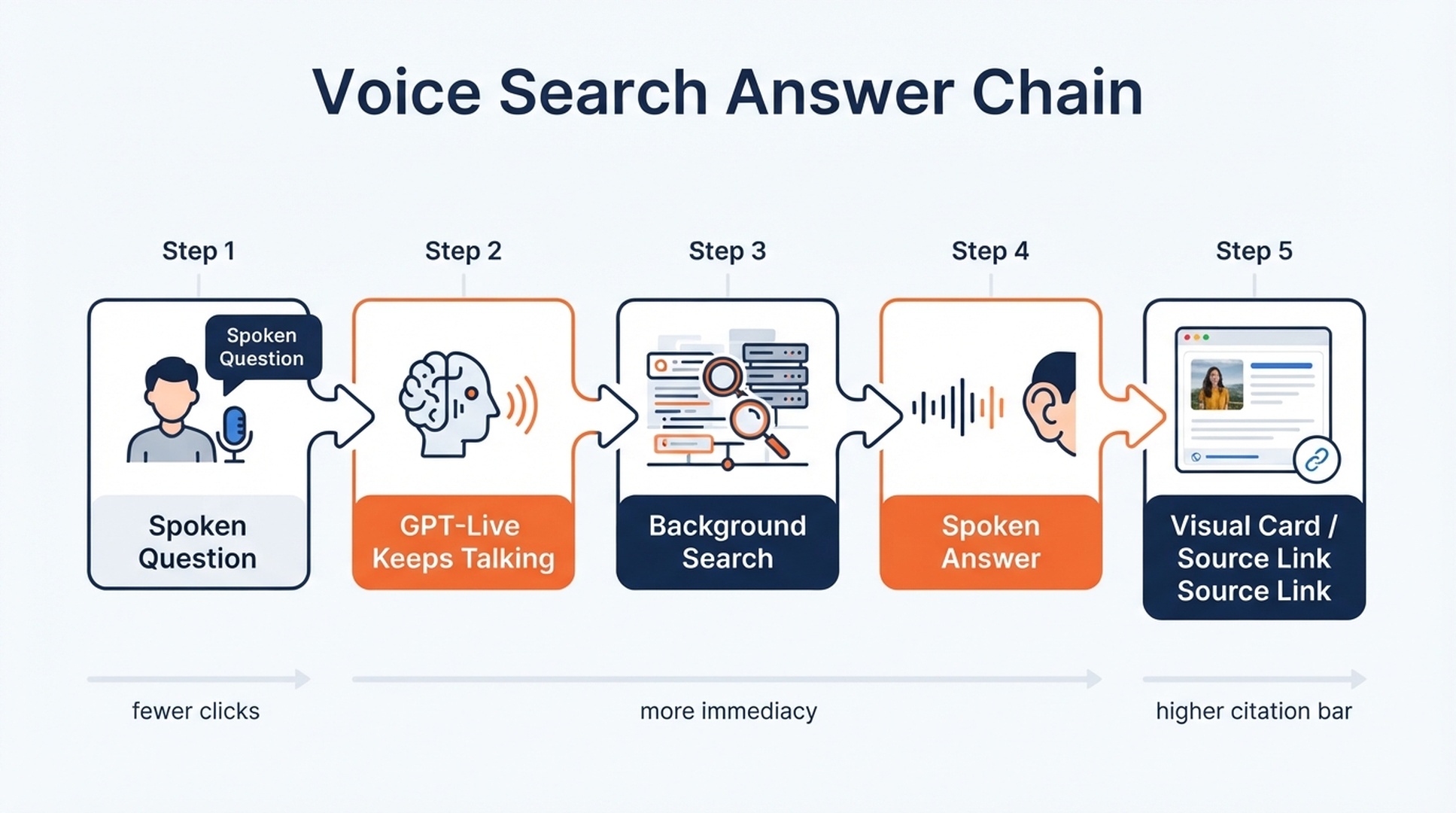
GPT-Live connects spoken questions with background search and visual answers in one conversational flow.
What Is Confirmed
Let's separate the facts from the forecast. Based on OpenAI's official materials, these points are confirmed:
Confirmed point | Source signal | Why it matters for growth teams |
|---|---|---|
GPT-Live-1 and GPT-Live-1 mini are new voice models | OpenAI launch post and system card | Voice is getting a model-level upgrade, not only a UI change |
GPT-Live is full-duplex | OpenAI launch post and system card | It can handle pauses, interruptions, and back-and-forth more naturally |
GPT-Live can delegate search, reasoning, and complex work to a background model | OpenAI launch post | Spoken questions can trigger retrieval and synthesis behind the scenes |
GPT-5.5 is used in the background at launch | OpenAI launch post | The search and reasoning layer can improve as frontier models change |
Live can use web search, memory, and supported visual widgets | OpenAI Help Center | Voice answers may combine speech, text, cards, and source links |
Live does not initially support video or screen sharing | OpenAI Help Center and launch post | Advanced Voice still matters for some mobile visual workflows |
GPT-Live-1 becomes the default Voice model for paid consumer users, with mini for Free users | OpenAI launch post, Help Center, and system card | This is a default experience shift, not a tiny lab demo |
Search Engine Journal's article lines up with those official sources. Its SEO angle is an interpretation, but the factual base is solid: GPT-Live brings search and richer visual response behavior into ChatGPT Voice.
Why This Matters for AI Search Visibility
Most AI search analysis still assumes a typed question. The user enters a query, reads a generated answer, checks source links, and maybe clicks through.
Voice has a different rhythm.
- Spoken queries are longer and messier: "What's a good tool for checking whether AI search is mentioning my site? Something my team can actually use, not a giant enterprise dashboard."
- Users may accept the first spoken answer instead of comparing a page of links.
- If the answer includes a card for weather, stocks, sports, locations, products, or facts, the card itself may become the final interface.
- If source links are not spoken, prominent, or easy to revisit, attribution can become less visible to the user.
That does not mean websites stop mattering. It means the job changes. Pages need to be easy for AI systems to retrieve, understand, summarize, and trust. Ranking is still useful, but citation readiness moves closer to the front of the funnel.
Auspia's view: voice search will put more pressure on answer eligibility. In a spoken answer flow, the brand has to earn its place before it can earn the click.
Five Changes We Expect Next
These are forecasts based on the confirmed product direction. They are not promises from OpenAI.
1. Query Research Will Need Spoken Prompts
Typed keyword sets are too clean. Voice prompts include hedging, context, corrections, and follow-up questions. A user might start with "best AI SEO tools," then add "actually, I need one for citations in ChatGPT," then ask "which one is easiest for a small marketing team?"
That means prompt libraries should include:
- natural spoken questions
- follow-up questions
- comparison prompts
- time-sensitive prompts
- "near me" or location-aware prompts where relevant
- buying-stage prompts, not just informational prompts
A keyword list is no longer enough for AI visibility testing.
2. Source Selection May Become More Concentrated
A spoken answer cannot comfortably list twenty sources. The model will likely lean on fewer, clearer, better-structured sources when it needs to answer quickly.
This favors pages with strong entity clarity:
- product pages that state who the tool is for
- comparison pages with honest tradeoffs
- help docs with current facts
- pricing pages with clear terms
- case pages with specific evidence
- category pages that explain the market, not just the brand
Loose blog paragraphs may still help, but pages with clean facts and clear boundaries are better retrieval candidates.
3. Visual Cards Will Reduce Some Low-Intent Clicks
OpenAI says ChatGPT can show rich visual cards while users talk, with examples such as weather, stocks, and sports. The bigger point is the format: when the answer can be carded, the user may not need to open a website.
This does not automatically mean traffic loss across the board. It probably means fewer low-intent clicks and more expensive high-intent clicks. Users will leave the voice answer when they need to verify, compare, buy, sign up, download, or go deeper.
The practical question is not "will clicks disappear?" It is "which clicks remain worth earning?"
4. Local, Finance, Sports, Ecommerce, and B2B Tools May Feel It First
Voice works naturally for immediate, contextual questions:
- "What's the best restaurant near me for a client dinner?"
- "Why is this stock down today?"
- "Who plays tonight?"
- "Which running shoe should I buy if I have flat feet?"
- "What's a good alternative to this SEO tool for a small team?"
Those are commercial or decision-heavy moments. If your acquisition path depends on users searching, reading a few articles, and then clicking a brand site, you should test whether voice answers are shortening that path.
5. Citation Monitoring Will Need a Voice Layer
Many teams already test ChatGPT, Perplexity, Gemini, or Google AI Overviews in text. Voice adds a new layer:
- Does the same question produce a different answer when spoken?
- Does Voice trigger search?
- Does it show a visual card?
- Are sources visible?
- Is the brand name spoken out loud?
- Can the user easily tap through to the source later?
The test will be imperfect because rollout depends on plan, region, workspace, app version, and device. But imperfect visibility is still better than flying blind.
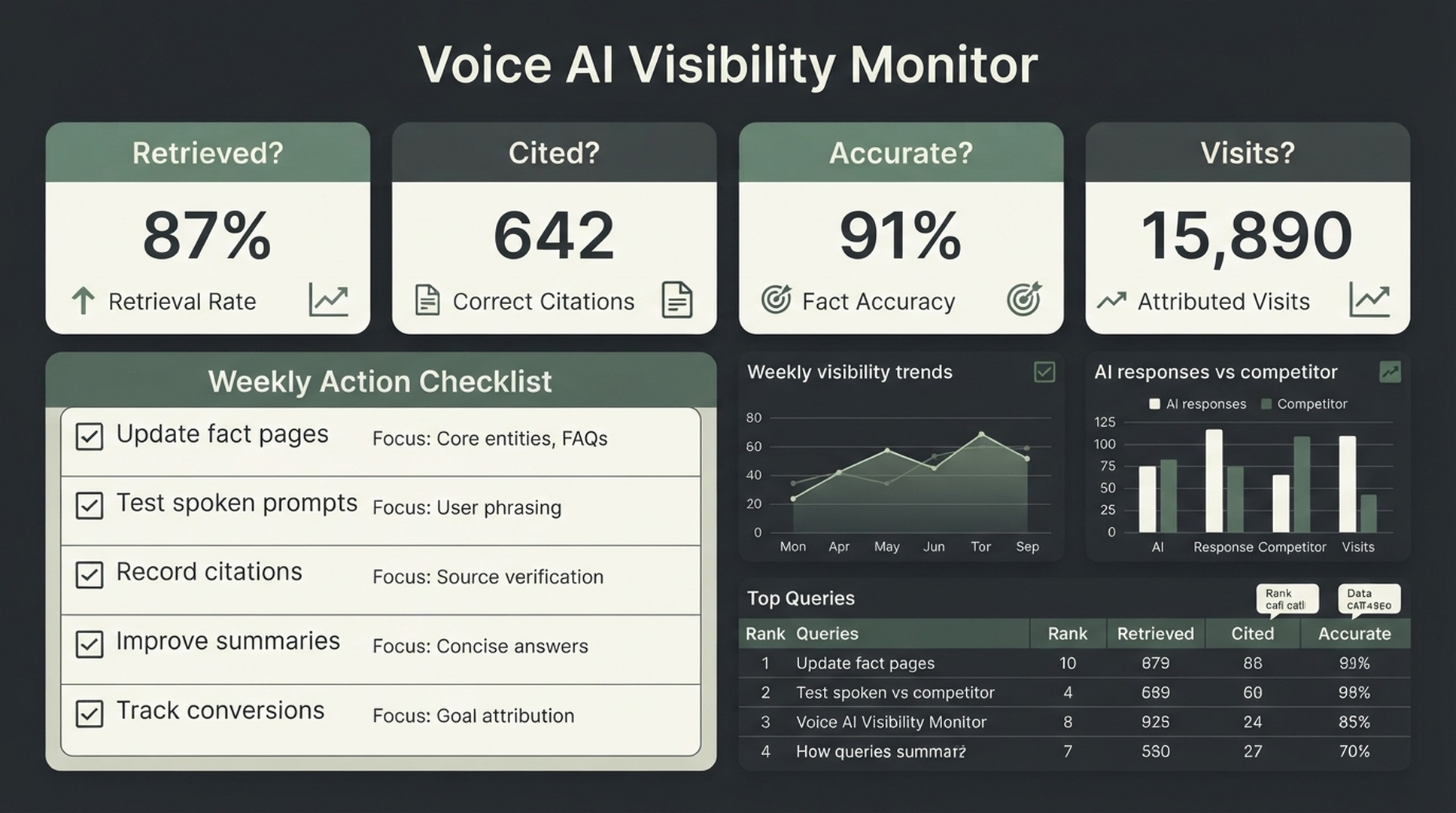
Voice AI visibility should track retrieval, citation, answer accuracy, and downstream visits separately.
What Teams Should Do This Week
Do not rewrite the whole site because GPT-Live launched. Start with a small monitoring loop and fix the pages that AI systems are most likely to misunderstand.
- Create 30 spoken prompts. Write them as real users would say them. Include comparison, recommendation, troubleshooting, pricing, alternative, "latest," and "near me" prompts where relevant.
- Split the prompts by intent. Use brand prompts, category prompts, and buying-decision prompts. Each tests a different risk.
- Compare text and voice answers. Record whether search is triggered, whether cards appear, whether sources are visible, and whether your brand is mentioned.
- Refresh key fact pages. Prioritize about pages, product pages, pricing pages, integration pages, case pages, and help-center pages.
- Add extractable summaries. Each important page should answer: what is this, who is it for, what problem does it solve, what are the limits, and when was it last updated?
- Measure beyond clicks. Voice may not always send direct traffic. Watch branded search, direct visits, signup-page visits, demo requests, support questions, and sales call language.
- Keep a human review step. OpenAI itself warns that ChatGPT can make mistakes, especially for date-sensitive, time-sensitive, or location-sensitive questions. Higher-risk topics need stricter source review.
If you already run AI search visibility checks, add voice prompts to the existing set. Auspia's AI Search Visibility Checker can help with the first layer of brand visibility, but voice behavior still needs device-level sampling and human notes.
What Is Still Unclear
The launch does not answer every SEO question. These are the details to watch:
- Will voice answers speak source names out loud?
- How visible will source links be inside visual cards?
- Will answers vary heavily by account, region, app version, or device?
- Does GPT-Live use the same citation behavior as typed ChatGPT when it delegates web search?
- When GPT-Live comes to the API, will developers be able to control citation, widget, or tool-use presentation?
These details matter because they decide whether voice search becomes a source-friendly discovery surface or a more closed answer layer inside ChatGPT.
It is too early to make a sweeping traffic prediction. It is not too early to start measuring.
Auspia View: Treat This as a New Answer Channel
GPT-Live is best understood as an interface shift for AI search. Search has not disappeared. It is moving into the background of a live conversation.
For growth teams, that means four habits become more important:
- write for spoken, contextual questions
- make entity facts and page purpose obvious
- track AI answers, not only rankings
- separate retrieval, citation, click, and conversion in reporting
If your content strategy only competes for blue links, GPT-Live-like experiences will make traffic changes harder to explain. If your site already invests in clear facts, structured pages, answer blocks, and citation-worthy evidence, voice search could become another place where your brand enters the decision before the user ever opens a browser tab.
FAQ
Is GPT-Live officially launched?
Yes. OpenAI announced GPT-Live on July 8, 2026, and says it is rolling out to ChatGPT users globally. Availability can still vary by plan, region, workspace, app version, and device.
Was the Search Engine Journal report accurate?
The core facts are accurate. The article's claims about GPT-Live, GPT-Live-1, GPT-Live-1 mini, background search delegation, visual cards, and default Voice model behavior are supported by OpenAI's official launch post, Help Center, and system card. The SEO implications are analysis, not OpenAI commitments.
Does GPT-Live replace traditional SEO?
No. Traditional SEO still provides the crawlable, verifiable web pages that AI systems can retrieve and cite. GEO and AEO build on that foundation by making pages easier for AI answer systems to understand and use.
What should brands optimize first?
Start with pages that AI systems must understand correctly: brand fact pages, product pages, comparison pages, pricing pages, help docs, and case pages. Make the purpose, audience, evidence, constraints, and update date clear.
Will voice answers reduce website traffic?
They may reduce some low-intent clicks, especially when a visual card fully satisfies the need. But they may also create more qualified downstream visits. Track mentions, citations, branded search, direct traffic, and conversions instead of relying only on referral clicks.
Author: Sophie Renard, AI Search Briefing Analyst Tracking 30+ Platforms at Auspia. Sophie writes concise briefings on AI search product changes and what growth teams should measure next.