2026 seller memo: Amazon GEO is no longer just keyword ranking
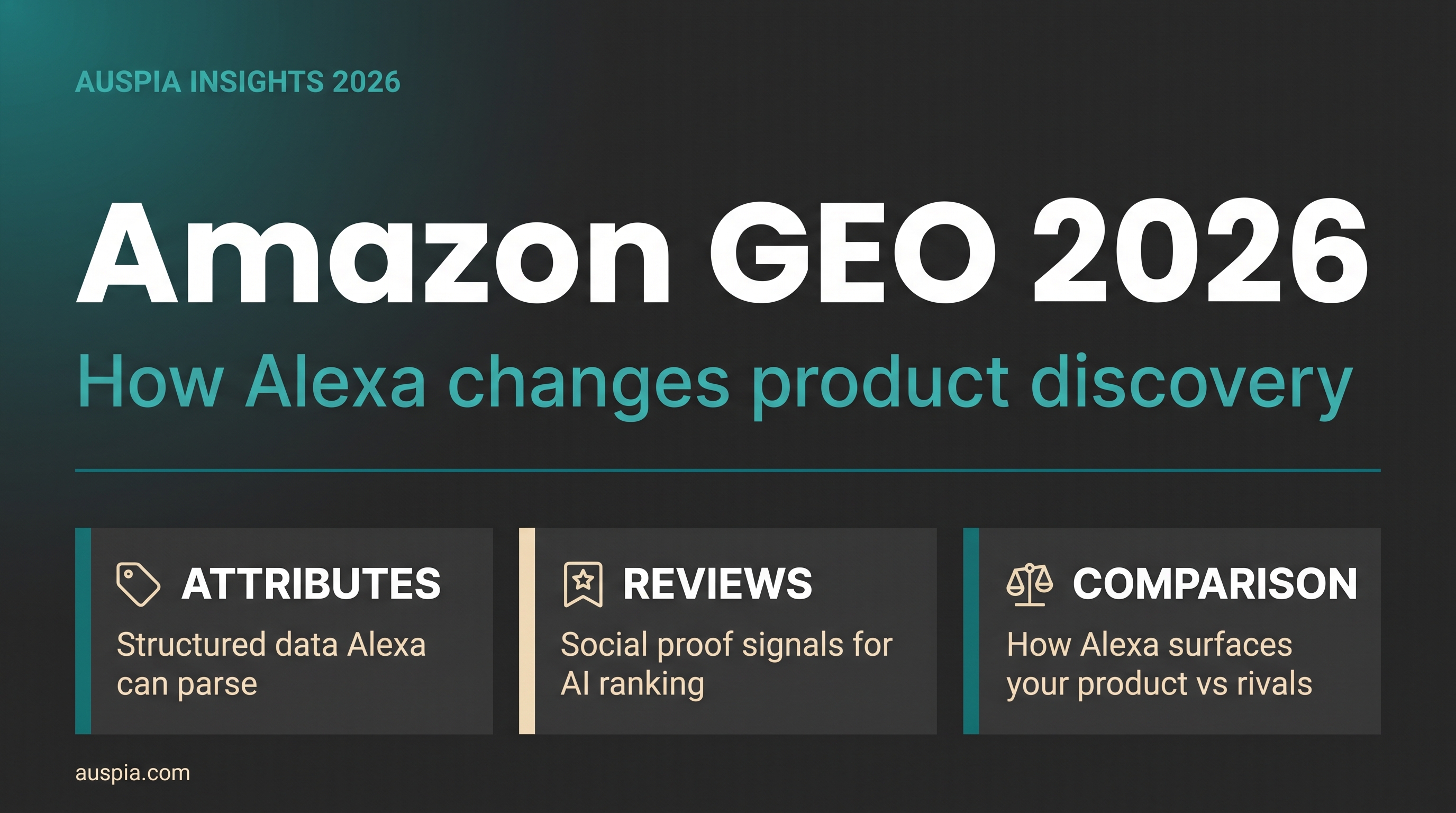
Amazon GEO in 2026 means making a product detail page easy for Amazon's AI shopping experiences to understand, summarize, compare, and recommend. The practical shift is simple: a listing is not only competing for a keyword position; it is competing to become a clean answer inside an AI-assisted shopping flow.
The source article's useful point is that Alexa-style shopping changes what a seller should optimize. Empty attributes, keyword-stuffed bullets, vague A+ modules, thin reviews, and unmeasured long-tail phrases all become liabilities when an assistant has to answer a shopper's question quickly.
For Amazon sellers, the near-term move is not to abandon SEO. It is to rebuild the listing so every important claim has a structured field, a plain-language benefit, a comparison cue, and review evidence behind it.
What changed: from product search to assistant-shaped answers
Traditional Amazon optimization often starts with a search term: find the keyword, place it in the title, support it in bullets, monitor rank, and improve conversion. That still matters.
AI-assisted shopping adds a second layer. The assistant has to answer questions such as:
- Which option is better for a small kitchen?
- Is this safe for daily use?
- How does it compare with a cheaper alternative?
- What do recent buyers complain about?
- Can I reorder or subscribe without thinking about it again?
That changes the optimization target. Sellers need to prepare product facts in a format that can be extracted, compared, and trusted. This is why GEO matters for Amazon listings: the goal is visibility inside generated answers, not only visibility inside blue-link or grid-style results.
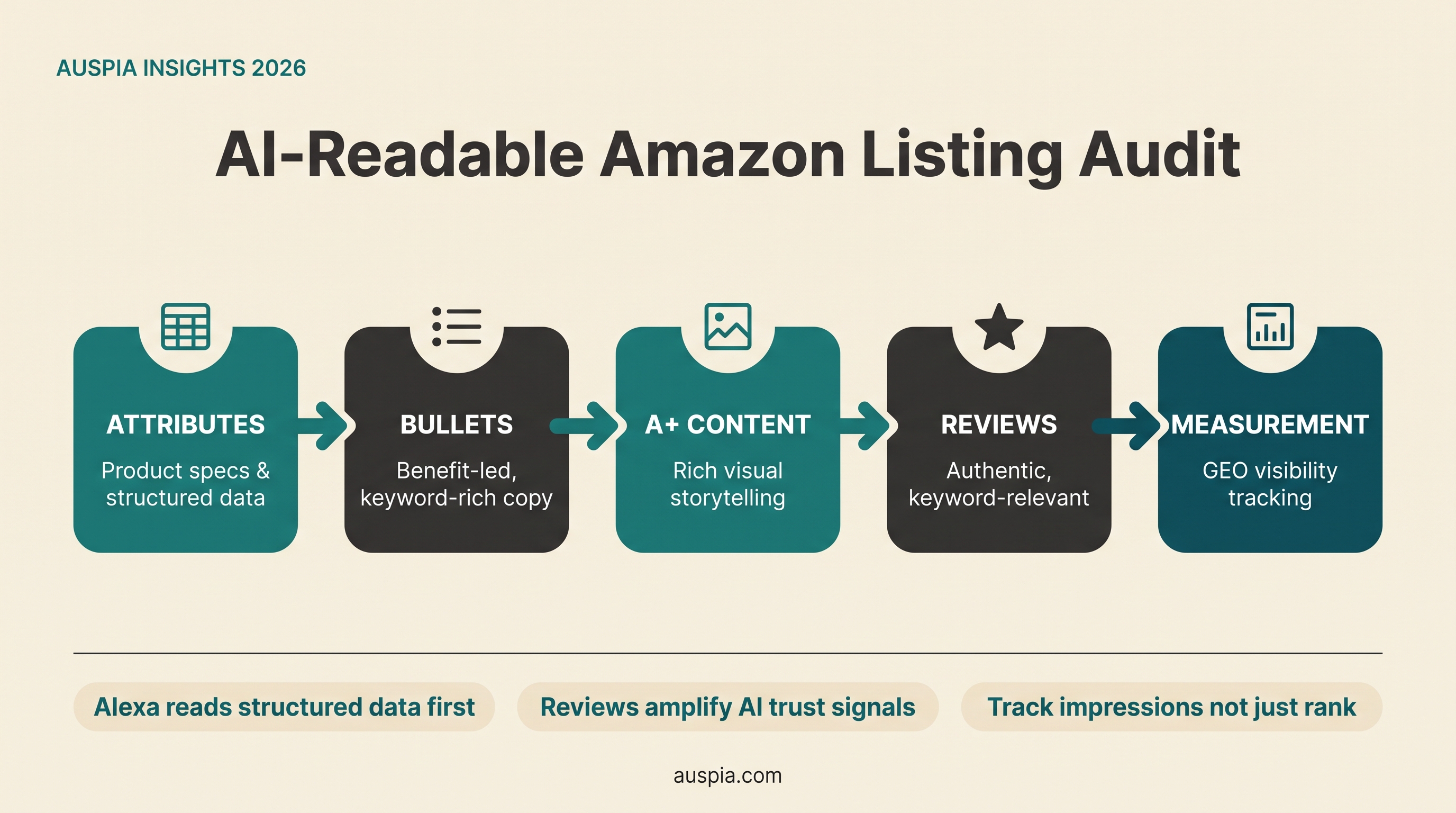
The five Alexa-era signals sellers should audit first
Signal | What Alexa-style shopping needs | Listing risk if ignored | Better 2026 action |
|---|---|---|---|
Product attributes | Clean facts for filters, summaries, and comparisons | The assistant cannot answer specific fit, size, material, compatibility, or use-case questions | Complete every relevant attribute field and keep it consistent with the title, bullets, and A+ content |
Bullet structure | Extractable feature-benefit pairs | Keyword-heavy bullets become hard to summarize | Start each bullet with a concrete feature, then explain the buyer outcome |
A+ content | Evidence, use cases, and comparison context | Decorative marketing modules add little answer value | Add comparison tables, scenario modules, care instructions, and compatibility notes |
Review language | Fresh buyer phrasing and objections | Old or shallow reviews weaken the evidence layer | Mine reviews for pain points, use-case terms, objections, and proof gaps |
Measurement | Feedback on whether semantic phrases improve discovery | Teams keep optimizing for old head terms only | Track rank, conversion, query performance, and AI-relevant long-tail phrases together |
The important pattern: each signal helps the assistant reduce uncertainty. A product with clear facts, buyer-language benefits, and recent review evidence is easier to summarize than a product page that only repeats keywords.
Listing fields now behave like answer ingredients
A product attribute is not just backend hygiene. In an AI shopping interface, it can become a direct answer ingredient.
For example, if a desk lamp listing leaves out color temperature, eye-care certification, clamp width, power source, and warranty length, the assistant has less to work with when a shopper asks, "Which desk lamp is best for homework in a small room?"
A stronger listing makes those facts explicit across multiple surfaces:
- Attribute fields:
color temperature,brightness levels,power source,material,dimensions - Title: the main product type and primary use case, without stuffing
- Bullets: feature first, outcome second
- A+ content: use-case comparison and setup context
- Reviews: language that confirms the product works for the claimed use case
That redundancy is not spam if the facts are consistent. It is how sellers make the product easier to retrieve and explain.
A better bullet formula for Amazon GEO
Many Amazon bullets still read like a keyword bucket. That is risky because an assistant needs sentence-level meaning, not just term frequency.
Use this structure instead:
Weak bullet | Stronger Alexa-ready bullet |
|---|---|
|
|
|
|
|
|
The stronger version still contains keywords. The difference is that the keyword sits inside a clear claim. That makes the content more useful for shoppers and more extractable for answer systems.
A+ content should answer comparison questions, not decorate the page
A+ content often becomes a brand brochure. In 2026 Amazon GEO work, that is not enough.
The better question is: if an assistant had to compare this product with three alternatives, what evidence would it need?
Useful A+ modules include:
- A comparison table that explains model differences without exaggeration
- A use-case grid, such as
small rooms,travel,kids,pet owners, ordaily reorders - A compatibility section for sizes, devices, refills, replacement parts, ingredients, or materials
- A care and setup section that reduces returns and negative reviews
- A "who this is not for" note when fit matters
This kind of content helps humans decide faster. It also gives AI systems cleaner material for product summaries and side-by-side comparisons.
Reviews are becoming a language source, not only a trust score
The source article is right to emphasize reviews, but the reason is broader than ratings. Reviews contain the phrases customers naturally use when they describe the job they hired the product to do.
For Amazon GEO, review mining should answer five questions:
- What exact use cases do buyers mention repeatedly?
- Which benefits do buyers describe in their own words?
- Which objections appear before purchase or after delivery?
- Which phrases appear in recent reviews but not in the listing?
- Which claims in the listing lack review support?
Do not copy reviews into the listing. Instead, translate repeated buyer language into accurate product copy. If recent reviewers say a lamp is "good for homework," "not too bright at night," and "easy for a child to adjust," those phrases point to a more natural semantic cluster than a generic phrase like LED desk lamp alone.
The 2026 audit: score every ASIN for assistant readiness
Use this scorecard before rewriting a listing. It keeps the team from treating Amazon GEO as a vague AI trend.
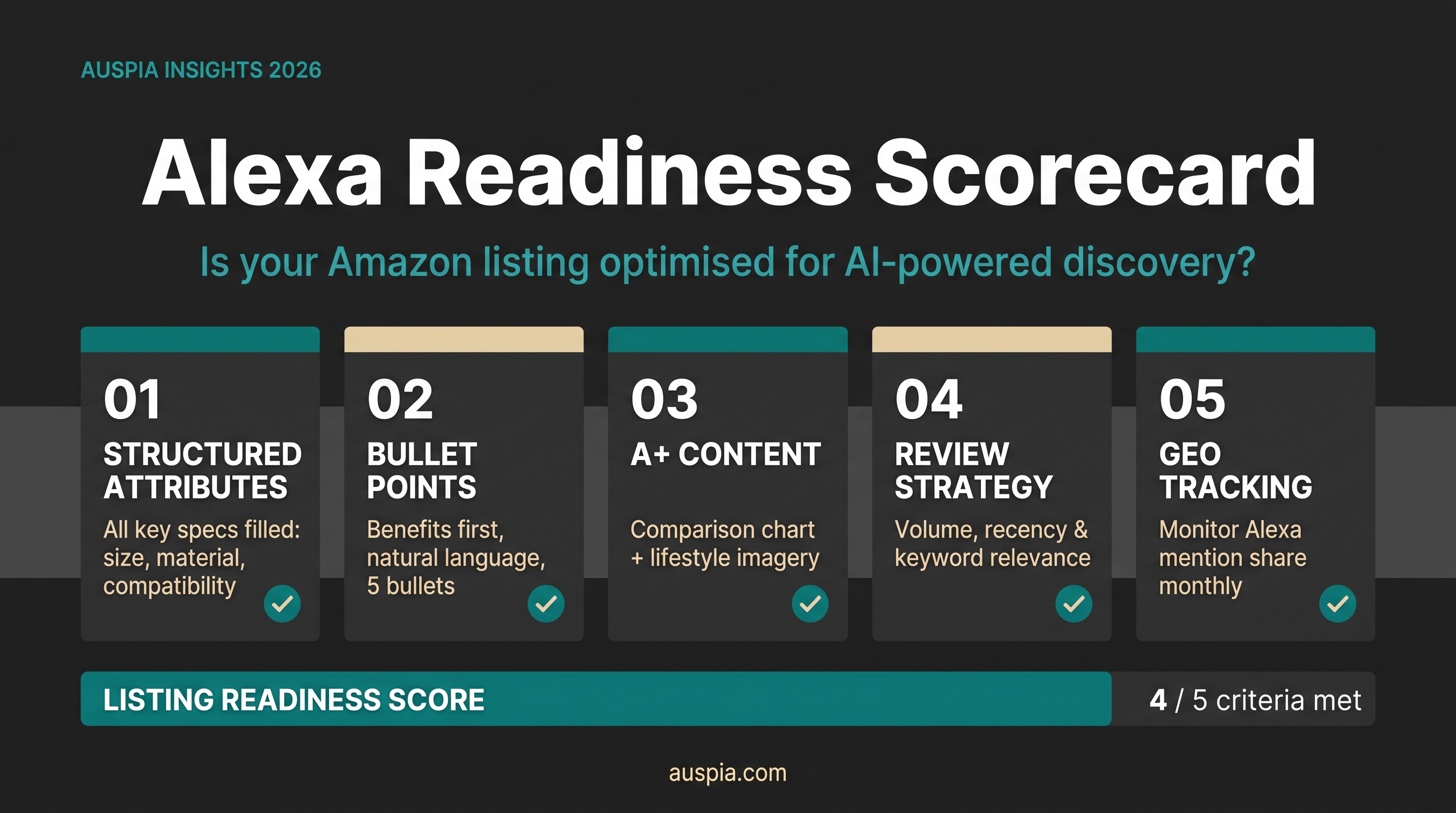
Area | Pass condition | Score |
|---|---|---|
Attributes | The top 20 buyer questions can be answered from structured product facts | 0-2 |
Bullets | Each bullet starts with a feature and connects it to a real buyer outcome | 0-2 |
A+ content | The page includes comparison, use-case, and compatibility information | 0-2 |
Reviews | Recent reviews are mined for phrases, objections, and proof gaps | 0-2 |
Measurement | The team tracks semantic queries, conversion, and changes after rewrites | 0-2 |
A score of 8-10 means the listing is reasonably assistant-ready. A score of 5-7 means the product can probably be understood but may lose in comparison-heavy flows. A score below 5 means the listing is likely too thin, too keyword-stuffed, or too hard to summarize.
A 7-day Amazon GEO sprint for one product line
Do this with one priority ASIN before rolling it across a catalog.
Day 1: Map buyer questions. Pull search terms, customer questions, reviews, competitor bullets, and support issues. Turn them into 20-30 natural-language shopper questions.
Day 2: Fill attribute gaps. Compare the question list with structured fields. Add missing factual attributes where Amazon allows it.
Day 3: Rewrite bullets. Replace keyword buckets with feature-benefit bullets. Keep important terms, but make each bullet answer a specific buyer need.
Day 4: Rebuild one A+ module. Add a comparison table, use-case grid, compatibility note, or setup guide. Prioritize the question that most often blocks conversion.
Day 5: Mine review language. Pull repeated phrases from recent positive and negative reviews. Use them to refine titles, bullets, and FAQ-style explanations where appropriate.
Day 6: Set up measurement. Track rank and conversion for core keywords plus semantic phrases, such as desk lamp for homework, spill proof kids water bottle, or washable dog bed for muddy paws.
Day 7: Review the delta. Look for early signs: better click-through on long-tail phrases, improved conversion on updated modules, fewer repeated objections, and stronger comparison performance.
What not to overdo
Amazon GEO is not permission to make unsupported claims. It is also not a reason to stuff every buyer phrase into the title.
Avoid these mistakes:
- Adding attributes that are not accurate or not supported by the product
- Turning bullets into long paragraphs that shoppers cannot scan
- Using A+ content for slogans instead of decision support
- Treating old reviews as permanent proof when product quality or buyer expectations have changed
- Measuring only rank while ignoring conversion, returns, and review sentiment
The best 2026 strategy is factual, structured, and testable. If the claim helps a shopper choose, it probably helps an assistant explain. If the claim is vague, inflated, or unsupported, it creates risk.
Auspia view: optimize for comparison, not just discovery
The biggest Amazon GEO mistake is assuming the assistant only needs to find your product. In reality, it also needs to compare your product, justify why it fits, and avoid recommending something that creates buyer regret.
That means sellers should build listings around comparison readiness:
- What is this product best for?
- Who should not buy it?
- Which attributes prove the fit?
- Which recent reviews support the claim?
- Which competing product type will it be compared against?
In 2026, the winning listing is not the one with the most repeated keyword. It is the one that gives Amazon's shopping AI the cleanest path from shopper question to confident recommendation.
FAQ
What is Amazon GEO?
Amazon GEO is the practice of optimizing Amazon product content so AI-assisted shopping systems can understand, summarize, compare, and recommend the product. It includes structured attributes, extractable bullets, useful A+ content, review language, and measurement.
Is Amazon GEO replacing Amazon SEO?
No. Amazon SEO still matters for keyword discovery, ranking, and conversion. Amazon GEO adds another layer: making the listing useful for generated answers, product comparisons, and assistant-led shopping flows.
What should sellers update first for Alexa-style shopping?
Start with product attributes and bullets. If those are incomplete or keyword-stuffed, the assistant has weak raw material. Then improve A+ comparison content, review mining, and semantic query tracking.
Should sellers add customer review phrases to titles?
Only when the phrase is accurate, relevant, and natural. Review language is useful because it reveals buyer intent, but sellers should not copy reviews or force awkward phrases into titles.
How do I measure whether Amazon GEO is working?
Track a mix of keyword rank, long-tail query visibility, click-through rate, conversion rate, review sentiment, return reasons, and performance before and after listing changes. For AI shopping surfaces, also monitor whether the product appears in comparison and answer-style experiences when available.
Author: Ryan Chen, Senior Amazon Operations Expert with 10 Years in Marketplace Growth at Auspia. Ryan writes about Amazon GEO, marketplace search behavior, AI-assisted product discovery, and operational playbooks for Amazon sellers.