Short version
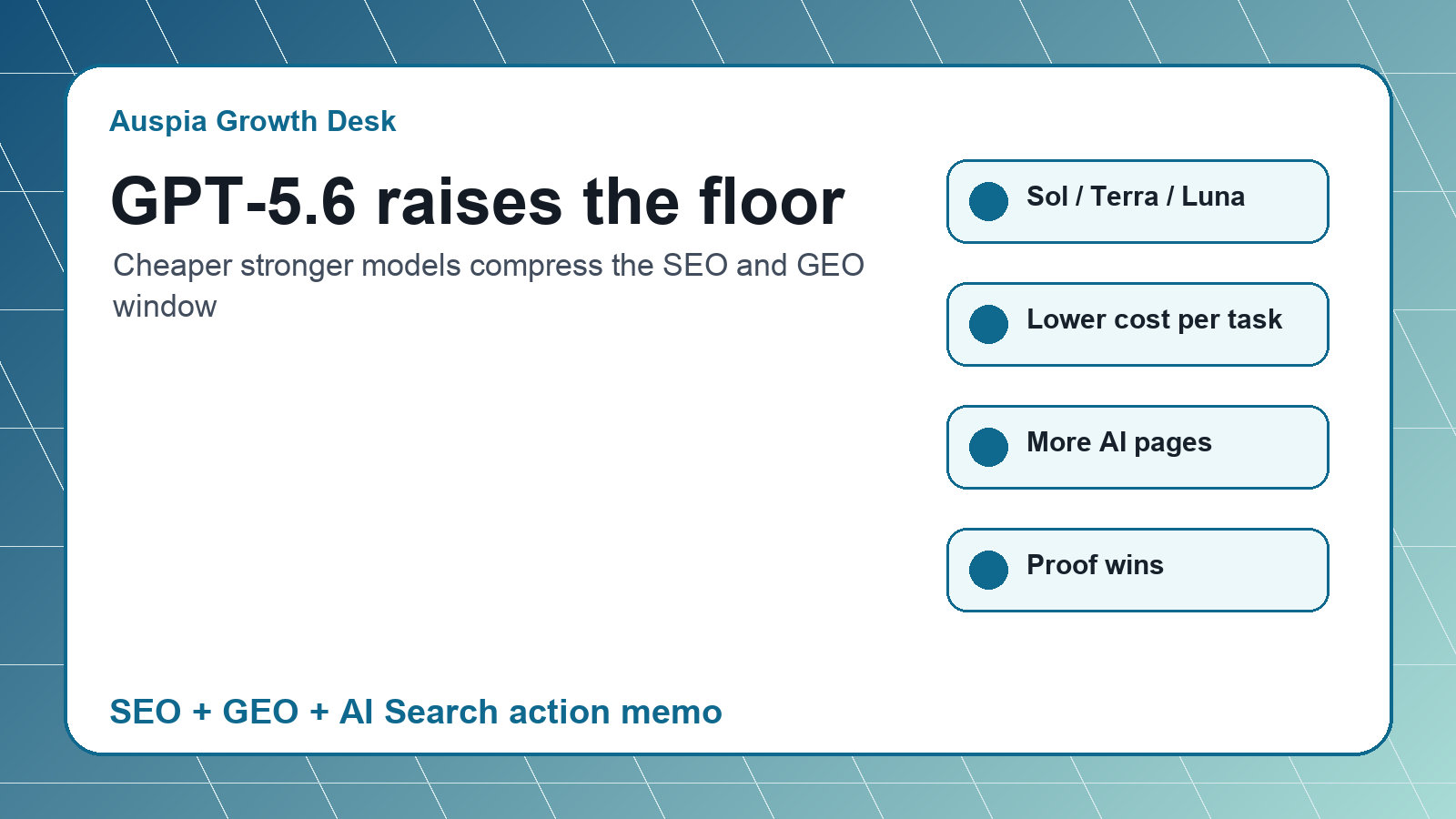
OpenAI's GPT-5.6 release is not just another model announcement for marketers. The important part is the shape of the lineup: Sol for flagship work, Terra for a lower-cost balance, and Luna for high-volume tasks. When good enough AI gets cheaper and faster, average content production stops being a moat.
For SEO and GEO teams, the practical conclusion is blunt: the window for winning with volume alone is closing. Stronger models will create more drafts, more landing pages, more refreshes, and more automated experiments. The teams that still win will pair AI production with technical SEO, evidence, brand signals, and citation-ready pages.
What changed
OpenAI's developer documentation describes GPT-5.6 as a model family for complex production workflows. It also explains the new naming scheme: gpt-5.6 routes to gpt-5.6-sol, while gpt-5.6-terra is positioned for strong performance at a lower price and gpt-5.6-luna for efficient high-volume workloads.
The release also drew heavy attention on Hacker News. The discussion page for GPT-5.6 crossed more than a thousand points and hundreds of comments within the first wave of discussion, which is a good signal that developers, founders, and AI builders see this as a practical release, not a narrow benchmark event.
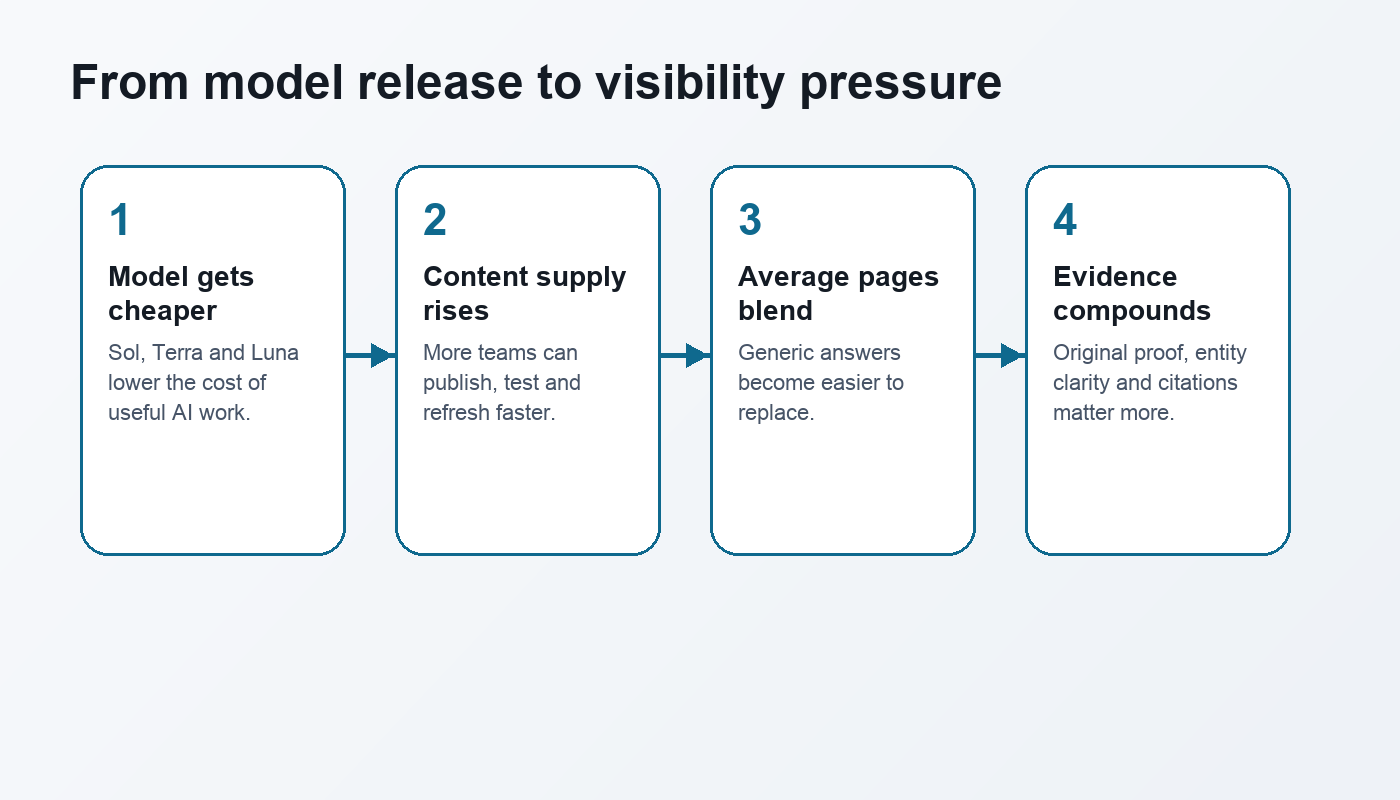
The detail growth teams should care about is not one leaderboard number. It is this: better reasoning, lower token waste, and cheaper model tiers reduce the cost of producing acceptable work.
Why this matters for search teams
Search is already crowded with AI-assisted content. GPT-5.6 changes the economics again. If Luna can handle high-volume tasks and Terra can cover a large share of balanced production work, teams can generate briefs, FAQs, product comparisons, support pages, and content refreshes with less budget pressure.
That sounds good until every competitor can do it too.
Model shift | Search effect | What weak teams will do | What strong teams should do |
|---|---|---|---|
Cheaper high-volume work | More pages enter the index | Publish more generic pages | Build fewer, better evidence pages |
Better coding and tooling | Faster technical fixes | Generate scripts without QA | Use agents for scoped audits and diffs |
Better workflow automation | Faster refresh cycles | Rewrite old posts mechanically | Refresh pages with new proof and intent data |
Better answer synthesis | More AI-like content sameness | Copy SERP summaries | Add original examples, data, and named entities |
The new floor rises. The ceiling does not rise automatically.
The Auspia read: AI content supply is the pressure, not the strategy
The next SEO fight is less about who can write 100 posts. It is about who can make 20 pages that a search engine, an AI answer system, and a buyer all trust.
A page needs more than fluent paragraphs. It needs a clean crawl path, a clear entity, a reason to cite it, and enough supporting evidence that the answer system does not have to guess. That means:
- A short answer near the top that can be extracted without losing context.
- Evidence blocks that name sources, dates, tests, examples, and constraints.
- Internal links that help crawlers understand topic depth.
- External proof where the brand is mentioned outside its own website.
- Schema and page structure that make the content easy to parse.
This is where many small teams make the wrong jump. They see a stronger model and decide to scale output. The better move is to scale quality control.
A practical response for small teams this week
Start with your pages that already have some search signal. Do not open a blank content calendar just because a new model shipped.
- Export the top 50 landing pages from Google Search Console.
- Mark pages with declining clicks, rising impressions, or weak CTR.
- For each page, ask whether the page has a direct answer, proof, comparison table, FAQ, and internal link path.
- Use GPT-5.6-style automation to create repair briefs, not final copy.
- Ship changes in small batches and measure rankings, clicks, AI mentions, and cited-source appearances.
If you need a fast technical baseline, run the page through a Website SEO Score Checker before giving an agent permission to rewrite anything. A brilliant draft still fails if the page is slow, blocked, duplicated, or buried.
What not to overread
Model benchmarks are useful, but they do not tell you whether your site will earn more traffic next month. A stronger model can help with research, outlines, code, and QA. It can also help competitors flood the market with same-sounding content.
The durable advantage sits outside the model: your data, your examples, your category point of view, your customer questions, and your reputation across the web.
FAQ
Does GPT-5.6 make SEO content easier to create?
Yes. It lowers the friction for planning, drafting, refreshing, coding, and QA. That makes baseline content easier for everyone, which means the competitive bar rises.
Should teams publish more because GPT-5.6 is cheaper?
Not by default. Use cheaper model tiers to improve research coverage, refresh cadence, and quality checks first. More pages only help when the pages answer distinct intent and add proof.
What is the GEO risk from stronger models?
AI answer systems will have more content to choose from. Pages with weak evidence, unclear brand facts, and generic summaries will be easier to ignore.
What should small teams do first?
Repair existing pages with demand before opening new topics. Add extractable answers, proof blocks, comparison tables, internal links, and third-party evidence where possible.
Sources
- OpenAI developer documentation on using GPT-5.6: https://developers.openai.com/api/docs/guides/latest-model
- OpenAI GPT-5.6 launch page: https://openai.com/index/gpt-5-6/
- Hacker News discussion: https://news.ycombinator.com/item?id=48849066
Author: Sophie Renard, AI Search Briefing Analyst Tracking 30+ Platforms at Auspia. Sophie writes concise briefs on platform changes and what growth teams should do next.