Buyers do not wake up wanting to search for your brand
They want to solve a problem, compare options, avoid a bad purchase, or get a quick answer before a meeting. Increasingly, they put that question into an AI assistant before they visit a search result or a company website.
That changes the job of brand content. A company does not need to appear in every answer. It needs to be easy to understand when the right question is asked: who it is for, what it helps with, where it is a poor fit, and what evidence supports those claims.
The distinction matters. A brand name can show up in an AI response and still leave the buyer with no reason to prefer it. The stronger goal is a useful recommendation context: "This option fits this situation because..." That sentence is where brand positioning, content structure, and proof have to meet.
Start with the moment of hesitation
The best AI-search content plan rarely begins with a category keyword. It begins with the moment a buyer becomes unsure.
Consider these questions:
- "Which customer-support platform works for a 50-person SaaS team with a multilingual help center?"
- "What should a finance team check before choosing an expense-management tool?"
- "Which cybersecurity provider is a good fit for a company with a small IT team?"
Each question contains a situation, a constraint, and an implied decision. They are much more useful than "best customer support software" because they show what the buyer needs help deciding.
Ask your sales, customer-success, and product-marketing teams to list the questions that arrive just before a shortlist, a trial, a technical review, or a renewal. Look for the recurring hesitation: price predictability, team size, migration effort, compliance, implementation time, geographic support, or integration depth. Those are the questions that deserve a clear public answer.
The recommendation chain: question, fit, proof, next step
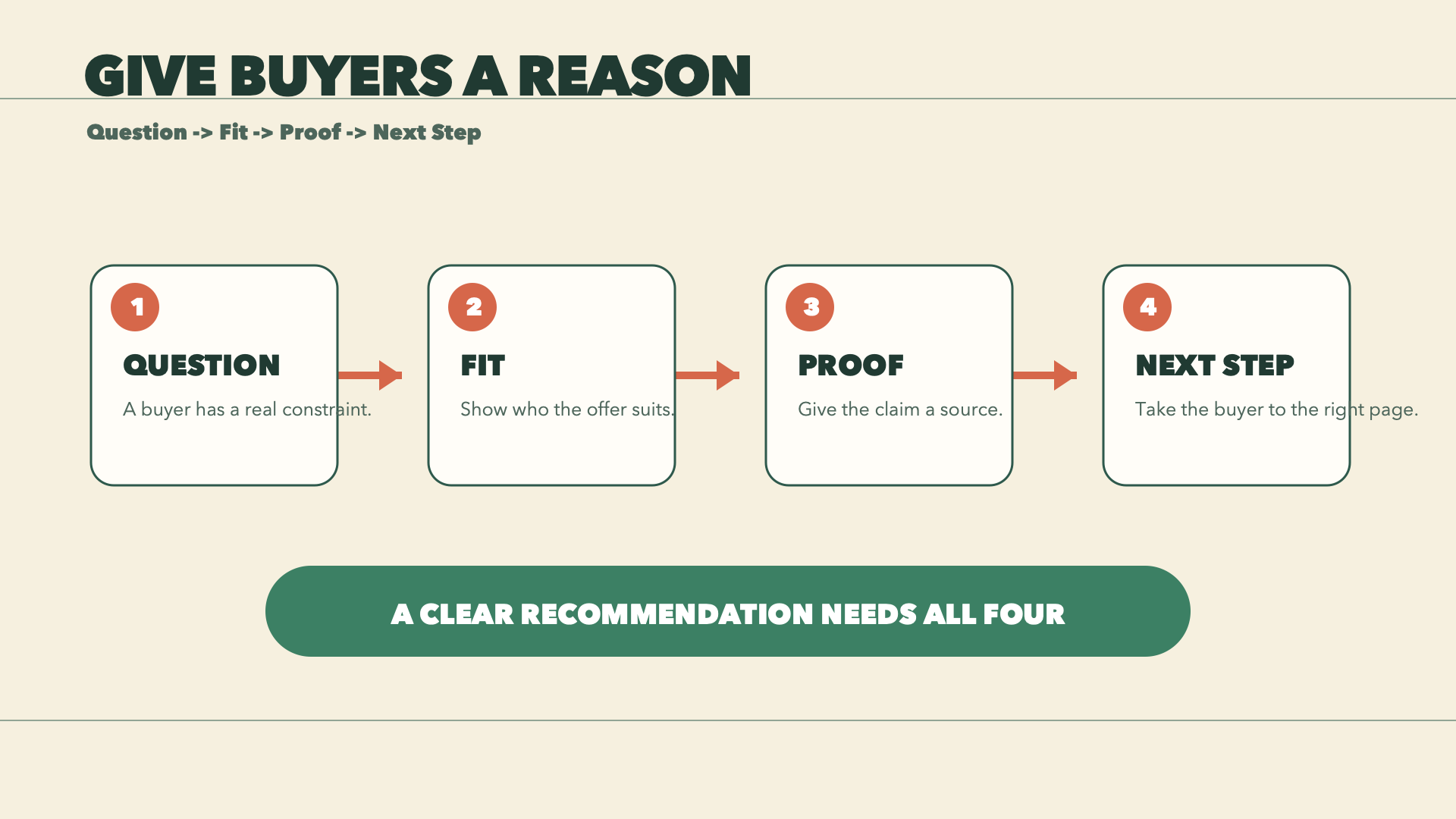
A usable brand recommendation has four parts. Weak content often has only one.
Part | What the buyer needs to understand | What your site should provide |
|---|---|---|
Question | The situation being solved | A page that uses the buyer's language and names the constraint |
Fit | Why one approach suits that situation | A specific description of audience, use case, and trade-off |
Proof | Why the explanation should be trusted | Product details, documentation, examples, policies, or verifiable data |
Next step | What the buyer can check or do now | A natural path to a comparison, product page, demo, guide, or implementation resource |
The chain works for people as well as answer systems. A buyer should not have to infer whether an offer is designed for their situation. An assistant should not have to assemble a claim from a slogan, three scattered feature pages, and an outdated blog post.
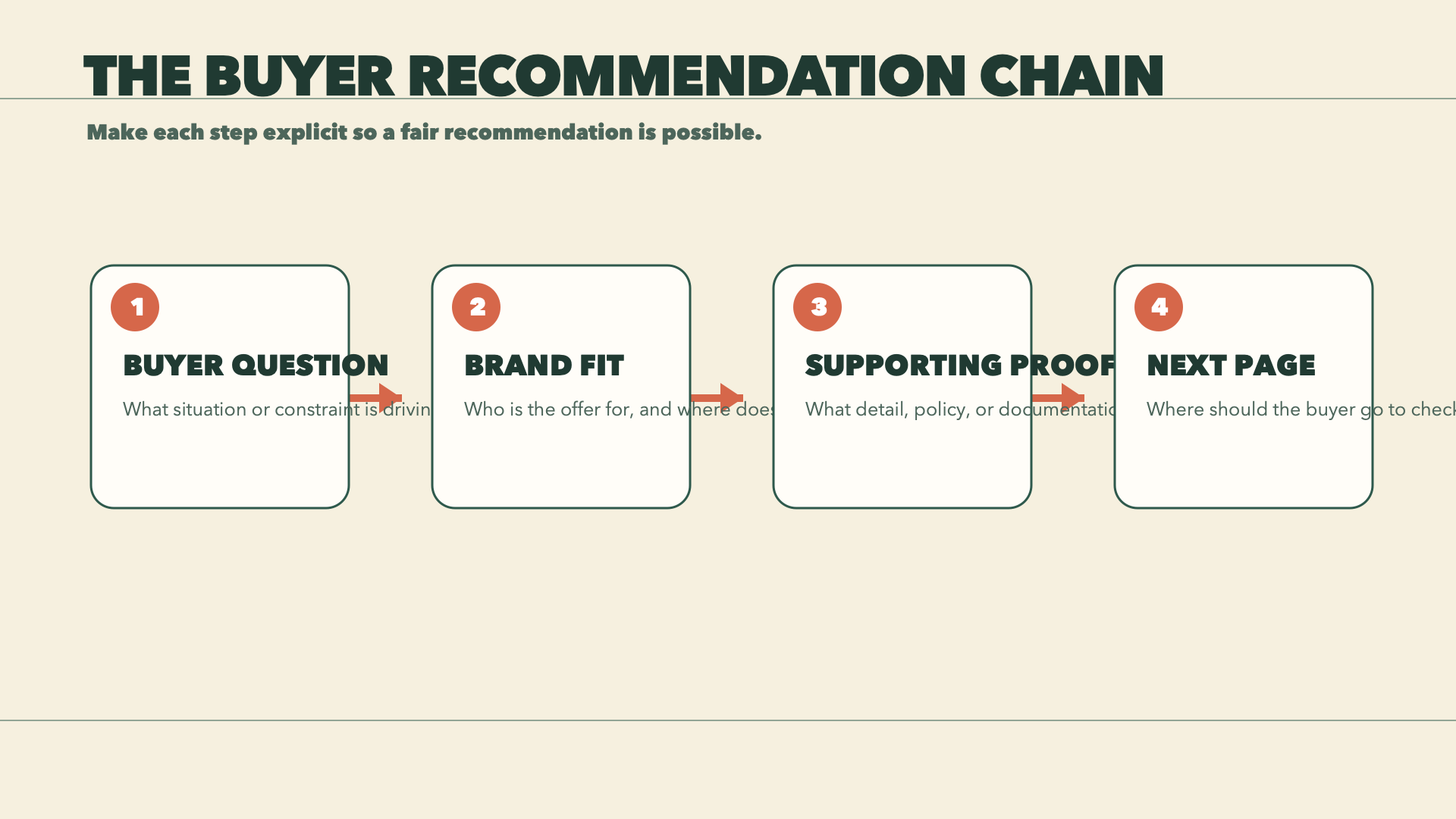
A brand recommendation works when the buyer can follow the question, fit, proof, and next step without filling in the gaps alone.
Replace slogans with decision-ready statements
Many brands already have a strong value proposition. The problem is that it is written for a homepage hero, not for a buyer making a specific choice.
Here is the difference:
Vague brand language | Decision-ready version |
|---|---|
"A modern support platform for growing teams" | "A support platform for B2B SaaS teams that need a shared inbox, self-service documentation, and role-based workflows without a long enterprise deployment." |
"Secure finance operations for every business" | "Expense controls and approval workflows for distributed finance teams that need policy enforcement and audit-ready records." |
"AI-powered analytics that drive growth" | "Product analytics for teams that need to identify activation drop-offs, test onboarding changes, and share behavior reports without writing SQL." |
The second column is not automatically better because it is longer. It gives the reader a boundary. It says who the product is for, what work it handles, and what condition matters. Honest boundaries increase trust because they reduce the sense that every company is claiming to be the answer for everyone.
Before publishing these statements, check them with product and legal owners. A clear claim that cannot be supported is worse than a cautious one.
Build pages around the questions that shape a shortlist
You do not need a new page for every prompt variation. Start with a small set of content surfaces that can answer multiple related questions well.
A use-case page for the buyer's situation
A strong use-case page describes the job, the constraints, the working process, and the expected result. It should include details a serious buyer would ask for: team size or maturity where relevant, implementation dependencies, integrations, limitations, and a practical example.
Avoid taking a generic feature list and replacing the headline with an industry name. The page needs a real reason to exist. If a company cannot explain how its product works differently for a particular context, it may not yet have a use-case page to publish.
A comparison page that respects the decision
Comparison pages are valuable when they help a buyer make a fair choice. State the criteria before declaring a winner: pricing model, deployment model, core workflow, integrations, governance, data handling, service model, and the conditions that make each option more suitable.
The most credible comparison pages include a "choose another option if" section. That does not weaken the brand. It makes the page more useful, reduces mismatched leads, and gives the recommendation context a clear boundary.
A concern page that answers the question nobody wants to ask sales
Buyers often use AI to ask the questions they are reluctant to put in a demo form: How difficult is migration? Does this product work in our market? What happens if we need to leave? What are the limitations? What proof exists for a security or compliance claim?
An honest FAQ, implementation guide, policy page, or technical documentation page can do more for trust than another thought-leadership article. The test is simple: could a buyer use this page to rule you in or out for a real reason?
Test how the market understands you, not just whether it names you
Once you have a defined group of buyer questions, run a small recurring review across the answer surfaces your audience actually uses. Record the full answer context, not only a mention count.
Look for four signals:
- Is the brand absent from a question where it has a legitimate fit?
- When the brand appears, is the stated reason accurate?
- Are competitors associated with a clearer use case, proof point, or limitation?
- Does an answer direct the buyer to information that is current and genuinely helpful?
The aim is not to write content that parrots an answer engine. It is to find gaps between how the company wants to be understood and the public evidence a buyer can actually find.
For example, a company may want to be considered by regulated mid-market teams, but its public pages only say "enterprise-grade security." The missing work is not a prompt trick. It is a concrete evidence problem: explain the relevant controls, ownership model, documentation, implementation scope, and any limitations accurately.
A small content map beats a large publishing calendar
Map each priority question to the evidence a buyer needs. The result should feel like a coverage plan, not a keyword dump.
Buyer question | Decision that follows | Evidence needed | Best page type |
|---|---|---|---|
"Is this right for a distributed support team?" | Shortlist or reject | Workflow, language support, ownership model, onboarding expectation | Use-case page |
"How does this compare with a larger suite?" | Compare trade-offs | Scope, integrations, cost model, limits, migration considerations | Comparison page |
"Can we meet our policy requirements?" | Move to technical review | Documentation, controls, contractual boundaries, support process | Trust or documentation page |
"How quickly can our team get value?" | Start a trial or delay | Setup steps, dependencies, responsibilities, time range where supportable | Implementation guide |
This map gives content, product marketing, and sales a shared language. It also makes updates easier to prioritize. When a sales objection repeats, the owner can ask whether the relevant evidence is missing, unclear, stale, or simply hard to discover.
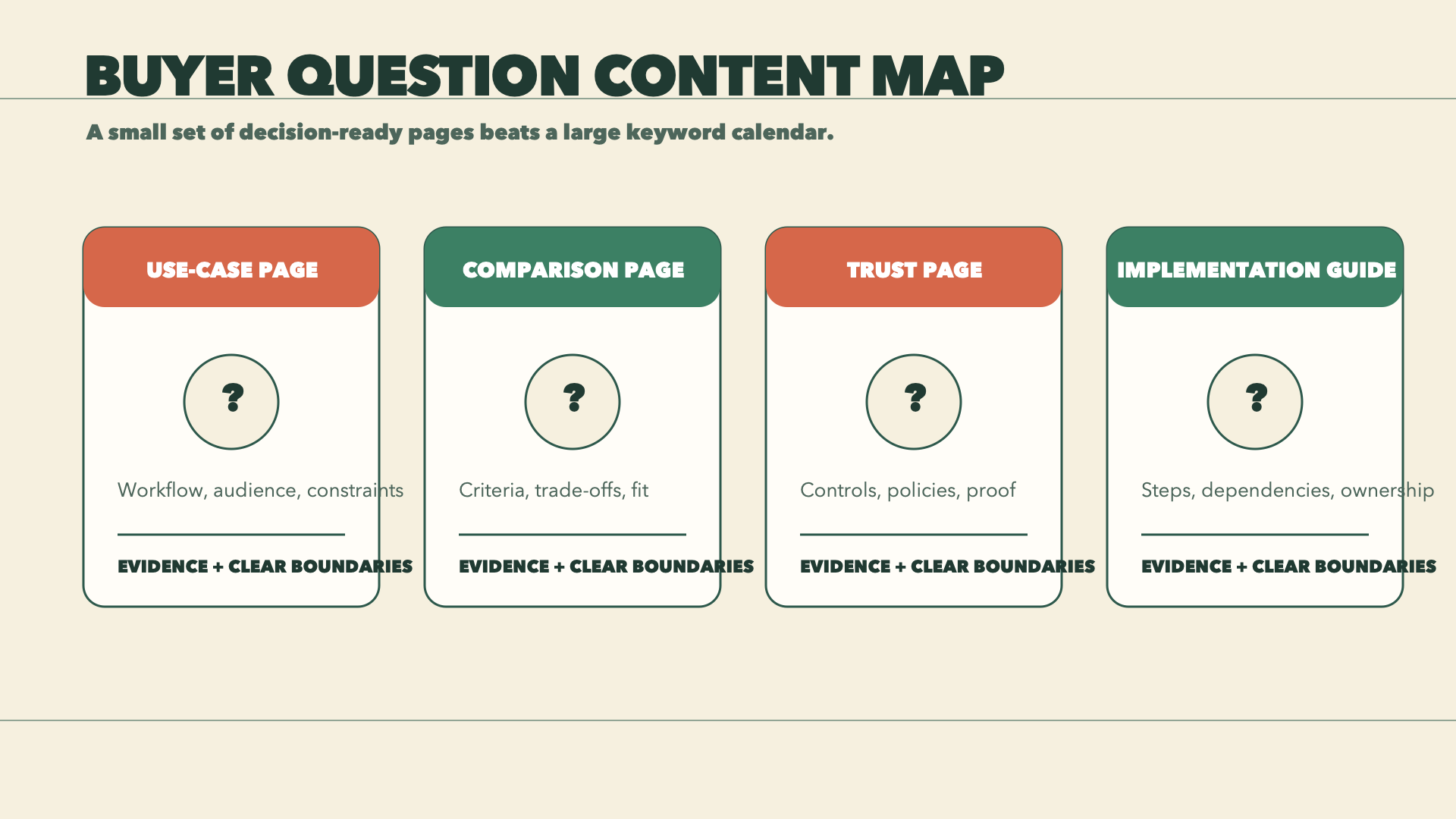
Map recurring buyer questions to the pages that provide the specific evidence each decision requires.
Where AI-search work goes wrong
Three habits create thin, forgettable content.
First, teams chase broad "best tools" prompts because the answers look impressive in a demo. Those prompts can be useful for market awareness, but they often contain too little context to guide a content decision.
Second, teams write only positive claims. Buyers know every product has boundaries. The absence of limitations makes a page less credible, particularly for a serious purchase.
Third, teams treat a brand mention as the finish line. It is only the beginning of a better question: did the answer give a buyer a true, useful reason to consider us?
The Auspia view: make the right answer easier to support
GEO should not flatten brand strategy into a contest for mentions. Its practical value is exposing the questions where a brand's explanation, proof, and public information fall short.
Use your existing customer language, then build the pages that make a fair recommendation possible. Start with the questions closest to a real decision, strengthen the evidence behind your answer, and review whether the market is understanding the brand as intended. Teams can use Auspia's AI Search Visibility Checker to establish a starting view of the questions and answer contexts worth investigating.
FAQ
Should every brand try to appear in every AI answer?
No. Focus on questions where your offer is genuinely relevant and where a clearer public explanation would help a buyer make a better decision. Broad, low-context mentions are rarely the most valuable signal.
Is a comparison page safe to publish if competitors are named?
It can be, if the page is factual, current, and useful. Base the comparison on transparent criteria, avoid unsupported claims, and explain where another option may fit better.
How often should we update this content map?
Review it when buyer objections change, product capabilities change, a new market becomes important, or recurring answer checks reveal a gap. For many teams, a monthly review is enough to keep ownership clear.
Author: Lydia Hart, Brand Entity Strategist for 200+ Entity Audits at Auspia. Lydia writes about clear brand facts, buyer-fit language, and the evidence that helps companies be understood accurately.