The Short Answer
On July 28, 2026, Ahrefs announced that Brand Radar now monitors brand mentions in Claude AI answers. The feature uses Claude Sonnet 4.6 with web search and runs 8 verification checks per update instead of a single pass. It is available for custom prompts.
It is a useful signal. It also confirms something teams should have acted on months ago: Claude is a real AI search surface. Tracking brand visibility across AI platforms is no longer a one-tool, one-platform job.
What Ahrefs Actually Shipped
Brand Radar already monitored brand presence in ChatGPT and Google AI Overviews. The Claude expansion adds a third AI answer surface to the dashboard.
Three details worth paying attention to:
It uses Claude to monitor Claude. The feature queries Claude Sonnet 4.6 with web search enabled, so the monitoring runs through the same retrieval-and-generation pipeline real users experience.
Eight checks per update, not one. A single AI answer can vary between queries, sessions, and web search refreshes. Eight checks per cycle reduces the chance that a one-off omission gets misread as a real visibility gap.
Custom prompts only, for now. You define the question, Brand Radar reports whether your brand appears. Useful for tracking specific high-value queries. Less useful for discovering brand appearances you did not think to check.
Why Claude Joining the AI Visibility Map Matters
Until recently, AI brand visibility monitoring meant two platforms: ChatGPT and Google AI Overviews. Teams that tracked those two felt reasonably covered.
That assumption is breaking down. Here is what the AI answer surface actually looks like for a brand right now:
AI Platform | Search/Sourcing Behavior | Brand Monitoring Tool Support |
|---|---|---|
ChatGPT | Bing-backed web search (Plus/Pro) | Ahrefs Brand Radar, Semrush, custom |
Google AI Overviews | Google Search index | Ahrefs Brand Radar, Semrush, Google Search Console |
Claude | Web search (Sonnet 4.6+) | Ahrefs Brand Radar (new) |
Perplexity | Real-time web + academic index | Limited third-party tools |
Gemini | Google Search index | Limited; some GSC signals |
Copilot | Bing index | Limited |
Grok | Web + X platform data | None |
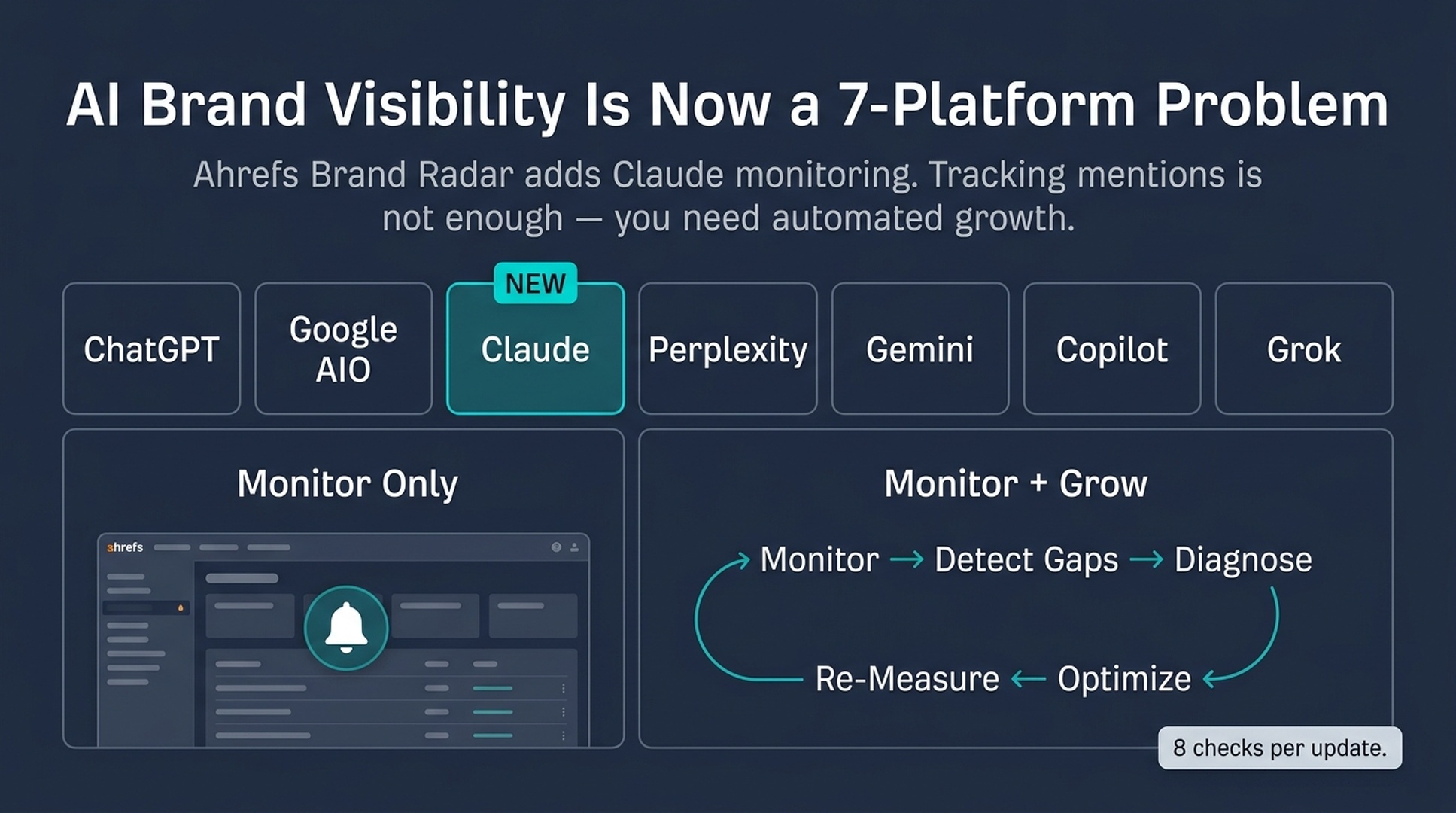
Three platforms now have dedicated monitoring. Four more have little to none. And the list keeps growing. Meta AI, Apple Intelligence, Amazon Rufus, and enterprise search agents all pull brand information from the web and surface it. None of them show you a traditional search results page.
The monitoring gap is not a tool gap. It is a surface-count problem. Each new AI platform that answers questions about your brand is a surface where visibility matters, and where most teams have zero measurement.
The Deeper Problem: Knowing Is Not Fixing
Even if you monitor all seven platforms in the table above, two problems remain.
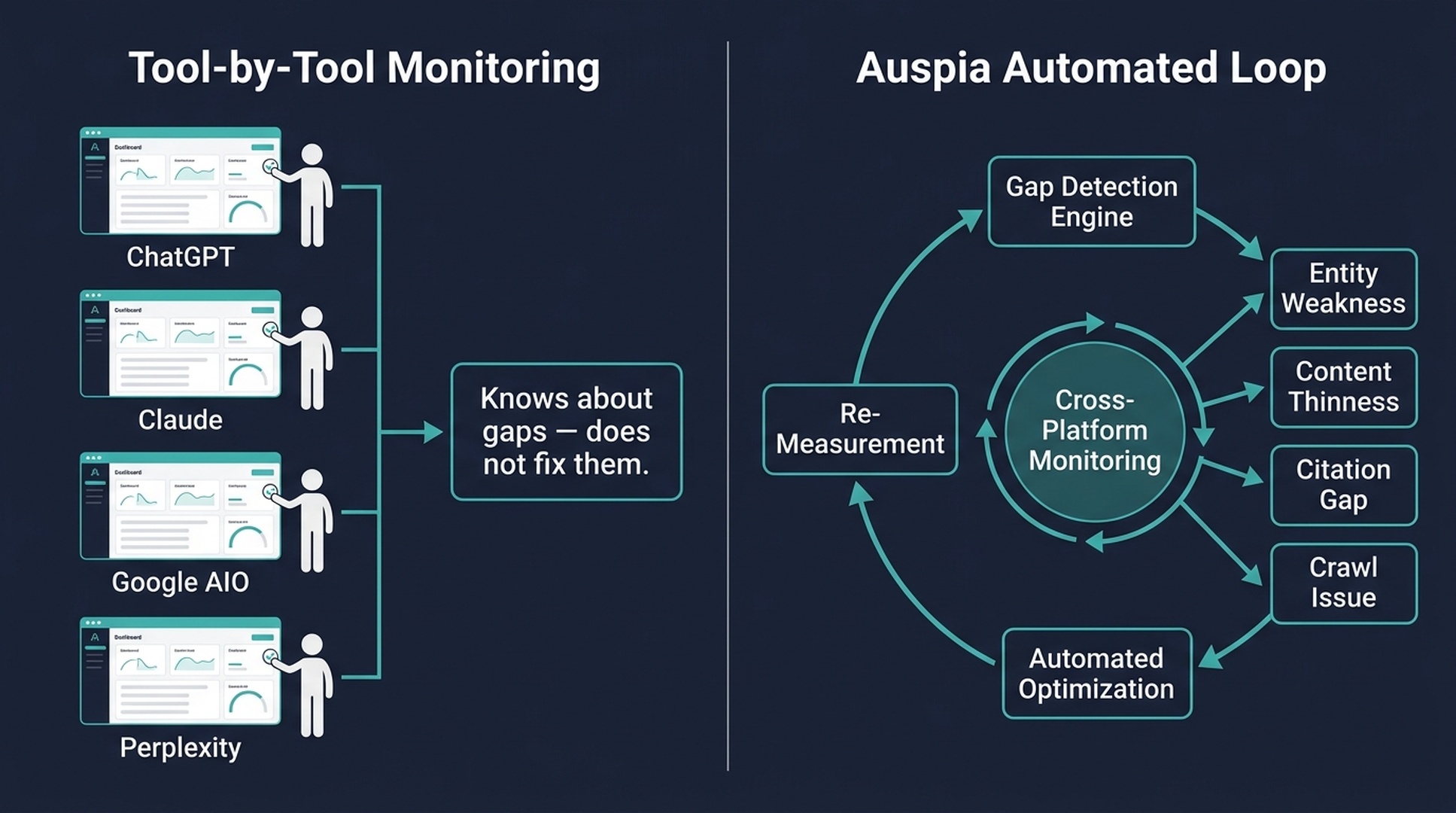
First, monitoring is manual until it is not. Checking dashboards across multiple tools, interpreting different scoring methods, and deciding what to act on takes hours per week. Most teams drift back to checking one platform. Usually the one their current tool already supports.
Second, seeing a gap does not close it. A dashboard that says "your brand was not mentioned in Claude's answer to question X" tells you what happened. It does not tell you why. It does not fix the underlying page, entity, or citation weakness. It does not improve your visibility next week.
The conversation needs to shift from monitoring AI mentions to automated AI visibility operations.
Auspia's Take: Automated Monitoring Meets Automated Growth
At Auspia, we took a different path. Instead of building one more platform-specific brand tracker, we built a system that does two things together:
Cross-platform automated monitoring. Auspia tracks brand visibility across ChatGPT, Google AI Overviews, Claude, Perplexity, Gemini, and more. Scheduled checks run in the background. No dashboard login required. You get a weekly visibility report, not a firehose of alerts.
Automated growth, not just alerts. When Auspia detects a visibility gap — a question where a competitor is cited but your brand is missing, or a topic cluster where your brand is absent across multiple AI platforms — it does not stop at reporting. It identifies the likely cause: thin page content, missing entity signals, weak citation sources, crawlability gaps. It generates an optimization plan. In many cases it can execute the fix through its agent workflow.
The diagram below shows the difference:
Most teams do not need more dashboards. They need fewer dashboards that lead to action.
What Teams Should Do This Week
Whether you use Ahrefs Brand Radar, Auspia, or build something in-house, here is a practical three-step plan:
1. Pick your AI visibility baseline (30 minutes)
Choose 10-15 questions that matter to your brand — the ones prospects, customers, or journalists actually ask AI platforms about your product, category, or competitors. Run them manually through ChatGPT, Claude, and Google AI Overviews once. Record:
- Is your brand mentioned at all?
- If yes, is the description accurate?
- If no, which competitor or source is cited instead?
This manual baseline takes 30 minutes and will surface gaps that no dashboard will flag on its own.
2. Set up automated tracking for at least three platforms (this week)
If you already use Ahrefs Brand Radar, Claude support is live. Set up your custom prompts. If you use another tool, check whether it covers more than one or two AI platforms.
Rule of thumb: If you can name an AI platform where someone might ask about your industry but you have zero visibility data for it, that is your next monitoring priority.
3. Connect monitoring to a fix workflow (before the end of the month)
A brand visibility gap that sits in a dashboard for six weeks is not monitoring. It is a slow-motion leak. For every gap you detect, assign one of four fix paths:
Gap Type | Likely Root Cause | Fix Path |
|---|---|---|
Brand never mentioned for a core question | Weak entity signals, thin brand page | Strengthen About page, Wikipedia, Crunchbase, brand schema |
Competitor cited instead | Competitor has stronger source pages on the topic | Build a better resource page; earn citations from trusted sources |
Brand appears but description is wrong | Inconsistent or outdated brand facts across the web | Audit and correct brand entity data across key platforms |
Brand appears for some queries but not related ones | Topic cluster is incomplete | Fill content gaps; internally link related pages |
If your current tool only reports gaps and does not help you close them, the workflow from detection to fix is on you to build. That is the part most teams skip. It is also the part that determines whether AI visibility actually improves.
What Still Needs Watching
Claude's role as a search entry point is still evolving. Unlike Google, which disclosed over 40 billion AI Overviews served in May 2026, or ChatGPT, which crossed 800 million monthly users, Claude's search usage volume is smaller and less transparent.
That does not mean you should ignore it. Monitor it proportionally. Track your brand presence, understand which question types Claude answers with web search, and increase investment as the surface grows.
AI search is not consolidating into one winner. It is fragmenting. Your monitoring either covers the sprawl or it does not.
FAQ
Does Ahrefs Brand Radar cover all AI platforms now?
No. As of July 2026, Brand Radar supports ChatGPT, Google AI Overviews, and Claude. Perplexity, Gemini, Copilot, Grok, and other AI answer surfaces are not covered by this tool.
How is Claude AI monitoring different from ChatGPT monitoring?
The core mechanics are similar. Both track whether your brand appears in AI-generated answers to specific prompts. The Claude implementation uses Claude Sonnet 4.6 with 8 verification checks per update, more than the typical single-pass approach.
Do I need to monitor my brand on Claude if my audience doesn't use it?
Not urgently, but pay attention to the direction of travel. Claude's web search means it answers questions about your brand even when your audience does not actively use it. Journalists, analysts, investors, and partners might. A wrong or missing brand mention on any AI platform is a reputation signal you cannot control after the fact.
Is AI visibility monitoring enough on its own?
No. Monitoring tells you where you stand. It does not improve your standing. Without a connected fix workflow — entity signals, source pages, citations, content gaps — monitoring is expensive observation with no return.
Author: Adrian Cole, Analyst of 1,000+ AI Search Results at Auspia. Adrian writes about how brands appear in ChatGPT, Perplexity, Gemini, Claude, Google AI Overviews, and other AI answer surfaces — and what growth teams can do to improve that visibility.