Measurement Starts With A Hard Truth
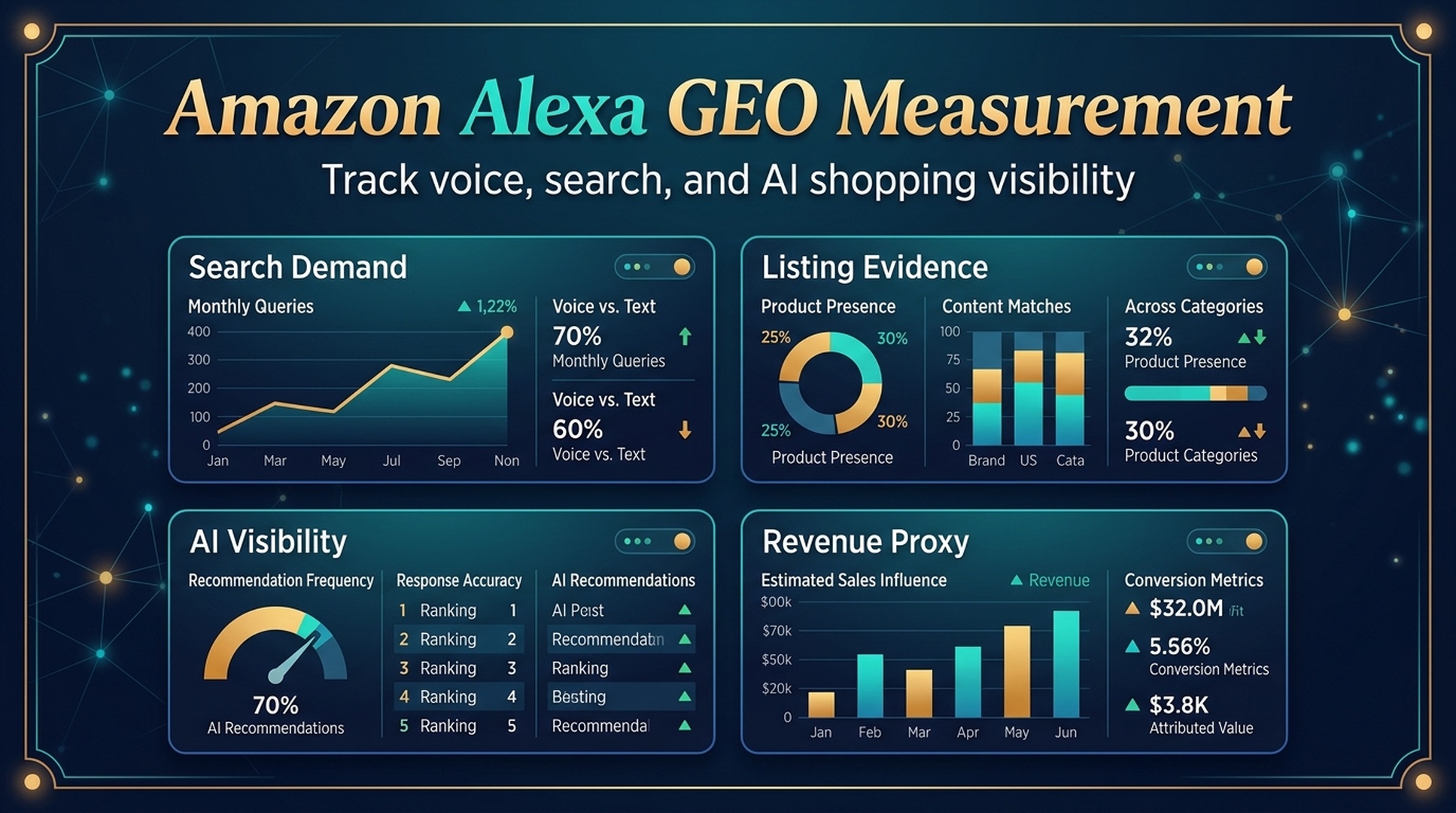
Amazon Alexa GEO measurement is directional, not perfect. Sellers should not expect one dashboard to say, “You rank number three in Alexa.” Voice shopping, Amazon search, AI shopping assistants, shopping lists, reorders, ads, product content, and customer behavior all create partial signals.
The right measurement model is a stack. Track search demand, content readiness, assistant visibility, and business outcomes separately, then look for movement across the layers. If a listing becomes easier to understand, product questions decline, AI answers mention the brand more often, and search or reorder behavior improves, the GEO work is probably moving in the right direction.
DataForSEO research for this article confirmed the commercial value around broader marketplace and AI discovery terms: amazon seo showed meaningful CPC and commercial intent, while amazon brand analytics appeared as a smaller but relevant informational term. The lesson is simple: sellers should measure Alexa GEO as part of marketplace search performance, not as an isolated voice gimmick.
Do Not Measure Alexa GEO Like Traditional Ranking
Traditional SEO often starts with rank tracking. Alexa GEO needs a different mindset because the output may be spoken, summarized, personalized, reordered, or hidden inside a shopping flow.
A seller may influence an Alexa-related journey even when the buyer never sees a blue link or a classic results page. For example:
- A buyer adds a generic item to a shopping list.
- Alexa or Amazon suggests a reorder based on history.
- A shopper asks a compatibility question before buying a smart home device.
- An AI shopping assistant summarizes review themes.
- Amazon search converts better because the listing answers voice-style questions.
- Support questions fall because setup content becomes clearer.
Those are not all “rankings.” They are visibility, trust, and action signals.
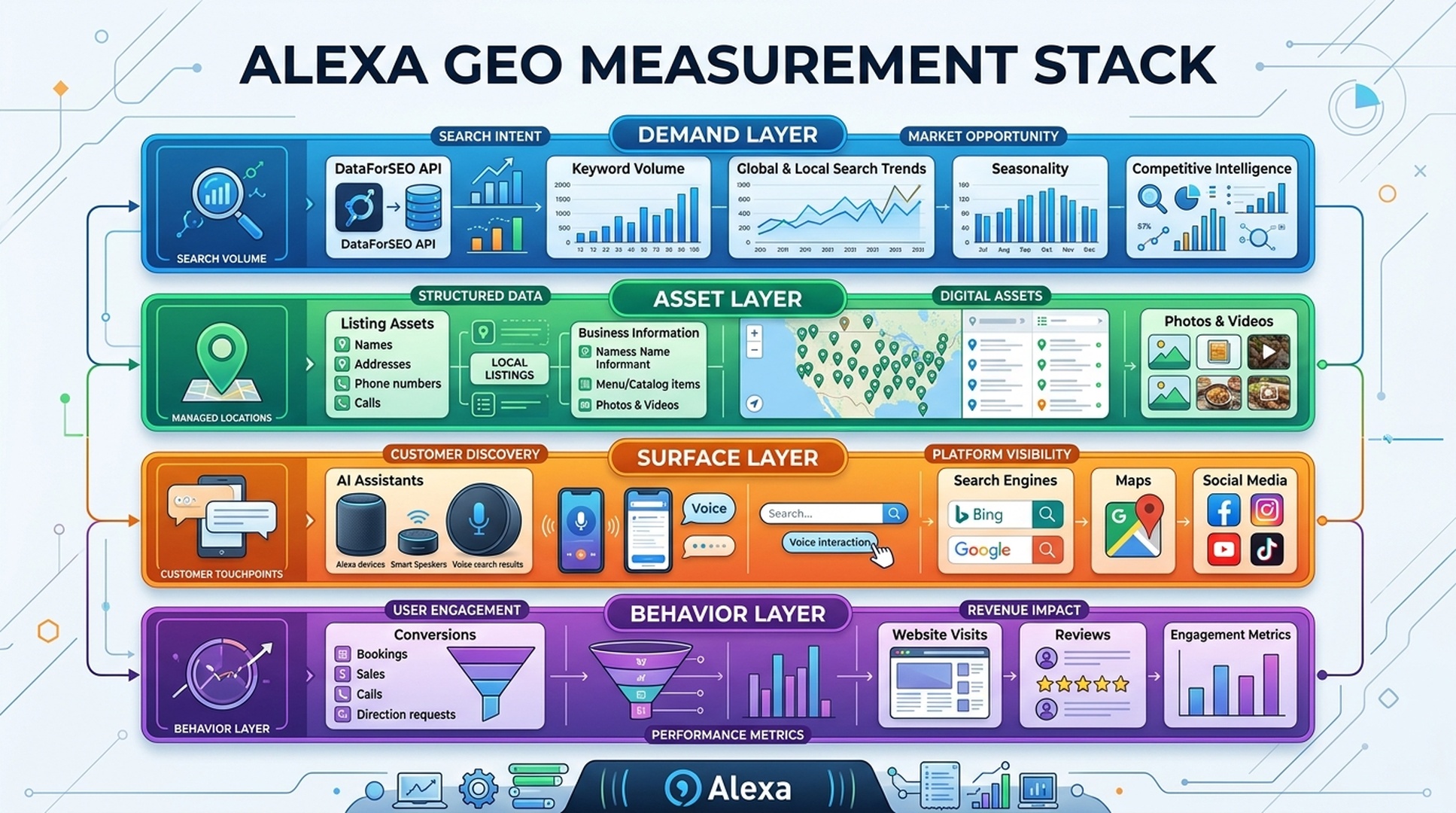
The Four-Layer Alexa GEO Measurement Stack
Use four layers so the team does not overreact to one metric.
Layer | What to track | Tools or sources | What it tells you |
|---|---|---|---|
Demand | Query volume, related questions, CPC, autocomplete, Amazon search terms | DataForSEO, Amazon autocomplete, Brand Analytics where available, ad reports | What buyers ask and what advertisers value |
Asset | Listing coverage, A+ Content, Q&A, reviews, support pages, schema on brand site | Manual audit, content checklist, review mining | Whether answers exist in usable form |
Surface | Amazon search appearance, Alexa app behavior, AI assistant answers, shopping-list/reorder prompts | Manual prompt checks, SERP snapshots, Amazon tests, AI visibility tools | Where the brand appears or disappears |
Behavior | CTR, conversion rate, ad query efficiency, repeat purchase, support tickets, review themes | Seller Central, ads console, support system, review analysis | Whether better answers change buyer action |
The stack prevents false confidence. A seller might improve content assets before behavior changes. Or ads might show demand before organic visibility catches up. The team needs to see the sequence instead of demanding one instant proof point.
Build A Prompt And Query Library
Measurement starts with a stable library of questions. If the team changes the question set every week, it cannot tell whether visibility improved.
Create a library across five intent groups:
Intent group | Example prompt or query | Why it matters |
|---|---|---|
Category discovery | “What is the best unscented dishwasher detergent on Amazon?” | Tests generic recommendation visibility |
Comparison | “Which is better for small apartments, Brand A or Brand B air purifier?” | Tests differentiation and constraints |
Compatibility | “Does this smart plug work with Alexa without a hub?” | Tests technical clarity |
Reorder | “Reorder my usual coffee filters” | Tests naming, pack size, and repeat-purchase signals |
Troubleshooting | “Why won't Alexa find my light strip?” | Tests support-led GEO and post-purchase trust |
Keep the library small enough to run consistently. Twenty to fifty prompts are better than two hundred prompts that nobody checks after the first month.
What To Measure In Amazon Search
Amazon search still matters because Alexa and AI shopping journeys rely on product data, purchase behavior, and marketplace trust signals.
Track these marketplace metrics:
- Search query performance where available.
- Sponsored Products search term reports.
- Organic rank checks for priority terms.
- Click-through rate by query family.
- Conversion rate after listing changes.
- Unit session percentage.
- Review count, review rating, and review theme changes.
- Share of voice for paid and organic placements.
Do not use these numbers as a direct Alexa ranking report. Use them as proxies for whether the product is easier to discover, trust, and buy.
What To Measure In Product Content
Content measurement is often ignored because it feels less exciting than rank. For Alexa GEO, it is essential.
Create an asset scorecard for each priority ASIN:
Asset question | Score 0 | Score 1 | Score 2 |
|---|---|---|---|
Does the title explain product type and key differentiator? | No | Partly | Clearly |
Do bullets answer compatibility, use case, and constraints? | No | Some | Strongly |
Does A+ Content answer visual buyer questions? | No | Basic | Detailed |
Does Q&A cover real objections? | No | Thin | Useful |
Do reviews support the promised use case? | No | Mixed | Strong |
Is there a crawlable support page? | No | Exists but thin | Structured and maintained |
Are reorder or shopping-list terms clear? | No | Partly | Clear |
The scorecard gives the team a baseline before changes. It also helps explain why a product with strong ad spend may still perform poorly in assistant-style recommendations.
Run Weekly Visibility Checks
Manual checks are imperfect, but they are useful when done consistently. Use the same prompts, same location assumptions, same account state where possible, and the same notes template.
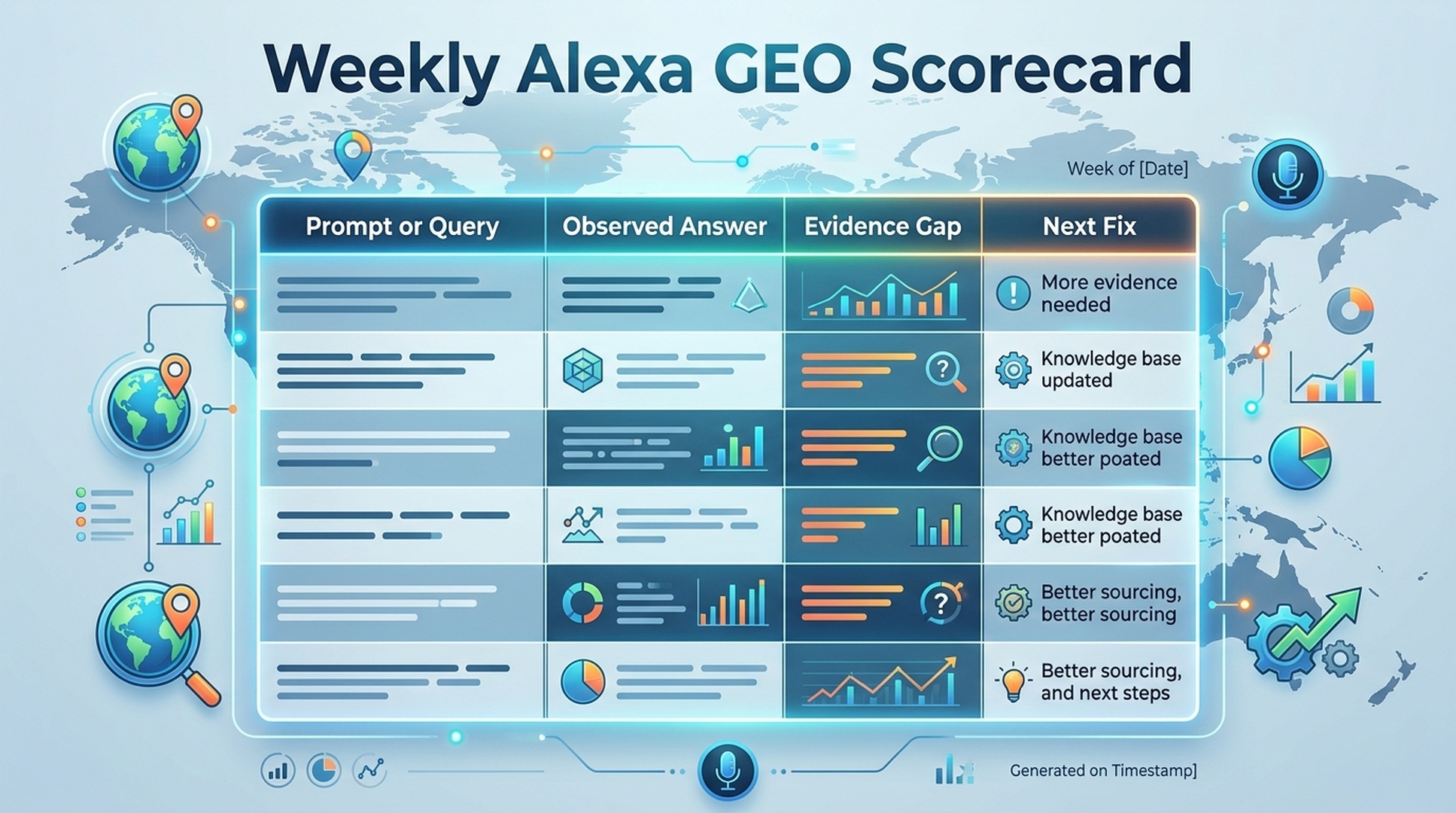
A weekly scorecard can be simple:
Prompt or query | Observed answer | Brand present? | Evidence gap | Next fix |
|---|---|---|---|---|
“Best Alexa-compatible smart plug without hub” | Competitor brands mentioned | No | Hub requirement not explicit | Rewrite bullets and A+ setup panel |
“Reorder unscented laundry pods” | Generic category prompt | Partial | Pack naming unclear | Standardize title and backend terms |
“Why does my smart bulb go offline?” | General troubleshooting answer | No | No support page | Publish symptom-based FAQ |
“Best coffee filter for pour over” | Brand not included | No | Weak review themes and no comparison content | Add use-case module and review mining |
The point is not to claim scientific precision. The point is to build an operating rhythm: observe, diagnose, improve the asset, then retest.
Connect GEO Metrics To Business Metrics
Alexa GEO work should eventually connect to commercial outcomes. The connection may be indirect, but it should exist.
Use this chain:
GEO change | Leading metric | Business metric |
|---|---|---|
Better compatibility content | Fewer unanswered Q&A themes | Higher conversion, fewer returns |
Clearer setup content | Fewer setup complaints | Better reviews, lower support load |
Stronger reorder naming | More branded search and repeat purchase | Higher reorder rate |
Better A+ Content | Higher engagement and conversion | Revenue per session |
Stronger review themes | More AI-answer evidence | Better trust and click-through |
If a seller cannot connect a GEO project to any business metric, the project is probably too abstract.
Common Measurement Mistakes
Avoid these traps:
- Treating Alexa GEO as a single rank number.
- Testing random prompts every week.
- Measuring only AI mentions and ignoring conversion.
- Changing titles, bullets, images, and price at the same time without notes.
- Confusing paid visibility with organic recommendation strength.
- Ignoring support tickets and review language.
- Declaring failure after one week of noisy data.
Measurement should make decisions calmer. If it creates more confusion, the scorecard is too complicated or the question library is unstable.
A 30-Day Measurement Plan
Use the first month to build baseline, not to chase perfect attribution.
Week | Work | Output |
|---|---|---|
1 | Build query and prompt library from DataForSEO, Amazon search terms, reviews, and Q&A | Stable test set |
2 | Audit top ASINs and brand support assets | Asset readiness baseline |
3 | Run visibility checks across Amazon, AI assistants, and support queries | Surface observation log |
4 | Connect changes to CTR, conversion, ad query efficiency, support tickets, and reviews | First measurement dashboard |
After that, repeat monthly. The goal is not to prove that one phrase caused one sale. The goal is to make every product detail page, support asset, and brand answer more likely to be used by buyers and AI systems.
FAQ
Can sellers directly track Alexa voice ranking?
Usually not in a clean, universal way. Sellers should use a layered model that combines query demand, product content readiness, visibility checks, and business outcomes.
Which metric matters most for Alexa GEO?
There is no single metric. For Amazon sellers, the most useful set usually includes search query performance, ad search terms, listing conversion, review themes, support tickets, and repeated prompt checks.
How often should sellers run Alexa GEO checks?
Weekly checks are useful for active projects. Monthly checks are enough for stable products. The key is using the same query and prompt set each time.
Should paid ads be part of Alexa GEO measurement?
Yes, but as a learning signal, not proof of organic visibility. Paid search terms reveal buyer language, commercial intent, and conversion patterns that can improve organic content.
How do reviews affect measurement?
Reviews show whether buyers confirm or contradict the product claims. They also provide evidence themes that AI shopping assistants may summarize when comparing products.
Auspia Takeaway
Amazon Alexa GEO measurement is not about finding one magic dashboard. It is about building a reliable evidence loop: buyer questions, product assets, assistant visibility, and business behavior.
The seller who measures this loop consistently will make better decisions than the seller who only asks, “Do we rank on Alexa?” In AI-assisted shopping, the better question is: “Are our product facts clear enough to be found, trusted, summarized, and acted on?”
Author: Ethan Marlowe, GEO Measurement Lead Across 500+ Prompts at Auspia. Ethan writes about prompt tracking, citation reporting, visibility dashboards, and AI answer quality checks for growth teams.