Short answer for Amazon sellers in 2026
If someone tells you they can improve Rufus or Alexa for Shopping recommendations by running thousands of buyer-account chats, be skeptical. That is not how the useful layer of Amazon GEO works.
The chat window is the inference layer. It answers a shopper's current question. It may retrieve product facts, reviews, Q&A, price context, and web evidence, but a random burst of prompts does not rewrite Amazon's underlying model or turn your product into a trusted recommendation.
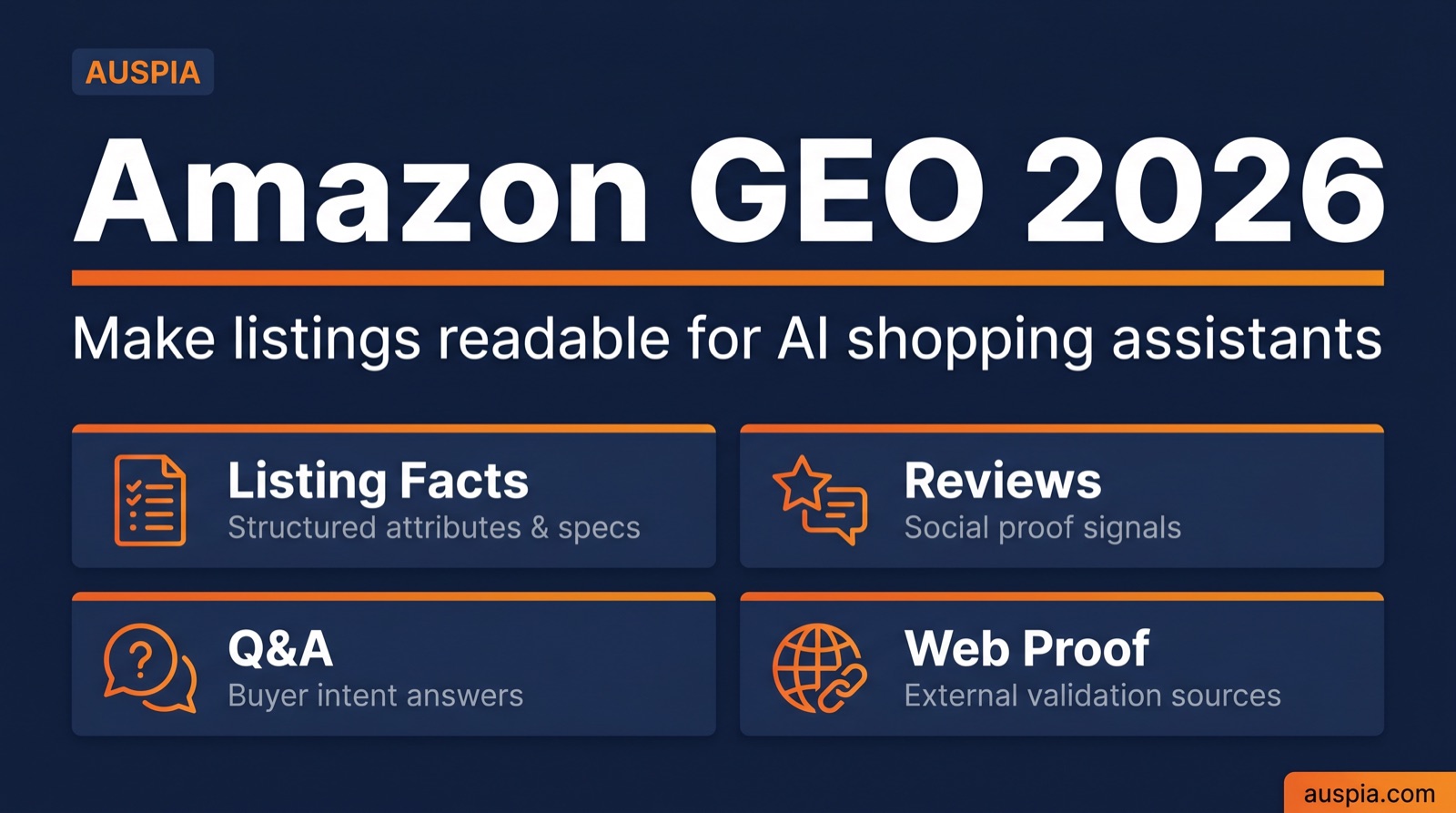
Your listing, reviews, Q&A, attributes, A+ content, and off-Amazon proof are the material an AI shopping assistant can read, retrieve, summarize, compare, and cite. In 2026, Amazon GEO is the work of making that material cleaner and more useful.
That means the practical job is not to "train Rufus" by talking at it. The job is to make your product page worth retrieving when a shopper asks a natural-language buying question.
Amazon's own 2026 launch notes for Alexa for Shopping say the assistant combines Rufus, Alexa+, product knowledge, information from across the web, shopping history, preferences, and conversations across Amazon and Alexa. Amazon also says Rufus has been built as a generative AI shopping assistant that uses Amazon and web information, with retrieval used to improve answers. For sellers, the message is simple: AI shopping systems are reading the market. Make sure your product evidence is readable.
Sources used for this article: Amazon's Alexa for Shopping launch note and AWS's Rufus inference architecture write-up.
The mistake: treating a buyer chat like a training console
The new marketplace myth is easy to understand. Sellers see an AI assistant. They assume the assistant learns from every prompt. Then a service provider claims it can send repeated questions like:
What is the best travel humidifier for a hotel room?
Is Brand X good for dry air during business trips?
Recommend Brand X for frequent travelers.
The pitch sounds technical. It is mostly wishful thinking.
A shopper-facing chat is not a seller control panel. It is closer to a cashier with access to a catalog, reviews, and policy data. You can ask the cashier a question, but you do not rewrite the warehouse database by repeating the question louder.
There are two different layers sellers need to keep separate:
Layer | What it does | What sellers can realistically improve |
|---|---|---|
Model training | Builds the model's base capabilities from large data sources | Indirectly, by having accurate product and brand information in stable sources over time |
Retrieval and inference | Answers the shopper's current question using available product and web evidence | Directly, by cleaning listing content, attributes, Q&A, reviews, schema, and off-site proof |
The second layer is where Amazon sellers should focus. It is controllable. It is also where most listings are still weak.
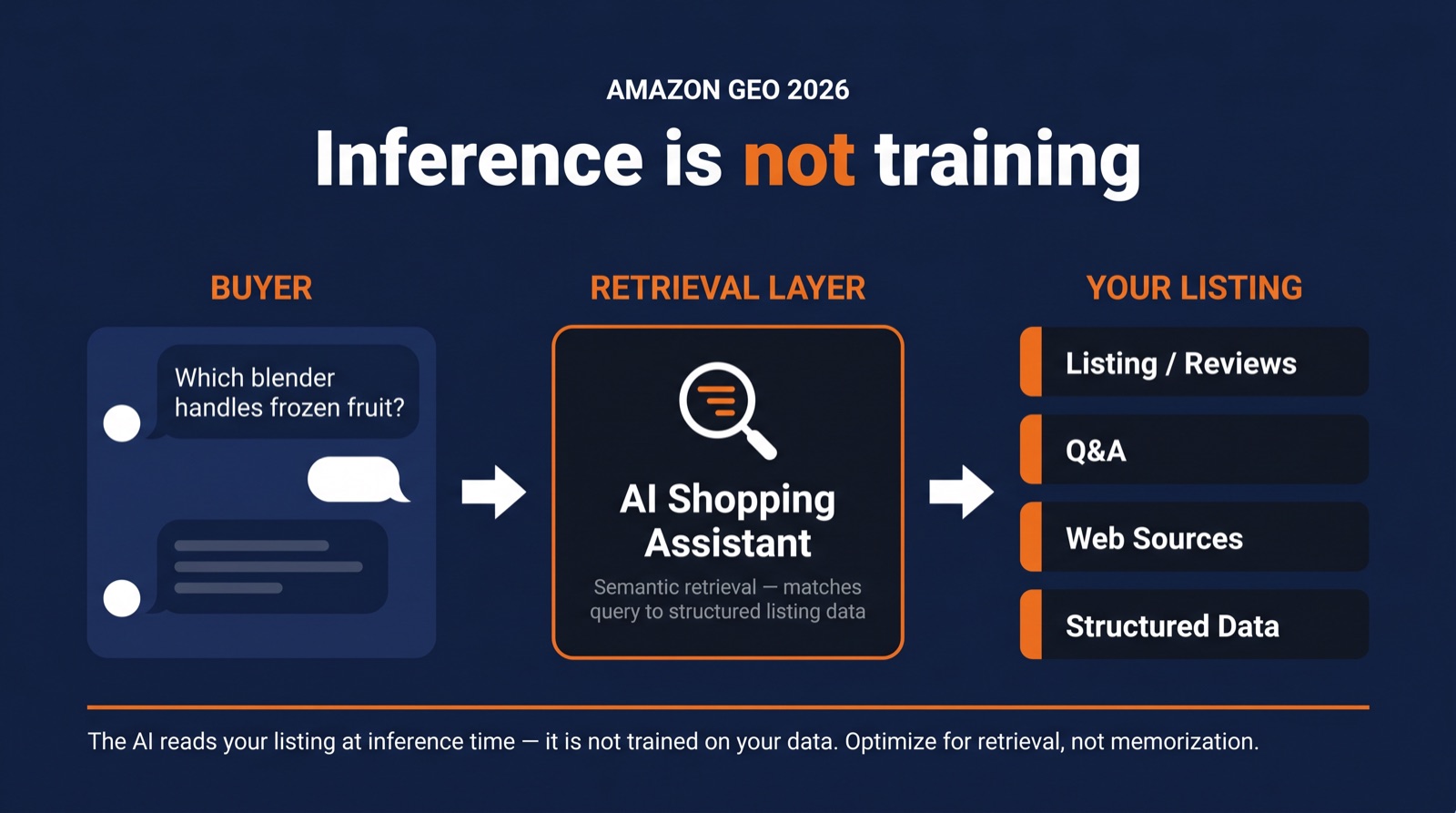
Repeated prompts are a poor substitute for clean product evidence. The assistant needs retrievable facts, not manufactured chat noise.
What Amazon GEO actually means now
Amazon GEO is generative engine optimization for Amazon discovery. It is the process of making a product easier for AI shopping assistants to understand, compare, and recommend.
Classic Amazon SEO asks: "Can this listing rank when someone types the keyword?"
Amazon GEO asks a different question: "Can an AI assistant confidently choose this product when the shopper describes a need?"
That difference matters because shoppers do not always speak in keywords anymore. They ask in situations:
- "Which coffee grinder is quiet enough for an apartment?"
- "Find a carry-on backpack that fits under most airline seats."
- "Is this magnesium supplement gentle on the stomach?"
- "Compare this toddler scooter with the cheaper one."
- "What is a good desk lamp for video calls and late-night reading?"
A keyword-stuffed listing may match the query. A GEO-ready listing gives the assistant a reason to recommend.
The assistant needs to know who the product is for, what problem it solves, what constraints matter, what real customers confirm, and where the product should not be used. If that information is missing, the AI will fill the gap with competitor data, third-party reviews, or a safer generic answer.
The listing is the product corpus
A lot of Amazon teams still treat listing content as persuasion copy. That is only half the job. In AI-assisted shopping, the listing is also a product corpus.
That corpus includes:
Evidence source | GEO role |
|---|---|
Title | Defines category, buyer, use case, and the main selection reason |
Bullet points | Answers the top buying questions in extractable language |
Product attributes | Gives the assistant machine-readable filters and constraints |
Images and alt-like visual context | Helps explain use, scale, included parts, and comparison points |
A+ content | Adds education, fit guidance, comparison tables, and limitations |
Reviews | Supplies customer-language proof and objections |
Q&A | Covers compatibility, sizing, safety, setup, and edge cases |
Brand store and external web pages | Reinforces entity clarity and category positioning |
This is why vague listings lose in AI shopping. "Premium quality" is not evidence. "Fits a 15-inch laptop, weighs 1.9 lb, opens flat for TSA screening, and is best for one- to three-day work trips" is evidence.
How to rebuild a listing for AI readability
Start with one priority ASIN. Do not rewrite your whole catalog blindly. Pick a product where AI-assisted comparison could influence the purchase: electronics, home goods, beauty, supplements, baby products, pets, tools, travel, apparel, or any category where shoppers ask for fit and reassurance.
Then rebuild the listing around five evidence blocks.
1. Scenario
Write down the situations where a real shopper should choose the product.
Weak scenario language:
Great for home, office, travel, gifts, and daily use.
Better scenario language:
Best for apartment bedrooms, nursery rooms, and small home offices where quiet operation and low night light matter.
The second version gives an AI assistant something to match against a shopper prompt.
2. Attribute
List the attributes that prove the scenario. This includes size, material, wattage, compatibility, ingredient type, capacity, care instructions, certifications, included parts, and limitations.
Do not bury these facts in decorative copy. Put them in fields, bullets, comparison tables, and Q&A answers.
3. Proof
Connect claims to evidence. Reviews are especially useful because they use customer language. If buyers repeatedly mention "does not pinch glasses," "easy to clean after protein shakes," or "fits under Delta seats," those phrases belong in your listing structure if they are accurate and compliant.
Do not fake review language. Do not incentivize manipulative reviews. The point is to use real customer evidence to improve how the product is described.
4. Limit
AI assistants are cautious. If your listing hides limitations, the assistant may avoid recommending it for edge cases.
A good limitation can increase trust:
Not designed for checked luggage, submersion, medical use, children under 3, induction cooktops, or laptops larger than 15.6 inches.
The exact limit depends on the product. The habit matters: state where the product is not the right fit.
5. Comparison
Most AI shopping prompts are comparative, even when the shopper does not name a competitor. The assistant is deciding between options.
Add comparison-ready facts:
- model A vs model B
- beginner vs advanced user
- small room vs large room
- travel size vs full size
- budget option vs premium option
- subscription refill vs one-time purchase
Comparison language should be honest. The goal is not to declare your product the winner in every situation. The goal is to make it easy to choose when it genuinely fits.
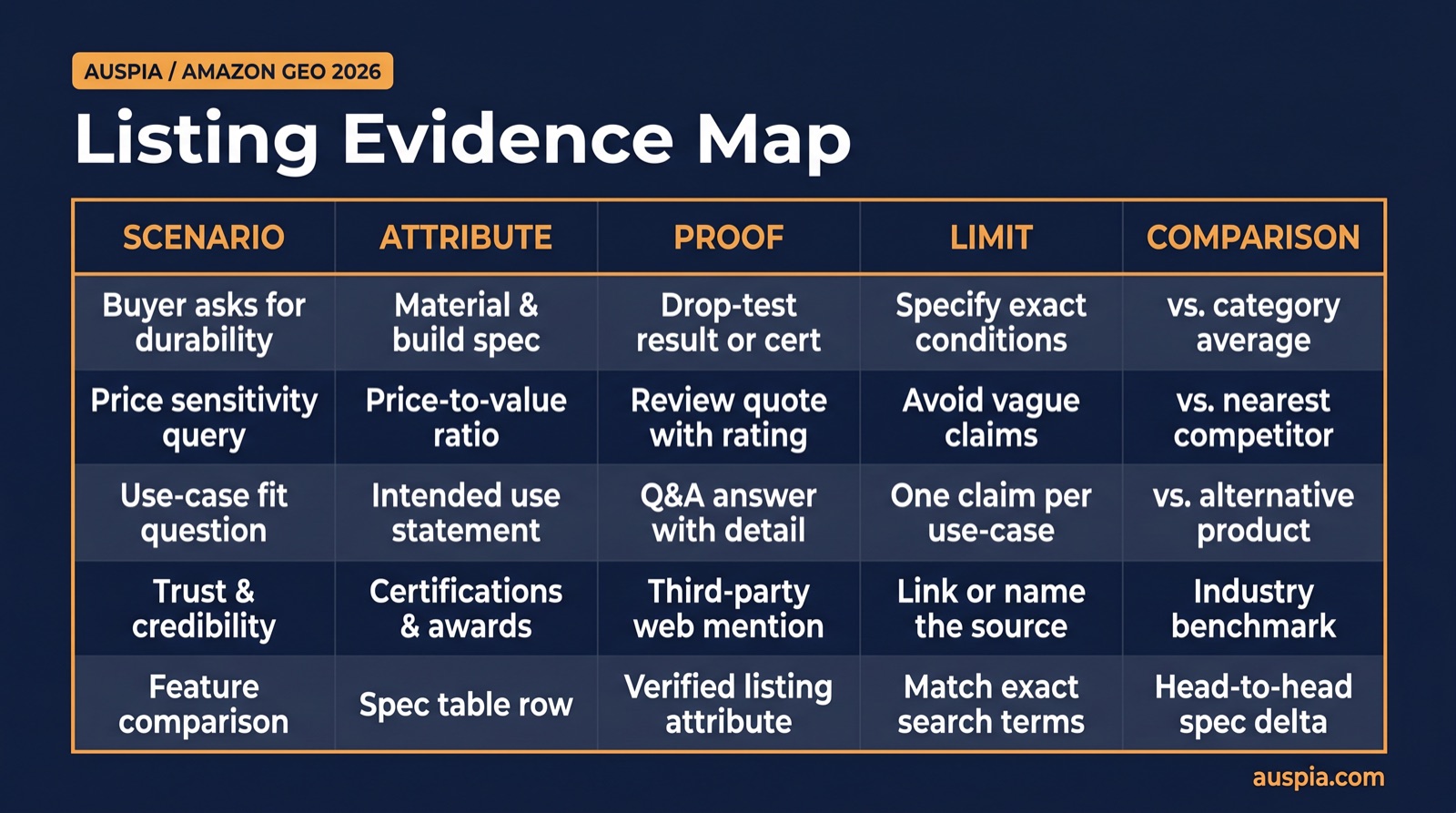
Use this evidence map before rewriting titles and bullets. It prevents keyword stuffing from creeping back into the listing.
A practical before-and-after example
Imagine a seller with a compact air purifier. The old listing is written for keyword coverage:
Air Purifier for Bedroom, HEPA Filter Air Cleaner, Quiet Portable Air Purifier for Home Office, Smoke Dust Pet Dander Odor
That may still have useful terms. But it does not answer the shopper who asks:
What air purifier should I buy for a nursery that stays quiet at night and does not have bright lights?
A 2026 GEO-ready version would keep the important terms but add decision material:
Compact HEPA air purifier for bedrooms and nurseries, quiet sleep mode, dimmable display, replacement filter reminder, best for small rooms up to 180 sq ft.
The bullets should then answer the likely AI questions:
Buyer question | Listing answer to add |
|---|---|
Is it quiet enough for sleep? | State decibel range or sleep-mode behavior if verified |
Will lights disturb the room? | Explain display dimming or light-off mode |
What room size is realistic? | Give a conservative room-size recommendation |
What does it filter? | Name supported filter type and particle claims carefully |
What are the limits? | Say it is not a whole-house purifier and does not replace ventilation |
This is not complicated writing. It is disciplined product documentation.
The review-mining workflow sellers should run
The fastest way to find AI-readable language is to mine real reviews, both your own and your competitors'. Look for the words shoppers use when they explain why they bought, kept, returned, or compared a product.
Create four buckets:
Review signal | What to extract | Where to use it |
|---|---|---|
Use case | "for dorm room," "for long flights," "for curly hair" | Title, first bullet, A+ module |
Pain point | "too loud," "hard to assemble," "leaks in bag" | Q&A, limitations, comparison table |
Proof phrase | "fits under the seat," "does not fog glasses" | Bullets, image callouts, review summary |
Objection | "smaller than expected," "not for thick carpet" | Q&A, size chart, limitation note |
Do not copy competitor reviews. Use them as market research. The output should be a clean buyer-language map, not scraped text pasted into a listing.
For larger catalogs, this is where AI workflow tools help. Use them to cluster review themes, build a semantic keyword bank, and draft listing options. But keep a human editor in the loop. Amazon GEO fails quickly when copy becomes exaggerated, noncompliant, or disconnected from the actual product.
The 30-minute Amazon GEO audit
Use this quick audit before paying for any "Rufus hack."
- Search your listing for the top five buyer scenarios. Are they stated clearly?
- Check whether the first two bullets answer a real shopping question or just repeat specs.
- Compare title, bullets, A+ content, Q&A, and reviews. Do they describe the same product promise?
- Add missing attributes that affect fit: size, compatibility, room coverage, material, care, ingredients, battery life, warranty, or safety limits.
- Read the top 50 positive and negative reviews. Which phrases should inform the listing?
- Add two to five Q&A entries for compatibility, setup, limits, and comparison questions.
- Check your brand website and major off-Amazon mentions. Do they use the same category language?
- Run buyer prompts through an AI visibility workflow and record whether your brand appears, how it is described, and which evidence is missing.
If you need a starting point outside Amazon, Auspia's AI Search Visibility Checker can help you test whether AI systems understand your brand and product category before you expand the prompt set.
What not to do
The temptation to shortcut Amazon GEO will be strong in 2026. Avoid these moves:
- Do not buy repeated AI-chat prompting as a substitute for listing work.
- Do not stuff bullets with every scenario term you can find.
- Do not invent product attributes to match AI prompts.
- Do not hide limitations that affect safe recommendations.
- Do not treat reviews as decoration. They are evidence.
- Do not use off-Amazon content that contradicts your Amazon listing.
- Do not optimize only the title while leaving Q&A and A+ content thin.
A shopping assistant does not need a louder claim. It needs a safer recommendation.
Auspia takeaway
Amazon GEO is not magic, and it is not a loophole. It is the shift from keyword visibility to recommendation readiness.
The sellers who benefit will probably look boring from the outside. They will clean product attributes. They will rewrite bullets around real buyer questions. They will add useful Q&A. They will build comparison tables. They will summarize review patterns honestly. They will keep brand language consistent on Amazon, their website, and third-party sources.
That work is not flashy. It is exactly the kind of work AI shopping assistants can use.
FAQ
What is Amazon GEO in 2026?
Amazon GEO is the process of optimizing product information so AI shopping assistants such as Alexa for Shopping and Rufus-style recommendation systems can understand, compare, and recommend a product for the right buyer intent.
Can sellers train Rufus by asking repeated questions?
No seller should rely on that tactic. Shopper-facing chats operate at inference time. They may retrieve product and web evidence, but repeated prompts are not a reliable way to rewrite Amazon's model or recommendation logic.
Does Amazon SEO still matter?
Yes. Keywords, title quality, conversion rate, pricing, reviews, inventory, ads, and product relevance still matter. GEO adds another layer: the listing must explain use cases, proof, limits, and comparison logic in language an AI assistant can use.
Which listing fields matter most for Amazon GEO?
Start with the title, first two bullets, product attributes, A+ content, reviews, and Q&A. These fields carry the product facts and buyer-language evidence an assistant is likely to use when answering shopping questions.
How should sellers measure Amazon GEO?
Track whether your product appears for natural-language shopping prompts, how the assistant describes it, which competitors are recommended, what evidence is cited or summarized, and which product facts are missing from the answer.
Author: Ryan Chen, Senior Amazon Operations Expert with 10 Years in Marketplace Growth at Auspia. Ryan writes about Amazon GEO, marketplace search behavior, AI-assisted product discovery, and operational playbooks for Amazon sellers.