Short answer for 2026
Amazon's move from Rufus to Alexa for Shopping is more than a product rename. For sellers, the practical shift is this: Amazon's AI shopping layer is moving from answering product questions to shaping the buying path itself.
Rufus taught shoppers how to research. Alexa for Shopping is being positioned to compare products, remember preferences, track price history, build carts, and trigger repeat or conditional purchases. That changes Amazon GEO in a very plain way. Your listing no longer needs to satisfy only keyword search and conversion filters. It also needs to be clear enough for an AI assistant to understand who the product is for, when it should be recommended, what evidence supports it, and when it should not be recommended.
If you sell on Amazon in 2026, the weak listing is not the one with too few keywords. It is the one with vague use cases, thin review evidence, inconsistent product facts, and pricing behavior that an assistant can easily explain against you.
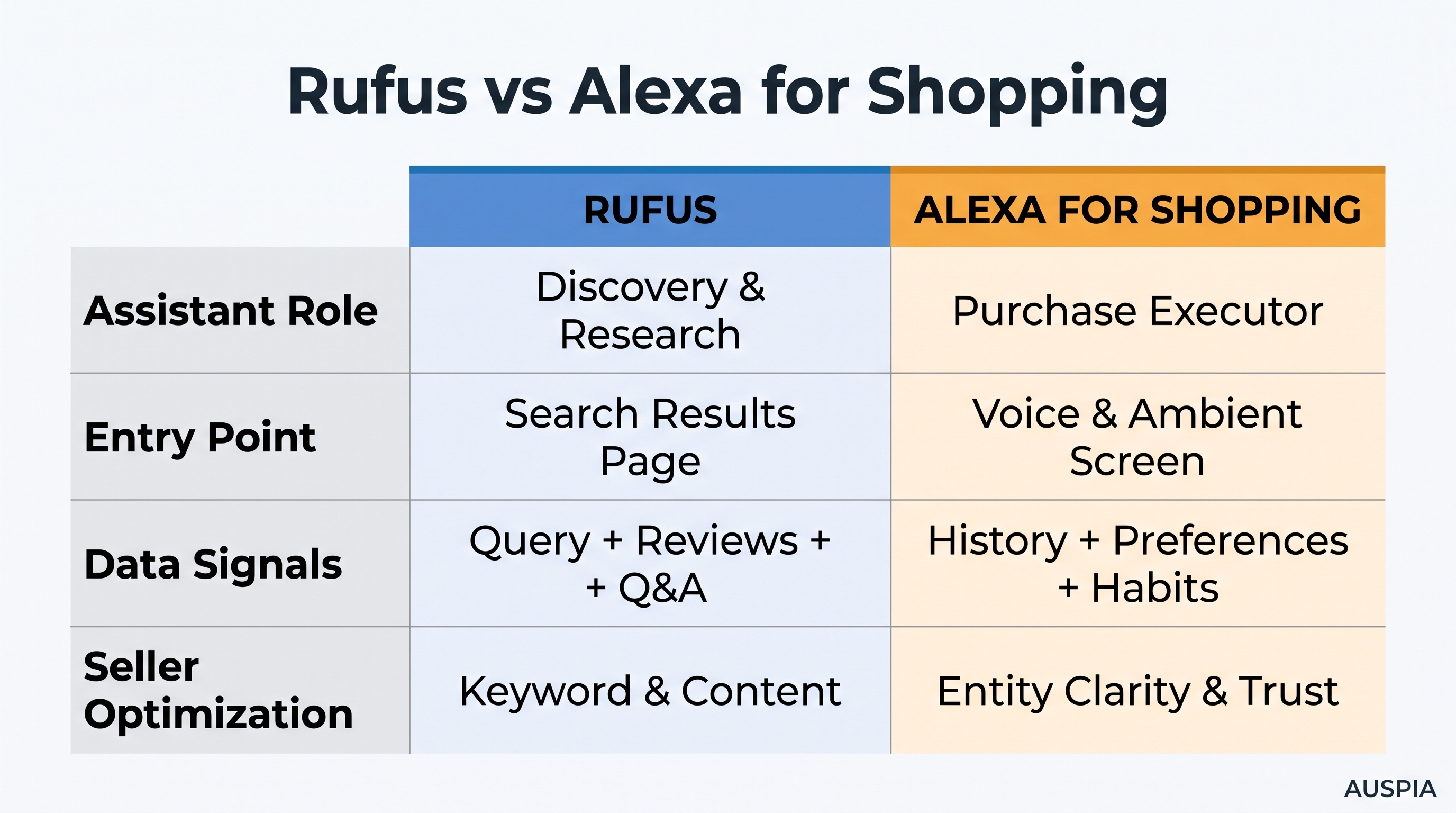
Rufus mostly helped with discovery and research. Alexa for Shopping pushes the assistant closer to comparison, memory, and purchase execution.
What changed: from chatbot to shopping agent
The old Rufus experience was useful, but it was still easy to ignore. It lived as a shopping assistant inside the Amazon app and website. Shoppers could ask it questions, summarize reviews, compare options, and get help understanding a product category.
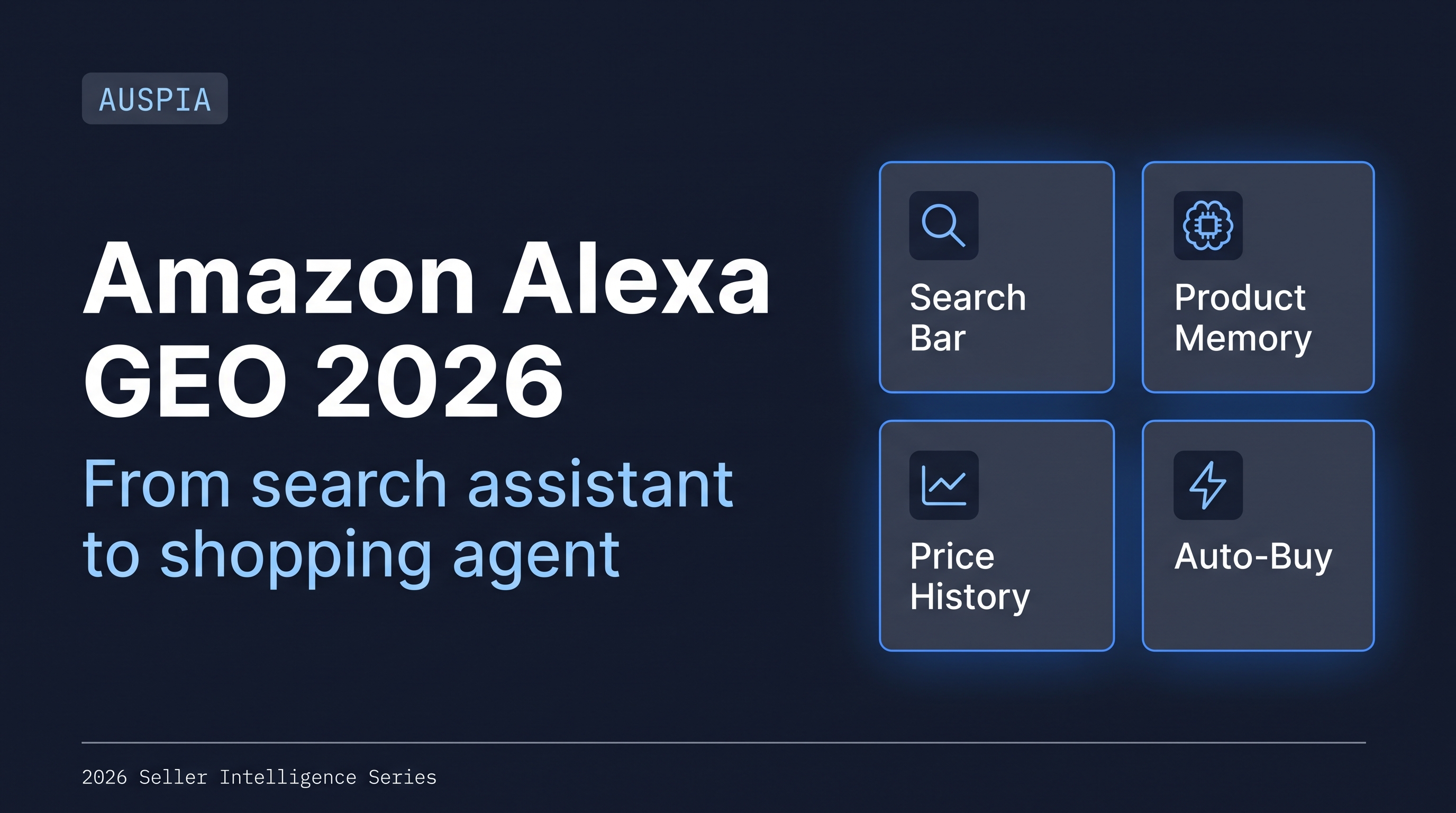
Alexa for Shopping changes the center of gravity. In May 2026, Amazon described Alexa for Shopping as the result of bringing together Rufus and Alexa+ on the Amazon Shopping app and website, positioning it as a personalized, agentic AI assistant. The assistant can answer questions in the main Amazon search bar, create shopping guides, generate product comparisons, show up to a year of price history, set price alerts, and support auto-buy actions at a target price.
That last part matters. Once the assistant can act on shopping intent, sellers are no longer optimizing only for a search result page. They are optimizing for an AI-mediated decision.
A simple way to read the shift:
Area | Rufus-style optimization | Alexa for Shopping optimization in 2026 |
|---|---|---|
Discovery | Match product keywords and category terms | Match use cases, buyer constraints, and natural-language prompts |
Comparison | Provide specs and review summaries | Make differences easy for AI to explain side by side |
Trust | Improve ratings and review count | Build review evidence around exact scenarios, objections, and outcomes |
Price | Win the visible price today | Avoid price patterns that look manipulative over a longer history |
Reorder | Wait for shoppers to search again | Earn repeat-purchase confidence and replenishment relevance |
Sources checked for this 2026 update
This analysis is based on Amazon's public material about Alexa for Shopping and Amazon's explainer on how to use Alexa for Shopping. The seller guidance is Auspia's interpretation of what those shopping-assistant features mean for Amazon GEO, listing clarity, price trust, and repeat-purchase visibility.
Seven differences sellers should actually care about
This article uses a practical seller lens: first explain what changed, then translate those changes into listing, pricing, and review actions for a global Amazon seller in 2026.
1. Rufus was research support. Alexa is closer to decision support.
Rufus helped answer questions like "Is this good for travel?" or "What do reviews say about battery life?" That is valuable, but the shopper still did most of the decision work.
Alexa for Shopping is designed to help with the next step: narrowing options, comparing tradeoffs, watching prices, building a cart, and in some cases automating a purchase task. For Amazon GEO, this means listings need decision-ready information, not just descriptive copy.
Bad listing language says: "Premium quality, great for daily use."
Better listing language says: "Designed for carry-on travel, fits under most airline seats, works best for 2-3 day trips, and includes a separate wet pocket for gym clothes or swimwear."
The second version gives the assistant something useful to match against a prompt.
2. The entry point is moving into the search habit.
Rufus could feel like an extra feature. Alexa for Shopping is more visible because Amazon has pushed AI assistance into the main shopping flow, including the search bar and shopping surfaces.
This changes query behavior. A shopper may not type "stainless steel water bottle 32 oz" anymore. They may ask, "Which water bottle stays cold all day and fits a car cup holder?" The assistant can then translate that into product candidates.
Sellers should still care about keywords. But the listing also needs sentences that map to jobs, settings, constraints, and compatibility.
3. Product data is not enough; context now matters.
Rufus already used product pages, reviews, Q&A, and other shopping data. Alexa for Shopping adds a stronger personalization layer because it can connect product knowledge with shopping history, preferences, and assistant context.
That does not mean sellers can control a shopper's history. They cannot. What sellers can control is whether the product entity is clean.
Clean product entity signals include:
- one consistent brand name across title, store, packaging, and A+ content
- precise model names and variant names
- dimensions, material, capacity, compatibility, and warranty stated the same way across the listing
- images and bullets that confirm the same use cases
- review patterns that mention the same practical benefits the listing claims
If the assistant sees a messy product entity, it has less reason to trust the recommendation.
4. Comparison will punish vague differentiation.
Alexa for Shopping can generate product comparisons. That sounds helpful until your product is the one with no clear reason to exist.
A vague listing can survive on a search page if the image is good and the price is low. In an AI comparison, vague products become filler. The assistant needs to explain why one item is better for a specific buyer.
For example, "soft fabric" is weak. "Brushed cotton that feels warmer than standard percale, better for cold sleepers" is stronger. "Portable" is weak. "Folds to 11 inches and fits in a laptop backpack side pocket" is stronger.
This is not creative copywriting. It is retrieval-friendly product truth.
5. Price history makes discount theater easier to expose.
Amazon says Alexa for Shopping can show up to a full year of price history. That makes a common seller habit riskier: raising prices before a promotion, then calling the later price a deal.
The assistant does not need to accuse anyone of anything. It only needs to show the pattern or tell the shopper that the current price is not unusual. That can weaken urgency fast.
For Amazon Alexa GEO, price trust becomes part of visibility. Stable pricing, real discounts, and consistent availability are easier for an assistant to recommend than a product with chaotic price swings and stock gaps.
6. Replenishment changes where demand is captured.
Alexa for Shopping can help shoppers add previously ordered products, build carts from conversational instructions, and manage recurring purchase needs. In practical terms, some demand may skip fresh keyword discovery.
That is a problem for sellers who rely only on first-time acquisition. If a product is meant for repeat purchase, the listing and product experience need to support reorder behavior.
A few examples:
- consumables should make quantity, usage rate, and refill timing obvious
- bundles should avoid confusing variant changes that break repeat buying
- packaging should make the product easy to recognize in order history
- Subscribe & Save eligibility, where relevant, should be treated as a GEO signal, not only a conversion tactic
7. Ads will likely become more conversational, but trust still decides the answer.
Amazon's advertising business will naturally look for ways to participate in AI shopping surfaces. Sellers should expect sponsored placements, conversational prompts, or AI-native ad formats to keep evolving.
But ads cannot fix unclear product truth forever. If the assistant is asked to recommend the most reliable option for a narrow use case, it will need evidence. Listing clarity, reviews, price history, fulfillment, return experience, and brand trust all become part of the commercial answer.
The new Amazon GEO model: optimize for prompts, proof, and purchase tasks
Traditional Amazon SEO asks, "Can this product rank for the keyword?"
Amazon GEO asks a different question: "Can an AI shopping assistant confidently recommend this product for a specific buyer task?"
That question has three layers.
Layer | What Alexa needs to understand | What the seller should improve |
|---|---|---|
Prompt fit | Who is asking, what they need, and what constraints matter | Use-case bullets, buyer scenarios, compatibility notes |
Proof | Whether the listing's claims are supported | Review themes, Q&A coverage, images, comparison facts |
Purchase confidence | Whether the assistant can safely move the shopper forward | Price stability, availability, delivery promise, reorder logic |
This is why Amazon GEO is not a trick. It is a cleaner operating model for listings. The assistant needs product facts that are easy to retrieve, compare, and defend.
Five listing upgrades to make before competitors catch up
Build a prompt map before rewriting the listing
Do not start by adding more keywords. Start with the questions a shopper would ask an assistant.
For a standing desk converter, the prompt map might include:
- "best desk converter for a small apartment"
- "standing desk converter that fits two monitors"
- "desk riser for someone under 5'4"
- "quiet adjustable desk converter for video calls"
- "budget alternative to a full standing desk"
Each prompt points to a different product fact. If those facts are missing, Alexa has to guess or choose a competitor that is easier to explain.
Rewrite bullets around buyer constraints
Most Amazon bullets are stuffed with features. Alexa needs constraints.
Useful constraints include size, fit, compatibility, setup time, care instructions, safety limits, ideal user, non-ideal user, and common objections.
A seller of pet stairs should not only say "high-density foam." It should say the stair height, weight guidance, sofa or bed height range, cover washability, and whether it suits older dogs with joint sensitivity. That gives the assistant more paths to a confident recommendation.
Make review evidence easier to accumulate
You cannot script customer reviews. You can improve the odds that real customers mention the use cases that matter.
Post-purchase instructions, packaging inserts, support flows, and product onboarding can ask customers to describe how they use the product without pushing for positive language. Over time, authentic reviews that mention "fits my Subaru cup holder" or "worked for a 10-hour shift" are much more useful than generic praise.
Treat price trust as an AI visibility factor
If Alexa can show a year of price history, then pricing behavior becomes part of the story. Sellers should keep promotion calendars cleaner, avoid fake urgency, and watch whether the current offer would still look credible when compared with the last 12 months.
That does not mean never discount. It means discounts need to make sense.
Strengthen product entity facts
Entity clarity is boring until it starts deciding recommendations. A clean entity helps AI systems connect the product to the right category, use case, and brand.
Make sure the following are consistent:
- brand name
- model name
- product type
- variant logic
- materials and dimensions
- compatibility claims
- warranty or support claims
- category language used in title, bullets, A+ content, and external brand pages
If you need a broader view of how AI systems read brand and product entities, Auspia's GEO resources are a useful next stop.
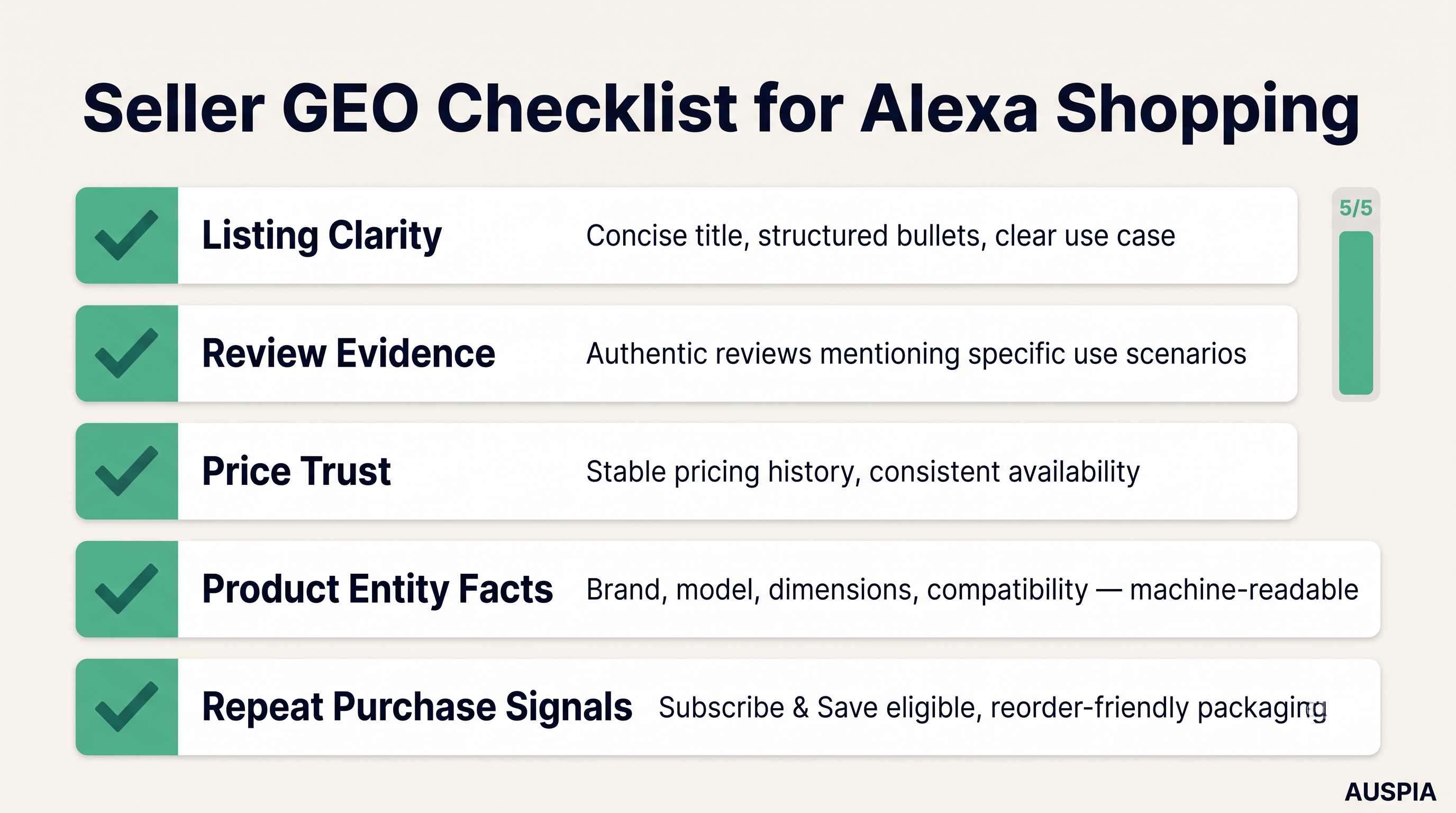
For Alexa-era Amazon GEO, listing clarity, review evidence, price trust, entity facts, and repeat-purchase signals are the five checks sellers should run first.
A 2026 Amazon Alexa GEO checklist
Use this as a quick audit before rewriting a listing.
Check | Pass condition | Common failure |
|---|---|---|
Use case clarity | The listing names who the product is for and when to use it | Generic "daily use" copy |
Comparison readiness | Differences versus alternatives are specific and factual | Claims like "better quality" without proof |
Review support | Reviews mention real scenarios and objections | Reviews are positive but vague |
Price trust | Promotions look credible against longer price history | Repeated artificial discount patterns |
Entity consistency | Brand, model, specs, and variants match everywhere | Conflicting names or unclear variant logic |
Reorder readiness | Repeat-purchase products are easy to recognize and replenish | Confusing pack sizes or changing bundles |
Prompt coverage | Listing answers natural-language buyer questions | Keyword list exists, but questions are unanswered |
What most sellers will get wrong
The first mistake is treating Alexa for Shopping as Rufus with a new label. Some of the underlying shopping-assistant logic may carry over, but the product direction is different. The assistant is being pulled deeper into the purchase flow.
The second mistake is over-optimizing for AI summaries while ignoring the product. If reviews complain about durability, no amount of prompt-friendly copy will make the recommendation safer.
The third mistake is assuming Amazon GEO means writing for robots. It is the opposite. The best AI-readable listing is usually the one a hurried human can understand in 20 seconds.
Auspia view
The sellers who benefit from Alexa for Shopping will not be the ones who add "Alexa optimized" to a checklist and move on. They will be the ones who make the product easier to understand, easier to compare, easier to trust, and easier to reorder.
That is the real Amazon GEO shift in 2026. Search visibility is still important, but the assistant layer is becoming a second gate. To pass it, sellers need better product facts, cleaner evidence, and less vague copy.
Rufus helped shoppers ask better questions. Alexa for Shopping may decide which answers deserve to become purchases.
FAQ
Did Amazon fully replace Rufus with Alexa for Shopping?
Amazon has brought Rufus and Alexa+ together under Alexa for Shopping in the Amazon Shopping app and website. In seller terms, it is safest to plan around Alexa for Shopping as the forward-facing AI shopping layer in 2026.
Is Amazon Alexa GEO the same as Amazon SEO?
No. Amazon SEO focuses on keyword ranking, relevance, conversion, and marketplace signals. Amazon Alexa GEO focuses on whether an AI assistant can understand, compare, and recommend a product for natural-language shopping tasks. The two overlap, but they are not identical.
What is the fastest Amazon GEO improvement for sellers?
Rewrite the title, bullets, A+ content, and Q&A around real buyer prompts. Add specific use cases, constraints, compatibility facts, and comparison points. Then check whether reviews and images support those claims.
Does price history affect Alexa recommendations?
Amazon says Alexa for Shopping can show up to a full year of price history and support price alerts. That means pricing behavior can affect shopper trust, even if Amazon does not describe it as a ranking factor.
Should sellers optimize for voice shopping?
Yes, but not by writing awkward voice keywords. Optimize for natural questions, repeat purchase behavior, clear product names, and easy cart-building instructions. Voice is one interface; the deeper change is assistant-led shopping.
Author: Ryan Chen, Senior Amazon Operations Expert with 10 Years in Marketplace Growth at Auspia. Ryan writes about Amazon GEO, marketplace search behavior, AI-assisted product discovery, and practical operating playbooks for sellers.