The short answer for 2026
Yes, Amazon listings can be rewritten in 2026. In many categories, they probably should be. The old fear was simple: touch the title, hero image, or category and A9 may re-evaluate the ASIN. That risk still exists, especially for products with stable rankings and sales history.
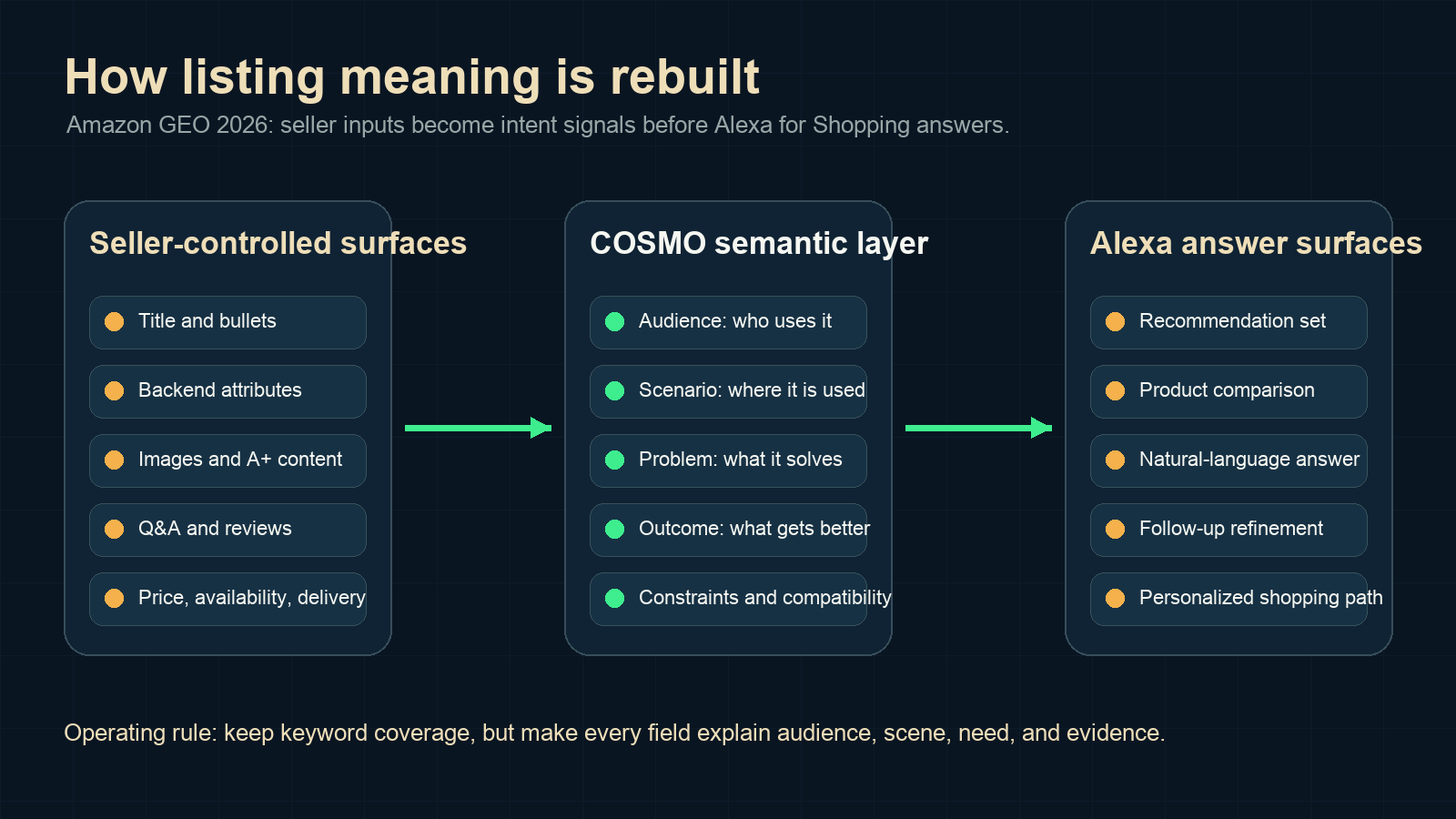
But the bigger risk has changed. Amazon's shopping stack now has to understand what a product means, who it is for, and which natural-language shopping questions it can answer. Rufus, renamed Alexa for Shopping in the U.S. on May 13, 2026, is the buyer-facing assistant. COSMO is Amazon's research-backed commonsense knowledge system for connecting product data with shopper intent. A listing that only repeats keywords may index, but it may not give Amazon's AI enough context to recommend, compare, or explain the product.
The practical answer: do not "big bang" rewrite a healthy listing. Rewrite it in controlled layers. Keep the proven keyword base, then add clearer audience, scenario, need, outcome, compatibility, and proof signals across the title, bullets, attributes, images, A+ content, Q&A, and reviews.
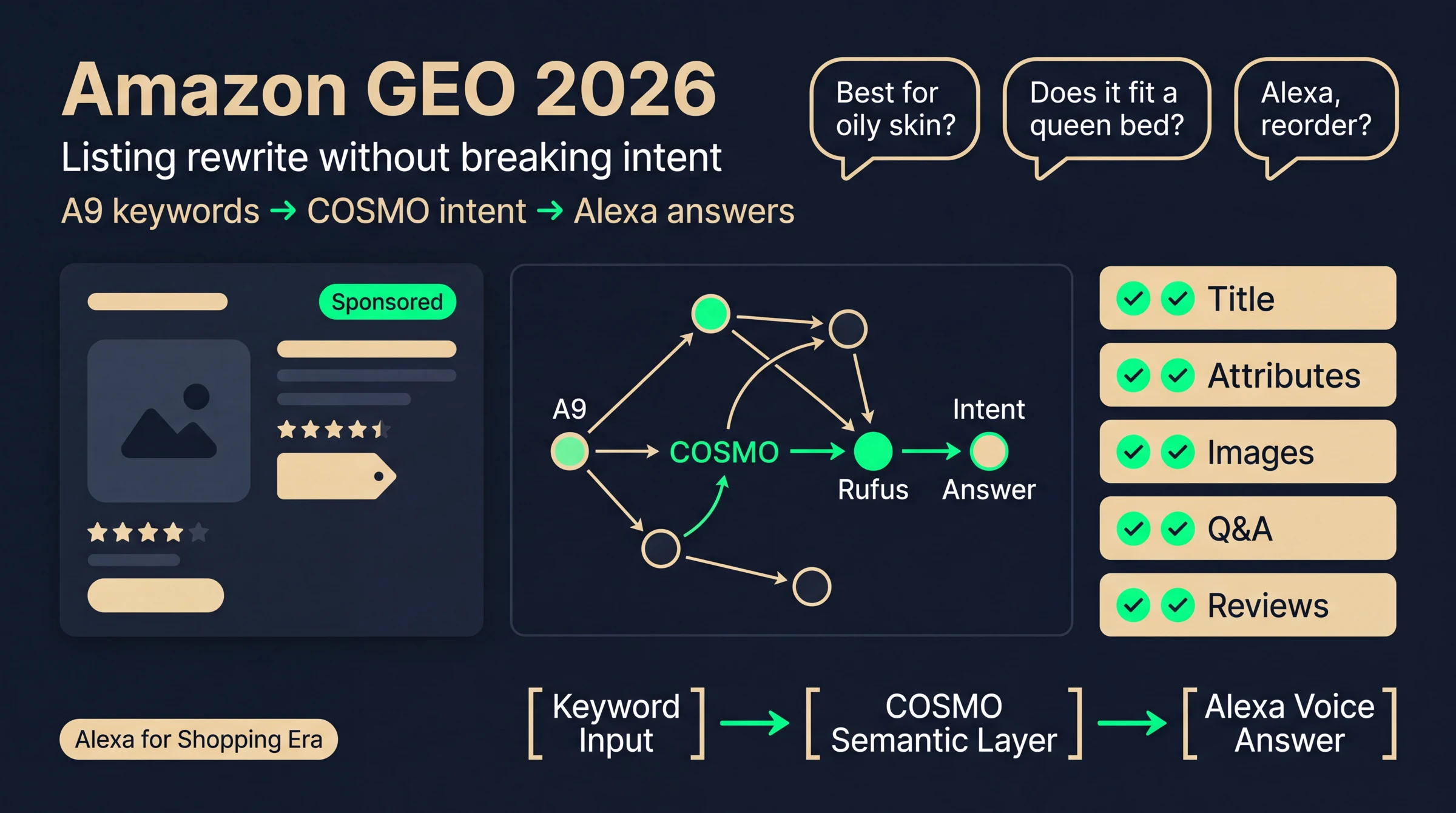
Caption: Amazon GEO in 2026 is less about replacing keywords and more about turning listing fields into intent signals.
What actually changed: from keyword matching to intent evidence
The older Amazon SEO habit was built around keyword coverage. Sellers tried to win the most important search terms in the title, push secondary phrases into bullets and backend search terms, and protect the ASIN from unnecessary changes once the link had weight.
That model is not gone. Amazon still needs clear product terms. A water bottle is still a water bottle. A collagen serum still needs to say what it is. If the listing cannot be indexed for the basic category language, no amount of AI-friendly copy will save it.
What changed is the second layer.
Amazon's official Rufus announcement described the assistant as trained on Amazon's catalog plus information from across the web so it can answer shopping questions, compare products, recommend options, and help discovery inside the Amazon shopping experience. Amazon Science's COSMO publication describes a system for mining user-centric commonsense knowledge from behavior and using knowledge graphs to close the gap between product attributes and how people think, behave, and shop.
For sellers, that points to a different kind of listing quality. Amazon does not only need words. It needs evidence about fit.
A keyword says: "stainless steel water bottle."
Intent evidence says: "fits a backpack side pocket, keeps drinks cold during a two-hour gym session, has a leak-resistant lid for commuting, and is easy for school-age kids to open."
Those details are not fluff. They tell an AI shopping assistant when the product belongs in an answer.
The wrong lesson sellers take from Rufus and COSMO
The mistake is thinking, "Amazon AI is smarter now, so keywords do not matter."
That is too neat. It is also dangerous.
A better operating principle is this: keywords still open the door; context tells Amazon which room the product belongs in.
If the listing loses its core noun phrases, it may lose indexation. If it keeps the nouns but fails to explain the audience, scenario, constraints, and proof, it may be weak in AI-assisted discovery. In 2026, strong listings need both.
Here is the shift in plain language:
Old listing habit | Better Amazon GEO habit in 2026 |
|---|---|
Repeat high-volume keywords | Keep core keywords, then attach them to shopper intent |
Describe product specs only | Explain who uses it, where, why, and under what constraints |
Treat images as conversion assets | Treat images as visual evidence for scenes and use cases |
Hide details in vague bullets | Put compatibility, materials, limits, and outcomes where AI can parse them |
Ignore Q&A unless customers ask | Use Q&A to answer legitimate edge-case buying questions |
Rewrite everything at once | Refresh in batches and measure indexing, conversion, and answer behavior |
A safer way to rewrite an Amazon listing
For an established ASIN, the rewrite should feel more like surgery than a makeover. Start with the fields that add meaning without destroying recognition.
First, preserve the product identity. The primary noun, brand-relevant descriptor, size, variant, and category language should not disappear. If the product already ranks for "ceramic nonstick frying pan," do not turn the title into a poetic lifestyle sentence about weeknight dinners.
Second, expand the intent layer. Add phrases that connect the product to real shopping situations: "for small apartment kitchens," "for oily skin routines," "for long-haul flights," "for toddler lunch boxes," "for queen-size platform beds." These are not random long-tail keywords. They are use-case anchors.
Third, complete structured attributes. This is one of the least glamorous parts of Amazon GEO, but it matters. Attributes, dimensions, materials, compatibility fields, care instructions, safety details, and variant data give systems cleaner labels than prose alone. If the listing copy says one thing and the attributes say nothing, the AI has less to work with.
Fourth, rebuild the images around recognition. A clean main image still has to sell the product quickly. Secondary images should show scale, use context, comparison, ingredients or materials, what's included, and common objections. Do not make every image a lifestyle mood board. Make them evidence.
Fifth, use A+ content to answer the buyer's next question. Many A+ modules are attractive but thin. In an AI shopping environment, the better modules explain how to choose between variants, what the product is not for, what problem it solves, and how it compares with adjacent options.
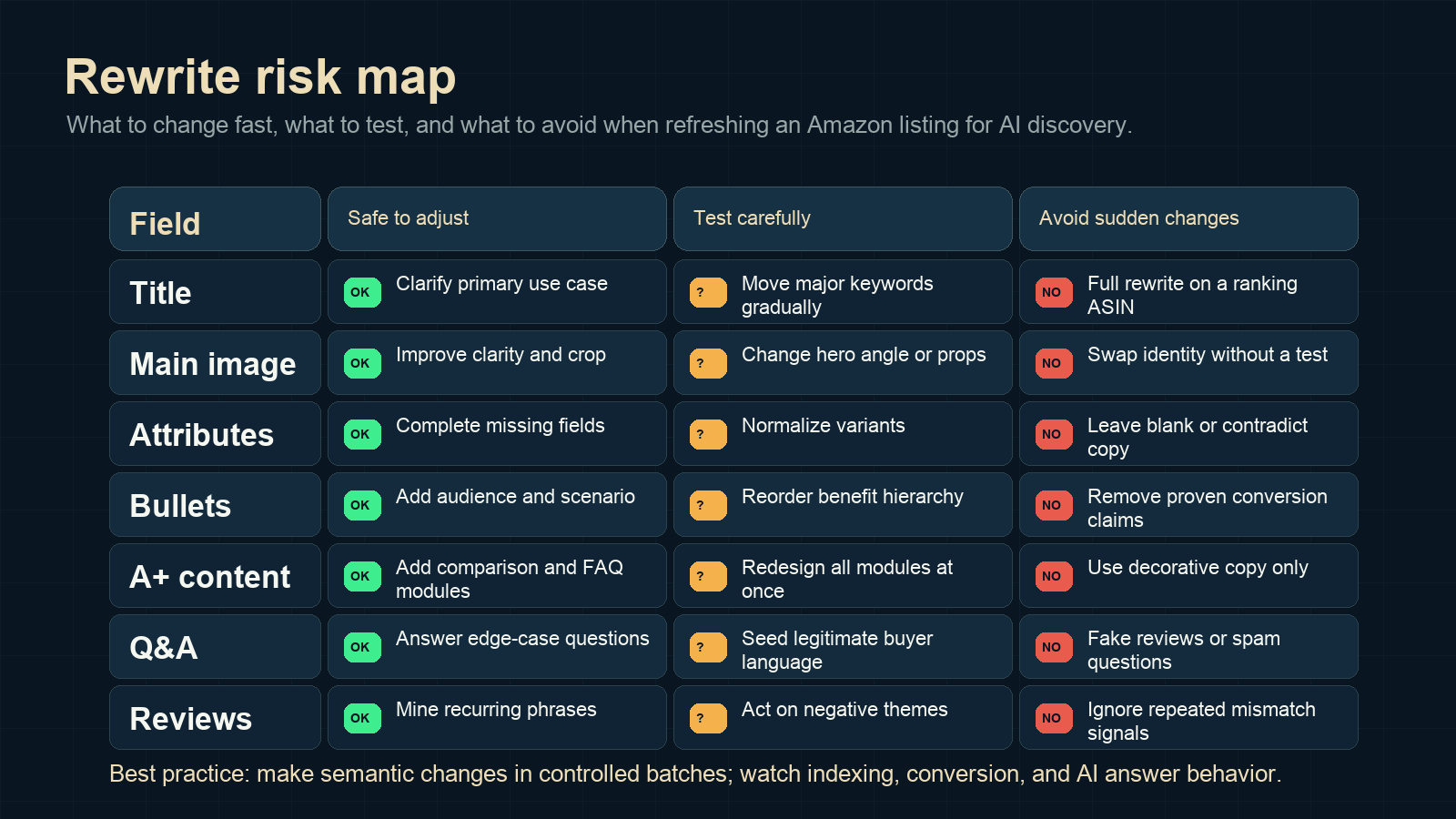
Caption: Rewrite the semantic layer first. Be more careful with identity-level fields on a ranking ASIN.
Field-by-field rewrite guidance
Listing field | What to improve | What to avoid |
|---|---|---|
Title | Keep the core noun phrase, add one clear use-case or differentiator if space allows | Replacing a proven indexed title with a broad lifestyle headline |
Bullets | Map benefits to audience, scenario, outcome, and constraint | Repeating the same keyword in five different ways |
Backend attributes | Fill every accurate field with clean, consistent data | Leaving fields blank because they are not visible to shoppers |
Main image | Improve clarity, cropping, product recognition, and compliant presentation | Changing the product's visual identity without a test |
Secondary images | Show use case, scale, comparison, contents, and proof | Decorative lifestyle shots that do not teach anything |
A+ content | Add comparison modules, care instructions, FAQs, and variant logic | Brand storytelling with no product decision help |
Q&A | Answer legitimate edge cases in natural buyer language | Fake questions, spam, or claims that contradict the listing |
Reviews | Mine repeated phrases and objections, then fix copy or product gaps | Treating review language as separate from discoverability |
The Q&A and review sections deserve more attention than most teams give them. They are where buyers use their own words. If buyers repeatedly mention "easy to clean," "fits under airline seat," or "too small for large dogs," those phrases tell you how the market understands the product. You cannot control reviews, and you should not manipulate them. But you can learn from them and make the listing clearer.
A concrete example: the water bottle rewrite
A weak A9-era title might look like this:
"Stainless Steel Water Bottle, Insulated Bottle, Leakproof Water Bottle, Sports Bottle, Travel Bottle, 24 oz"
It is not terrible. It covers nouns. But it does not say much about the buyer's situation.
A more useful 2026 version might be:
"24 oz Insulated Stainless Steel Water Bottle for Gym, School, and Commuting, Leak-Resistant Lid, Fits Most Backpack Pockets"
That is still keyword-aware. The difference is that it gives Amazon and the shopper more context: capacity, material, use cases, leak resistance, and fit. The bullets can then separate the use cases instead of stuffing the same phrase again:
- For workouts: keeps cold drinks ready through a gym session or outdoor run.
- For school and commuting: slim shape fits most backpack side pockets and car cup holders.
- For daily cleaning: wide-mouth opening makes it easier to add ice and rinse after use.
- For buyer confidence: state the exact capacity, lid type, material, and care instructions.
This is the Amazon GEO mindset. The listing is still optimized, but it reads like an answer to buyer questions rather than a pile of indexed phrases.
What to measure after a rewrite
A listing refresh should have a measurement window. For many teams, 7 to 14 days is a reasonable first checkpoint, but high-volume ASINs and seasonal categories may need a different cadence.
Watch four signals:
- Indexing: Are the priority terms and use-case phrases still discoverable?
- Conversion: Did sessions, unit session percentage, and sales move in the expected direction?
- Query mix: Are you gaining exposure for more specific use-case queries?
- AI answer behavior: When you ask Alexa for Shopping-style questions, does your product appear for the right reasons?
The last check is new for many Amazon teams. Ask questions the way shoppers do: "What is a good water bottle for a middle school backpack?" "Which serum is better for oily skin?" "What storage bin fits under a dorm bed?" If the assistant hedges, recommends competitors, or misses an obvious use case, the listing may have a context gap.
This is also where broader AI Search Visibility thinking helps. The goal is not only to rank for a term. The goal is to be understood, selected, and explained accurately.
When not to rewrite aggressively
Some listings should not be touched quickly.
Be cautious when the ASIN has stable top positions for a narrow set of money terms, the product has recent review volatility, the category is highly seasonal, or a large PPC push is already running. Do not stack too many variables. If the title, hero image, price, coupon, and bullet structure all change in the same week, you will not know what caused the result.
A safer sequence is:
- Fill missing attributes and fix contradictions.
- Improve secondary images and A+ modules.
- Update bullets for clearer audience and scenario language.
- Test title refinements only after the lower-risk surfaces are stable.
- Review query, conversion, and AI-answer behavior before the next batch.
That order is not glamorous. It is easier to manage.
Auspia view: Amazon GEO is a product understanding problem
Amazon GEO is not just "Rufus optimization" or "Alexa keyword research." Those phrases are useful shortcuts, but they can lead teams into another round of tool-chasing.
The real work is product understanding.
Can Amazon identify the product category without confusion? Can it connect the product to real shopper situations? Can it see enough proof in attributes, images, A+ content, Q&A, and reviews to answer a buyer's question? Can it avoid recommending the product when it is a poor fit?
That last question matters. GEO is not only about being recommended more often. It is about being recommended in the right context, because bad-fit recommendations create returns, negative reviews, and weaker long-term signals.
For 2026, the best Amazon listings will not read like old keyword documents. They will read like structured answers.
FAQ
Is Amazon Rufus the same as Alexa for Shopping in 2026?
Amazon says Rufus was renamed Alexa for Shopping in the U.S. on May 13, 2026. Many sellers and software tools still use "Rufus" because the name became common shorthand for Amazon's AI shopping assistant. For optimization work, treat them as the same buyer-facing AI shopping experience unless Amazon separates the products again.
Does COSMO replace A9?
No public source says sellers should think of COSMO as a simple replacement for A9. A better way to think about it is that Amazon search and shopping discovery now include both keyword/indexing logic and semantic intent understanding. Sellers still need clear product terms, but they also need richer context.
Should I remove repeated keywords from my Amazon title?
Remove awkward repetition only if the title keeps the core product noun and the terms that matter for indexing. A cleaner title usually works better for shoppers and AI interpretation, but stripping too much category language can hurt discovery.
Can images help Amazon GEO?
Yes, but not because they look nice. Images help when they show scale, scenario, compatibility, included parts, materials, comparison points, and use outcomes. Those details help shoppers decide and give AI systems more product evidence.
How often should Amazon sellers refresh listings for AI discovery?
Refresh when the listing has clear context gaps, outdated claims, missing attributes, weak secondary images, confusing Q&A, or review language that reveals unanswered buyer questions. Do not rewrite a healthy listing every week. Use controlled batches and measure the effect.
Author: Ryan Chen, Senior Amazon Operations Expert with 10 Years in Marketplace Growth at Auspia. Ryan writes about Amazon GEO, marketplace search behavior, AI-assisted product discovery, and practical listing optimization for sellers.