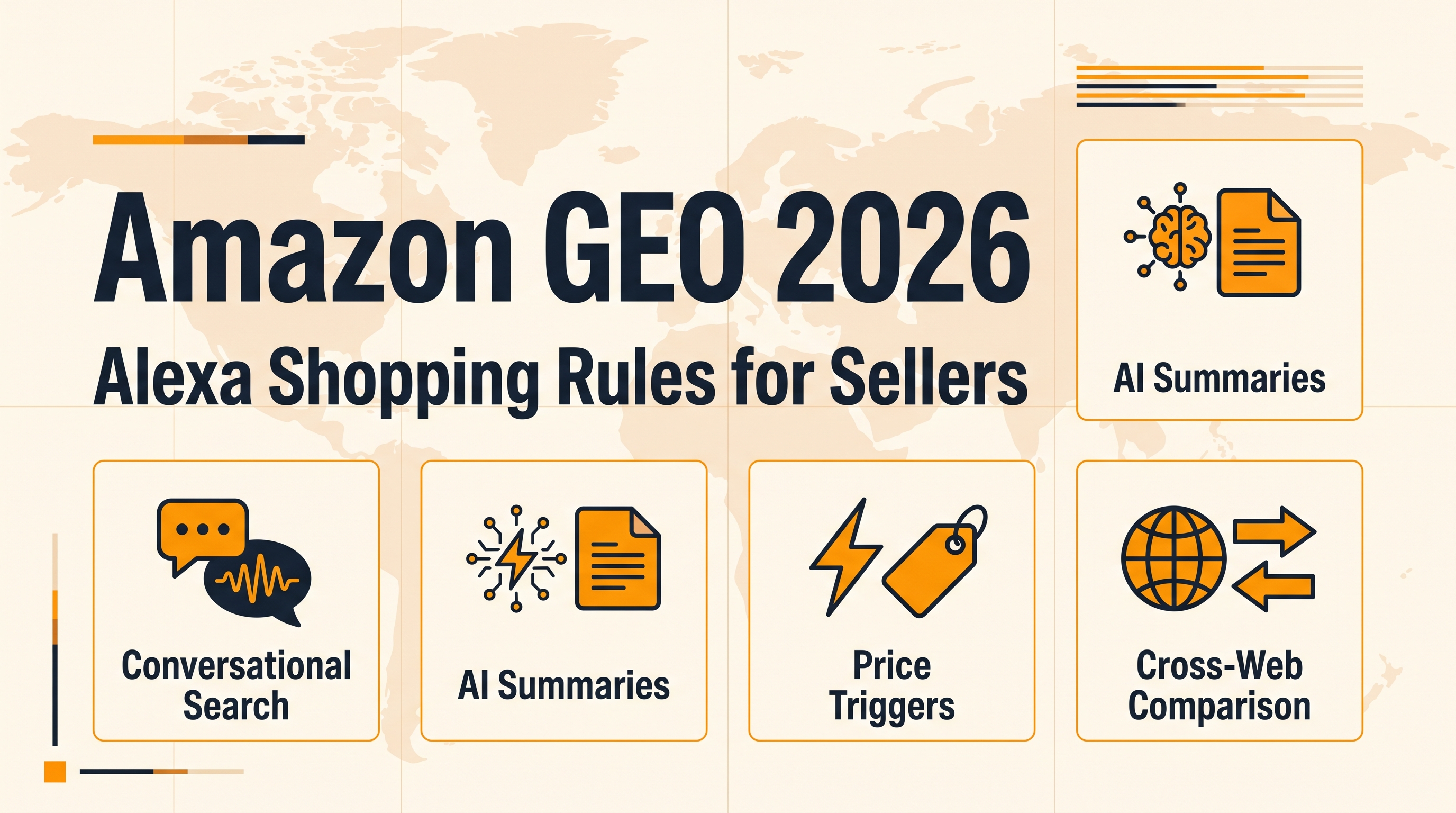
The 2026 seller takeaway
Amazon GEO in 2026 is no longer just about ranking for a product keyword. It is about making a listing easy for Amazon's shopping AI to understand, summarize, compare, and recommend inside a conversation. If Alexa for Shopping becomes the main assistant layer across search, product pages, Echo devices, and the Amazon app, sellers need to treat every product page as both a human sales page and an AI-readable evidence file.
This article is a practical Auspia-style rewrite of the seller lesson: do not panic about the Rufus-to-Alexa transition, but do change what you optimize. The strongest listings will be specific about use cases, price logic, inventory reliability, review evidence, and comparison points.
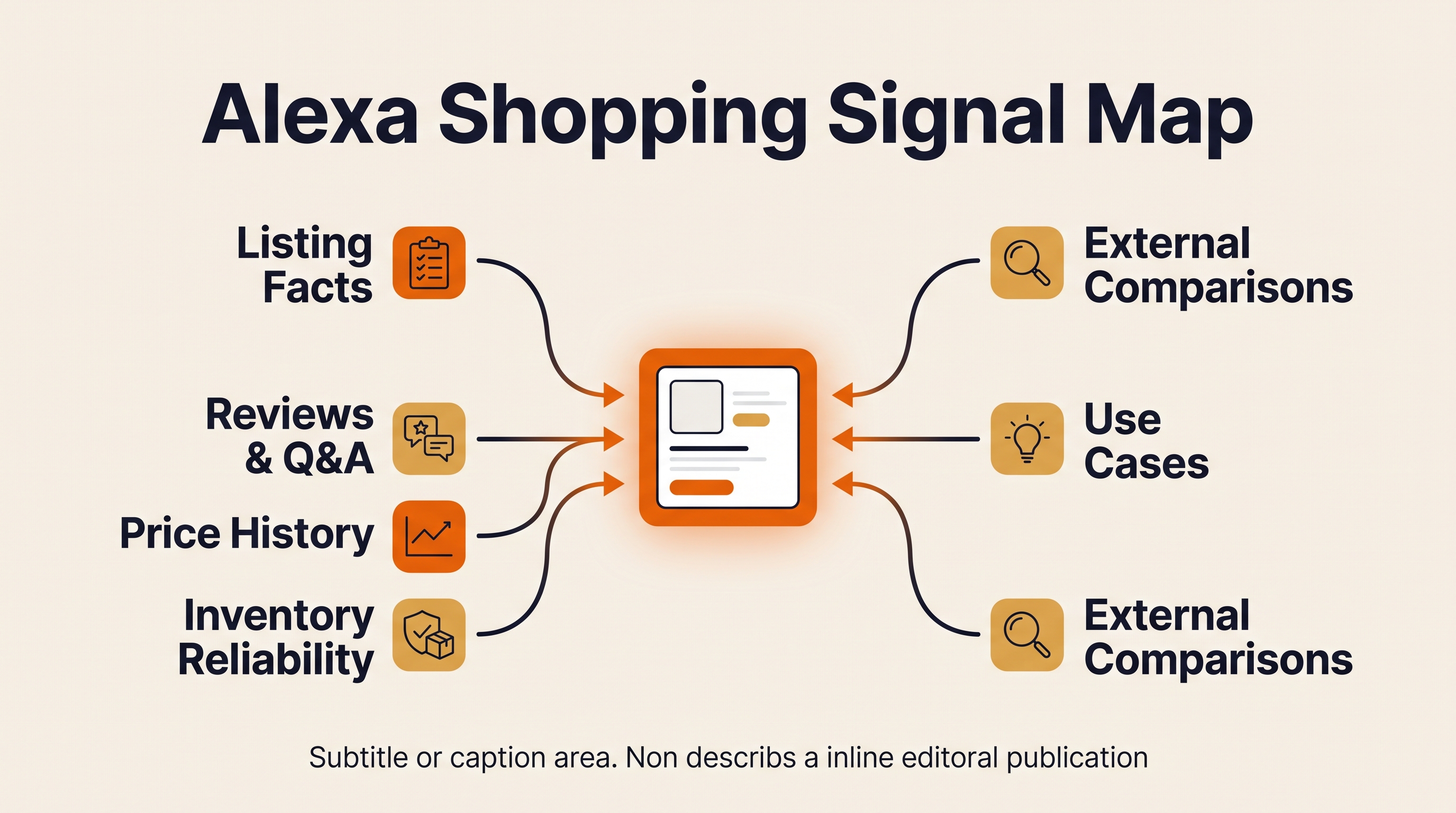
The new Amazon GEO surface is not one signal. It is a signal map that connects listing content, buyer context, price data, reviews, Q&A, and external comparison paths.
What changed from Rufus to Alexa for Shopping
Amazon's AI shopping experience has been moving from a single assistant feature toward a broader shopping layer. In seller terms, the important shift is not the brand name on the assistant. The important shift is that product discovery is becoming conversational, personalized, and action-oriented.
A keyword search asks, "Which listing ranks for coffee maker?" A shopping assistant asks, "Which product is likely to satisfy this buyer's exact context?" That context may include budget, space, household type, prior browsing, review concerns, replenishment timing, and price sensitivity.
For Amazon sellers, this means the old optimization stack is incomplete:
Old listing logic | 2026 Amazon GEO logic |
|---|---|
Insert the main keyword in title and bullets | Answer buyer scenarios in extractable language |
Win search rank for a phrase | Become the assistant's best-fit recommendation for a need |
Treat price as a static offer | Treat price history and promotion timing as recommendation signals |
Use Q&A only for support | Use Q&A as structured evidence for AI summaries |
Watch only Amazon competitors | Watch Amazon and broader web comparison pressure |
The practical rule is simple: a listing that is hard for a person to scan will also be hard for an AI assistant to summarize accurately.
Six new Amazon GEO rules for sellers in 2026
1. Search is becoming a conversation, not a keyword box
Buyers no longer need to reduce their need to a two-word query. They can ask for "a quiet air purifier for a nursery under $150," "a travel bottle that does not leak in a backpack," or "a beginner espresso setup for a small apartment."
That changes the job of listing copy. Titles and bullets still need core terms, but they also need clear scenario language:
- who the product is for;
- where it is used;
- what constraint it solves;
- what budget, size, compatibility, or skill level it fits;
- what it should not be used for when the limitation matters.
Auspia recommendation: rewrite the first two bullets as answer blocks, not adjective stacks. Instead of "premium, durable, versatile design," use specific claims such as "fits under 14-inch cabinets," "runs below 45 dB on sleep mode," or "includes adapters for USB-C and Lightning devices."
2. AI summaries will compress your listing into a few claims
Shopping assistants do not repeat a listing word for word. They extract, reconcile, and summarize. If the title says one thing, A+ content says another, and reviews describe a third reality, the AI summary may highlight the wrong point or expose a contradiction.
Sellers should audit the listing as a single source of truth:
Page area | What Alexa-style summaries may extract | Seller audit question |
|---|---|---|
Title | product type, primary use, key spec | Is the main claim specific and current? |
Bullets | benefits, constraints, proof points | Are the bullets measurable or vague? |
Images/A+ | use cases, dimensions, comparisons | Do visuals support the same promise as the copy? |
Q&A | objections and edge cases | Are important questions answered clearly? |
Reviews | real buyer language and recurring issues | Are recent reviews aligned with the intended positioning? |
The seller risk is not only lower visibility. It is misframing. If your listing leaves gaps, the assistant may fill them from reviews, competitor pages, or category assumptions.
3. Price becomes a trigger, not just a label
When a shopping assistant can monitor price history, remember thresholds, and help buyers act when a product reaches a target, pricing becomes part of the recommendation environment. A one-day coupon, an erratic discount pattern, or a sudden spike can all influence buyer trust and assistant behavior.
For sellers, 2026 Amazon GEO requires a more disciplined pricing calendar:
- define a stable reference price;
- use coupons and deals with a predictable reason;
- avoid chaotic repricing that makes the product look unstable;
- map discount timing to inventory and margin reality;
- monitor whether price changes affect conversion, review velocity, and assistant-style recommendations.
The goal is not to be the cheapest product. The goal is to be the clearest value for a buyer's stated constraint.
4. Cross-device memory makes use-case specificity more valuable
Alexa-style shopping can connect moments across devices: a buyer may ask a voice question at home, browse on mobile later, and complete the purchase on desktop. This makes generic copy weaker because the assistant is matching products to a living context, not only to a session query.
Sellers should add use-case language that can be matched to real buyer situations:
- "for dorm rooms";
- "for renters who cannot drill";
- "for new parents setting up a night feeding station";
- "for small kitchens with limited counter space";
- "for monthly replenishment";
- "for beginners who need tool-free setup."
This is not keyword stuffing. It is context coverage. The best listing gives the assistant enough clean facts to say, "This product fits that situation."
5. Competition may extend beyond Amazon's own shelf
AI shopping assistants are increasingly designed to compare products, evaluate alternatives, and route buyers to the path that best satisfies the task. That means sellers should assume the buyer's comparison set is wider than one Amazon results page.
A 2026 Amazon GEO audit should include:
- Amazon category competitors;
- direct-to-consumer sites selling similar products;
- marketplace price ranges;
- review themes on competing pages;
- external product specs that may be easier to parse than yours;
- whether your Amazon listing has enough evidence to win the comparison.
If a competitor's page explains compatibility, dimensions, warranty, and use cases more clearly than yours, the assistant has better material to work with, even if your product is strong.
6. AI shopping access will expand the audience quickly
The more accessible AI shopping becomes, the faster seller exposure shifts from typed queries to assisted decisions. This matters most for products with high information density: electronics, appliances, beauty, supplements, pet products, baby gear, tools, furniture, and replenishable household goods.
These categories invite questions. When buyers ask more questions, the assistant has more influence over which products enter the consideration set.
Sellers should prioritize optimization in this order:
- high-margin products where better matching can lift profit;
- products with complex specs or compatibility issues;
- products with strong reviews but weak listing clarity;
- products where Q&A already shows repeated buyer confusion;
- replenishable SKUs where subscriptions or repeat purchase behavior matters.
The Amazon GEO audit checklist
Use this checklist before rewriting a listing for Alexa-era discovery.
Check | Pass condition | Why it matters for Amazon GEO |
|---|---|---|
Scenario coverage | The listing names 3-5 realistic buyer situations | Helps conversational matching |
Fact consistency | Title, bullets, A+, images, Q&A, and reviews do not conflict | Reduces summary risk |
Review evidence | Recent reviews support the main claims | Gives the assistant validation signals |
Q&A structure | Common objections have direct, short answers | Improves answer extraction |
Price discipline | Promotions follow a clear cadence | Supports trust and threshold-based buying |
Inventory readiness | Stock can absorb demand spikes | Prevents lost visibility after recommendation |
Comparison clarity | Dimensions, compatibility, warranty, and limitations are visible | Helps the product survive broader comparison |
Auspia teams can also run category and listing checks through AI search and GEO tools to see whether product pages are readable, extractable, and likely to support assistant-generated answers. For a broader site-level workflow, start with the AI Search Visibility Checker.
A simple before-and-after listing rewrite
Here is the kind of change sellers should make.
Weak bullet:
Premium coffee maker with durable design, easy operation, and great taste for home and office use.
Stronger Amazon GEO bullet:
Compact 5-cup coffee maker for apartments, dorm rooms, and small office counters; one-button brewing, reusable filter, 25-minute keep-warm plate, and a water window for beginners who want a simple morning setup.
The stronger version gives an AI assistant more retrieval hooks: capacity, audience, setting, ease level, feature details, and use case. It also gives the buyer a clearer reason to trust the match.
What sellers should do this week
Do not rewrite every SKU at once. Start with a focused 2026 Amazon GEO sprint:
- Pick 10 listings where AI-assisted comparison is likely to matter.
- Export titles, bullets, A+ copy, Q&A, recent review themes, price history, and inventory status.
- Write five buyer questions for each listing, using natural language rather than keywords.
- Check whether the listing answers those questions without forcing the buyer to infer.
- Rewrite the top two bullets and Q&A answers first.
- Track conversion, review themes, return reasons, and visibility changes after the update.
The best early win is usually not a full creative overhaul. It is making the product page easier to read, summarize, and recommend.
FAQ
Is Amazon GEO replacing Amazon SEO?
No. Amazon SEO still matters because keywords, relevance, conversion, pricing, availability, and reviews remain important. Amazon GEO adds another layer: whether AI shopping systems can understand the listing and match it to conversational buyer intent.
Should sellers still optimize for keywords?
Yes, but keywords should not be the whole strategy. Use keywords to define relevance, then use scenarios, specs, Q&A, and review-backed claims to help AI assistants explain why the product fits a buyer's need.
What is the biggest Alexa shopping risk for sellers?
The biggest risk is unclear or inconsistent product information. If the assistant summarizes your listing from messy inputs, it may understate the product's strength, surface review complaints, or recommend a clearer competitor.
Which products should be optimized first?
Start with products that buyers research before purchasing: higher-priced items, products with compatibility questions, replenishable goods, products with many reviews, and categories where use case matters more than a simple keyword.
How often should sellers update Amazon GEO content in 2026?
Review priority listings monthly, and update faster when price strategy, inventory, review themes, or product specs change. AI-readable content decays when the facts on the page stop matching the buyer experience.
Author: Ryan Chen, Senior Amazon Operations Expert with 10 Years in Marketplace Growth at Auspia. Ryan writes about Amazon GEO, AI-assisted product discovery, marketplace search behavior, and practical listing optimization for sellers.