
Seller takeaway for 2026
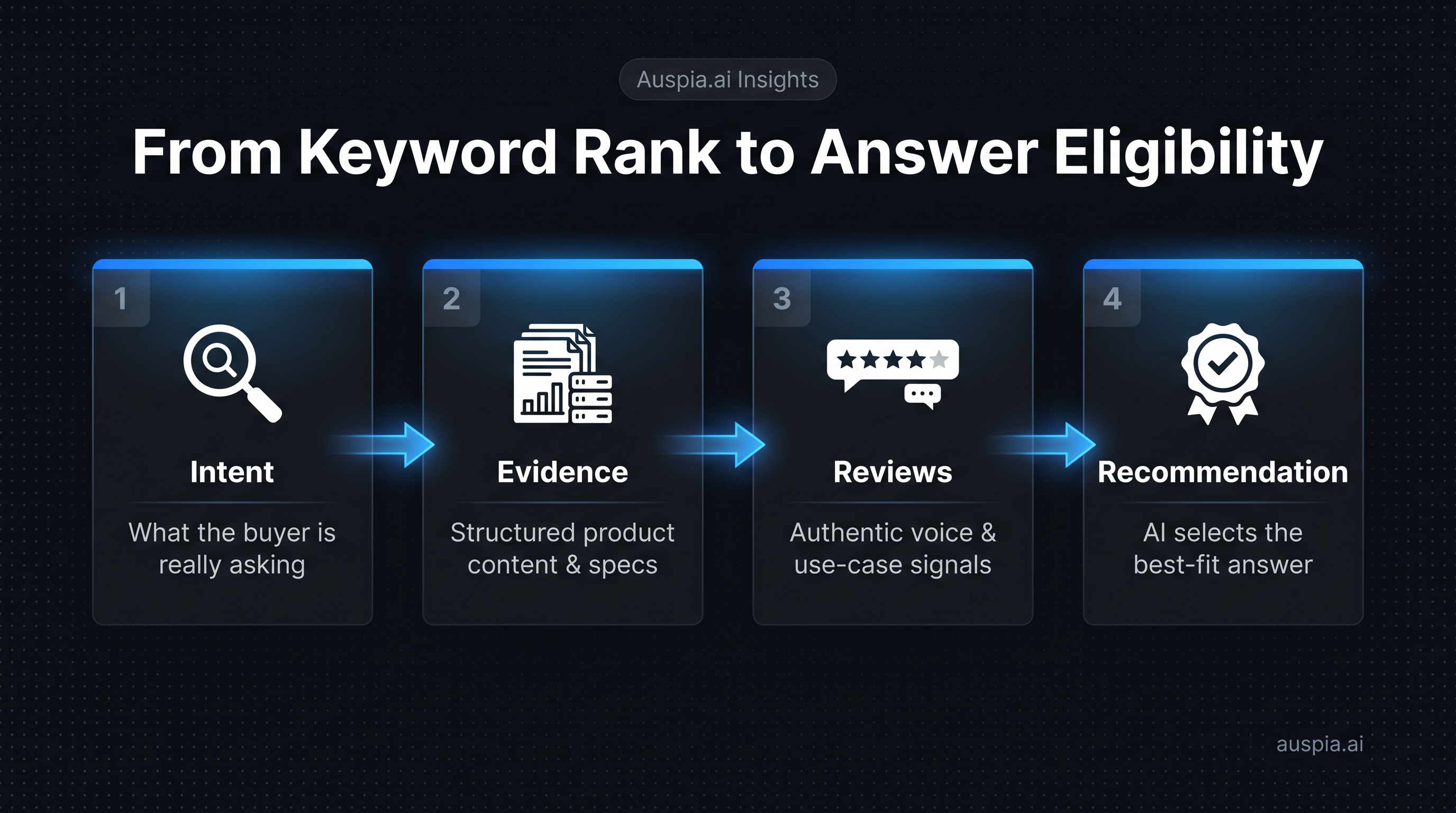
Amazon did not simply rename an assistant. In May 2026, Amazon introduced Alexa for Shopping by bringing together Rufus and Alexa+, making the shopping assistant easier to reach from the Amazon app, website, search bar, and Echo Show. For sellers, the practical change is this: product discovery is moving from only keyword-result competition toward answer eligibility.
A buyer can still type power bank, compare listings, and click ads. But more buyers will also ask questions such as "What is a lightweight power bank for a three-day camping trip?" or "Which lunch bag works for a child who forgets ice packs?" In that moment, the seller is not only competing for a search position. The listing must give the assistant enough evidence to understand the product, compare it, and explain why it fits a specific need.

What changed on Amazon's side
Amazon's own launch page describes Alexa for Shopping as a personalized, agentic AI assistant that combines product knowledge, web information, shopping capabilities, personal preferences, shopping history, and Alexa conversations. Amazon also says customers can ask questions in the main Amazon search bar, generate product comparisons, see category insights, view up to a year of price history, and use shopping automation features.
That matters because the assistant has more jobs than a classic search page. It may need to interpret the buyer's use case, narrow the category, compare products, explain trade-offs, and help the buyer act. The listing that only says "premium quality" or "great gift" gives the assistant little to work with. The listing that names the buyer, situation, constraint, proof, and limitation has more usable material.
For Amazon GEO in 2026, the question is no longer just: "Do we rank for the keyword?" The better question is: "When the assistant answers a buyer's real shopping question, are we one of the products it can confidently include?"
The old playbook still matters, but it is incomplete
Keyword work, retail readiness, ads, pricing, availability, review quality, and conversion rate still matter. Alexa for Shopping is built on Amazon's commerce environment, not outside it. A poorly stocked, badly reviewed product is unlikely to become a strong recommendation just because the copy sounds conversational.
The incomplete part is the old belief that keyword coverage is enough. AI shopping assistants evaluate meaning. They need to know what the product is for, who it fits, what makes it different, what evidence supports the claim, and when another product might be a better choice.
Traditional Amazon search work | Alexa-era Amazon GEO work |
|---|---|
Match the highest-volume keyword | Match the buyer's exact task, context, and constraint |
Win a visible search slot | Become a defensible answer candidate |
Repeat feature terms | Connect features to use cases and outcomes |
Treat reviews as star rating support | Treat review language as semantic evidence |
Optimize one listing surface | Align title, bullets, A+, images, Q&A, and review themes |
The risk for commodity listings
AI-assisted recommendations are less forgiving to products that look interchangeable. A search results page can show dozens of similar lunch bags, cables, organizers, or chargers. An answer-style assistant often tries to reduce choice. It may surface a smaller set of products with clearer reasons.
That creates a new risk: the buyer may never reach your listing if the assistant has already filtered it out as generic. This is especially dangerous in categories where many sellers use the same claims, the same photo logic, and the same bullet style.
A generic listing says:
- "High quality material"
- "Easy to use"
- "Perfect gift"
- "Multiple occasions"
A more assistant-readable listing says:
- "Insulated lunch bag for elementary school students who need a compact box that fits inside a backpack"
- "Leak-resistant lining tested for upright snack containers, not loose soup"
- "Front label pocket helps teachers identify the bag in shared cubbies"
- "Best for 4-6 hour school days with a slim ice pack"
The second version is not just more persuasive for humans. It gives an AI shopping layer more entities, situations, constraints, and recommendation reasons.
Reviews are becoming product evidence, not just reputation
Many sellers watch reviews mainly for star rating, defect complaints, and conversion impact. In an AI shopping environment, review language can become product evidence. If many buyers mention "worked well for camping," "fits under airplane seat," "easy for kids to open," or "too small for a 15-inch laptop," those phrases help define what the product is truly good or bad for.
This does not mean sellers should manipulate reviews. It means sellers should read reviews as a semantic dataset. Positive review themes can be reflected in bullets, A+ modules, comparison charts, and Q&A if they are accurate. Negative review themes should drive product fixes, image clarification, sizing tables, or expectation-setting copy.
For example, if a portable charger has repeated praise for weekend camping but complaints about laptop charging, the listing should not blur the product into "all-day power for every device." A stronger GEO version would state that it is ideal for phones, earbuds, flashlights, and small USB devices during short outdoor trips, while clearly explaining laptop limitations.
How to rebuild a listing for Alexa-era discovery
Start with the buyer question, not the keyword. A keyword such as portable charger is too broad. The assistant needs to answer more specific prompts:
- "What portable charger should I take camping if I need something light?"
- "Which power bank is safe for a student backpack?"
- "What charger works for a family road trip with multiple phones?"
- "Which option is better for emergency kits?"
Then map each prompt to evidence inside the listing.
Buyer question | Listing evidence to add | Where it belongs |
|---|---|---|
Who is this product best for? | Audience, scenario, constraints, non-fit cases | Title, bullets, A+ intro |
Why this product over similar products? | Differentiators, measurable specs, comparison logic | Bullets, comparison chart, image captions |
What proof supports the claim? | Certifications, dimensions, material details, review themes | Bullets, images, A+, Q&A |
What could disappoint buyers? | Size limits, compatibility limits, care instructions | Q&A, images, product description |
What phrase would a buyer use naturally? | Problem-led and situation-led wording | Bullets, A+, Q&A |
A useful rewrite pattern is: buyer + situation + constraint + proof + limit.
Weak: "Durable lunch bag for kids."
Stronger: "Compact insulated lunch bag for elementary students who need a lightweight bag that fits in a backpack, with a wipe-clean lining and space for a slim ice pack; not designed for full-size meal prep containers."
That sentence does more than add words. It tells the assistant when to recommend the product and when not to.
A 30-minute seller audit for 2026
Use this quick audit before rewriting a listing. The goal is not to chase every possible AI prompt. The goal is to make the product easier to understand, compare, and recommend.
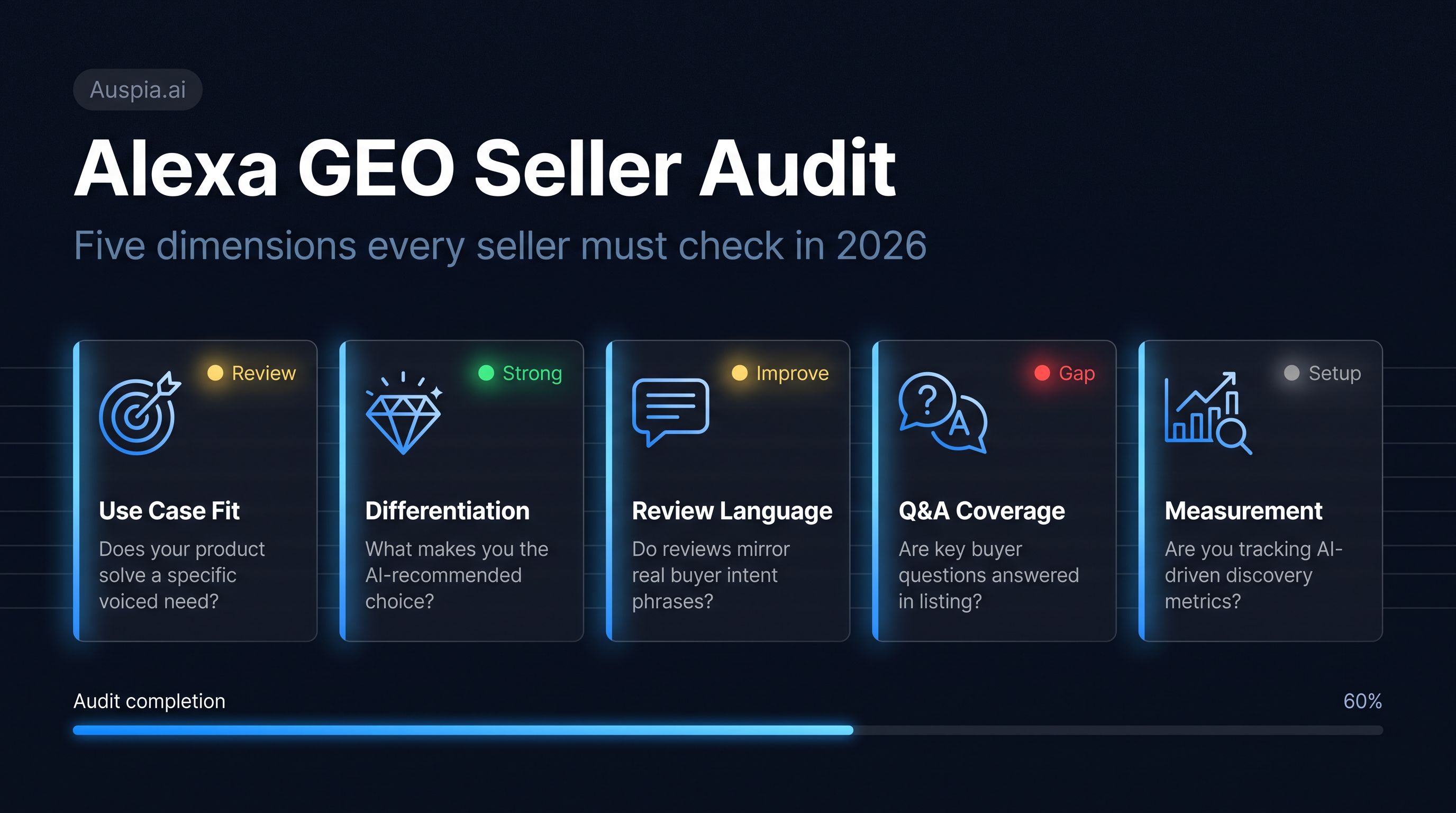
Audit item | Pass condition | If it fails |
|---|---|---|
Use-case fit | A buyer can tell exactly who the product is for in 10 seconds | Rewrite the first bullet around a real scenario |
Differentiation | The listing gives 2-3 concrete reasons to choose it over similar products | Replace generic adjectives with measurable or observable proof |
Review language | Positive and negative review themes are reflected accurately | Mine the last 100 reviews for repeated phrases |
Q&A coverage | Common buyer doubts are answered before purchase | Add compatibility, sizing, safety, and limitation answers |
AI answer monitoring | The team checks assistant answers for category prompts | Create a weekly prompt set and record who appears |
If you use Auspia's AI Search Visibility Checker, adapt the same habit to Amazon: test prompts, record answer patterns, compare product mentions, and look for the evidence gaps behind missing recommendations.
What sellers should monitor next
Amazon will keep changing the assistant interface, and visibility rules will not be fully transparent. That is normal. Sellers should not wait for a perfect measurement system before adapting.
Track five signals every week:
- Which buyer questions does the assistant answer in your category?
- Which products appear repeatedly, and what reasons are given?
- Which of your claims are supported by reviews, images, specs, and Q&A?
- Which generic claims can be replaced with specific scenarios or constraints?
- Which negative review themes should be fixed before they become recommendation blockers?
The best Amazon GEO work in 2026 will look less like keyword stuffing and more like evidence design. You are building a listing that a buyer can understand quickly, a marketplace system can classify correctly, and an AI shopping assistant can recommend with a reason.
FAQ
Is Rufus completely gone?
Amazon says Alexa for Shopping brings together Rufus and Alexa+. Practically, sellers should treat the change as an assistant-layer upgrade rather than a simple disappearance of Rufus. The Rufus-style product research function is now part of a broader Alexa shopping experience.
Does Amazon GEO replace Amazon SEO?
No. Amazon GEO adds another layer. You still need keyword relevance, retail readiness, pricing, availability, reviews, ads, and conversion quality. GEO focuses on whether your product information is clear enough to be used in AI-assisted answers and recommendations.
Should sellers rewrite titles for long conversational prompts?
Not blindly. Titles still need clarity, compliance, and shopper readability. Put the most important scenario and differentiator where it helps, but use bullets, A+ content, image captions, and Q&A for richer conversational answers.
What is the fastest first step?
Mine reviews for repeated use-case language. If buyers repeatedly mention a specific scenario, benefit, or problem, check whether your listing already explains it clearly. If not, update the bullets, images, A+ modules, or Q&A with accurate wording.
How often should sellers check Alexa for Shopping answers?
For active categories, weekly is a reasonable starting point. Use the same prompt set each time so you can compare changes instead of relying on random one-off searches.
Author: Ryan Chen, Senior Amazon Operations Expert with 10 Years in Marketplace Growth at Auspia. Ryan writes about Amazon GEO, marketplace search behavior, AI-assisted product discovery, and practical listing optimization playbooks for sellers.