Amazon GEO in 2026: the short version
Amazon search is moving beyond the keyword box. With Alexa for Shopping combining Rufus, Alexa+, Amazon product data, shopping history, reviews, price history, and information from across the web, ecommerce discovery is moving toward a recommendation layer. Amazon announced the combined Alexa for Shopping experience in May 2026, after Rufus had already helped more than 300 million customers research, compare, and buy products in 2025.
For sellers and ecommerce growth teams, the job changes in a practical way: a listing has to do more than rank for a query. It should give an AI shopping assistant enough evidence to understand the product, compare it fairly, explain who it is for, and recommend it with confidence.
That is Amazon GEO in 2026.
Traditional Amazon SEO asks: "Can shoppers find this listing when they type the keyword?"
Amazon GEO asks: "Can an AI assistant choose this product when the shopper describes a need?"
The difference sounds small until you look at how people actually ask AI shopping questions:
- "What is a good backpack for a three-day business trip?"
- "Which air purifier is quiet enough for a nursery?"
- "Compare these two espresso machines for a beginner."
- "Find a gift for a 10-year-old who likes robotics."
- "Is this chair better for lower back pain than the cheaper one?"
Those are not neat keyword searches. They are decisions. The seller who gives the assistant better decision material has an advantage.
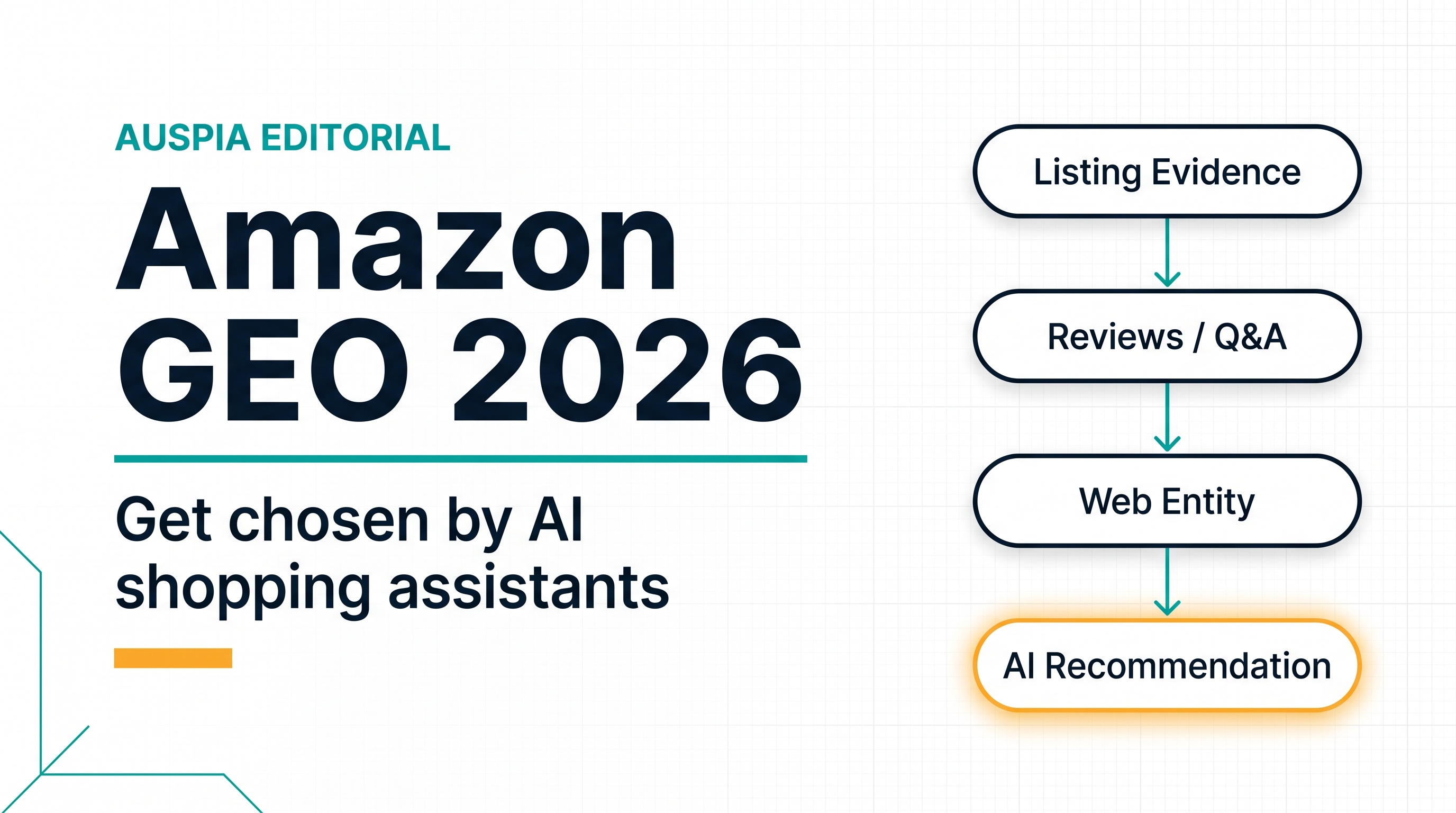
Caption: Amazon GEO turns product content into decision evidence, not just keyword coverage.
Why Alexa for Shopping changes the seller playbook in 2026
Amazon describes Alexa for Shopping as an agentic AI assistant available in the Amazon Shopping app and website for U.S. customers, with the full Amazon store experience also coming to Echo Show devices. Its public feature set matters for sellers because it is built around research, comparison, summaries, price context, and shopping tasks. Product retrieval is only one piece of it.
As of Amazon's May 2026 rollout notes, the current Alexa for Shopping experience can:
Assistant behavior | Why sellers should care |
|---|---|
Answer shopping questions in the main Amazon search bar | Product copy has to match natural-language needs, not just short keywords. |
Create shopping guides for bigger purchases | Category education, use cases, and comparison logic become more important. |
Compare products from search results | Differences must be explicit enough for an assistant to explain. |
Surface AI overviews in search and product detail pages | Listings need extractable claims and clean product facts. |
Use reviews, price history, and product context | Review language and pricing trust can shape the recommendation story. |
Pull in information from across the web | Brand entity work outside Amazon now affects Amazon discovery indirectly. |
Schedule or automate purchases | Reorder logic, replenishment fit, and trust signals matter more for consumables. |
This does not mean old Amazon SEO disappears. Titles, images, pricing, ratings, conversion rate, inventory, and ads still matter. But GEO adds a second layer on top: can the product be understood and defended by a machine that is trying to help the shopper decide?
That is the part many sellers still underbuild.
From keyword matching to decision matching
Old Amazon SEO was often built like this:
- Put the main keyword in the title.
- Add variants in bullets.
- Push important terms into backend search fields.
- Drive traffic and reviews.
- Improve conversion rate.
That still has value. The problem is that AI shopping assistants do more than match words. They interpret scenarios.
A shopper may never type "portable bluetooth speaker waterproof IPX7 24 hour battery." They may ask for "a beach speaker that will survive sand, water, and a full Saturday outside."
A keyword-first listing might say:
Portable Bluetooth Speaker, IPX7 Waterproof, 24H Battery, Outdoor Bass Speaker
A GEO-ready listing says something closer to:
Portable Bluetooth speaker for beach days, camping weekends, and outdoor parties, with IPX7 waterproof protection and up to 24 hours of battery life.
The second version still contains the keywords. The difference is that it also gives the assistant a recommendation scenario: beach, camping, outdoor parties, waterproof risk, battery duration.
That is the shift. Keep the keywords. Wrap them in the language of use, audience, constraints, and outcomes.
The 7 Amazon GEO moves sellers should make now
1. Rewrite listings around use cases, not product nouns alone
Start with the shopper's real context. A listing for a desk lamp is more than "LED desk lamp." It might be about late-night study, video calls, small apartments, eye strain, dorm rooms, or a shared bedroom.
Add scenario language where it is true:
Weak listing language | Better GEO-ready language |
|---|---|
"LED desk lamp with USB port" | "LED desk lamp for small desks, dorm rooms, and late-night study, with a USB port for charging a phone or earbuds." |
"Travel backpack 40L" | "40L carry-on travel backpack for three-day business trips, weekend flights, and laptop-safe packing." |
"Dog water bottle" | "Leak-resistant dog water bottle for hikes, road trips, and park days, designed for one-handed use." |
The goal is not longer copy for its own sake. The goal is to make the product easy to place in a human situation.
2. Turn bullet points into answer blocks
Many listings still use bullets as a pile of specs:
- 5000mAh battery
- IPX7 waterproof
- Bluetooth 5.3
- Lightweight design
That is easy to scan, but it does not answer the questions an assistant needs to answer.
A better structure is:
- Lasts up to 24 hours for camping weekends, beach days, or outdoor parties.
- IPX7 waterproof protection helps the speaker handle rain, pool splashes, and wet hands.
- Bluetooth 5.3 keeps pairing stable when the phone is in a backpack or nearby room.
- Lightweight body fits in a day bag without taking over the whole pack.
This is still factual. It is simply written in a way that can be quoted, summarized, compared, and matched to intent.
A useful test: after every bullet, ask "What buyer question does this answer?" If the answer is unclear, rewrite it.
3. Design review language without manipulating reviews
Reviews are becoming part of the AI-readable evidence layer. That does not mean sellers should script reviews or push customers toward fake language. That is a bad idea.
It does mean post-purchase communication should encourage specific, honest feedback.
Instead of asking for a generic review, ask customers to mention what actually helped them:
- Who used the product?
- Where did they use it?
- What problem did it solve?
- What did they compare it with?
- Was anything confusing, smaller, louder, heavier, or easier than expected?
Low-value review language says:
- "Good product."
- "Fast shipping."
- "Nice."
High-value review language says:
- "Bought this for my mother because the buttons are large and easy to read."
- "Used it on a rainy camping trip and the battery lasted the weekend."
- "Lighter than my old model, but the handle could be softer."
That last example includes a flaw. Good. Real reviews are more useful than polished review farms. AI assistants need trust, not cheerleading.
4. Treat Q&A as a product knowledge base
Amazon Q&A is often neglected after launch. For GEO, that is a mistake.
Q&A is where shoppers ask the messy questions that product copy misses:
- "Will this fit a 2024 MacBook Pro?"
- "Can a beginner assemble it alone?"
- "Is it quiet enough for an apartment?"
- "Does it work with thick carpets?"
- "Can I use it for a 70-pound dog?"
These questions are exactly the kind of source material an assistant can turn into a recommendation.
Build a Q&A map for every important product:
Q&A cluster | Example questions to answer |
|---|---|
Compatibility | Devices, sizes, parts, rooms, materials, software, accessories |
Use case | Travel, family use, beginners, professionals, small spaces, outdoor use |
Risk reduction | Noise, cleaning, safety, returns, durability, setup difficulty |
Comparison | Lighter than what, quieter than what, better for whom, not ideal for whom |
Troubleshooting | Setup, charging, pairing, assembly, maintenance, replacement parts |
If your product page does not answer these questions, an assistant may fill the gap with a competitor that does.
5. Build the brand entity outside Amazon
This is the part many marketplace sellers resist because it feels indirect. But Alexa for Shopping publicly says it combines Amazon product knowledge with information from across the web. That means the web around your brand matters. This is not speculation pulled from a GEO pitch deck; it is in Amazon's own product description of the assistant.
Amazon GEO is bigger than the product page.
A brand should have consistent external evidence:
- A clear brand website with product category pages.
- A plain-English About page that explains what the brand makes and for whom.
- Product documentation, comparison pages, sizing guides, or care guides.
- Credible reviews from relevant publishers, creators, or niche communities.
- Consistent brand names, product names, and category descriptions across Amazon, Google, YouTube, Reddit, TikTok, and retailer pages.
- Schema markup where it makes sense, especially Organization, Product, FAQ, and Review schema on owned pages.
For teams that want to audit this quickly, Auspia's AI Search Visibility Checker can help inspect how a brand or product appears across AI answer surfaces.
The practical question is simple: if an AI system looks beyond Amazon, will it find a coherent brand or scattered fragments?
6. Make comparison advantages explicit
AI shopping assistants are comparison machines. If two products look similar, the assistant needs a reason to recommend one.
Most sellers bury that reason. They write generic claims like "premium quality" or "perfect gift." Those phrases do not help the assistant choose.
Better comparison language is specific:
- Quieter motor for apartment workouts.
- Narrower 18-inch frame for small kitchens.
- Beginner-friendly setup with no app account required.
- Lower sugar per serving than the previous formula.
- Replacement filters available in two-packs.
- Works with both USB-C and USB-A chargers.
You do not need to attack competitors. You need to state the buying tradeoff clearly.
A useful internal exercise: write five sentences that start with "Choose this if..." and five that start with "Do not choose this if..." The second list is uncomfortable, but it improves trust and reduces bad-fit buyers.
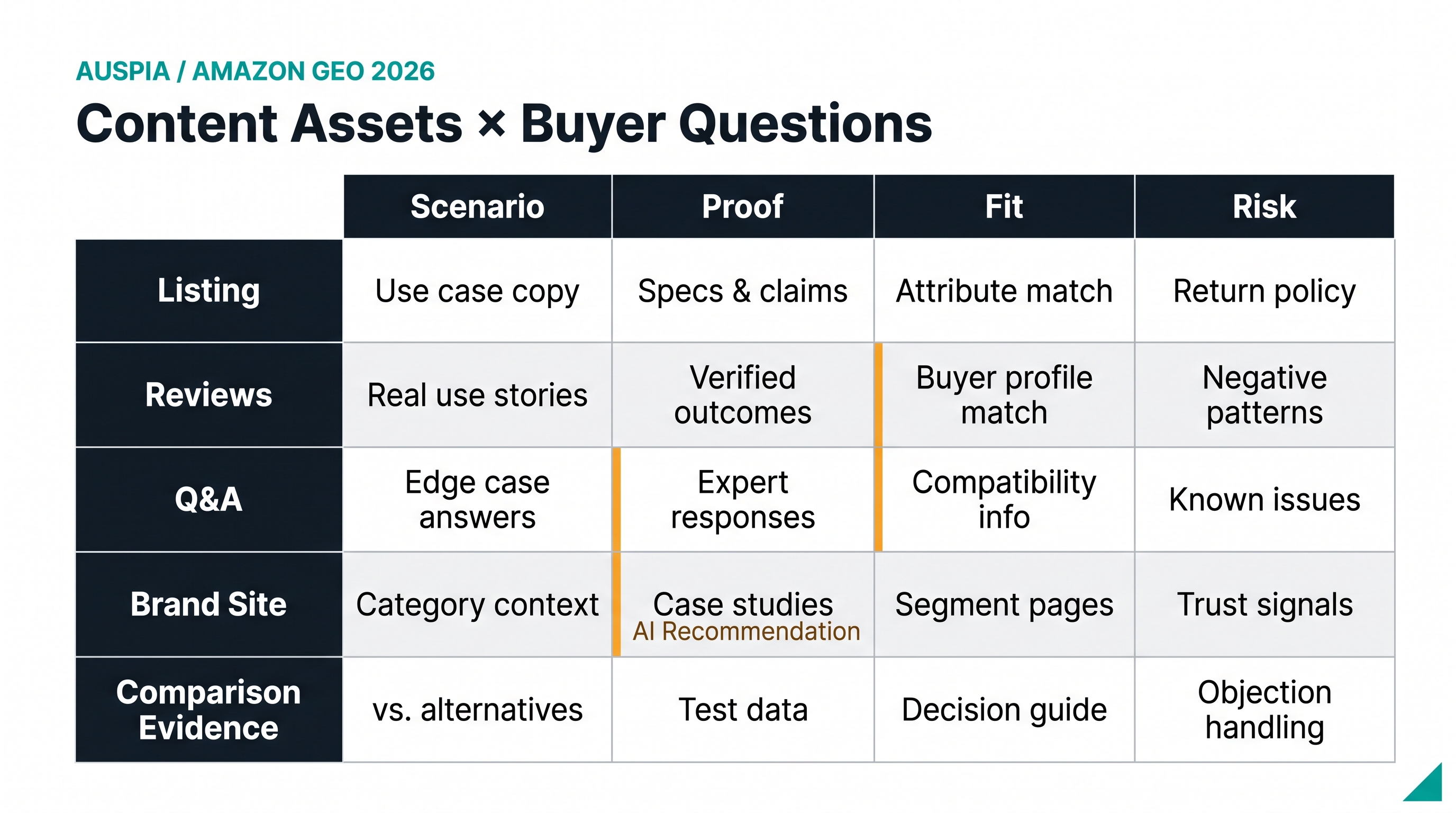
Caption: A practical content matrix helps sellers see which AI-readable evidence is missing.
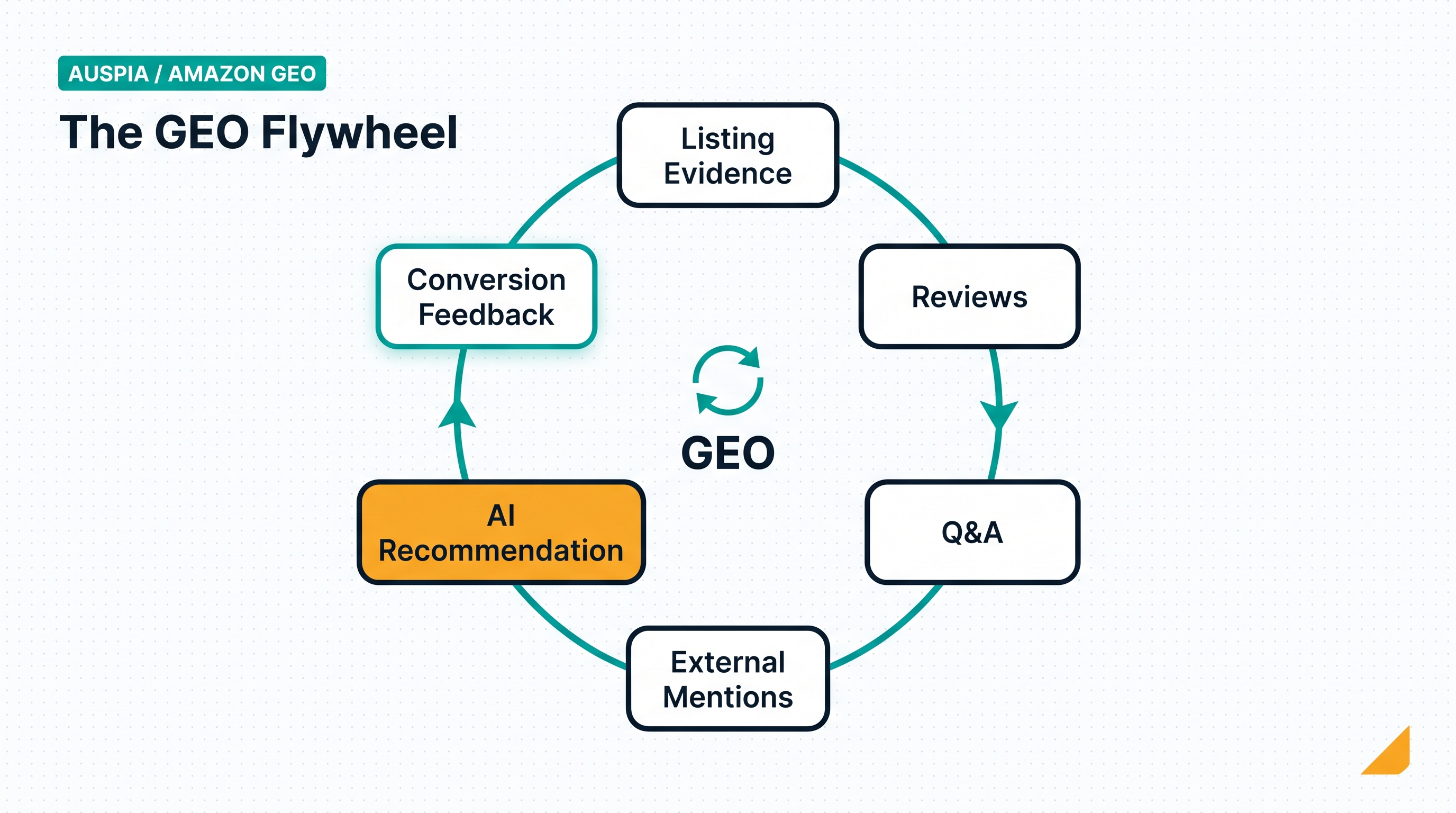
7. Watch the new flywheel: AI recommendation, conversion, trust
Amazon has always rewarded products that convert. AI shopping adds another feedback loop.
A likely 2026 flywheel looks like this:
- The assistant understands the product and recommends it for a specific scenario.
- Better-fit shoppers click, compare, and buy.
- Conversion rate and review quality improve.
- The product gains more evidence that it fits the scenario.
- The assistant has more confidence recommending it again.
The reverse is also true. If the assistant cannot understand the product, or if reviews show mismatch, confusion, or returns, the product may struggle even if it has keyword coverage.
This is why Amazon GEO should sit beside Amazon SEO, not underneath it. SEO gets the product into the candidate set. GEO helps the assistant decide whether the product deserves to be selected.
A 2026 Amazon GEO checklist
Use this as a fast audit before rewriting a listing.
Area | GEO question | Quick fix |
|---|---|---|
Title | Does it include the main use case plus buyer context? | Add one clear scenario or audience phrase. |
Bullets | Can each bullet answer a buyer question? | Rewrite specs into problem-solving statements. |
Images | Do images show scale, context, compatibility, and comparisons? | Add annotated lifestyle and comparison images. |
A+ Content | Does it explain who the product is for and not for? | Add a use-case module and comparison module. |
Reviews | Do reviews mention real scenarios? | Ask for honest feedback about use, fit, and results. |
Q&A | Are compatibility and edge cases answered? | Seed and maintain a Q&A map. |
External web | Can the brand be understood outside Amazon? | Build entity pages, guides, documentation, and consistent profiles. |
Comparison | Is the product's difference easy to explain? | Add clear "choose this if" language. |
Measurement | Are you tracking AI visibility, not just rank? | Test prompts in Alexa, Rufus, Google AI Overviews, ChatGPT, and Perplexity. |
How to measure Amazon GEO without overcomplicating it
Amazon does not give sellers a clean "GEO score" inside Seller Central. So start with a lightweight prompt set.
Build 20 to 50 prompts for your category:
- Scenario prompts: "What is a good [product] for [scenario]?"
- Audience prompts: "Which [product] is best for [buyer type]?"
- Comparison prompts: "Compare [your product] with [competitor]."
- Constraint prompts: "Find a [product] under $X that is good for [need]."
- Risk prompts: "Which [product] is safest/easiest/quietest for [context]?"
Then record:
Metric | What to track |
|---|---|
Mention rate | Does the product or brand appear? |
Recommendation position | Is it first, grouped, or only mentioned as an alternative? |
Reason quality | Does the assistant explain the right advantage? |
Source quality | Is the answer using Amazon content, reviews, external pages, or weak sources? |
Competitor pattern | Which competitors appear repeatedly and why? |
Error pattern | What does the assistant misunderstand? |
Do this monthly. Do it after major listing rewrites. Do it before heavy ad pushes. A product page that cannot be explained by AI may waste more ad spend over time.
What sellers should stop doing
A few habits will age badly in an AI-shopping environment.
Stop writing listings for keyword tools first. Real shoppers do not talk like keyword exports.
Stop treating reviews as a star-count asset only. Review language is evidence.
Stop leaving Q&A to chance. It is a public knowledge base.
Stop using vague superiority claims. "High quality" is not a recommendation reason.
Stop thinking the brand website is optional. If Amazon's assistant can use web information, your external brand footprint is part of the product story.
Auspia take
The big shift is not "Amazon SEO is dead." The change is more practical than that.
Amazon SEO gets you found. Amazon GEO gets you chosen.
In 2026, the best ecommerce teams will write product content for three readers at once: the human shopper, Amazon's ranking systems, and the AI assistant that turns messy buyer intent into a short list of recommended products.
That means product pages need cleaner semantics, better scenario coverage, useful reviews, stronger Q&A, and a brand entity that holds together across the open web.
If your listing only says what the product is, it is underwritten. If it explains who should buy it, when to use it, how it compares, and why real buyers trust it, it is much closer to GEO-ready.
FAQ
What is Amazon GEO?
Amazon GEO is the practice of making product listings, reviews, Q&A, brand pages, and external web evidence easier for AI shopping assistants to understand, compare, and recommend. It builds on Amazon SEO but focuses on decision quality. Keyword visibility is only one part of the job.
Is Amazon GEO different from Amazon SEO?
Yes. Amazon SEO helps a product appear for keyword searches. Amazon GEO helps an AI assistant understand when the product is a good recommendation for a shopper's described need, scenario, budget, or constraint.
Does Alexa for Shopping use information outside Amazon?
Amazon says Alexa for Shopping combines deep product knowledge with information from across the web, along with shopping capabilities and personal context. That makes external brand consistency more important for sellers.
Should sellers remove keywords from listings?
No. Keywords still matter. The better move is to keep important keywords while adding natural use-case language, audience fit, comparison points, and answer-style bullets.
What should I improve first for Amazon GEO?
Rewrite the title and bullets around buyer questions. Add use cases, constraints, and comparison reasons. Then improve Q&A and review collection so the page contains more specific, honest evidence.
Author: Adrian Cole, Analyst of 1,000+ AI Search Results at Auspia. Adrian writes about how brands appear in ChatGPT, Perplexity, Gemini, Google AI Overviews, and AI shopping assistants.