Paid Visibility Is A Learning System, Not A Shortcut To Voice Recommendations
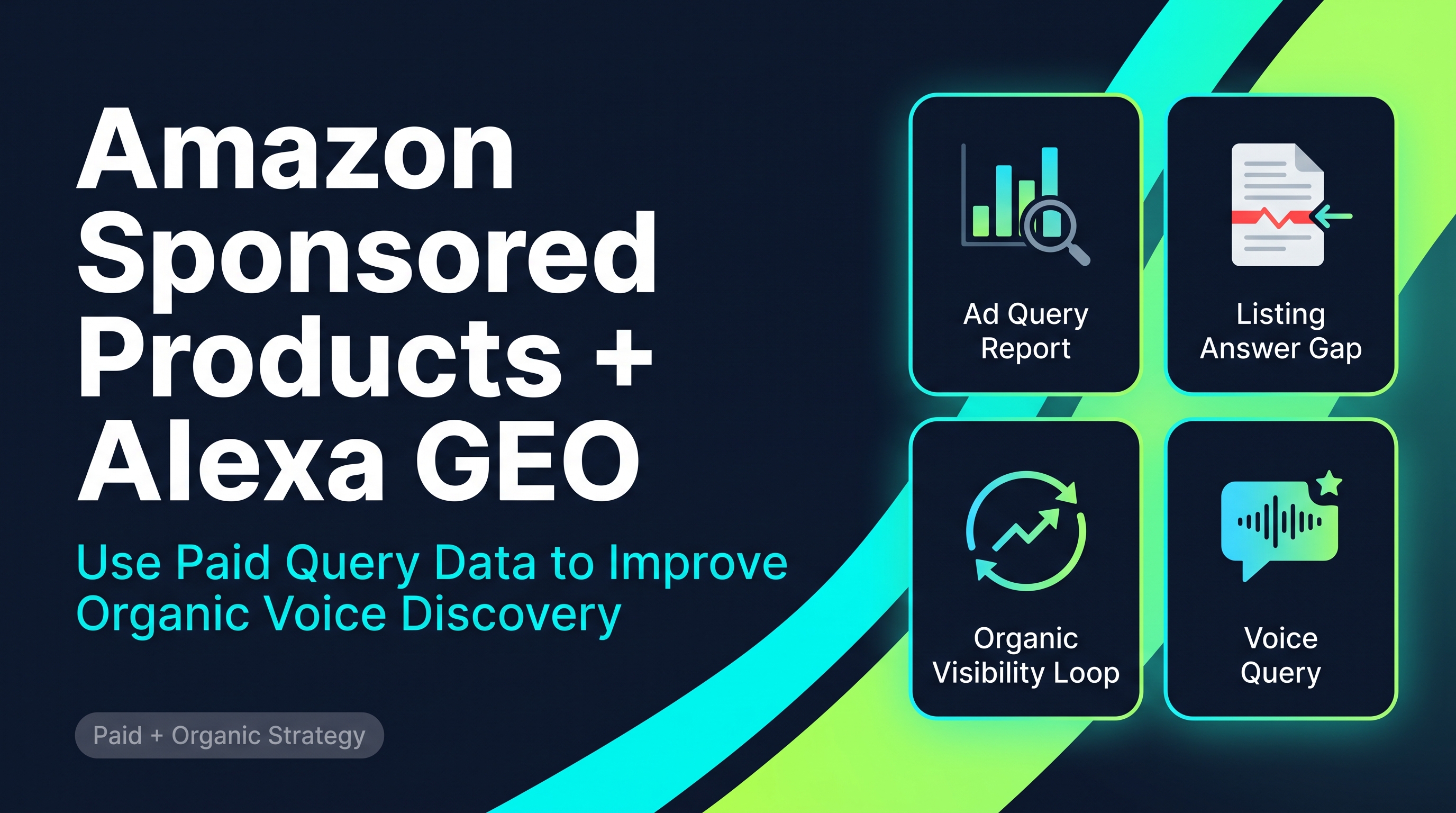
Amazon Sponsored Products can support Alexa GEO, but not because ads directly buy organic voice recommendations. The real value is learning: paid campaigns expose the search terms, conversion gaps, objection queries, and reorder phrases that sellers can use to improve product listings for organic discovery.
For Amazon sellers, this matters because voice and assistant-style shopping depend on clarity. If an ad query converts, it may reveal language that deserves stronger placement in the title, bullets, images, A+ Content, or Q&A. If an ad query spends without converting, it may reveal a mismatch between the buyer's question and the listing's answer.
DataForSEO research for this series showed amazon sponsored products at about 1,900 monthly searches with CPC around $14.53, amazon seo at about 1,000 with CPC around $22.87, and voice search optimization at about 720 with CPC around $56.65. The commercial signal is clear: sellers and agencies pay to understand both marketplace visibility and voice/search behavior. The opportunity is to connect those systems instead of running them in separate silos.
The Paid-To-Organic Learning Loop
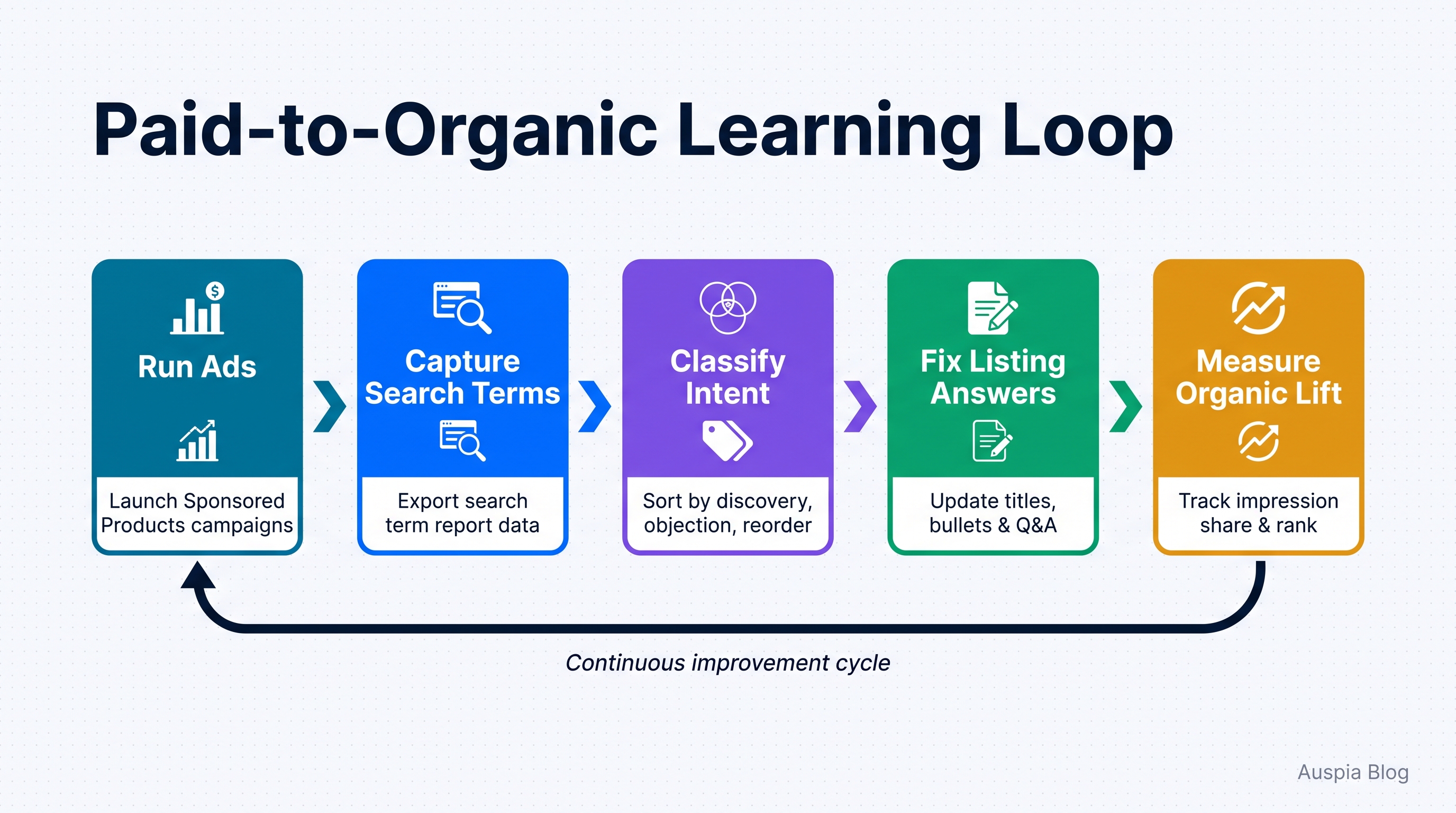
A practical Sponsored Products + Alexa GEO workflow has five steps.
Step | Seller action | GEO output |
|---|---|---|
Run ads | Launch campaigns around category, use case, competitor, and long-tail terms | Query exposure |
Capture search terms | Export search term and campaign performance reports | Real buyer language |
Classify intent | Sort terms into discovery, comparison, objection, and reorder groups | Intent map |
Fix listing answers | Update titles, bullets, images, A+ Content, Q&A, and backend terms | Better answer coverage |
Measure organic lift | Track conversion, organic rank, branded search, and repeat signals | Learning loop |
This loop keeps ads from becoming a separate spend channel. It turns paid traffic into product discovery intelligence.
What Sponsored Products Can Teach GEO Teams
Sponsored Products data is useful because it shows what buyers actually typed before seeing, clicking, or buying a product. That is different from brainstorming keywords in a vacuum.
Ad signal | What it may mean | GEO action |
|---|---|---|
High clicks, high conversion | The query matches the product and buyer expectation | Promote the language into visible listing assets |
High clicks, low conversion | The listing attracts interest but does not answer the buyer | Improve bullets, images, Q&A, or price/pack clarity |
High spend, no sales | Intent mismatch or missing objection answer | Negate, reposition, or fix the listing gap |
Low impressions, high conversion | Niche query with strong fit | Build more content around that use case |
Brand + product queries | Buyers remember or compare the brand | Protect brand terms and clarify variants |
Refill or replacement queries | Repeat-purchase or compatibility intent | Improve reorder cues and compatibility content |
Safety or fit queries | Objection-driven shopping | Add Q&A and proof assets |
For Alexa GEO, the most valuable terms are often not the broadest. They are the phrases that reveal how a buyer would ask for the product in natural language.
The Four Ad Query GEO Signals
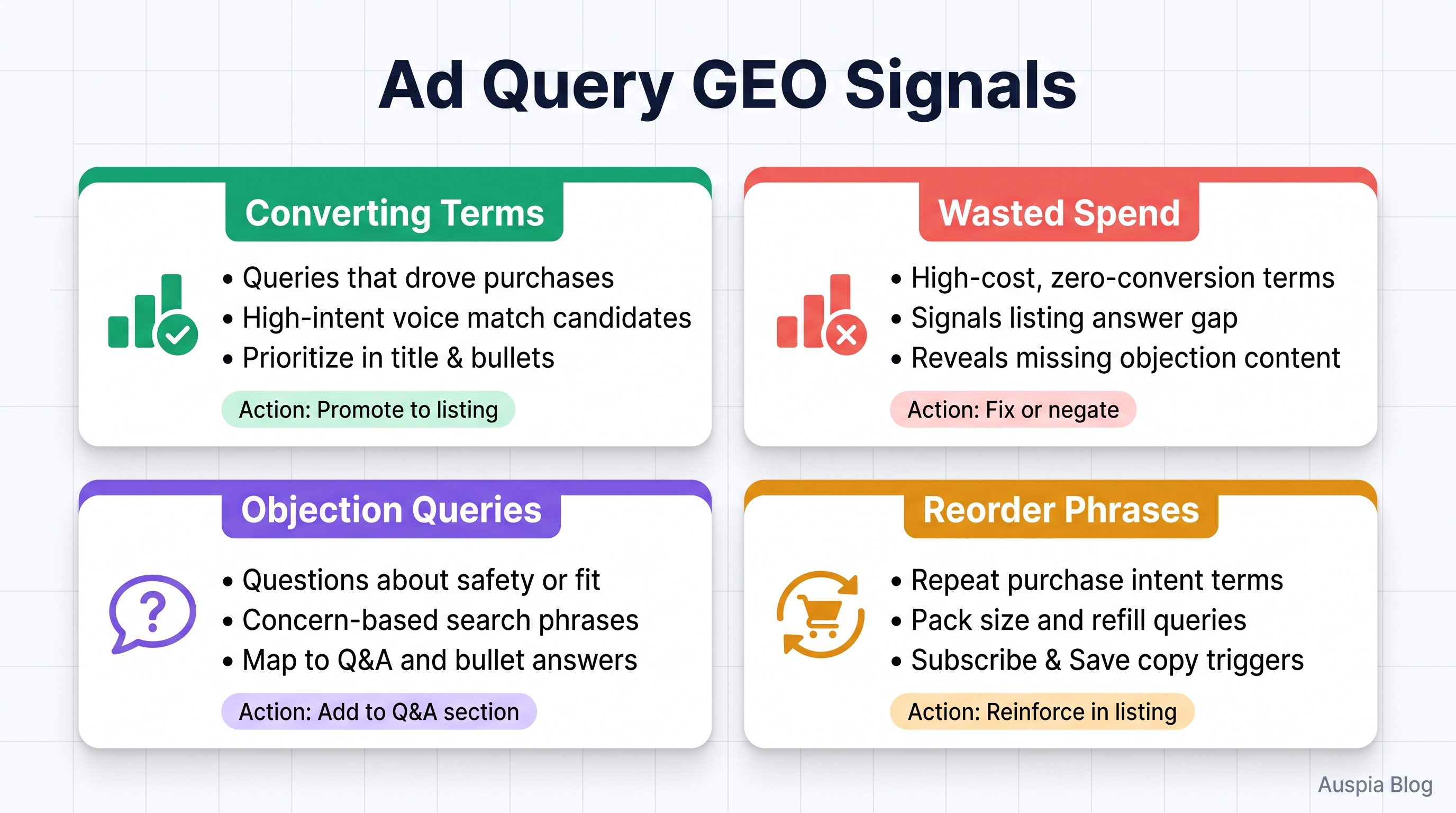
When reviewing Sponsored Products data, do not only sort by spend. Sort by learning value.
1. Converting Terms
These are queries that produce orders. They can reveal which use cases, attributes, or buyer phrases deserve stronger visibility in the listing.
Example: if fragrance free dog wipes for sensitive paws converts, the listing should clearly answer fragrance, pet use, sensitivity, and paw cleaning.
2. Wasted Spend
High-cost, low-conversion terms are not just budget problems. They may reveal answer gaps. Maybe the product does not fit the query, or maybe the listing fails to prove the fit.
Example: if replacement filter model 300 gets clicks but no sales, check whether compatibility is visible in title, image, bullets, and Q&A.
3. Objection Queries
Some search terms contain the buyer's concern: safe, non-toxic, hypoallergenic, quiet, compatible, leak-proof, hard water, sensitive skin, no fragrance, easy install.
These phrases should usually feed Q&A, bullet copy, image callouts, and A+ Content.
4. Reorder Phrases
Terms with refill, replacement, bulk, subscribe, same, again, pack, count, cartridge, filter, or refill pack often signal repeat-purchase logic.
These should influence variant naming, pack-size visibility, subscription language, and replenishment cues.
Why This Matters For Alexa And Voice Discovery
Voice shopping compresses the decision. A buyer may not browse ten listings before deciding. The assistant-style path needs clear product fit, credible evidence, and low ambiguity.
Sponsored Products data helps sellers discover which ambiguity matters most:
Voice-style concern | Ad query clue | Listing fix |
|---|---|---|
"Will this fit?" | model, compatible, replacement, size | Compatibility chart and Q&A answer |
"Is this safe?" | non-toxic, sensitive, kids, pets | Ingredients, safety language, review themes |
"Which version?" | scent, flavor, count, pack, formula | Variant comparison and image labels |
"Can I buy it again?" | refill, reorder, bulk, subscribe | Pack-size and routine-use copy |
"Is it worth it?" | best, reviews, durable, premium | Proof bullets, review themes, A+ comparison |
Paid query data becomes GEO input when it changes the answer quality of the product detail page.
What Not To Do With Sponsored Products Data
The wrong move is to stuff every converting ad term into the title. That creates unreadable listings and can weaken conversion.
Use this placement map instead:
Query type | Best placement | Avoid |
|---|---|---|
Core category term | Title and first bullet | Repeating synonyms in the title |
Attribute term | Title if essential; bullets/images if supporting | Hiding important specs only in backend terms |
Objection term | Q&A, bullet, image, A+ module | Making unsupported safety claims |
Comparison term | A+ Content or comparison table | Forcing complex differences into one bullet |
Reorder term | Variant name, pack-size image, subscription cue | Adding "reorder" unnaturally everywhere |
Weak-fit term | Negative keyword or repositioning | Paying forever for the wrong buyer |
Ads tell you what to investigate. They do not automatically tell you where the words belong.
A 30-Day Sponsored Products GEO Workflow
Days 1-5: Export And Clean Query Data
Pull search term reports for the last 30-90 days. Keep query, campaign, match type, impressions, clicks, spend, sales, conversion rate, and ASIN.
Days 6-8: Classify Intent
Label each query as discovery, comparison, objection, reorder, brand, competitor, or weak fit. Add a column for spoken likelihood: would someone naturally say this query aloud?
Days 9-14: Map Queries To Listing Assets
For each high-value query, choose the asset that should answer it: title, bullet, image, A+ Content, Q&A, backend term, or negative keyword.
Days 15-20: Rewrite And Add Proof
Make small, controlled updates. Improve one product family at a time. If a claim needs proof, use specifications, images, review themes, or Q&A rather than vague superlatives.
Days 21-30: Measure Before Scaling
Track paid conversion, organic conversion, search term quality, click-through rate, ranking movement, Q&A changes, review themes, and return reasons. Watch whether wasted spend declines and organic performance improves for the same intent cluster.
Example: Turning A Paid Query Into GEO Copy
Imagine a seller runs Sponsored Products for a dishwasher tablet and sees this query:
dishwasher tablets for hard water no residue
A weak response is to stuff the title:
Best Dishwasher Tablets Hard Water No Residue Cleaning Pods
A stronger GEO response is:
Asset | Update |
|---|---|
Title | Include hard-water use only if it is a core differentiator |
Bullet | "Designed to help reduce cloudy residue in hard-water dishwashing cycles" |
Image | Show a hard-water use-case callout with pack count |
A+ Content | Compare daily cleaning, hard-water use, and fragrance options |
Q&A | Answer "Do these work in hard water?" with careful, factual language |
Backend terms | Add relevant synonyms if not already covered naturally |
Ads | Keep the term if profitable; split into exact or phrase campaign for testing |
This approach makes the listing more useful for typed search, voice query interpretation, and human conversion.
Metrics That Matter
Do not measure Sponsored Products GEO only by ACoS. ACoS matters, but GEO learning requires a wider dashboard.
Metric | Why it matters |
|---|---|
Converting search terms | Shows language that deserves listing support |
Wasted spend by intent | Shows mismatch or missing answers |
Organic rank for query clusters | Shows whether listing updates support organic discovery |
Conversion rate by ASIN | Shows whether answer quality improved |
Q&A volume | Shows whether unanswered questions decline |
Review themes | Shows whether buyers confirm the intended use case |
Return reasons | Shows whether traffic quality improved |
Repeat purchase or Subscribe & Save | Shows whether reorder intent is becoming durable |
A good result is not only cheaper ads. It is a product detail page that answers better after the paid learning cycle.
Common Mistakes
Mistake 1: Treating ads and GEO as separate teams. Paid search terms should inform organic listing improvements.
Mistake 2: Promising that ads create voice recommendations. Ads can reveal query language and improve listing quality, but sellers should not claim they can buy Alexa recommendations.
Mistake 3: Optimizing only for high-volume terms. Lower-volume terms can reveal high-fit voice, objection, and reorder intent.
Mistake 4: Ignoring wasted spend. Wasted spend often points to missing answers, wrong-fit traffic, or confusing product positioning.
Mistake 5: Updating every listing at once. Run controlled changes by ASIN family so you can learn what worked.
FAQ
Do Amazon Sponsored Products directly improve Alexa voice recommendations?
No. Sponsored Products should not be described as a direct way to buy Alexa recommendations. Their GEO value is in query learning, conversion testing, and identifying listing answer gaps.
How can paid search data support Alexa GEO?
Paid search data shows the terms buyers use before clicking or buying. Sellers can classify those terms by intent and use them to improve listing titles, bullets, images, A+ Content, Q&A, backend terms, and negative keyword strategy.
Which ad queries are most useful for GEO?
Converting long-tail terms, objection phrases, compatibility queries, refill/reorder terms, and high-spend low-conversion queries are especially useful because they reveal buyer language and content gaps.
Should I add every converting ad term to my title?
No. Titles should stay clear and readable. Map terms to the right asset: title for core classification, bullets for answers, images for proof, A+ Content for comparison, Q&A for objections, and backend terms for relevant synonyms.
What should I measure after using ads for GEO?
Measure paid conversion, wasted spend, organic rank movement, listing conversion rate, Q&A patterns, review themes, return reasons, and repeat-purchase indicators.
Auspia Takeaway
Amazon Sponsored Products can support Alexa GEO when sellers use paid data as an intelligence loop. Ads reveal what buyers ask, what converts, what wastes money, and what the listing fails to answer.
The goal is not to buy voice visibility. The goal is to use paid query evidence to build a better product detail page: clearer answers, stronger proof, fewer objections, and more durable organic discovery.
Author: Ryan Chen, Senior Amazon Operations Expert with 10 Years in Marketplace Growth at Auspia. Ryan writes about Amazon GEO, marketplace search behavior, AI-assisted product discovery, listing optimization, and operational playbooks for Amazon sellers.