


The Listing Has To Become An Answer System
Amazon Product Listing GEO is the practice of turning each part of a product detail page into a clear answer for search engines, AI shopping assistants, and voice-led buyers. It is not a new trick layered on top of Amazon SEO. It is a stricter way to use the assets sellers already control: title, bullets, images, A+ Content, Q&A, reviews, variations, and backend search terms.
The old listing question was: "Which keywords should we add?" The better GEO question is: "Which buyer question should this asset answer, and what evidence makes the answer credible?"
That distinction matters for Alexa and AI shopping because users often speak in full tasks. They ask what fits, what is safe, what works with their device, what is better for a use case, and what they bought last time. A listing that only repeats category keywords may be visible, but still hard for an assistant or a cautious shopper to trust.
The Product Detail Page Asset Map
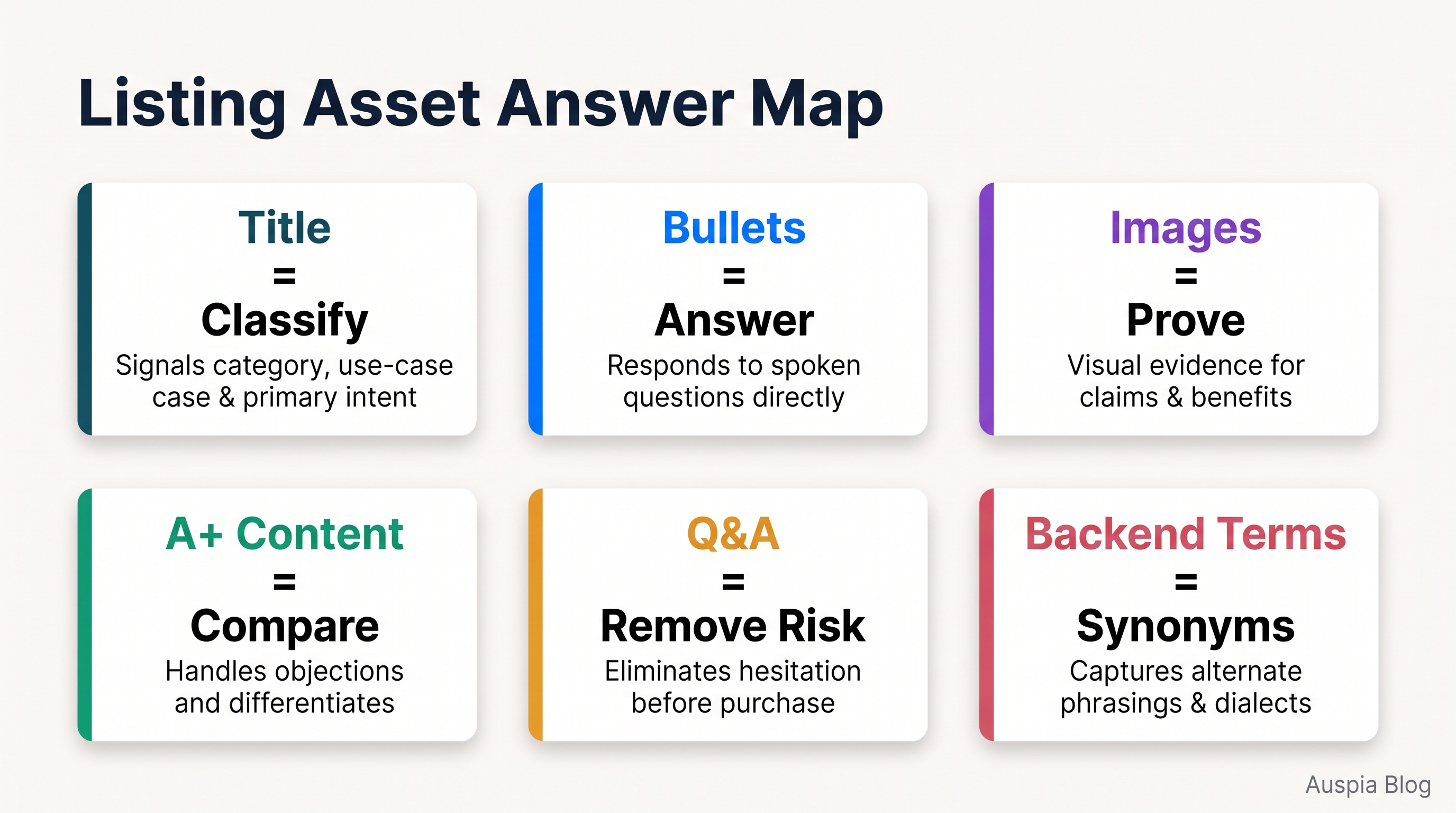
A strong Amazon listing does not ask every field to do the same job. Each module should carry a different kind of answer.
Listing asset | GEO job | What it should answer | What to avoid |
|---|---|---|---|
Title | Classify | What is this product, for whom, and for which primary use? | Stacking synonyms until the title becomes unreadable |
Bullets | Answer | What use cases, constraints, and benefits matter most? | Generic benefit claims with no buyer context |
Images | Prove | Can the buyer see size, fit, result, contents, or compatibility? | Decorative lifestyle shots that do not reduce uncertainty |
A+ Content | Compare | Which variant, use case, or feature should the buyer choose? | Brand storytelling that ignores practical questions |
Q&A | Remove risk | What objections stop a buyer before purchase? | Leaving repeated questions unanswered |
Reviews | Supply evidence | What do real buyers confirm or complain about? | Treating reviews only as a star rating |
Backend terms | Capture language | Which relevant synonyms and alternate phrasings are missing? | Adding irrelevant keywords, competitor brands, or repetition |
Amazon's own seller guidance has long emphasized product titles, descriptions, bullet points, search terms, images, pricing, and keyword research. Manage Your Experiments also gives eligible sellers ways to test content such as titles, images, bullet points, descriptions, and A+ Content. GEO does not replace those fundamentals. It gives them a buyer-question operating model.
A Teardown: Keyword Stuffing Versus Answer Design
The fastest way to understand Product Listing GEO is to compare two listing styles.
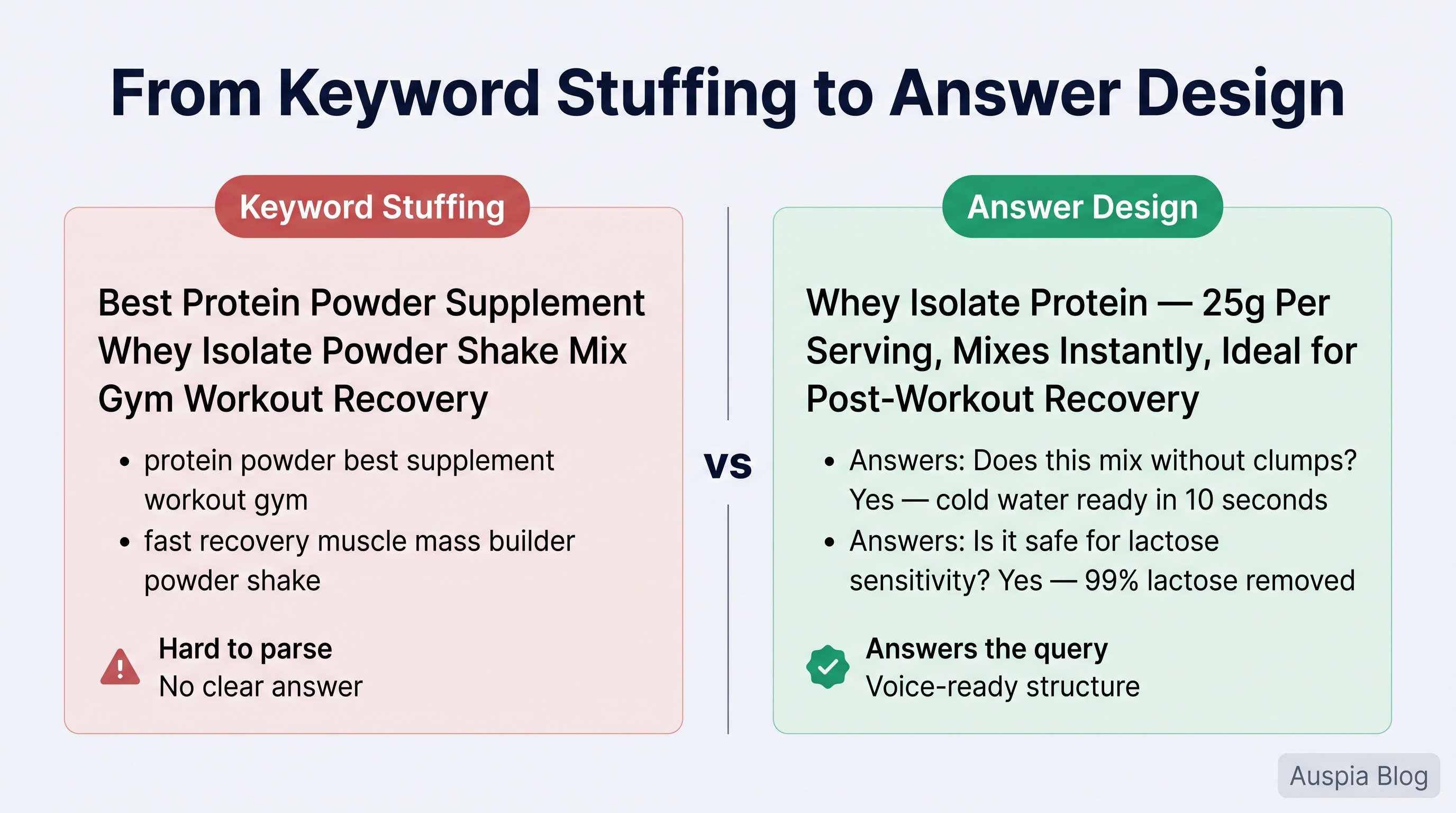
A keyword-stuffed protein powder listing might say:
Best Protein Powder Supplement Whey Isolate Powder Shake Mix Gym Workout Recovery Muscle Mass Builder
The listing is full of searchable words, but it is not easy to parse. It does not answer whether the powder mixes well, whether it is suitable for lactose-sensitive buyers, how much protein is in each serving, or who should choose this variant.
An answer-designed version might say:
Whey Isolate Protein - 25g Per Serving, Mixes Instantly, Ideal for Post-Workout Recovery
Then the bullets answer spoken questions:
Buyer question | Stronger listing answer |
|---|---|
Does it mix without clumps? | Mixes in cold water in about 10 seconds with a shaker bottle. |
Is it suitable for lactose-sensitive buyers? | Whey isolate formula with 99% lactose removed; check ingredients if highly sensitive. |
How many servings are in the tub? | 30 servings per container; one scoop per serving. |
Is it for bulking or recovery? | Designed for post-workout recovery and daily protein support. |
The second version still uses keywords, but the structure is easier for buyers, search systems, and AI answer systems to understand.
Title GEO: Classify Before You Persuade
The title is not the place to answer every possible question. It is the place to classify the product accurately and name the primary purchase reason.
A useful title pattern is:
Brand + product type + essential attribute + primary use case + key quantity/compatibility
Examples:
Product | Weak title pattern | Stronger GEO title pattern |
|---|---|---|
Dishwasher tablets | Best Dishwasher Pods Tablets Cleaner Lemon Fresh Bulk | Lemon Dishwasher Tablets, 60 Count - Hard-Water Cleaning Pods for Daily Dishwashing |
Air filter | Replacement Filter Compatible HEPA Purifier Filter | HEPA Replacement Filter for Model 300 Air Purifier - 2 Pack for Bedroom and Office Use |
Dog wipes | Dog Wipes Pet Cleaning Grooming Deodorizing Wipes | Fragrance-Free Dog Wipes, 100 Count - Gentle Paw and Coat Cleaning for Sensitive Skin |
A strong title helps Amazon search and voice interpretation by making the product easy to classify. It also helps a buyer remember the item later when they say a reorder phrase.
Bullet GEO: Answer The Spoken Questions
Bullets should not repeat the title with slight variations. They should answer the highest-value buyer questions from your query map.
A practical five-bullet structure:
- Primary use case: Who is this for and when should they use it?
- Important specification: Size, quantity, compatibility, ingredient, material, or capacity.
- Proof of claim: What makes the benefit believable?
- Objection handling: Safety, fit, setup, smell, durability, or return concern.
- Reorder or routine cue: How long it lasts, when to replace it, or how to choose the right variant.
For example, a replacement air filter listing might use:
Bullet role | Example answer |
|---|---|
Use case | Designed for bedrooms, home offices, and small living rooms. |
Specification | Fits Model 300 air purifiers; check the model number before ordering. |
Proof | Multi-layer filtration captures dust, pollen, and pet dander. |
Objection | No tools required; filter clicks into place in under one minute. |
Routine | Replace every 3-6 months depending on air quality and daily usage. |
This is more useful than five bullets that all say "premium filter," "high quality filter," and "best replacement filter."
Image GEO: Prove What Text Cannot Prove
Images are often the strongest underused GEO asset. Voice and AI shopping still need evidence, and product images can communicate facts that text makes tedious.
Use image slots to prove:
- Size and scale against a familiar object.
- What is included in the box.
- Compatibility with models, dimensions, or parts.
- Before/after outcomes when allowed and truthful.
- Ingredient, material, or construction details.
- Variant differences such as scent, color, pack size, or flavor.
- Usage steps and installation process.
If buyers ask "Will this fit?" a compatibility chart image may do more for conversion than another lifestyle photo. If buyers ask "How big is it?" a scale image may reduce returns. If buyers ask "Which variant should I buy?" a comparison image can prevent wrong-variant purchases.
A+ Content GEO: Compare Without Crowding The Listing
A+ Content is where sellers can handle richer questions without overloading the title or bullets.
Use A+ Content for:
Question type | A+ Content module idea |
|---|---|
Which variant should I choose? | Comparison chart by use case, size, flavor, scent, or compatibility |
How does this solve my problem? | Problem-solution module with specific buyer scenarios |
What makes this different? | Differentiator table with claims supported by facts |
How do I use it? | Step-by-step visual guide |
What should I buy next? | Routine, bundle, accessory, or replacement-cycle module |
This is where sellers should build answer depth. A+ Content can support AI shopping because it clarifies relationships: product-to-use-case, variant-to-buyer, accessory-to-main product, and feature-to-objection.
Q&A And Reviews: Mine The Queries You Did Not Invent
If a question appears repeatedly in Q&A, reviews, support tickets, or return reasons, it is no longer a random question. It is a listing gap.
Look for repeated patterns:
Customer language | What it may reveal | Listing fix |
|---|---|---|
"Does not fit" | Compatibility is unclear | Add model chart to title, bullets, image, and Q&A |
"Smaller than expected" | Scale is unclear | Add dimensions and scale image |
"Strong smell" | Scent expectation mismatch | Clarify fragrance level and ingredients |
"Hard to assemble" | Setup friction | Add installation image and Q&A answer |
"Bought wrong size" | Variant confusion | Rename variants and add comparison table |
Reviews should not be manipulated or treated as copy. But review themes are valuable research. They tell you what buyers need an answer to before they trust the listing.
Backend Search Terms: Use Synonyms, Not A Junk Drawer
Backend terms are useful when they capture relevant alternate wording that does not belong naturally in visible copy. They are not a place for irrelevant categories, competitor names, repeated terms, or claims the product cannot satisfy.
Good backend candidates include:
- Alternate spellings.
- Abbreviations.
- Regional phrasing.
- Use-case synonyms.
- Material or attribute synonyms.
- Compatible model wording when accurate.
Bad backend candidates include:
- Competitor brand names.
- Unrelated high-volume categories.
- Repeated words already covered naturally.
- Medical, safety, or performance claims you cannot support.
- Keywords that would attract the wrong buyer and increase returns.
For GEO, backend terms are the synonym layer. They help capture language variety, while visible assets answer the buyer's actual questions.
The Product Listing GEO Scorecard
Use this scorecard before rewriting a product family.
Question | 0 points | 1 point | 2 points |
|---|---|---|---|
Does the title classify the product clearly? | Vague or stuffed | Clear category but weak use case | Clear category, attribute, and use case |
Do bullets answer buyer questions? | Generic claims | Some specs included | Each bullet answers a distinct question |
Do images prove important facts? | Decorative only | Some specs shown | Size, fit, contents, comparison, or proof shown |
Does A+ Content help choose? | Brand-only story | Some feature explanation | Clear comparison and use-case modules |
Does Q&A remove objections? | Sparse or unanswered | Some answers | Repeated objections answered directly |
Do reviews reveal content gaps? | Not reviewed | Reviewed manually | Review themes mapped to listing updates |
Are backend terms relevant? | Stuffed or irrelevant | Mostly relevant | Synonyms only, no repetition or false intent |
Is there a testing plan? | None | Informal check | Experiments or metric review scheduled |
A product family scoring under 10 has a GEO clarity problem. A product family scoring 12 or higher is usually easier for buyers and assistant-style systems to understand.
How To Rewrite Without Creating Repetition
Because sellers often manage many ASINs, listing GEO can accidentally create duplicate-looking content. Use these rules to keep pages distinct:
- Give every variant a specific reason to exist.
- Change the primary use case when the product actually serves a different buyer.
- Use review language specific to that product, not generic category claims.
- Keep titles consistent enough for reorder, but not identical across variants.
- Put comparison logic in A+ Content instead of repeating the same bullet language everywhere.
- Test one meaningful change at a time when using experiments.
The goal is not to make every listing sound like the same template. The goal is to make every listing answer the questions that belong to that product.
FAQ
What is Amazon Product Listing GEO?
Amazon Product Listing GEO is the process of structuring titles, bullets, images, A+ Content, Q&A, reviews, and backend terms so search engines, AI shopping assistants, and buyers can understand the product and its best use cases.
Is Product Listing GEO different from Amazon SEO?
Yes, but it builds on Amazon SEO. Amazon SEO focuses on search relevance and conversion fundamentals. Product Listing GEO adds a question-and-answer layer for AI shopping, voice queries, comparison intent, objections, and repeat-purchase behavior.
Should I put Alexa GEO keywords in my product title?
Only if the wording accurately describes the product and improves clarity. Most voice-style questions belong in bullets, images, A+ Content, or Q&A rather than in the title.
Which listing asset matters most for AI shopping?
There is no single asset. Titles classify, bullets answer, images prove, A+ Content compares, Q&A removes risk, reviews provide evidence, and backend terms capture synonyms.
How often should sellers update listings for GEO?
Review high-value ASIN families monthly or after meaningful changes in search terms, ads data, reviews, Q&A, returns, or competitor positioning. Test major changes rather than rewriting everything at once.
Auspia Takeaway
Product Listing GEO is answer design. The title tells the system what the product is. Bullets answer the buyer's spoken questions. Images prove the claims. A+ Content helps people choose. Q&A removes risk. Backend terms catch language variation.
When those assets work together, the listing becomes easier to retrieve, easier to summarize, easier to trust, and easier to reorder.
Author: Ryan Chen, Senior Amazon Operations Expert with 10 Years in Marketplace Growth at Auspia. Ryan writes about Amazon GEO, marketplace search behavior, AI-assisted product discovery, listing optimization, and operational playbooks for Amazon sellers.


