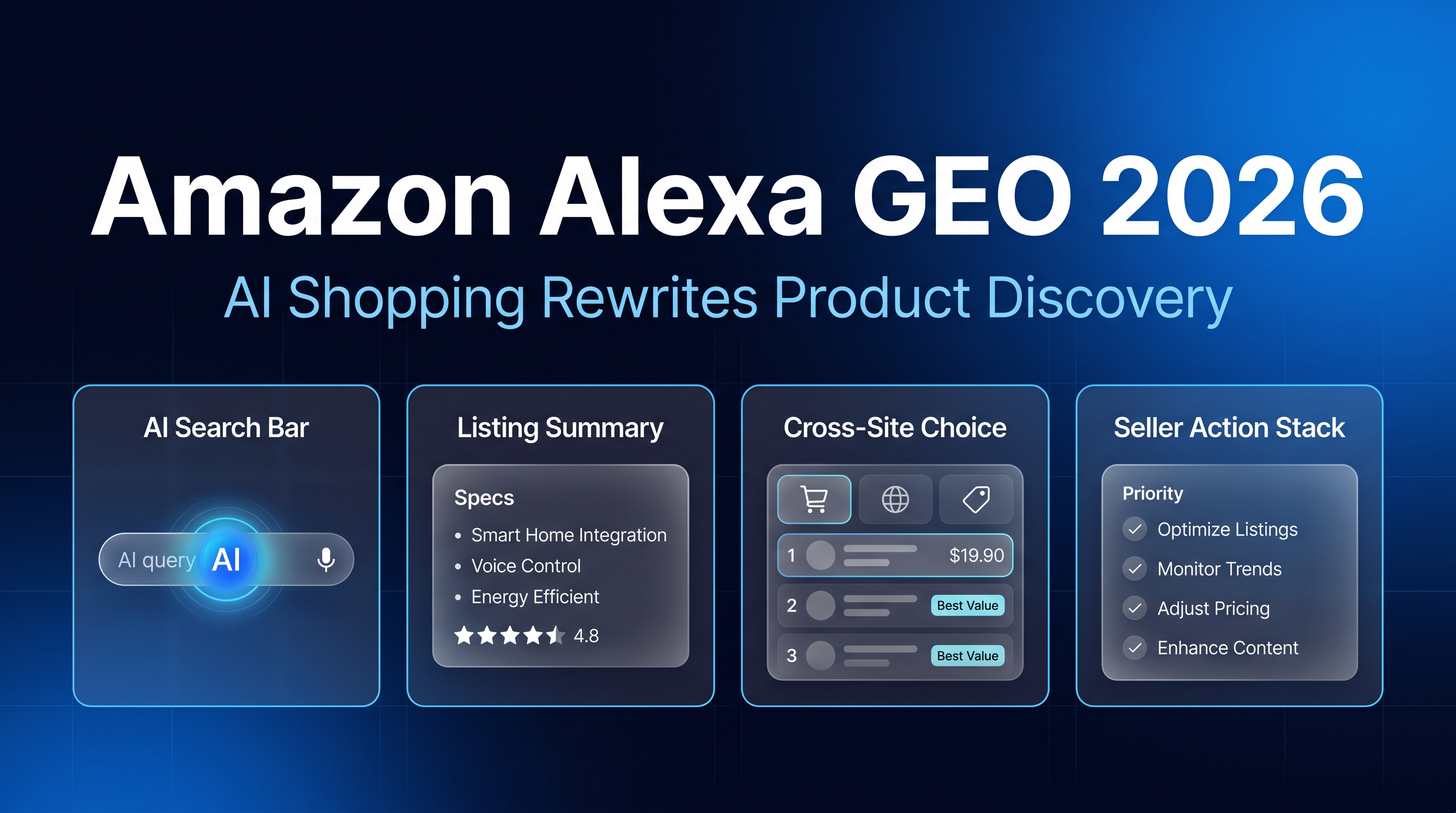
Short Version: Amazon GEO Is Moving From Keyword Rank To AI-Mediated Choice
In 2026, Amazon sellers should treat Alexa-style shopping assistants as a new discovery layer, not a cosmetic search feature. The important shift is not whether Rufus, Alexa, or another Amazon assistant name appears in the interface. The shift is that buyers increasingly describe a situation, constraint, or outcome, and the AI layer compresses product pages, reviews, prices, delivery facts, and outside signals into a smaller recommendation set.
That changes the seller's job. A listing still needs keywords, but it also needs machine-readable product facts, review evidence, precise use-case language, price confidence, and off-Amazon consistency. In other words, Amazon GEO is becoming the operating discipline for being understood, summarized, and recommended by AI shopping surfaces.
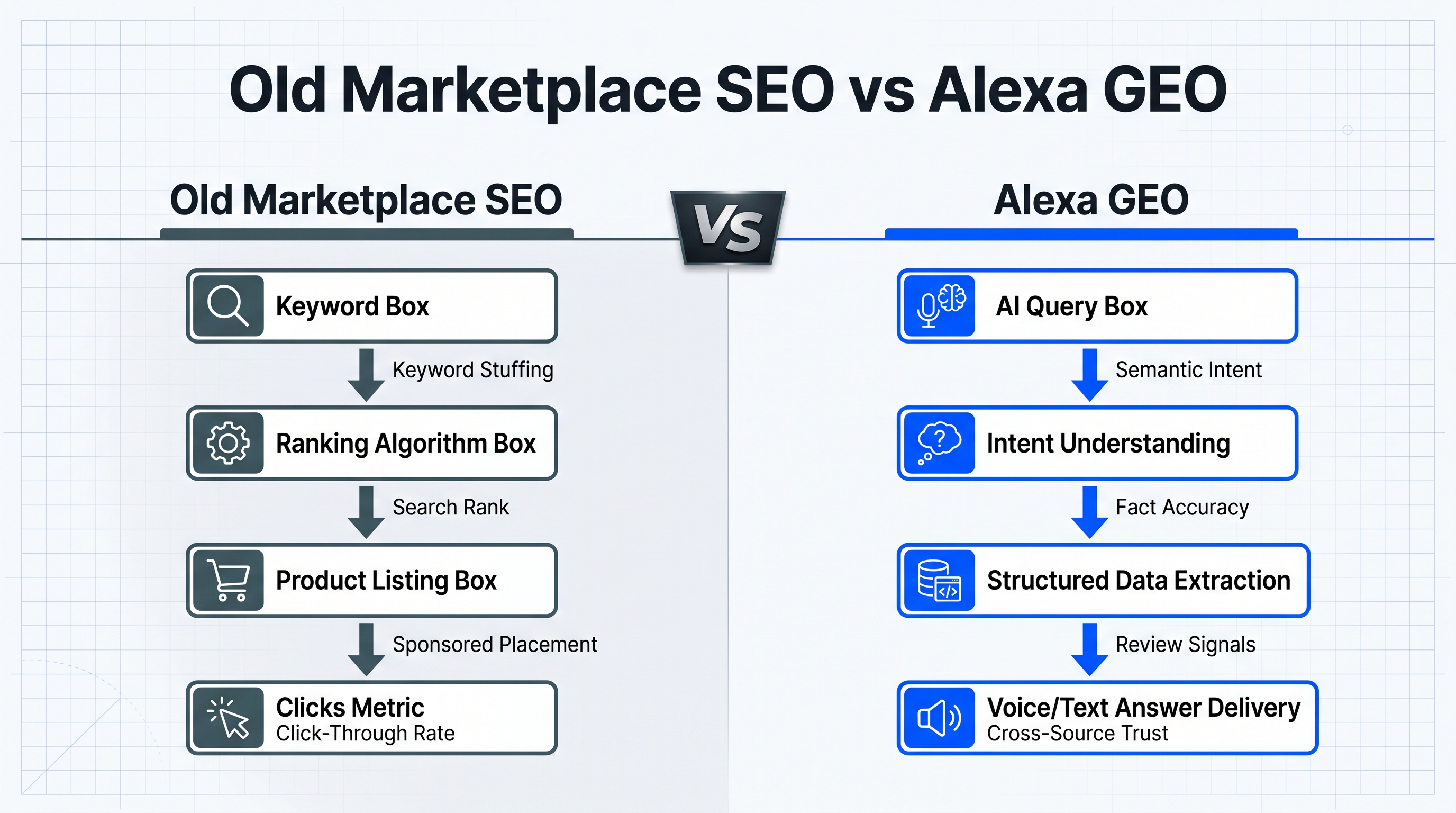
Visual note: Marketplace SEO optimizes the path from keyword to listing click. Alexa GEO optimizes the path from buyer intent to AI-selected product evidence.
What Changed In The Seller Mental Model
The source article this piece is modeled after framed the change as a major Amazon AI shopping reset: the assistant entry point becomes more visible, natural-language search gets stronger, AI-generated summaries influence product evaluation, and cross-site comparison becomes harder to ignore.
For Auspia readers, the practical point is broader and more durable: Amazon optimization is no longer only about winning the search results page. It is about winning the answer that sits between the buyer and the product page.
Old seller habit | 2026 Amazon GEO habit |
|---|---|
Optimize title keywords for exact-match search | Map product facts to natural-language shopping intents |
Treat bullet points as persuasive copy only | Treat bullets as source material for AI summaries |
Monitor rank and ad placement | Monitor answer inclusion, summary accuracy, and comparison context |
Compete only inside Amazon search results | Prepare for cross-site price, review, and availability checks |
Rewrite listings for humans first | Write for humans and for AI extraction at the same time |
This does not mean traditional Amazon SEO is dead. It means the old work has a new evaluation layer above it.
The Five 2026 Signals Sellers Should Watch
1. The AI Entry Point Is Becoming A Default Shopping Habit
When an AI shopping assistant is placed closer to the search box, home screen, browser, or voice device, the behavior changes. Buyers no longer need to know the right keyword. They can ask:
- "quiet air purifier for a small apartment with a washable filter"
- "giftable espresso machine for someone who hates complicated setup"
- "running belt that fits a large phone and does not bounce"
Those prompts contain constraints, objections, and outcomes. A product page that only repeats category keywords may not give the AI enough structured evidence to match the product confidently.
2. Natural-Language Matching Rewards Complete Product Context
Amazon GEO is less about stuffing the phrase "best small apartment air purifier" and more about proving the product is relevant to that situation. Strong pages make the following facts easy to extract:
- dimensions, compatibility, materials, wattage, weight, and noise level;
- ideal buyer scenarios and unsuitable scenarios;
- setup difficulty, maintenance requirements, and replacement parts;
- warranty, delivery, returns, and bundled accessories;
- real review patterns that support or contradict the claim.
If a claim matters to buyer choice, it should not be hidden in an image, vague lifestyle paragraph, or unsupported adjective.
3. AI Summaries Reduce The Seller's Control Over The First Impression
AI-generated product summaries can compress a long listing into a short set of deciding facts. That is convenient for buyers, but risky for sellers. If the product page contains weak claims, inconsistent specs, unclear use cases, or review complaints that are not addressed, the summary may emphasize the wrong thing.
A useful operating question is: if Amazon's AI had to summarize this listing in six lines, what would it say, and would that summary help conversion?
4. Cross-Site Comparison Makes Price And Proof More Visible
AI shopping experiences are moving toward comparison: price, delivery, review quality, return confidence, availability, and alternative sellers. Even when the transaction happens on Amazon, the buyer's trust may be shaped by evidence from the wider web.
That makes off-site consistency more important. Seller websites, brand pages, review pages, product manuals, videos, schema, and marketplace feeds should tell the same product story. Conflicting specs create retrieval friction. Missing off-site product evidence weakens trust.
5. Voice And Multi-Device Shopping Compress The Funnel
Alexa-style commerce is not only a search page problem. Voice and device-assisted shopping make the journey shorter. Buyers may ask for a recommendation, hear a compressed answer, and choose from fewer options.
In that environment, clear product identity matters. A product with a memorable model name, consistent category language, and explicit fit-for-use signals is easier for an assistant to retrieve and explain.
A Practical Amazon Alexa GEO Readiness Checklist
Use this checklist before rewriting a listing or launching a new SKU in 2026.
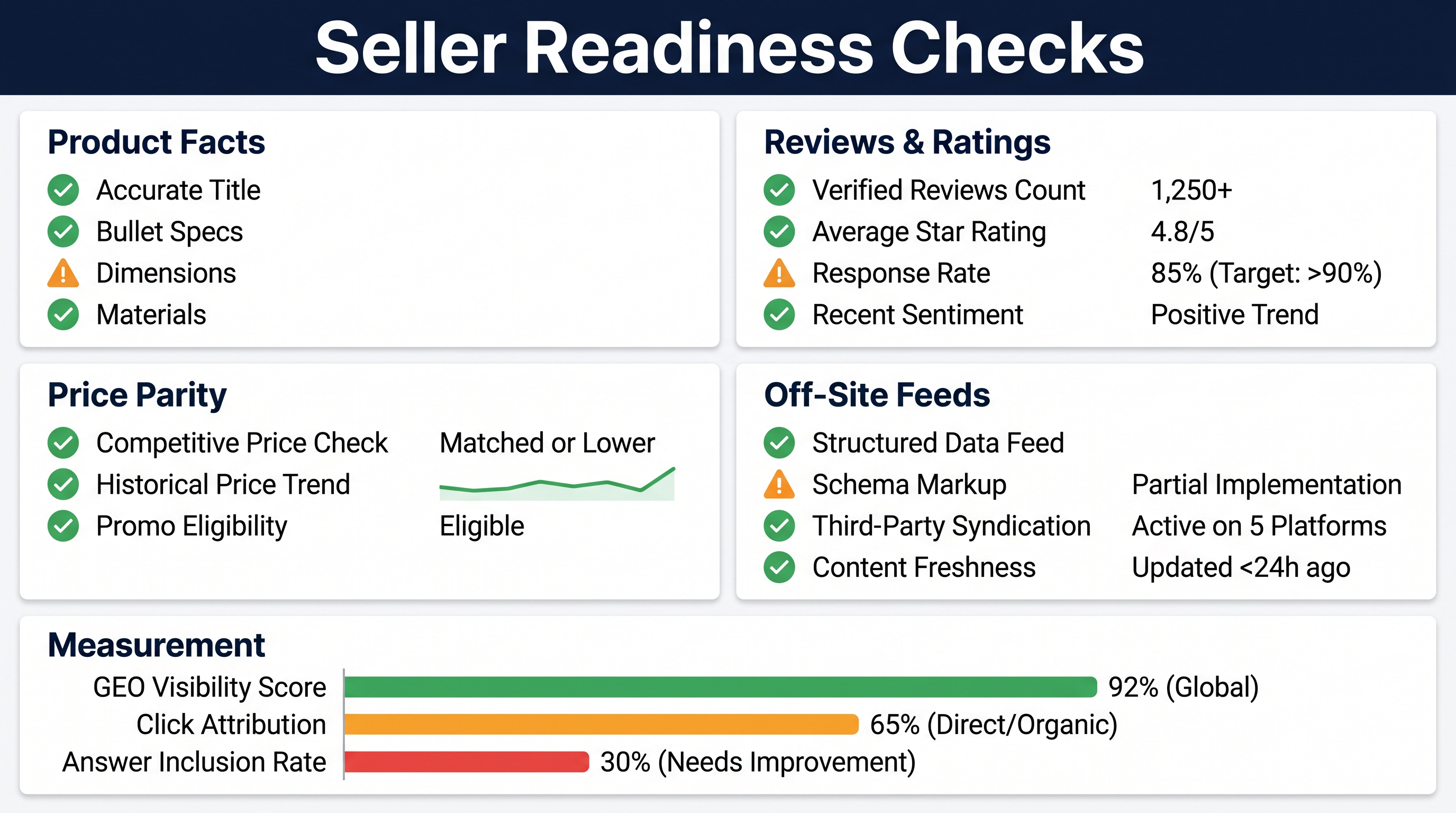
Visual note: Sellers need to audit facts, reviews, pricing, off-site evidence, and measurement together. GEO is not only a copywriting task.
Check | What to review | Good signal |
|---|---|---|
Product facts | Title, bullets, A+ content, specs, comparison tables | The same facts appear consistently across modules |
Intent coverage | Common natural-language buyer prompts | Each prompt has a clear product-fit answer |
Summary risk | What AI may extract from the page | The likely summary highlights the intended differentiators |
Review evidence | Repeated praise and repeated complaints | Claims are supported by review language, not contradicted by it |
Price parity | Amazon price versus other visible channels | Differences are explainable and do not create trust gaps |
Off-site consistency | Brand site, manuals, videos, structured data, feeds | Specs, names, and claims match the Amazon listing |
Measurement | Prompt tests, answer inclusion, rank, CTR, conversion | Seller tracks AI visibility alongside classic marketplace metrics |
For teams building a repeatable process, Auspia's AI Search Visibility Checker is a useful companion for testing how products, brands, and category claims appear across AI answer surfaces.
Listing Rewrite Example: From Keyword Copy To AI-Extractable Evidence
Weak listing copy:
Premium compact air purifier for bedroom and home. Powerful, quiet, stylish, and easy to use. Great for families, pets, and small spaces.
Stronger Amazon GEO copy:
Compact HEPA air purifier for rooms up to 220 sq ft. Runs at 24 dB in sleep mode, includes a washable pre-filter for pet hair, and uses replacement filter model AP-220F. Best fit: bedrooms, nurseries, small apartments, and home offices where low noise matters. Not designed for open-plan rooms above 300 sq ft.
The stronger version works better because it gives the AI layer specific extractable facts. It also states a boundary. Boundaries reduce mismatch, returns, and disappointed reviews.
What Sellers Should Do This Week
Build A Prompt Map
List 20-50 natural-language prompts a buyer might ask before choosing your product. Include constraints such as budget, room size, compatibility, sensitivity, gift use, noise, weight, delivery urgency, and maintenance.
Rewrite The Highest-Impact Modules First
Start with title, bullets, product attributes, comparison table, A+ content, and FAQ-style answers. Do not rewrite everything into robotic prose. The goal is clear human copy with extractable facts.
Create A Summary QA Step
Before publishing a listing update, ask the team to write the six-line AI summary the listing is likely to produce. If the summary misses the value proposition, the listing is not ready.
Align Off-Amazon Evidence
Update brand-site product pages, manuals, schema markup, support pages, and product videos so they reinforce the same specs and use cases. Amazon's AI ecosystem does not exist in isolation from wider buyer research.
Measure Both Marketplace And AI Visibility
Track traditional metrics such as rank, CTR, conversion rate, ad efficiency, and review velocity. Add GEO metrics such as prompt inclusion, summary accuracy, competitor comparison context, and answer sentiment.
What Not To Overreact To
Do not treat every interface rumor as a reason to rewrite your whole catalog. Platform names and placements can change. The durable trend is AI-mediated product selection.
Also avoid the opposite mistake: assuming Amazon GEO is just another name for keyword SEO. If your listing cannot answer buyer constraints in plain language, AI shopping assistants have less evidence to use.
A balanced seller strategy keeps the old fundamentals and adds a new layer:
- keep keyword relevance and category fit;
- make product facts complete and consistent;
- write use-case language that matches real buyer prompts;
- support claims with review evidence and off-site proof;
- test how AI systems summarize and compare the product.
FAQ
Is Rufus completely gone in 2026?
Do not build your strategy around a single assistant name. Amazon has continued investing in AI shopping experiences, and the important seller-side change is the same whether the interface is called Rufus, Alexa, or another shopping assistant: AI systems increasingly summarize, compare, and recommend products before the buyer reads the full listing.
What is Amazon GEO?
Amazon GEO is the practice of making Amazon listings and supporting product evidence easier for generative AI shopping systems to understand, summarize, compare, and recommend. It extends marketplace SEO with AI-readable facts, natural-language intent coverage, review evidence, and cross-channel consistency.
How is Amazon Alexa GEO different from Amazon SEO?
Amazon SEO focuses on ranking and conversion inside marketplace search. Amazon Alexa GEO focuses on whether an AI shopping layer can understand the buyer's request, retrieve your product as a fit, summarize it accurately, and compare it favorably against alternatives.
Should sellers still optimize keywords?
Yes. Keywords still help classification, relevance, ads, and classic search results. The mistake is stopping there. In 2026, strong listings also need explicit specs, use cases, constraints, proof points, and consistency across Amazon and external sources.
What is the fastest first step for a seller?
Pick one important SKU and run a prompt audit. Write the ten natural-language questions buyers are most likely to ask, then check whether the listing provides clear evidence for each answer. Fix the missing facts before changing cosmetic copy.
Author: Ryan Chen, Senior Amazon Operations Expert with 10 Years in Marketplace Growth at Auspia. Ryan writes about Amazon GEO, marketplace search behavior, AI-assisted product discovery, and practical operating playbooks for sellers.