The List Is Where Generic Need Can Become Brand Memory
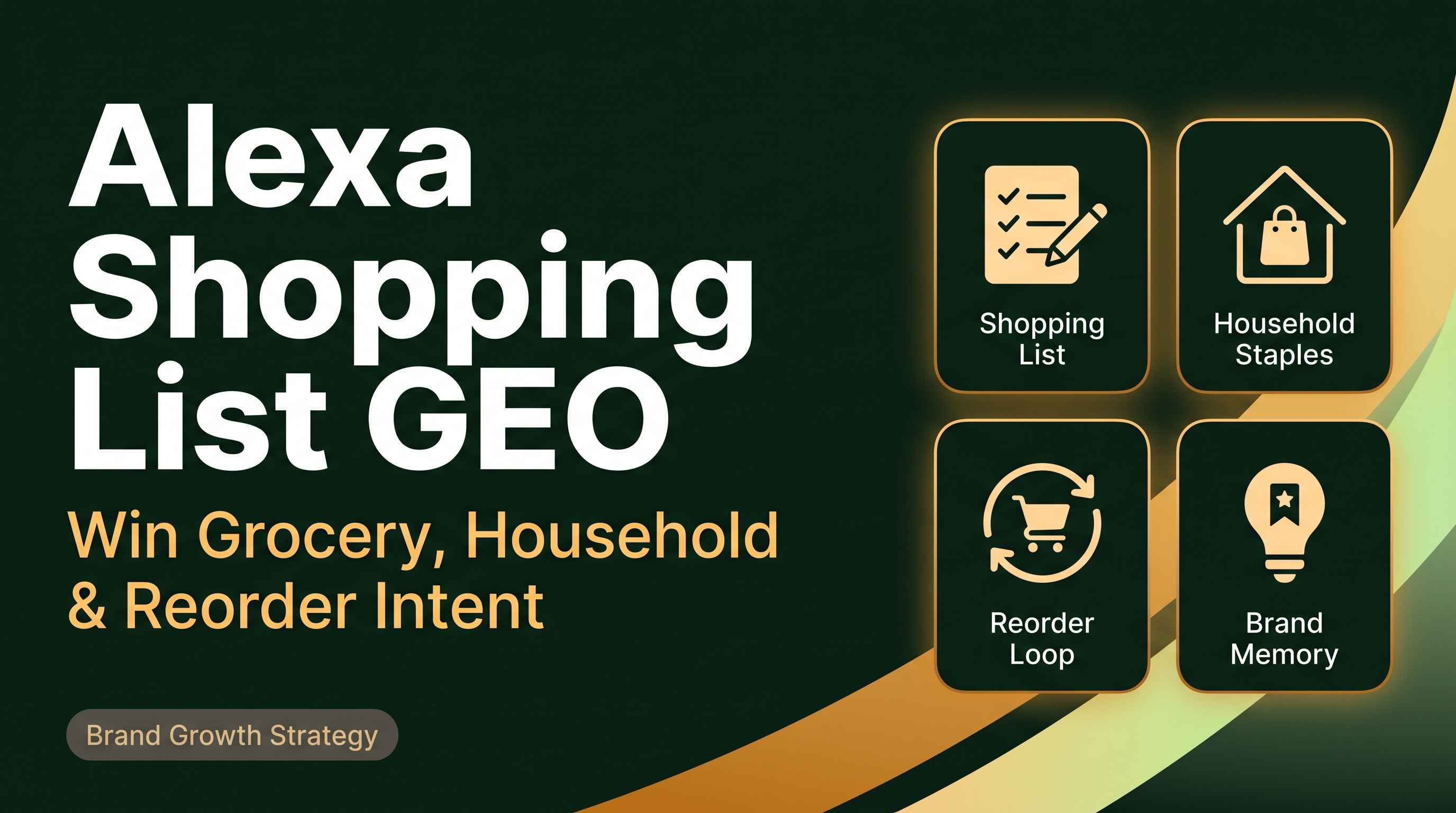
Alexa Shopping List GEO is the practice of making a brand easier to remember, choose, and reorder when shoppers use voice assistants, shared lists, and routine household replenishment. It matters most for grocery, household staples, pet supplies, personal care, office supplies, and other products that buyers run out of and buy again.
This is not about forcing a product into someone's shopping list. It is about understanding the list-to-reorder path: a shopper notices they are running low, adds an item by voice, chooses a product, uses it up, and eventually repeats the behavior. The brand that wins is often the one with the clearest category fit, easiest-to-say name, least confusing variant structure, and strongest reorder cues.
DataForSEO research supports this behavior-led angle. alexa shopping list and close variants showed about 1,600 monthly searches in the U.S. Suggestions also included questions such as how to share alexa shopping list, how to use alexa shopping list, where is my alexa shopping list, can alexa make a shopping list, alexa shopping list not working, and voice shopping with alexa. Those queries are buyer-operations queries, not classic product keywords. For brands, they reveal how shopping begins before the final product search.
Why Shopping List Intent Is Different From Search Intent
Traditional Amazon SEO often starts when the buyer searches for a product. Shopping list intent can start earlier, when the buyer says something like:
- "Add paper towels to my shopping list."
- "Add dog food."
- "Add shampoo."
- "Remind me to buy dishwasher tablets."
- "Reorder the coffee pods I bought last time."
Those phrases may not include a brand at first. The seller opportunity is to turn a generic list item into a remembered, trusted, repeatable product choice.
Search intent | Shopping list intent |
|---|---|
Buyer compares products now | Buyer captures a need for later |
Query may include features and price | Query may be generic and short |
Listing has to win the click | Product has to become memorable and reorderable |
Optimization centers on rank and conversion | Optimization also includes habit, pack size, naming, and replenishment |
For replenishable products, the most valuable question is not only "Can we rank for this keyword?" It is also "Can buyers remember and reorder the right item without confusion?"
The Four Categories With The Clearest List Opportunity
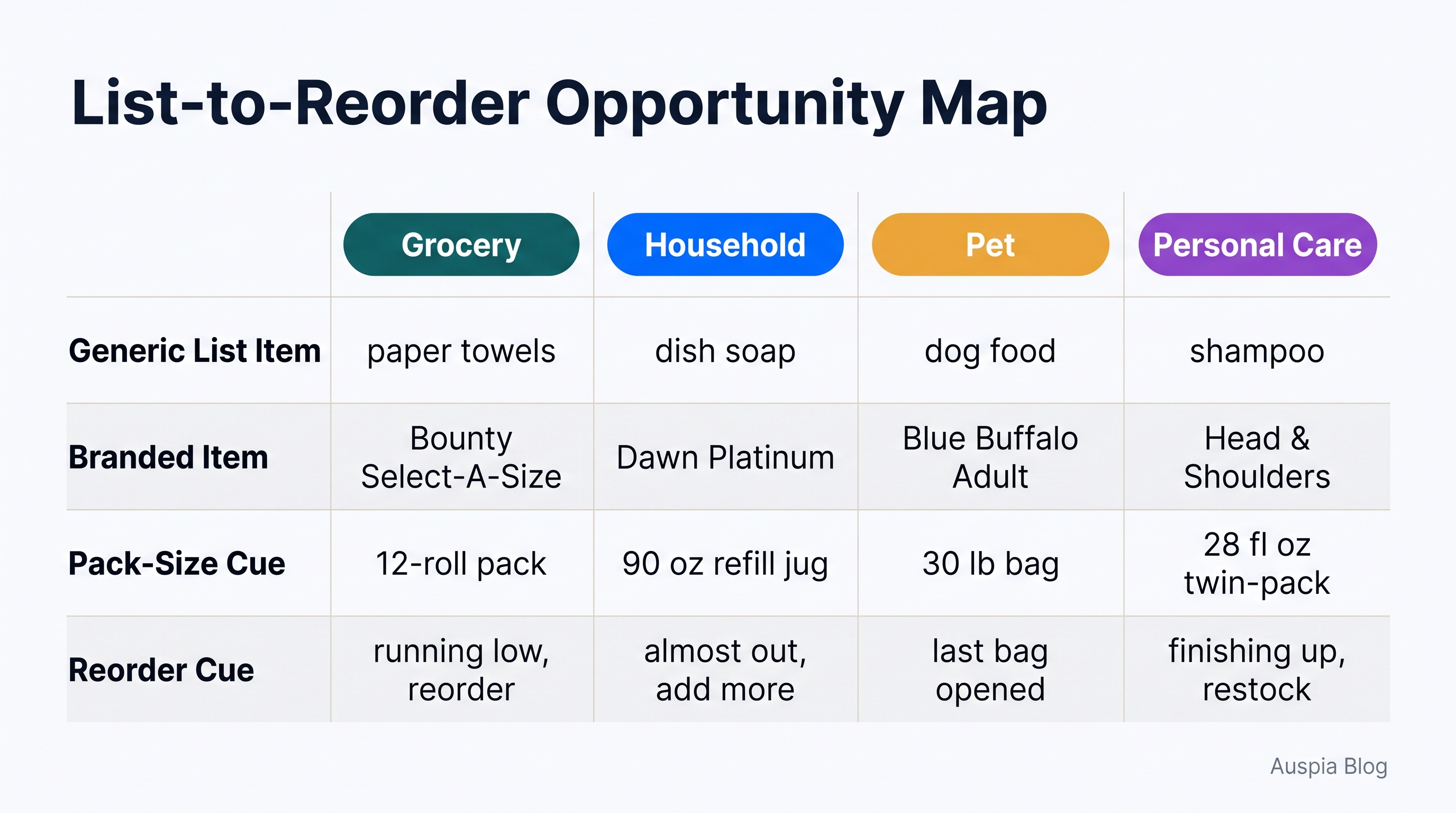
Shopping list GEO is strongest when the product has routine depletion. These categories usually produce clearer list and reorder signals.
Category | Generic list phrase | Brand opportunity | GEO focus |
|---|---|---|---|
Grocery | coffee, cereal, olive oil, protein bars | Become the default product behind a repeat pantry item | Flavor, pack size, dietary need, subscription cues |
Household | paper towels, dish soap, detergent, trash bags | Make size and variant easy to remember | Count, scent, compatibility, refill language |
Pet | dog food, cat litter, treats, flea treatment | Build trust around pet type, size, age, and routine | Breed/size fit, bag weight, formula, replacement cycle |
Personal care | shampoo, toothpaste, wipes, deodorant | Reduce wrong-variant purchases | Scent, skin/hair type, size, twin-pack, sensitivity claims |
A brand does not win list intent by saying "best" more often. It wins by being the easiest correct choice when the buyer moves from need capture to purchase.
The List-To-Reorder Flywheel
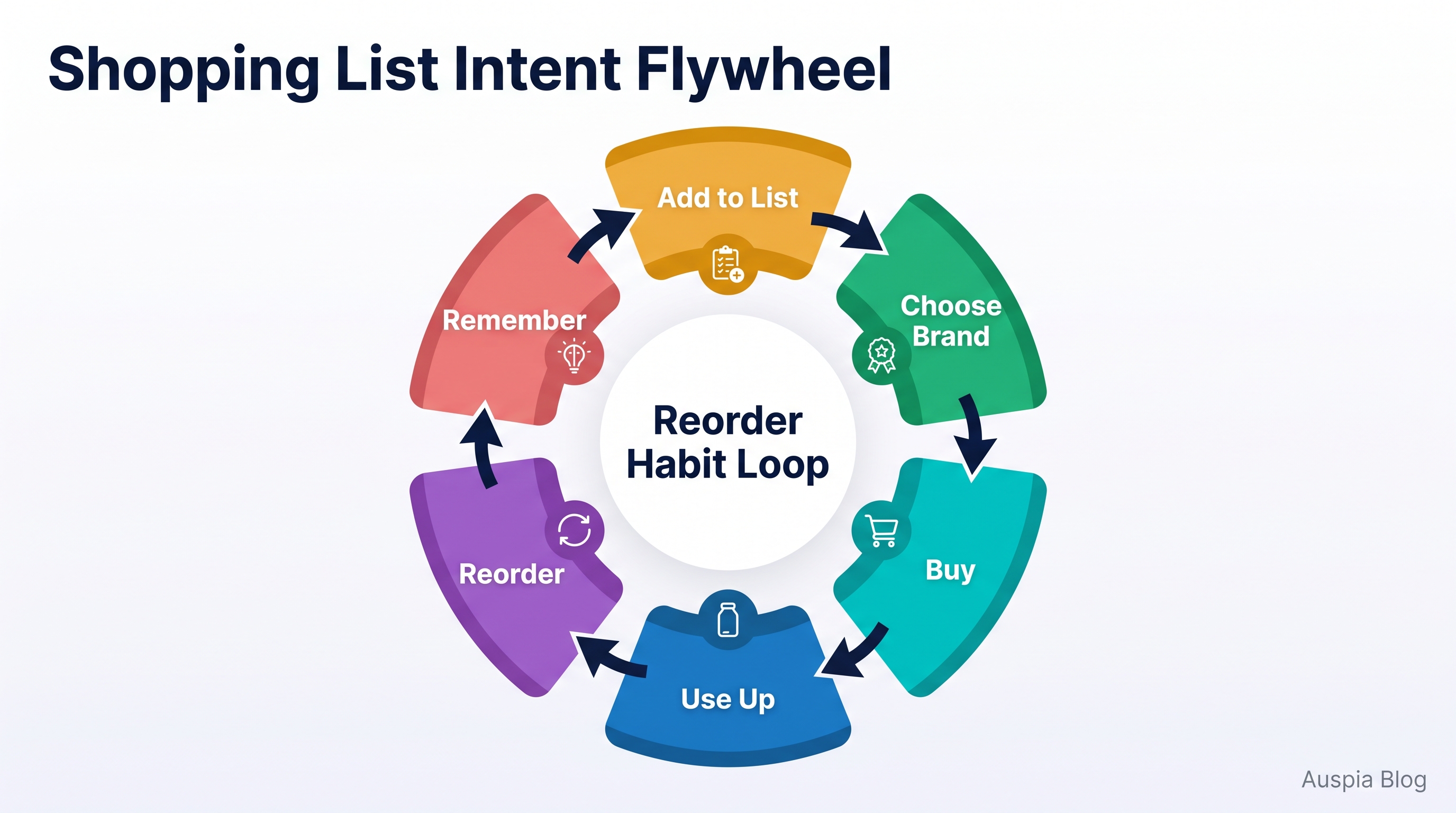
Think of the shopping list as a habit loop with six stages.
1. Add To List
The buyer notices a need. This is often generic: "add laundry detergent" or "add cat food." Sellers cannot control the voice assistant, but they can research which generic items lead to their category and make sure their listing clearly owns the relevant use cases.
2. Choose Brand
The buyer or household member selects a product from the list. This is where Amazon SEO, ads, reviews, price, and listing clarity still matter. If the product is confusing, the list item stays generic or goes to a competitor.
3. Buy
The buyer confirms the item. Pack size, Subscribe & Save, delivery speed, variant clarity, and review confidence influence the decision.
4. Use Up
The product enters the household routine. If the product performs well and the packaging is easy to recognize, the buyer has a reason to repeat.
5. Reorder
The next query may be branded or memory-based: "reorder my usual coffee pods," "buy the same dog food," or "add more lemon dish soap." Clear variant naming makes this easier.
6. Remember
Brand memory becomes the moat. The household does not need to reconsider every time. The product becomes the default answer to a recurring need.
How Brands Can Move From Generic List Item To Remembered Product
The path from "paper towels" to a specific brand is not one content field. It is a sequence of small clarity decisions.
Problem | Seller move | Example |
|---|---|---|
Generic list item has no brand | Make the category and use case obvious | "Paper Towels, 12-Roll Pack, Select-A-Size Sheets" |
Buyer forgets variant | Keep naming consistent across pack sizes | Same scent/flavor/size wording in title and variants |
Household buys wrong size | Put count and pack size in title, image, and bullet | "90 oz refill jug" not hidden in description |
Reorder phrase is ambiguous | Use distinctive but speakable names | Avoid variant names that differ only by tiny suffixes |
Buyer worries about fit or safety | Use Q&A and images to remove risk | Pet formula by age/weight; skin type; device compatibility |
Product is routine | Add replacement-cycle language | "One bag lasts about four weeks for a medium dog" |
This is GEO because the assistant-style shopping path needs a stable product entity: what it is, who it is for, which version it is, and when it should be bought again.
Query Signals Sellers Should Track
For shopping list GEO, do not only track category keywords. Track operational queries and household phrases.
Query type | Example | What it teaches |
|---|---|---|
List usage | how to use alexa shopping list | Buyers use voice lists as a shopping workflow |
Sharing | how to share alexa shopping list with family | Household decisions may involve multiple people |
Location | where is my alexa shopping list | The list may be reviewed in app before buying |
Voice purchase | alexa voice shopping | Some buyers move from list to purchase by voice |
Reorder | alexa reorder | Repeat behavior can matter more than first discovery |
Notifications | turn off amazon shopping notifications on alexa | Privacy and household friction can shape adoption |
Troubleshooting | alexa shopping list not working | Operational failures can interrupt buying behavior |
A seller cannot optimize for all of these directly on a product page. But the signals explain where friction lives. If families share lists, pack size and variant clarity matter. If buyers review the list later in an app, product naming matters. If buyers reorder by memory, brand and variant consistency matter.
What To Change On Amazon Listings
Use the shopping list lens to audit product detail pages.
Product Title
The title should include the product type, pack size or count, essential variant, and primary use case when space allows. For list and reorder behavior, clarity beats cleverness.
Weak: Premium Fresh Clean Dish Soap Refill Lemon Kitchen Degreaser Large Bottle
Stronger: Lemon Dish Soap Refill, 90 oz - Grease-Cutting Kitchen Soap for Daily Dishes
Main Image And Secondary Images
The image set should make the product recognizable when a buyer scans a list or repurchases. Show pack count, size, refill format, variant, and what is included. If the product has multiple scents or formulas, show the difference visually.
Bullets
Bullets should answer routine-use questions:
- How long does this last?
- Who or what is it for?
- Which variant should I choose?
- Is it safe for my household, pet, skin, device, or diet?
- When should I reorder?
A+ Content
Use A+ Content to compare variants and routines. A household buyer may not remember whether they bought "fresh scent," "free and clear," or "sport odor defense." A comparison module can reduce wrong repeat purchases.
Q&A
Answer the questions that block routine purchase: compatibility, allergies, scent strength, pet age, food texture, expiration, storage, and replacement timing.
Brand Memory Rules For Voice And List Behavior
Brand memory is fragile in voice shopping. A name that looks good on a package may be hard to say, spell, or distinguish by voice.
Use these rules:
- Keep the brand and variant name easy to pronounce.
- Avoid variant names that sound too similar.
- Use consistent pack-size language across title, image, and variation names.
- Do not rename the same product differently across ASINs.
- Put the most memorable differentiator in visible copy.
- Use packaging that helps buyers recognize the product when they reorder.
- For consumables, explain when the buyer is likely to run out.
If buyers cannot say it, remember it, or distinguish it, they are less likely to ask for it again.
A 14-Day Shopping List GEO Audit
Use this audit for one replenishable product family.
Day | Action | Output |
|---|---|---|
1-2 | Pull DataForSEO and Amazon suggestions around category, list, and reorder terms | Query sheet |
3-4 | Mine reviews, Q&A, returns, and support tickets for routine-use language | Friction list |
5-6 | Audit title, variations, pack-size wording, and image clarity | Naming gaps |
7-8 | Rewrite bullets for routine, safety, fit, and replacement questions | Answer bullets |
9-10 | Build or improve A+ variant comparison | Choice module |
11 | Add Q&A answers for repeated objections | Risk removal |
12 | Review ad search terms for generic-to-brand movement | Search term notes |
13 | Choose one test: title, image, bullet, or A+ module | Test plan |
14 | Create a monthly measurement dashboard | Repeatable workflow |
Measure conversion rate, repeat purchase rate where available, Subscribe & Save adoption, branded search growth, return reasons, review language, Q&A volume, and ad search term changes.
Mistakes That Weaken Shopping List GEO
Mistake 1: Optimizing only for first purchase. Replenishable categories win when buyers buy again. Treat reorder clarity as a listing requirement.
Mistake 2: Hiding pack size. If buyers cannot quickly distinguish 12-count, 24-count, 90 oz, refill, travel size, or twin-pack, they may choose the wrong item or switch brands.
Mistake 3: Using confusing variant names. Voice and list workflows punish subtle naming differences. Make variants distinct and speakable.
Mistake 4: Ignoring household language. Shared lists are practical. Buyers say "the dog's food," "the big refill," or "the blue shampoo," not always your exact keyword.
Mistake 5: Treating list queries as low-value because CPC is low. DataForSEO showed low CPC for many Alexa shopping list queries, but the strategic value is behavioral. These terms show how routine shopping starts.
FAQ
What is Alexa Shopping List GEO?
Alexa Shopping List GEO is the process of optimizing brand, product, and listing clarity for shopping-list and reorder behavior, especially in routine categories such as grocery, household goods, pet supplies, and personal care.
Does this mean sellers can control Alexa shopping list recommendations?
No. Sellers cannot guarantee Alexa recommendations or control a buyer's list. The controllable work is to make the product easier to choose, remember, distinguish, and reorder when shopping-list behavior leads to Amazon purchasing.
Which products benefit most from shopping list GEO?
Products that run out and are bought repeatedly benefit most: paper towels, detergent, dish soap, coffee, snacks, supplements, pet food, cat litter, wipes, shampoo, toothpaste, filters, batteries, and compatible refills.
Should brands optimize for generic phrases or branded reorder phrases?
Both. Generic phrases help with first discovery and list capture. Branded reorder phrases matter after the buyer has chosen the product once and needs to buy it again with less friction.
What is the first action for a small Amazon seller?
Choose one replenishable ASIN family, review the title and variation names, then make pack size, variant, use case, and reorder timing clearer across the title, images, bullets, and Q&A.
Auspia Takeaway
Alexa Shopping List GEO is about habit, not just search. The list captures a need. The listing turns that need into a product choice. The product experience creates the memory. Clear naming, pack-size visibility, variant consistency, and reorder cues help the brand become the default answer the next time the household runs low.
For sellers in grocery, household, pet, and personal care, this is one of the most practical ways to connect Amazon SEO, Alexa behavior, and repeat purchase strategy.
Author: Eva Laurent, Ecommerce Search Strategist for 10k+ Product Pages at Auspia. Eva writes about ecommerce SEO, product discovery, category content, and repeat-purchase search behavior.