A+ Content Is Where Sellers Can Answer The Questions Bullets Cannot Carry
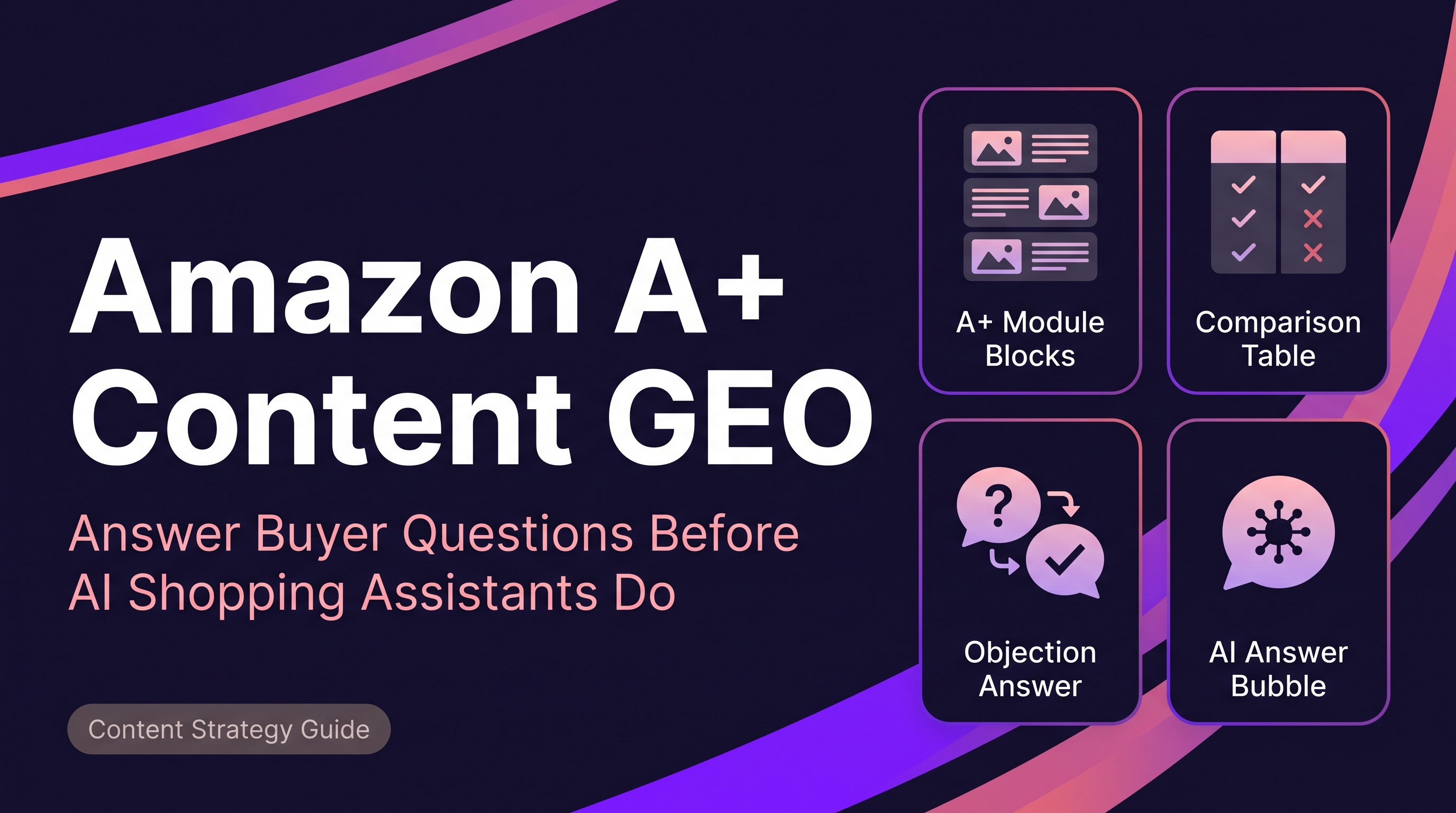
Amazon A+ Content GEO is the practice of using enhanced product content to answer the buyer questions that are too visual, comparative, or nuanced for a title and bullet list. It helps sellers explain use cases, compare variants, prove claims, reduce objections, and prepare the product for AI shopping summaries.
The core idea is simple: if an AI shopping assistant or voice-led buyer has to decide whether your product fits a need, your A+ Content should already contain the answer. It should not just tell a brand story. It should resolve practical shopping uncertainty.
This matters because titles and bullets have limited space. Reviews and Q&A are reactive. A+ Content gives sellers room to organize the product decision before the buyer asks someone else, compares competitors, or lets an assistant summarize the category for them.
The A+ Question Journey
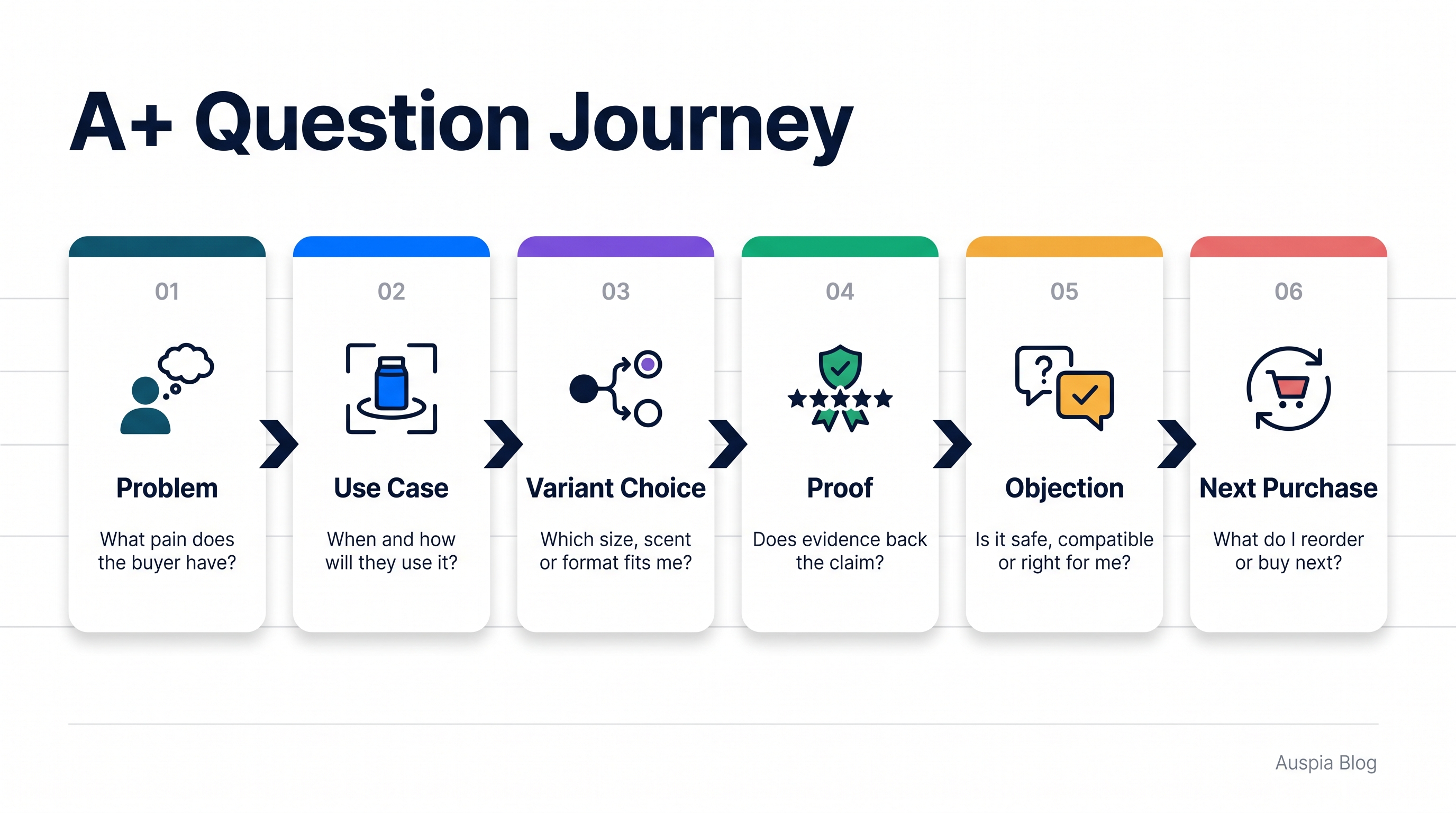
Strong A+ Content does not start with the brand. It starts with the buyer's decision path.
Stage | Buyer question | A+ Content job |
|---|---|---|
Problem | What pain am I trying to solve? | Name the use case clearly |
Use case | When and how will I use this? | Show real scenarios and constraints |
Variant choice | Which size, scent, flavor, formula, or format is right? | Compare options without confusion |
Proof | Does the claim have evidence? | Use specs, materials, certifications, review themes, or demonstrations |
Objection | Is it safe, compatible, durable, or suitable? | Answer the concern directly |
Next purchase | What do I reorder, refill, or buy with it? | Support routine, bundle, or accessory decisions |
If A+ Content cannot answer these questions, AI shopping systems and human shoppers may fill the gaps using competitor pages, reviews, ads, or generic summaries.
Why A+ Content Matters For GEO
GEO is about making content easy for answer systems to understand, cite, and summarize. On Amazon, A+ Content can support that by giving the product page structured explanation beyond the basic listing fields.
A+ Content helps with:
- Entity clarity: what the product is, which category it belongs to, and how variants relate.
- Use-case clarity: who should buy it and when it is the right fit.
- Comparison clarity: how one variant differs from another.
- Evidence clarity: what supports the product's claims.
- Objection clarity: what buyers worry about before purchase.
- Routine clarity: how the product is used, replaced, or reordered.
Amazon's own seller guidance around listing optimization emphasizes titles, bullets, descriptions, images, and A+ Content as controllable assets. For GEO, A+ Content is especially useful because it can hold explanation, not just keywords.
Six A+ Modules That Answer Buyer Questions
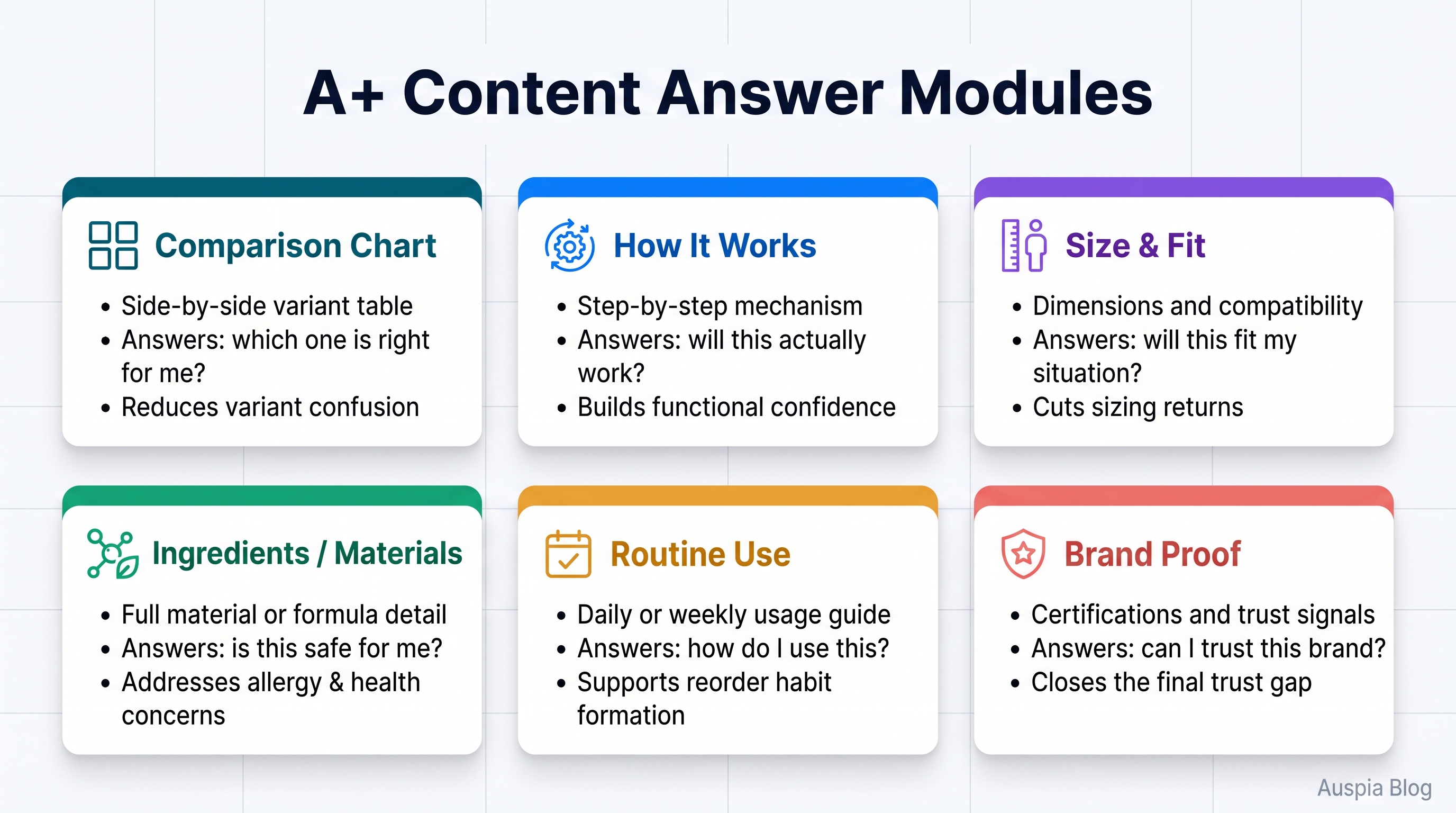
Use A+ modules as answer modules, not decoration.
Module | Buyer question it answers | Best for |
|---|---|---|
Comparison chart | Which version is right for me? | Variants, sizes, flavors, formulas, bundles |
How it works | Will this actually solve my problem? | Devices, supplements, cleaning products, tools |
Size and fit | Will this fit my space, body, device, pet, or model? | Apparel, parts, filters, accessories, home goods |
Ingredients/materials | Is this safe, durable, or suitable? | Food, supplements, skincare, pet, kids, household |
Routine use | How often do I use, replace, or reorder it? | Consumables, refills, subscriptions, replacement parts |
Brand proof | Can I trust this seller or product line? | Premium products, new brands, technical categories |
A+ Content performs best when each module has a job. If every module repeats the same slogan, the page looks richer but answers less.
Build A+ Content Around The Missing Question
Before creating an A+ module, identify which question is missing from the current listing.
Missing question | A+ module to build | Example |
|---|---|---|
Which variant should I choose? | Comparison chart | Sensitive skin vs daily clean vs extra strength |
How do I know it fits? | Size and compatibility module | Model list, measurements, fit guide |
Is the ingredient safe for my situation? | Ingredient/material explainer | Fragrance-free, allergen notes, material details |
How does the product work? | Process or mechanism module | Three-step cleaning, filter layers, usage flow |
Why is this better than a cheaper option? | Proof and differentiator module | Materials, count, warranty, review themes |
What should I reorder? | Routine use and replenishment module | Pack duration, refill format, Subscribe & Save cue |
This approach prevents A+ Content from becoming a generic brand brochure.
Example: A+ Content For A Replacement Filter
A replacement filter listing often fails because buyers worry about fit. The title and bullet can say "compatible," but A+ Content can prove it.
A+ section | Content idea | Question answered |
|---|---|---|
Compatibility chart | Model 100, 200, 300 supported; model 400 not supported | Will this fit my device? |
Size diagram | Exact dimensions with measurement callouts | Is this the same size as my current filter? |
Installation steps | Remove panel, replace filter, reset indicator | Can I install it myself? |
Replacement timing | Replace every 3-6 months depending on air quality | When do I reorder? |
Comparison module | Standard filter vs allergy filter vs pet filter | Which variant should I choose? |
Q&A prompt | Common fit and setup questions | What could go wrong? |
This is stronger GEO than repeating "replacement filter compatible HEPA" five times. It gives both the buyer and an answer system structured evidence.
Example: A+ Content For A Personal Care Product
Personal care buyers often need safety, fit, scent, and routine answers.
A+ section | Content idea | Question answered |
|---|---|---|
Skin/hair type guide | Oily, dry, sensitive, color-treated, daily use | Is this for me? |
Ingredient explainer | Key ingredients and what they do | Is it safe or suitable? |
Scent module | Fragrance strength and unscented option | Will I like the smell? |
Routine module | Morning/evening use, frequency, expected bottle duration | How do I use and reorder it? |
Variant comparison | Travel size, standard bottle, twin pack | Which size should I buy? |
Review theme callout | Common buyer outcomes summarized carefully | What do other buyers experience? |
The goal is not to make medical claims. The goal is to clarify product fit with factual, compliant content.
The A+ Content GEO Scorecard
Use this scorecard before publishing or refreshing A+ Content.
Question | Weak A+ Content | Strong A+ Content |
|---|---|---|
Does it answer a real buyer question? | Brand story only | Each module maps to a decision question |
Does it compare variants clearly? | Similar products listed without guidance | Buyer can choose by use case, size, formula, or routine |
Does it prove claims? | Vague benefit language | Specs, images, materials, certifications, or review themes support claims |
Does it reduce objections? | Avoids risk topics | Answers fit, safety, compatibility, size, scent, or setup |
Does it support repeat purchase? | No reorder guidance | Explains refill, replacement, routine, or pack duration |
Is it readable for AI summaries? | Dense image text and slogans | Clear headings, simple structure, repeated entity clarity |
Does it avoid duplication? | Same copy across every ASIN | Product-specific use cases and variant differences |
Can it be tested? | No hypothesis | Module has a measurable goal such as conversion or return reduction |
A+ Content should improve buyer confidence. If it only improves page aesthetics, it is underused.
How To Source The Right Questions
Use multiple sources before writing A+ Content:
Source | What to look for |
|---|---|
DataForSEO | Search terms, related questions, category language, voice-search patterns |
Sponsored Products reports | Converting terms, wasted spend, objection queries, reorder phrases |
Reviews | Repeated praise, repeated complaints, use-case language |
Q&A | Questions the listing failed to answer |
Returns | Wrong size, wrong variant, quality mismatch, compatibility problems |
Competitor pages | Comparison points buyers expect in the category |
Support tickets | Confusion that happens after purchase |
Do not copy competitors or reviews. Extract the underlying buyer question, then answer it better with your own product facts.
Common A+ Content GEO Mistakes
Mistake 1: Treating A+ Content as a brand poster. Brand story matters, but buyers still need fit, comparison, proof, and objection answers.
Mistake 2: Repeating bullet copy. A+ Content should add explanation, not duplicate the five bullets with nicer design.
Mistake 3: Hiding important text inside dense images. If text is too small or decorative, it may be less useful for humans and hard for systems to interpret.
Mistake 4: Using the same A+ layout for every variant. Similar structure is fine, but variant-specific questions should change.
Mistake 5: Making unsupported claims. A+ Content should be specific, but not exaggerated. Use careful language and support claims with product facts.
A 10-Module Planning Template
Use this template for one product family.
Module order | Module purpose | Example question |
|---|---|---|
1 | Category and use case | What is this product for? |
2 | Main problem | What problem does it solve? |
3 | How it works | How does it work? |
4 | Variant comparison | Which version should I choose? |
5 | Size/fit/compatibility | Will it fit my situation? |
6 | Ingredients/materials/specs | Is it safe, durable, or suitable? |
7 | Proof | What evidence supports the claim? |
8 | Routine use | How do I use it regularly? |
9 | Reorder or accessory path | What do I buy again or next? |
10 | Brand trust | Why should I trust this product line? |
You do not need all ten modules for every product. Choose the modules that answer real decision questions.
FAQ
What is Amazon A+ Content GEO?
Amazon A+ Content GEO is the use of enhanced product content to answer buyer questions, clarify variants, prove claims, reduce objections, and make product pages easier for AI shopping systems and humans to understand.
Is A+ Content more important than titles and bullets?
No. Titles and bullets still carry core classification and quick answers. A+ Content adds depth for comparison, proof, objections, and use-case explanation.
What should sellers put in A+ Content for Alexa GEO?
Focus on questions that voice or AI shoppers may ask: which version is right, will it fit, is it safe, how does it work, what proof supports the claim, and what should I reorder or buy next.
Should A+ Content include keywords?
It should use natural category and use-case language, but not keyword stuffing. The priority is clear answers, product facts, and buyer decision support.
How do I measure whether A+ Content GEO worked?
Track conversion rate, return reasons, Q&A patterns, review themes, ad query performance, variant selection, and repeat purchase indicators after updating A+ modules.
Auspia Takeaway
A+ Content is one of the best places to turn Amazon SEO into GEO because it gives sellers room to explain. Titles classify. Bullets answer quickly. A+ Content helps buyers compare, trust, choose, and remember.
If your A+ Content answers the questions before an AI shopping assistant has to, your product page becomes easier to summarize, easier to trust, and easier to buy.
Author: Eva Laurent, Ecommerce Search Strategist for 10k+ Product Pages at Auspia. Eva writes about ecommerce SEO, product discovery, category content, and repeat-purchase search behavior.