The 2026 Seller Takeaway
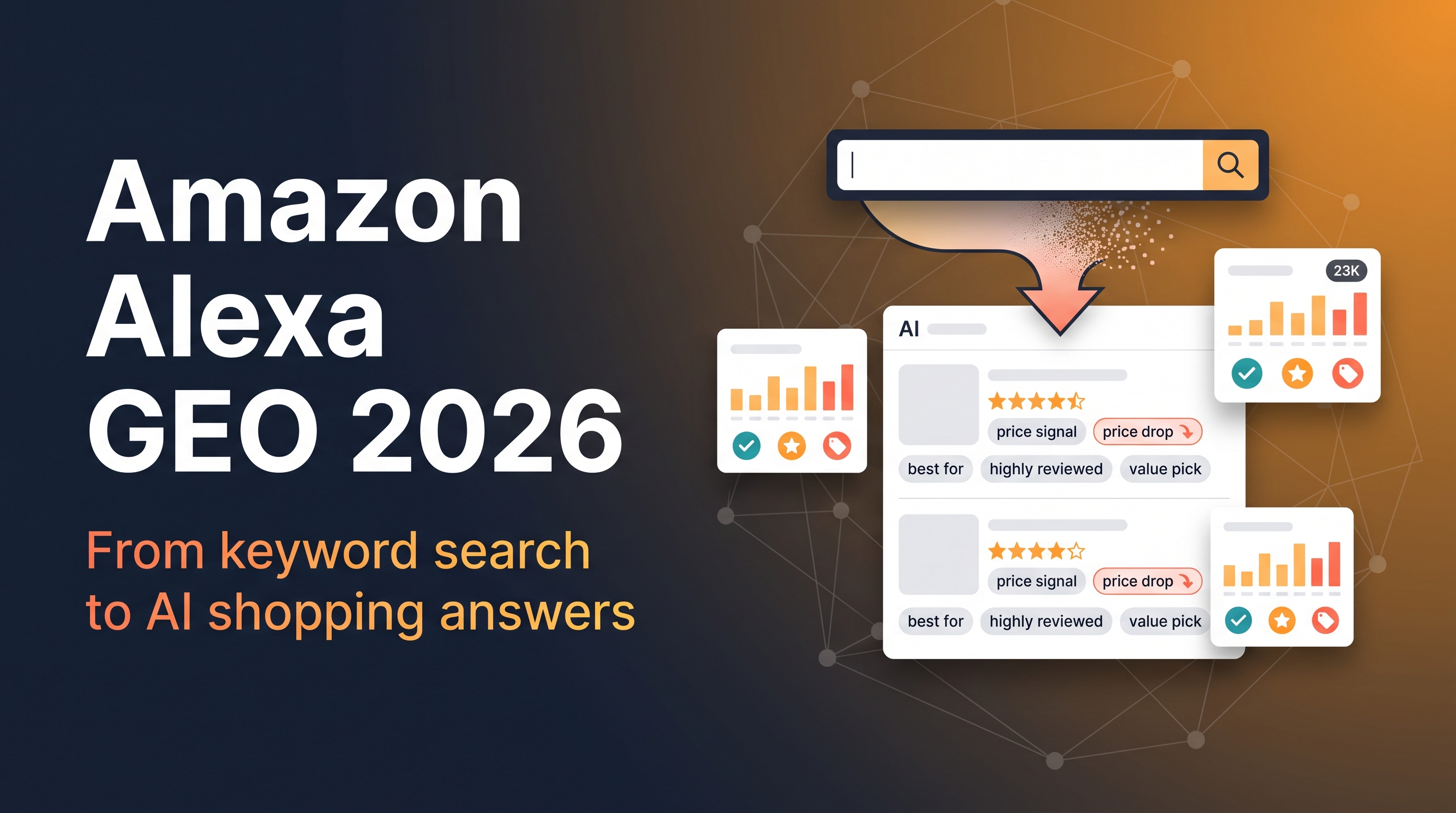
Amazon's AI shopping layer is no longer a side experiment that sellers can ignore. On Amazon's own retail news site, Rufus is now described as having been renamed Alexa for Shopping, while the new Alexa for Shopping announcement says Amazon is bringing together Rufus and Alexa+ on the Amazon Shopping app, website, and Echo Show devices.
For sellers, the practical change is simple: Amazon product discovery is moving from "match my keyword" toward "answer my buying problem." That does not mean keywords disappear. It means the listing now has to give an AI assistant enough structured, trustworthy, human-readable evidence to recommend the product in a conversational buying journey.
If your listing still depends on keyword stuffing, vague claims, thin Q&A, and review volume alone, 2026 is the year to rebuild it for Amazon GEO: product facts, use cases, proof, price trust, and buyer-language questions.
What Actually Changed: Rufus Did Not Just Get a New Name
The important point is not the branding. The important point is the surface area.
Rufus was Amazon's generative AI shopping assistant. Amazon's Rufus page now notes that on May 13, 2026, Rufus was renamed Alexa for Shopping. The separate Alexa for Shopping announcement says customers can ask questions in the main Amazon search bar, build shopping guides, compare products, view price history, automate deal-finding and cart-building, and use the experience for free when signed into an Amazon account.
That changes seller optimization in three ways:
Old seller habit | 2026 Alexa shopping reality | What sellers should do |
|---|---|---|
Optimize for exact-match keywords | Buyers ask conversational questions in search and product contexts | Map buyer questions to listing sections, Q&A, images, and review themes |
Treat the listing as a ranking document | Treat the listing as evidence for an AI answer | Make claims specific, verifiable, and easy to extract |
Watch only Amazon competitors | Alexa can compare products, prices, reviews, and broader web context | Monitor price, positioning, and proof across the category, not just one keyword |
Auspia's view: this is not a reason to panic. It is a reason to stop writing listings for an old search box only.
Why This Is Amazon GEO, Not Just Amazon SEO
Amazon SEO has traditionally focused on keyword relevance, conversion signals, reviews, pricing, availability, and ad performance. Those still matter. Amazon GEO adds a new layer: whether an AI shopping assistant can understand, summarize, compare, and recommend your product for a buyer's intent.
A buyer may not search "stainless steel water bottle 32 oz leakproof." They may ask:
- "What water bottle should I take to the gym that will not leak in my bag?"
- "Is this safe for a teenager's school backpack?"
- "Which option is better for hot coffee and cold water?"
- "What is the difference between these two bottles?"
A listing built only around keyword fragments may rank somewhere, but it gives the assistant weak material for an answer. A GEO-ready listing gives the assistant usable facts:
- capacity, dimensions, materials, compatibility, certifications, care instructions;
- use cases such as commuting, school, gym, travel, pets, outdoor work, or gifting;
- constraints such as not dishwasher-safe, not for carbonated drinks, or not compatible with a specific device;
- review-backed proof such as comfort, durability, fit, smell, noise level, leakage, or setup time;
- price and value context that makes the recommendation feel defensible.
This is why Amazon GEO is closer to answer engineering than keyword insertion.
The Listing Readiness Loop
The fastest way to adapt is to build a loop around the questions Alexa for Shopping is likely to answer: buyer question, AI answer, listing facts, review proof, and price trust.
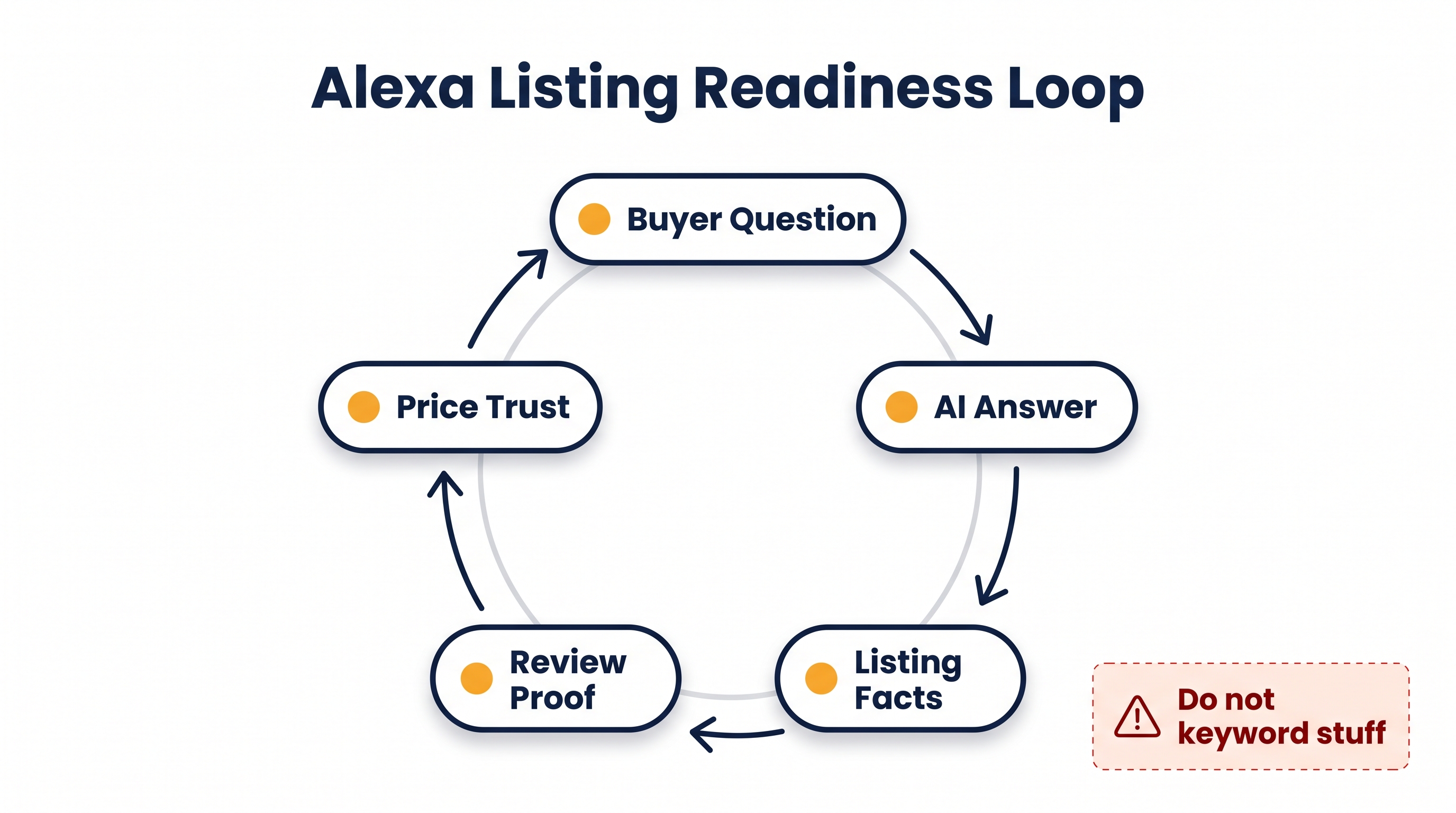
Caption: A 2026 Amazon GEO loop should connect conversational buyer questions to listing facts, review proof, and price trust instead of relying on keyword stuffing.
Use this loop during every listing review:
- Pick one buyer question that matters commercially.
- Check whether the title, bullets, images, A+ content, Q&A, and reviews answer it clearly.
- Remove repeated keyword blocks that do not add information.
- Add one verifiable fact, one use-case sentence, and one constraint.
- Re-check search and product-page experiences after the change.
What to Fix First: A 2026 Amazon GEO Priority Stack
Do not rewrite every SKU at once. Start with the product pages where AI assistance can change buyer decisions fastest: high-impression listings with weak conversion, products with many comparison questions, products in giftable categories, and products where buyers care about compatibility or safety.
1. Rewrite Titles for Meaning, Not Density
A strong 2026 title should still include the core product phrase, but it should not read like a keyword dump.
Weak pattern:
Wireless Earbuds Bluetooth Headphones Noise Cancelling Earphones Sport Gaming Running Bass Earbuds Black
Stronger pattern:
Wireless Bluetooth Earbuds for Commuting and Workouts, Secure Fit, Clear Calls, 32-Hour Charging Case
The stronger version gives an assistant more usable information: product type, use cases, fit, call quality, and battery context. It is not perfect, but it is easier to summarize and compare.
2. Turn Bullets Into Buyer-Question Answers
Each bullet should answer a question a buyer might ask before purchase.
Buyer question | Bullet should include |
|---|---|
Will it fit my use case? | scenario, dimensions, compatibility, who it is for |
Can I trust the claim? | material, standard, test condition, warranty, review theme |
What could go wrong? | limitations, maintenance, exclusions, what is not included |
Why this option? | one concrete differentiator, not a generic superlative |
Avoid bullets that repeat the same claim in five ways. Alexa-style shopping answers need distinction, not noise.
3. Build Q&A as an AI Retrieval Asset
Many sellers treat Q&A as a passive support area. In an AI-shopping environment, it becomes a retrieval asset. Add plain-language questions that mirror how buyers ask for advice:
- "Is this good for a small apartment?"
- "Will this work with an iPhone 15 case?"
- "Can I use it for hot drinks?"
- "Is it quiet enough for a bedroom?"
- "What size dog is this best for?"
Answer directly in the first sentence. Then add the condition, exception, or measurement. Do not bury the answer after promotional copy.
4. Make Reviews Easier to Interpret
You cannot script reviews, but you can make review evidence easier for shoppers and AI systems to interpret.
Operationally, that means:
- use post-purchase support to reduce preventable negative reviews;
- make setup, sizing, compatibility, and care instructions clear before purchase;
- track repeated review phrases and turn legitimate themes into listing improvements;
- fix gaps where reviews mention confusion that the listing should have prevented.
If buyers keep saying "smaller than expected," your GEO problem may not be the algorithm. It may be that your size evidence is weak.
5. Watch Price Trust, Not Just Price Rank
Amazon's Alexa for Shopping announcement highlights product comparisons, price history, deal-finding, and automated shopping capabilities. That means pricing is not only a conversion lever. It is part of the assistant's reasoning environment.
A seller should monitor:
- current price versus category alternatives;
- coupon and deal visibility;
- whether price changes align with review quality and perceived value;
- whether off-Amazon pages create a cheaper or clearer comparison point;
- whether bundles make the value easier or harder to understand.
The goal is not always to be cheapest. The goal is to make the value explanation defensible.
What the Official Page Shows
The public Amazon News page presents Alexa for Shopping as a broader assistant, not merely a renamed chatbot. It emphasizes search-bar questions, personalized shopping guides, product comparisons, price history, cart-building, and free access for signed-in customers.
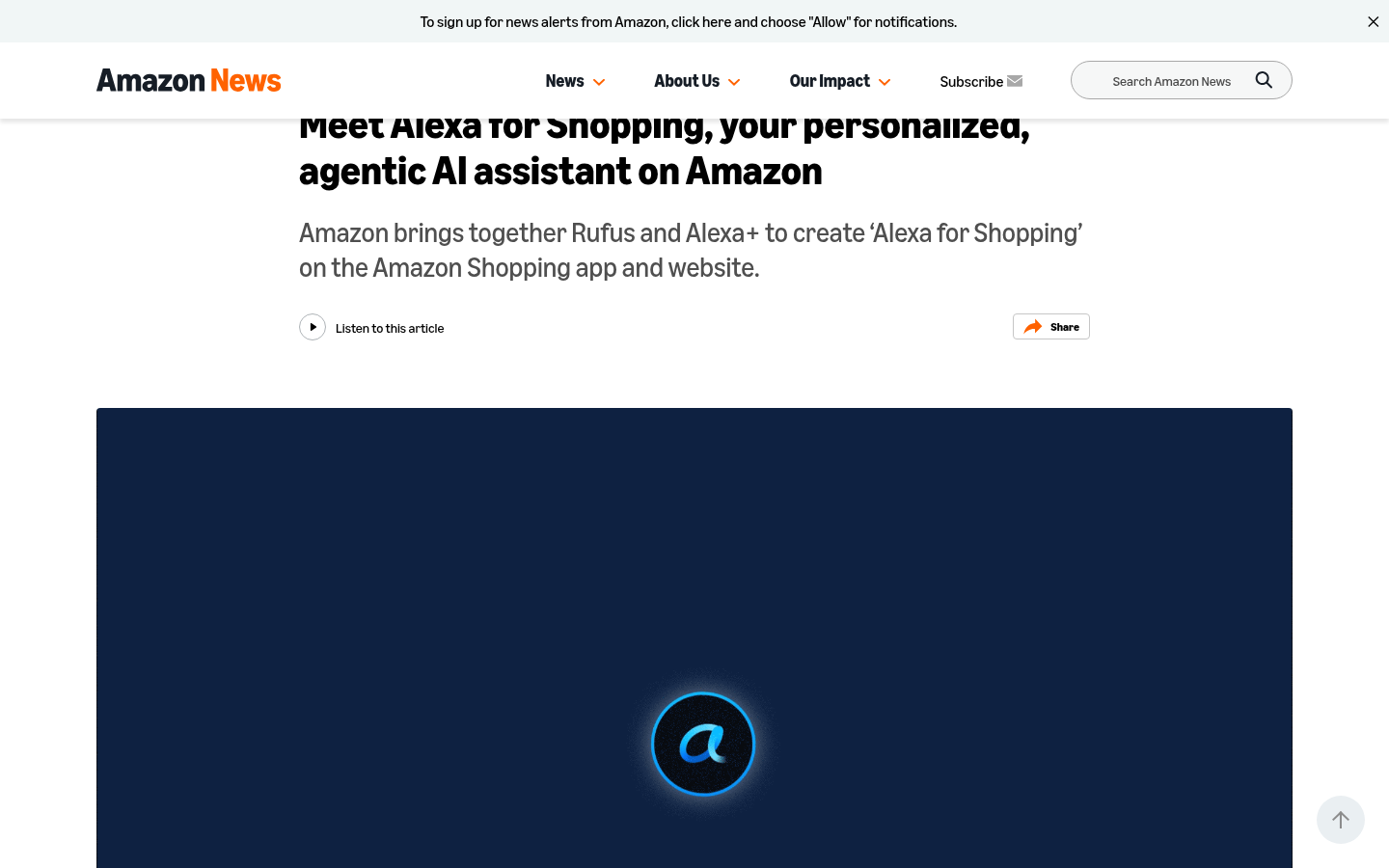
Caption: A public Amazon News screenshot captured for this article shows Alexa for Shopping positioned as a central shopping assistant, not a hidden experimental feature.
For sellers, the visible signal is clear: optimization should cover the whole decision path, not only the keyword that starts the session.
A 7-Day Amazon Alexa GEO Sprint
If you manage many SKUs, use a short sprint instead of a vague "optimize listings" project.
Day | Action | Output |
|---|---|---|
Day 1 | Choose 10 priority SKUs | List of high-impact pages by sales, impressions, margin, or comparison risk |
Day 2 | Collect buyer questions | 20-40 natural-language questions from search, reviews, support, ads, and competitor pages |
Day 3 | Audit listing evidence | Gap table for title, bullets, images, A+ content, Q&A, reviews, and price |
Day 4 | Rewrite title and bullets | Cleaner semantic copy with specific facts and constraints |
Day 5 | Add or improve Q&A | Direct answers to high-intent questions |
Day 6 | Review price and proof | Price context, coupon logic, review themes, missing evidence |
Day 7 | Test and document | Search prompts, observations, before/after notes, next SKU batch |
If you already use a visibility workflow, add Amazon-specific prompts to your broader GEO review process. The point is to make the same SKU understandable to search engines, AI assistants, and human buyers.
Common Seller Mistakes in the Alexa Shopping Era
Mistake 1: Treating Alexa as a separate traffic channel
Alexa for Shopping is better understood as a layer across search, product research, comparison, and purchase assistance. Do not optimize a separate "Alexa field." Improve the whole listing evidence system.
Mistake 2: Replacing keyword stuffing with AI stuffing
Adding repetitive phrases like "best AI recommended product" will not create trust. The stronger move is to add real facts, buyer scenarios, and limitations.
Mistake 3: Ignoring product images and A+ content
AI shopping systems still need clean product evidence. Images, comparison charts, size diagrams, ingredient panels, and compatibility tables can reduce ambiguity. If the visual layer contradicts the text layer, the assistant and buyer both lose confidence.
Mistake 4: Forgetting that AI answers summarize risk
Buyers ask assistants because they want uncertainty reduced. If your product has constraints, state them. A clear limitation can increase trust more than a vague promise.
FAQ
Is Rufus completely gone in 2026?
Amazon's own Rufus page says Rufus was renamed Alexa for Shopping on May 13, 2026. For sellers, the safer interpretation is that Rufus-style shopping assistance has been folded into a broader Alexa for Shopping experience rather than simply disappearing as a concept.
Does Amazon Alexa GEO replace Amazon SEO?
No. Amazon SEO still matters because relevance, conversion, reviews, price, and availability still influence discovery. Amazon GEO adds another requirement: your product information must be easy for an AI assistant to understand, compare, and recommend.
Should sellers remove keywords from titles and bullets?
No. Keep accurate core terms. Remove repetition, irrelevant modifiers, and unreadable keyword chains. The goal is semantic clarity: product type, use case, important facts, proof, and constraints.
What should a beginner seller do first?
Start with Q&A and bullets. Write down the top 20 buyer questions, then make sure the listing answers them directly. This is usually faster and safer than rewriting every asset at once.
Are off-Amazon competitors now more important?
They are harder to ignore. Amazon says Alexa for Shopping can use information from across the web and help customers compare options. Sellers should monitor broader category positioning, not just one Amazon keyword rank.
Final Takeaway
The 2026 Alexa for Shopping update rewards sellers who make product decisions easier. Amazon GEO is not a trick; it is disciplined product communication. The listings most likely to benefit are the ones that answer real buyer questions, show clear proof, explain value, and avoid the old habit of hiding weak information behind keyword density.
Author: Ryan Chen, Senior Amazon Operations Expert with 10 Years in Marketplace Growth at Auspia. Ryan writes about Amazon GEO, marketplace search behavior, AI-assisted product discovery, listing optimization, and operational playbooks for Amazon sellers.