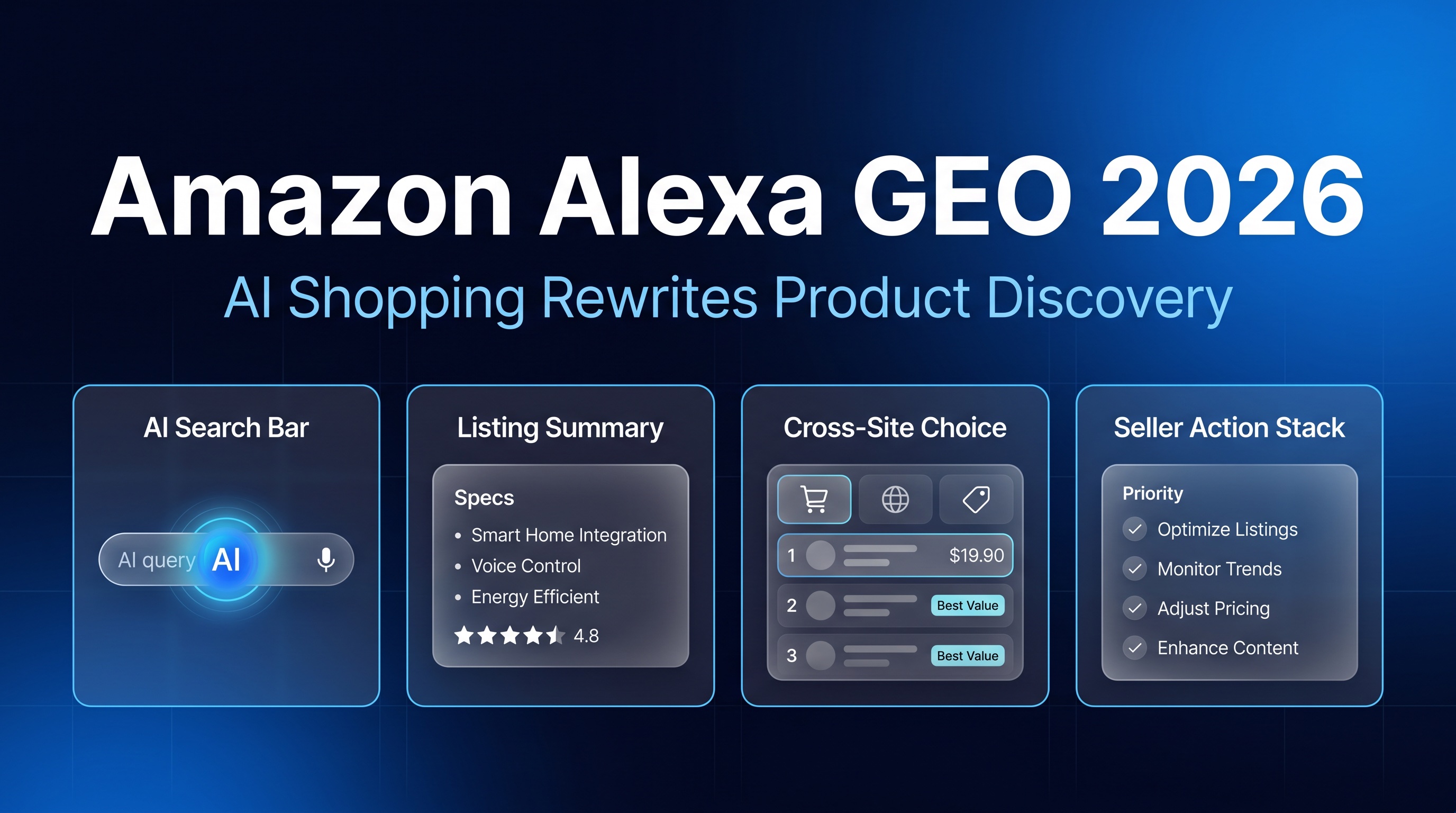
The 2026 Shift: Amazon GEO Moves From Keywords To Shopping Intent
As of June 2026, Amazon GEO is no longer just a listing optimization exercise. It is a visibility system for AI-assisted shopping, where Alexa for Shopping can interpret a shopper's situation, compare products, remember context, and turn a vague need into a recommendation path.
Amazon says Alexa for Shopping combines Rufus's product expertise with Alexa+ personalization, and that Rufus helped more than 300 million customers in 2025 research, compare, and buy products. That does not mean every Amazon result is now AI-selected. Traditional search still matters. But it does mean sellers need to stop treating Amazon as a keyword-density game and start treating it as an answer engine for product decisions.
The practical rule for 2026 is simple: long-tail intent wins only when your listing gives Alexa enough structured evidence to understand who the product is for, when it should be used, what problem it solves, and why it deserves to be recommended.
What Changed With Alexa For Shopping
Amazon's public framing matters. Rufus was introduced as a generative AI shopping assistant that could answer product questions, compare items, and help customers make more informed decisions inside Amazon Shopping. Alexa for Shopping is positioned as a broader, more personalized assistant across the Amazon Shopping app, website, and Echo Show devices.
That changes the seller problem in three ways:
Seller question | Old Amazon SEO answer | 2026 Amazon GEO answer |
|---|---|---|
How do I get discovered? | Rank for head terms and relevant long-tail keywords. | Become the best answer for a specific shopping situation. |
What does the algorithm need? | Keyword relevance, conversion history, price, reviews, and ads. | Product facts, intent coverage, comparison evidence, reviews, Q&A, and behavioral fit. |
What content matters most? | Title, bullets, backend search terms, and image quality. | The entire evidence layer: attributes, title, bullets, A+ content, reviews, Q&A, and customer language. |
What should ads test? | Which keywords can drive clicks and sales. | Which intent clusters produce efficient recommendations, clicks, and purchases. |
This is why the old "keyword sea" tactic needs a rewrite. A large query library is still useful. But in 2026, the goal is not to stuff every phrase into the listing. The goal is to map hundreds of shopper intents into clean, natural, evidence-rich content.
The New Long-Tail Advantage Is Semantic Coverage
The source article's core idea is right: broad head terms become less reliable when an assistant can intercept, interpret, and refine a shopper's request. A query like "bluetooth speaker" is too vague for an AI shopping assistant. A query like "waterproof bluetooth speaker for a small bathroom with strong bass" gives the assistant a use case, environment, feature priority, and implied constraint.
But the conclusion should be more precise. Long-tail volume alone is not a moat. Semantic coverage is.
Semantic coverage means your listing can answer intent variations such as:
- Who is this product for?
- What use case is it best suited for?
- What environment does it work in?
- What pain point does it solve?
- What constraints should a buyer know before purchasing?
- How does it compare with alternatives?
- Which reviews, Q&A answers, and attributes support the claim?
If your listing only repeats "waterproof bluetooth speaker" in five places, Alexa has a phrase. If your listing explains IP rating, shower-safe placement, battery life, mounting options, bass limits, and real customer use cases, Alexa has evidence.
Rebuild The Keyword Sea Into An Intent Library
Do not throw away keyword research. Reclassify it.
A 2026 Amazon GEO library should group terms by decision intent, not just search volume. For example:
Intent cluster | Example queries | Listing evidence to prepare |
|---|---|---|
Use case | "portable charger for camping", "speaker for shower" | Scenario-specific bullets, A+ use-case panels, lifestyle images. |
Buyer profile | "gift for dad who travels", "headphones for students" | Audience language, gifting notes, constraints, comparison copy. |
Problem | "charger that does not overheat", "mattress topper for back pain" | Safety claims, certifications, reviews, FAQ answers, disclaimers. |
Attribute | "10000mah usb c power bank", "ipx7 waterproof speaker" | Structured attributes, title clarity, backend terms, spec table. |
Comparison | "air purifier for bedroom vs living room" | A+ comparison chart, Q&A, review snippets, product family logic. |
Price or urgency | "best budget webcam for meetings" | Value proof, bundle logic, coupon context, review quality. |
This library should feed your listing, ads, A+ content, review analysis, and Q&A plan. It should not become a pile of repeated words.
Listing Evidence Layers Alexa Can Use
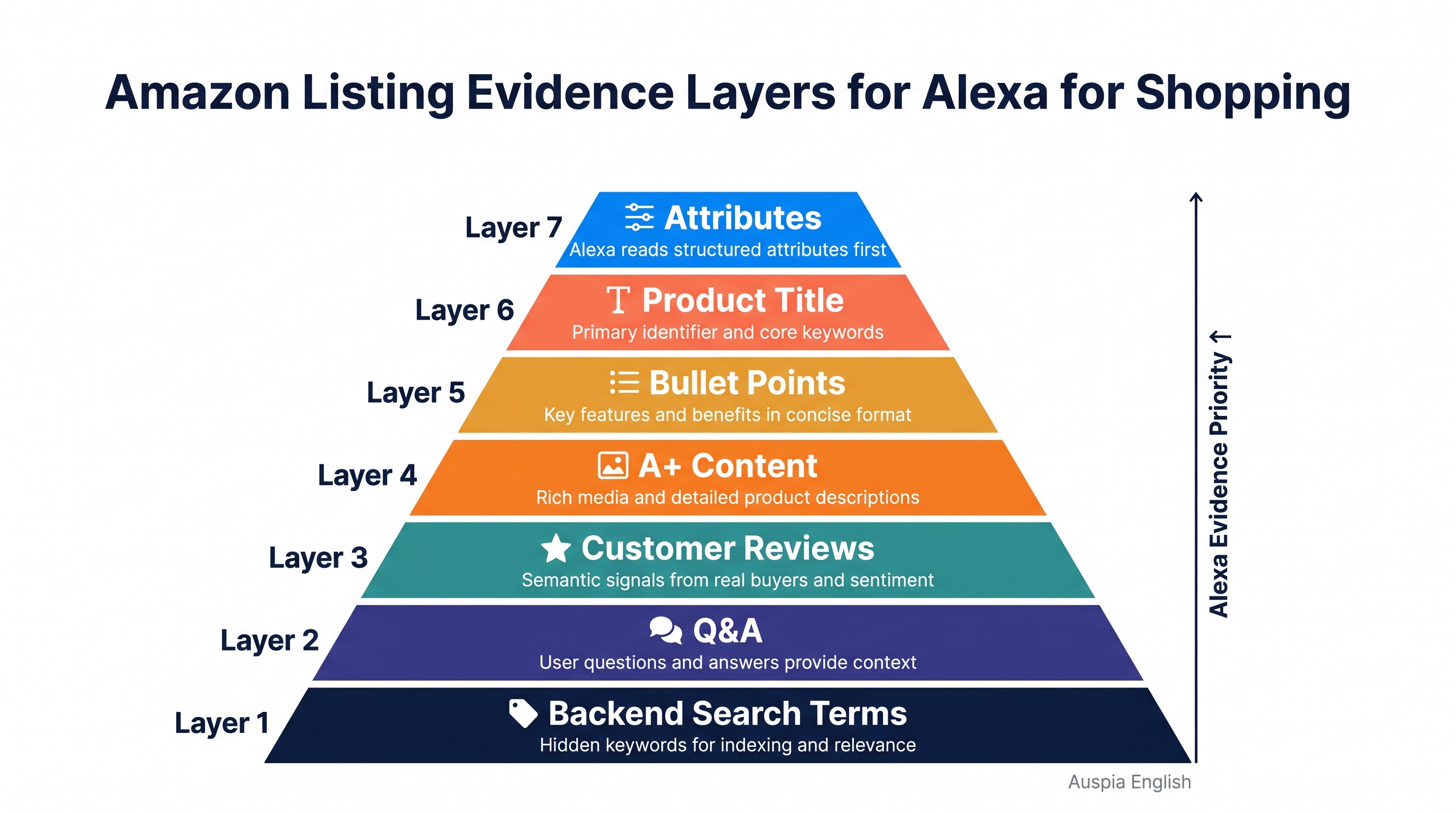
Think of an Amazon listing as a stack of evidence. Alexa for Shopping can only recommend confidently when the stack is consistent.
1. Attributes And Catalog Data
Attributes are the cleanest machine-readable signals. Fill every relevant field: dimensions, material, compatibility, size, color, capacity, warranty, certification, package contents, age range, and safety details.
Do not bury essential facts only in an image. If a shopper asks, "Will this fit a 13-inch laptop?" the answer should be explicit in structured fields and text.
2. Title
The title should identify the product and one or two high-value modifiers. It should not become a warehouse for every possible keyword.
Weak title:
Waterproof Bluetooth Speaker Portable Wireless Shower Speaker Outdoor Speaker Bass Speaker Travel Speaker Gift Speaker
Stronger title:
Waterproof Bluetooth Speaker for Shower and Outdoor Travel, Compact Wireless Speaker with Deep Bass and 12-Hour Battery
The stronger title still contains search terms, but it reads like a product answer.
3. Bullets
Each bullet should map to a shopper question:
- What is the main outcome?
- Where can I use it?
- What spec proves the claim?
- What is included?
- What should I know before buying?
A useful bullet does not just say "great quality." It says why the quality matters in a specific buying moment.
4. A+ Content
A+ content should carry the scenarios that do not fit naturally into the title or bullets. Use it for comparison tables, use-case panels, visual explanations, and buyer decision support.
For GEO, A+ content is not decoration. It is a way to make the product easier for AI systems and humans to understand.
5. Reviews And Q&A
Rufus and Alexa-style shopping assistants are valuable because they can synthesize messy buyer language. That makes reviews and Q&A strategically important. Look for repeated phrases in reviews, then answer those concerns in your listing and Q&A.
If buyers repeatedly ask about fit, noise, smell, compatibility, setup, durability, or returns, those are not support problems only. They are visibility signals.
6. Backend Search Terms
Backend search terms should cover relevant long-tail variants and synonyms that do not belong in customer-facing copy. They should not be a junk drawer for unrelated volume.
Use them for spelling variants, alternate phrasing, and concise phrase groups. Keep them clean.
The 2026 Amazon GEO Workflow For Sellers
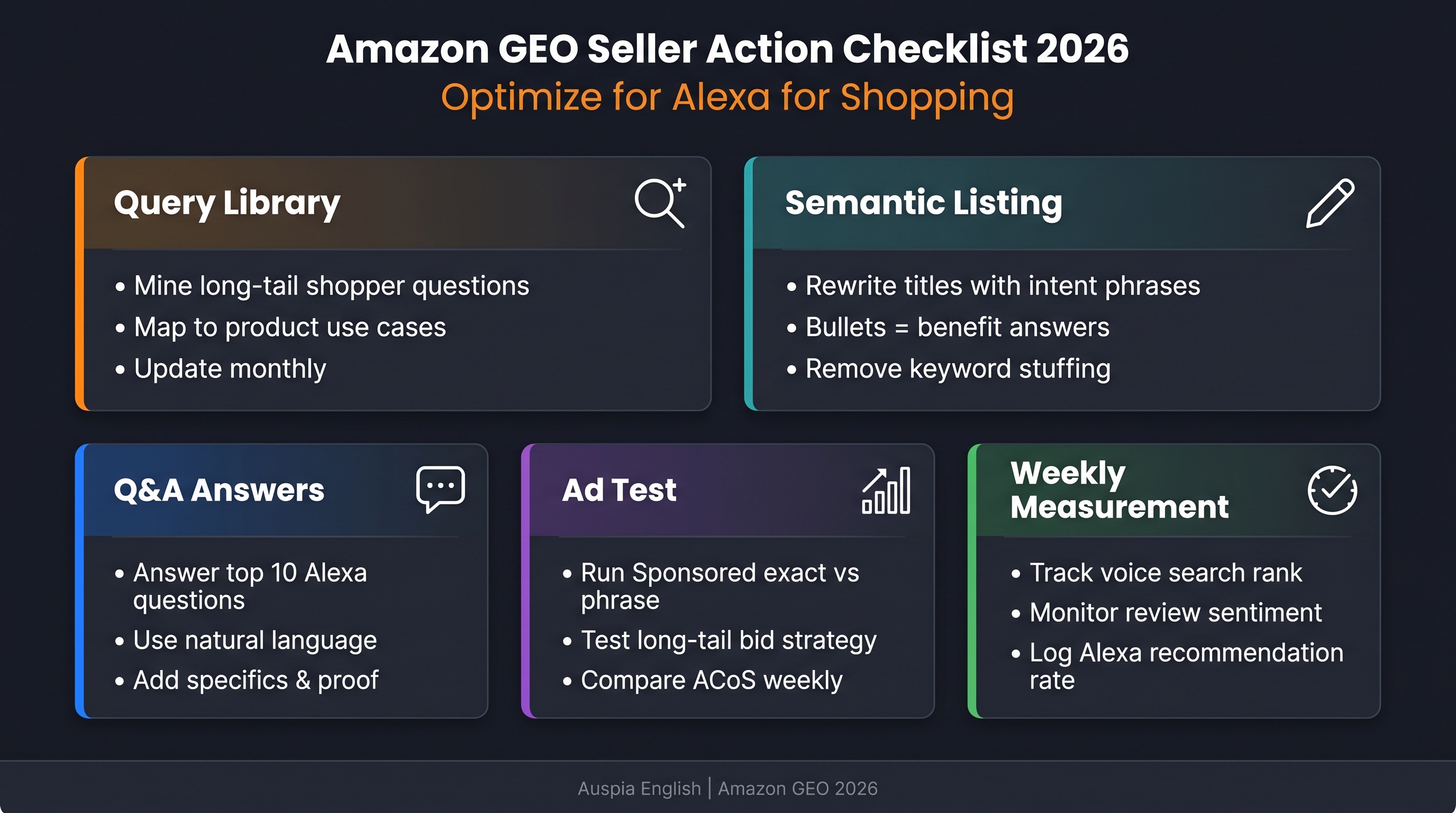
Here is a practical weekly workflow.
Step 1: Build a 500-query intent library. Pull from Amazon autocomplete, Sponsored Products search terms, competitor reviews, customer Q&A, brand analytics where available, support tickets, and off-Amazon product research behavior.
Step 2: Cluster queries by shopping situation. Group by use case, pain point, audience, product attribute, comparison, and buying constraint.
Step 3: Rewrite the listing by evidence layer. Put core identity in the title, decision support in bullets, deeper scenarios in A+ content, direct answers in Q&A, and clean variants in backend search terms.
Step 4: Launch small-budget ad tests by cluster. Do not test one giant long-tail campaign. Test clusters. Separate high-intent exact phrases from broad discovery. Add negatives quickly when a query is too generic, irrelevant, or expensive.
Step 5: Measure the intent, not just the keyword. Track impressions, CTR, CVR, ACoS, TACoS, review language, Q&A frequency, and which long-tail clusters produce profitable orders.
Step 6: Update weekly. Add 50 to 100 new phrases only after classifying them. Remove or suppress terms that bring clicks without buyer fit.
What Sellers Should Stop Doing
Three habits are especially risky in 2026.
First, stop confusing coverage with stuffing. A long-tail strategy is not a license to repeat every phrase. AI systems reward clarity, not clutter.
Second, stop optimizing only the title. Alexa for Shopping can reason across product detail pages, reviews, Q&A, and account context. A strong title cannot rescue weak evidence.
Third, stop treating ads and content as separate systems. Search term reports should inform listing copy. Listing changes should inform ad tests. Review language should inform Q&A. Amazon GEO works as a loop.
Auspia Take: Amazon GEO Is Now A Recommendation Readiness Problem
The most important change is not that Rufus became part of Alexa for Shopping. The important change is that Amazon is making AI assistance more native to the shopping journey.
For sellers, the new question is not "How many keywords did we include?" It is:
If a shopper describes a need in plain language, does our listing provide enough evidence for Amazon's assistant to consider us a safe, relevant recommendation?
That is recommendation readiness. It is the Amazon-specific version of GEO.
If you already track AI search visibility across Google AI Overviews, ChatGPT, Perplexity, and other answer systems, add Amazon shopping prompts to the same discipline. Use a query library, evidence checklist, prompt-style questions, and weekly measurement. Auspia's broader GEO resources can help teams build that operating rhythm beyond Amazon.
FAQ
Is Rufus completely gone in 2026?
Amazon's current public positioning is that Alexa for Shopping brings together Rufus's product expertise with Alexa+ personalization. For sellers, the operational takeaway is not the product name. It is that Amazon's shopping assistant experience is becoming more integrated, personalized, and intent-driven.
Does Amazon GEO replace Amazon SEO?
No. Amazon SEO still matters for relevance, ranking, ads, and conversion. Amazon GEO adds another layer: making listings understandable and recommendable by AI shopping assistants.
Should sellers still use long-tail keywords?
Yes, but they should use them as an intent map, not as stuffing material. Long-tail phrases should guide listing structure, Q&A, A+ content, and ad tests.
What is the best first action for a seller?
Start with one high-value ASIN. Build a 100-query intent library, cluster the queries, rewrite bullets and Q&A around the strongest buyer questions, then test the top clusters with small-budget ads.
Which tags fit this topic?
For Auspia taxonomy, this article fits amazon-geo and amazon-alexa-geo, with playbook if the CMS needs a format tag.
Sources: Amazon's Alexa for Shopping announcement; Amazon Science's Rufus technology overview; AWS's Rufus scaling article; CX Dive coverage of Alexa for Shopping reach and search-bar behavior.
Author: Ryan Chen, Senior Amazon Operations Expert with 10 Years in Marketplace Growth at Auspia. Ryan writes about Amazon GEO, marketplace search behavior, AI-assisted product discovery, and practical listing optimization workflows for sellers.