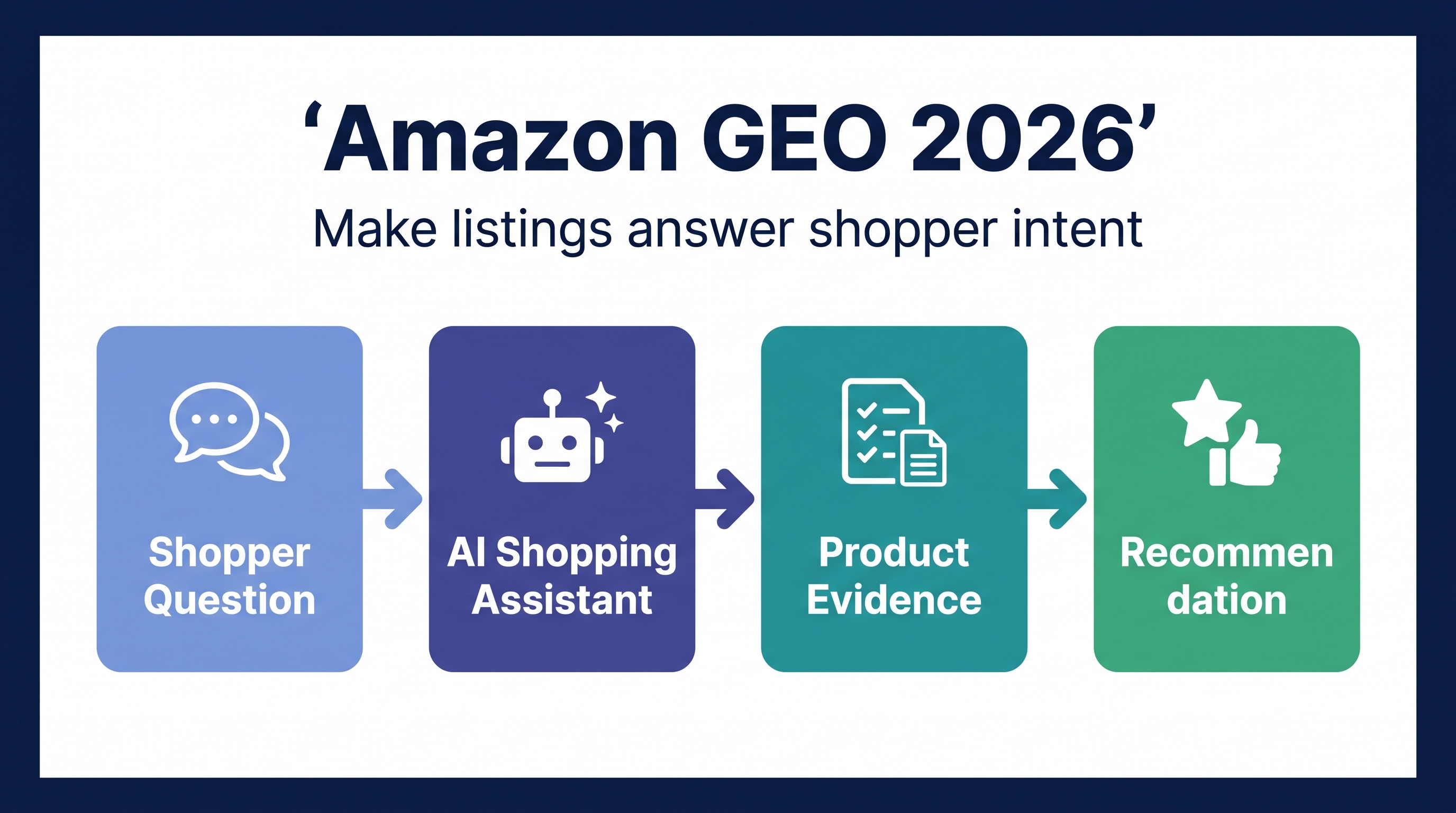
The 2026 shift: listings now have to answer shoppers, not just rank for keywords
Amazon GEO in 2026 is the practice of making product listings easy for Amazon's AI shopping assistants to understand, compare, and recommend when shoppers ask natural-language questions. The job is no longer just "fit the keyword into the title." A listing has to make clear who the product is for, what problem it solves, what proof supports that claim, and where the answer appears across title, bullets, A+ content, Q&A, reviews, and product attributes.
That is the useful lesson to take from the Rufus era. Amazon's own help pages describe Rufus as an AI-powered shopping assistant that lets customers ask shopping questions in the Amazon app and on Amazon.com. Amazon Science has also explained the technology behind Rufus as a generative AI shopping assistant that answers product-detail and comparison questions using Amazon's catalog and other signals.
By 2026, the naming and placement are changing too. Amazon's customer help now uses "Alexa for Shopping" language in the U.S., while Rufus remains visible in some Amazon regions and help pages. Third-party coverage in May 2026 reported Amazon putting Alexa for Shopping into the main search experience. Sellers should not get stuck on the label. The operating reality is simpler: more shopping journeys are becoming conversational, personalized, and evidence-hungry.
So the question for a seller is blunt: when a shopper describes a use case, does your listing give the AI assistant enough intent evidence to include you?
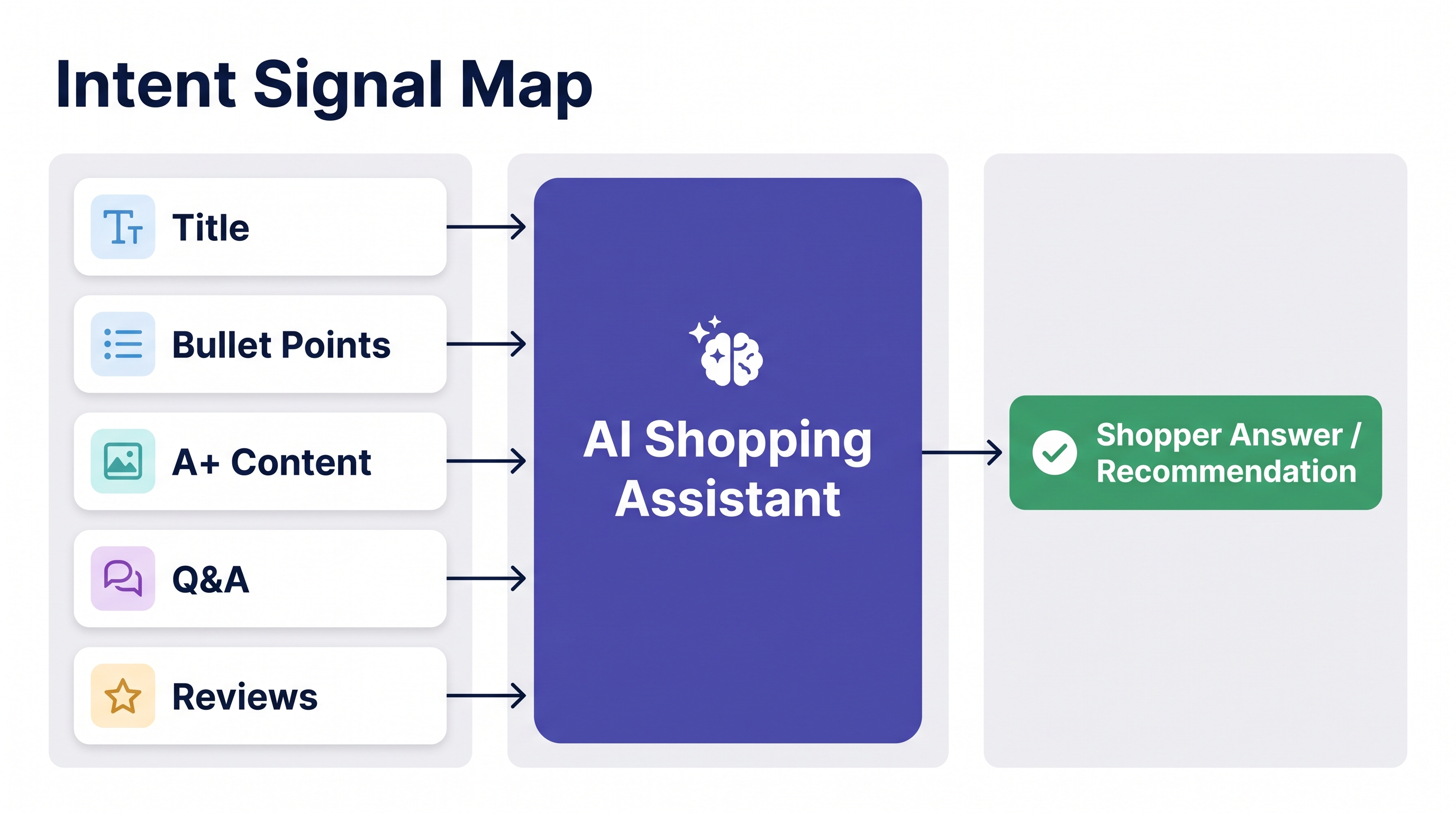
Caption: Amazon GEO turns scattered listing copy into structured intent signals that an AI shopping assistant can retrieve and compare.
The old listing habit breaks inside conversational shopping
A lot of Amazon listings still read like internal sell sheets. They lead with materials, patents, certifications, and adjectives. That can help a human buyer, but only after the buyer understands whether the product fits their situation.
AI shopping assistants tend to receive a different kind of input:
- "I need a carry-on for a one-week business trip that fits overhead bins and has a laptop pocket."
- "What is a good dog bed for an older Labrador with joint pain?"
- "Which desk chair works for someone tall who sits all day?"
- "I want nonstick pans that are safe for induction and easy to clean."
These are not short keywords. They are compressed intent briefs. Each query contains a buyer type, a use case, a constraint, and a fear. If the listing only says "premium materials" or "professional design," the assistant has to infer too much. Some systems can infer, but sellers should not build a visibility strategy around a maybe.
A stronger listing states the match directly:
Weak listing signal | Better intent signal |
|---|---|
"Premium orthopedic foam" | "Orthopedic dog bed for senior large dogs with hip and joint pressure points" |
"Durable ABS shell" | "Carry-on suitcase for weekly business travel, overhead-bin friendly with padded laptop access" |
"Ergonomic mesh chair" | "High-back office chair for tall users who sit 8-10 hours and need lumbar support" |
"Food-grade coating" | "Induction-safe nonstick pan for low-oil cooking and quick cleanup" |
The better examples still use product facts. They just connect the facts to a person, a situation, and a problem.
What AI assistants are likely extracting from your listing
Do not imagine an AI shopper as a picky copywriter. Think of it as a retrieval and comparison layer. It is scanning for signals it can use to answer a question.
The practical signal map looks like this:
Listing area | What it should prove | Example intent signal |
|---|---|---|
Title | Product type plus the most valuable buyer/use-case fit | "for tall users," "for senior dogs," "for induction cooktops" |
Bullets | Problem-to-feature answers | "wide base helps reduce tipping for messy eaters" |
A+ content | Comparison, scenario, sizing, and proof | size chart, use-case matrix, materials explanation |
Product attributes | Machine-readable constraints | dimensions, capacity, compatibility, age range, weight support |
Q&A | Natural-language intent coverage | "Will this fit a 15-inch laptop and still count as a personal item?" |
Reviews | Buyer vocabulary and proof gaps | repeated mentions of "easy assembly," "too small," "sturdy" |
This is why Amazon GEO is not a copywriting trick. It is information architecture for product discovery.
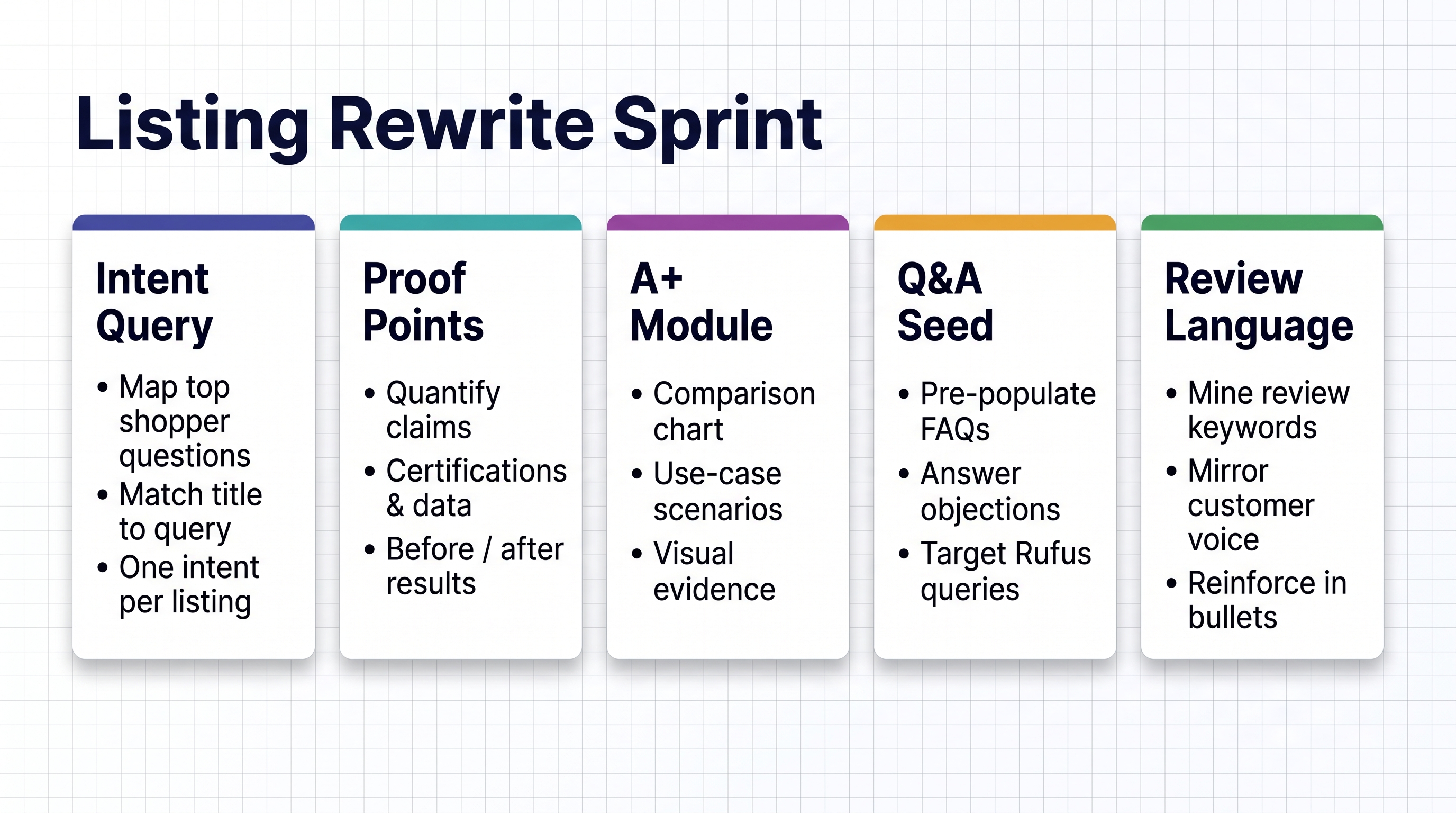
Caption: A good rewrite sprint connects each shopper question to proof, a listing module, and a review-monitoring loop.
Rewrite titles as intent anchors, not feature parades
A title still has to carry the core keyword. That does not change. What changes is the second half of the title.
A weak title tries to pack every product attribute into one line:
Ergonomic Office Chair with 4D Armrests, Breathable Mesh, Adjustable Lumbar Support, Certified Components
A stronger 2026 Amazon GEO title keeps the keyword but adds a matchable intent anchor:
Ergonomic Office Chair for Tall Users, High Back Desk Chair with Adjustable Lumbar Support for Long Sitting
The second version gives an AI assistant something to match when a shopper asks, "What chair is good for a tall person who works from home all day?"
Use this title check:
Question | Pass/fail test |
|---|---|
Does the title name the product type plainly? | The assistant should not have to infer the category. |
Does it include one high-value buyer segment or use case? | Pick the strongest one, not six weak ones. |
Does the wording match how shoppers speak? | "For tall users" beats a vague phrase like "enhanced ergonomic fit." |
Is the claim supported elsewhere? | If the title says "for heavy users," the bullets and specs need capacity proof. |
Do not stuff the title with every possible intent. Pick the buyer situation that matters most, then use bullets, A+ content, and Q&A to cover adjacent intents.
Turn bullets into answers to likely shopping questions
Most bullets still follow a feature-first formula: material, mechanism, design, package contents. That is tidy, but it often misses the buyer's actual language.
A better bullet answers a real question.
Weak bullet:
- Breathable mesh back with adjustable lumbar support and 4D armrests.
Intent-matched bullet:
- Built for long workdays: the breathable mesh back and adjustable lumbar support help tall users stay supported during 8-hour desk sessions.
Weak bullet:
- Made from natural bamboo with a food-safe finish.
Intent-matched bullet:
- Helps messy cats eat without tipping the bowl: the wide bamboo base keeps the feeding station steady for larger cats and fast eaters.
The structure is simple:
Bullet part | What to write |
|---|---|
Buyer situation | "For tall users," "for senior dogs," "for small apartments" |
Pain or constraint | "long sitting," "joint pressure," "limited counter space" |
Product mechanism | the specific feature that addresses the problem |
Proof | size, material, capacity, compatibility, certification, or review-backed language |
This is not about making claims louder. It is about making claims easier to retrieve.
Treat Q&A as intent training data
Q&A is one of the most underused modules for Amazon GEO because it is written in the same language shoppers use with AI assistants. The format is already conversational. That makes it useful.
Do not wait passively for random questions. Build a Q&A plan from your search term report, support tickets, competitor reviews, and return reasons.
Good Q&A seeds look like buyer questions, not marketing prompts:
Product | Better Q&A seed |
|---|---|
Office chair | "Will this chair work for someone over 6 feet tall who sits most of the day?" |
Carry-on luggage | "Can this fit a laptop, two outfits, and toiletries for a three-day work trip?" |
Dog bed | "Is this bed supportive enough for an older large dog with stiff hips?" |
Cookware | "Does this pan work on induction and clean easily after eggs or sauces?" |
Answer in plain language. Repeat the core intent with a different wording from the title and bullets. Add evidence only where it is true.
Bad answer:
Yes, this product is premium and durable.
Better answer:
Yes. The high-back frame and adjustable lumbar pad are designed for taller users, and the seat depth gives more leg support during long desk sessions. Check the size chart before ordering if you are close to the upper height or weight range.
That answer does three useful things: it addresses the buyer type, names the mechanism, and adds a constraint. AI assistants need all three.
Mine reviews for the words buyers actually use
Reviews are not just social proof. They are a live vocabulary feed.
Every month, pull the newest reviews for your product and two or three close competitors. Look for repeated phrases in four buckets:
Bucket | What to extract | How to use it |
|---|---|---|
Fit language | height, size, weight, room type, pet breed, skin type | Add to title, bullets, or size guidance when accurate. |
Pain language | back pain, spills, tipping, noise, assembly frustration | Turn into bullet and Q&A answers. |
Proof language | sturdy, easy to clean, compact, supportive | Use only if reviews and specs support it. |
Failure language | too small, hard to assemble, not for large dogs | Add constraints to reduce bad-fit traffic and returns. |
The failure language matters. A listing that overmatches the wrong intent may get more clicks but worse conversion, more returns, and weaker review text later. Amazon GEO should improve fit, not just visibility.
If buyers repeatedly say "great for small apartments" and your listing never says "small apartment," that is a missed intent signal. If buyers repeatedly complain "not for large dogs," do not hide it. Add sizing clarity so the AI assistant can recommend the product for the right shopper.
A 90-minute Amazon GEO rewrite sprint
Use this workflow when you need a fast listing repair, not a full brand rebuild.
Time | Task | Output |
|---|---|---|
0-15 min | Collect 20-30 real shopper phrases from search terms, reviews, Q&A, and competitor pages | Raw intent list |
15-30 min | Group phrases by buyer type, use case, pain, and constraint | Intent map |
30-45 min | Pick the top three intents that the product can honestly satisfy | Priority intent set |
45-60 min | Rewrite title and bullets around those intents | Draft listing copy |
60-75 min | Add 8-12 Q&A seeds in natural language | Conversational answer coverage |
75-90 min | Add proof checks: specs, size chart, certifications, photos, review support | Claim validation list |
If you want a quick audit before rewriting, run a few buyer-style prompts through your internal review process or an AI search visibility workflow. Auspia's AI Search Visibility Checker is useful for thinking in prompts rather than only keywords, but do not treat any single tool result as final proof of Amazon's ranking logic.
What not to do in 2026
Three mistakes keep showing up in Amazon GEO work.
First, do not replace keyword research with prompt guessing. Amazon search still has keyword, relevance, price, conversion, inventory, and ad signals. GEO adds an intent layer; it does not delete marketplace fundamentals.
Second, do not write claims the product cannot support. If the product is not truly suitable for tall users, senior pets, babies, sensitive skin, induction cooktops, or airline carry-on rules, do not chase the query. Bad-fit visibility creates bad reviews.
Third, do not make every module say the same sentence. A title, bullet, A+ chart, Q&A answer, and review loop should reinforce the same intent with varied, natural language. Repetition looks clumsy to humans and may not add much for retrieval.
The seller metric that matters now
Traditional listing optimization asks, "Can buyers find and understand this product?"
Amazon GEO asks a sharper question: "Can an AI assistant confidently explain when this product is the right choice?"
That confidence comes from consistent evidence. The title names the fit. The bullets answer the pain. A+ content shows the scenario and proof. Q&A handles natural-language doubts. Reviews confirm or correct the language. Product attributes backstop the claims.
Once you see the listing this way, the work changes. You are no longer polishing copy for applause. You are building a product answer system.
FAQ
Is Amazon GEO the same as Amazon SEO?
No. Amazon SEO focuses on marketplace visibility through keywords, relevance, conversion, ads, pricing, inventory, and other ranking signals. Amazon GEO focuses on whether AI shopping assistants can understand and recommend a product for natural-language shopper intent. Sellers need both.
Should sellers optimize for Rufus or Alexa for Shopping in 2026?
Optimize for the behavior, not only the name. Amazon has used Rufus language in many markets and help pages, while U.S. coverage and help pages now point to Alexa for Shopping. The shared seller task is to make listings answer conversational shopping questions with clear evidence.
How many intents should one listing target?
Usually three to five primary intents are enough for one product detail page. More than that tends to create vague copy. Use variants in Q&A and A+ content, but keep the title and first bullets focused on the strongest fit.
Can Q&A really affect AI shopping visibility?
Amazon does not publish a simple weighting formula for AI shopping recommendations. Still, Q&A is valuable because it uses natural buyer language and direct answers, which are exactly the formats conversational assistants need to parse. Treat it as a high-signal listing module, not a replacement for title, bullets, attributes, and reviews.
What is the safest first step for a seller?
Start with review language. Pull the phrases real buyers already use when they praise, complain about, or compare the product. Those phrases reveal the intent gaps your listing should address first.
Author: Ryan Chen, Senior Amazon Operations Expert with 10 Years in Marketplace Growth at Auspia. Ryan writes about Amazon GEO, marketplace search behavior, AI-assisted product discovery, and practical listing optimization playbooks for sellers.