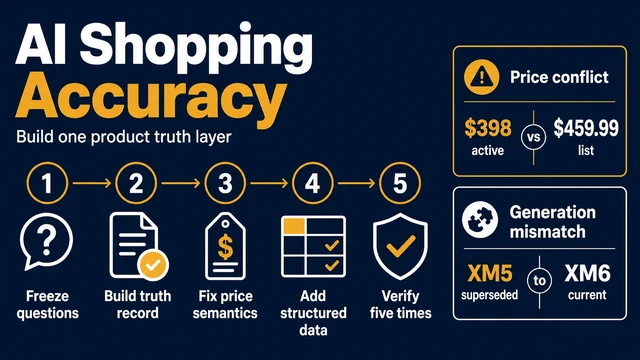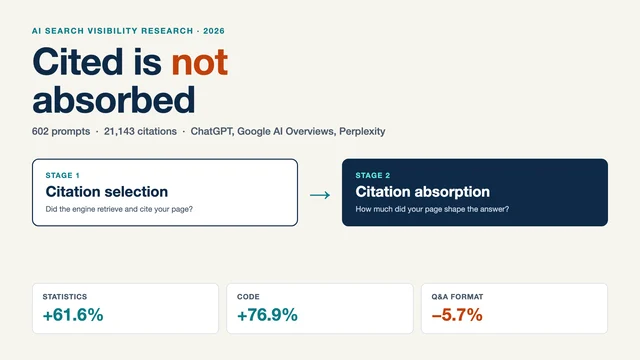
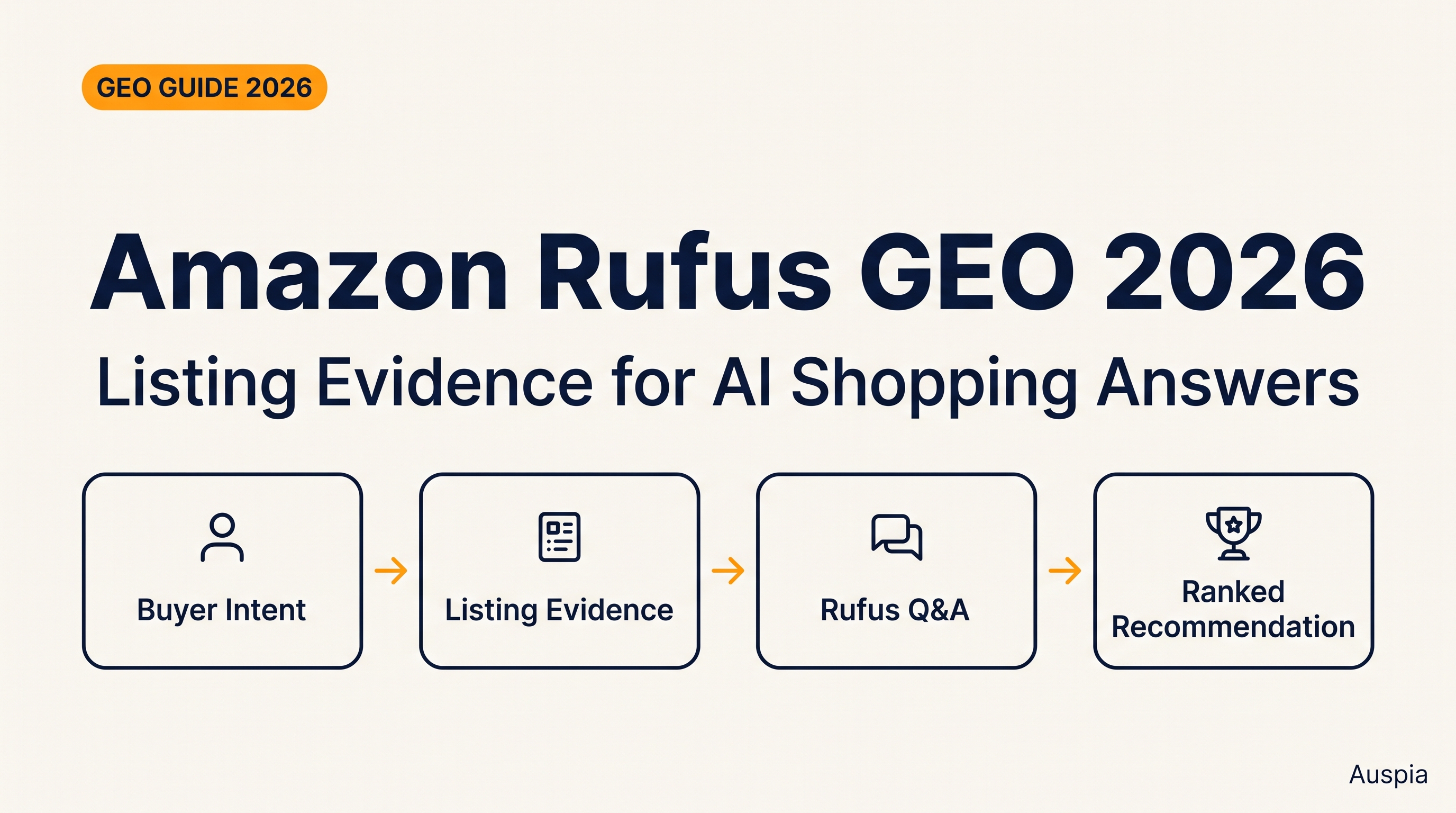
the 2026 answer for Amazon sellers
Amazon listing optimization has shifted from "add more keywords" to "make the product easy for a shopping AI to understand, compare, and recommend." Rufus and similar shopping assistants do not only match words. They interpret a buyer's intent, retrieve product candidates, compare the evidence inside listings, and generate a ranked recommendation.
Two papers make that shift much easier to act on. The first, "Bridging the Gap Between Information Seeking and Product Search Systems: Q&A Recommendation for E-commerce", explains why shopping assistants need question-and-answer content across exploration, comparison, and final decision stages. The second, "E-GEO: A Testbed for Generative Engine Optimization in E-Commerce", tests e-commerce GEO at scale with more than 7,000 realistic product queries and finds that some listing rewrites improve generative-engine rankings far more than generic marketing copy.
The practical takeaway: in 2026, an Amazon listing should read less like an ad and more like a clean evidence file for a buyer and for Rufus. Put the strongest reason to choose the product near the top. Turn buyer questions into answerable blocks. Use specific attributes, proof, and comparisons. Avoid fluff, keyword stuffing, and brand stories in the high-weight areas of the listing.
what the papers actually say
The Amazon Q&A recommendation paper frames product search as a journey, not a single query. A shopper starts broad, learns what matters, compares options, and then asks product-specific questions before buying. The paper describes three stages that map neatly to Amazon content planning:
Shopping stage | What the buyer is doing | What Rufus needs from the listing |
|---|---|---|
Exploration | Learning the category and refining requirements | Clear buying criteria, use cases, and category education |
Comparison | Choosing between similar products | Specific differentiators, measurable attributes, and tradeoffs |
Final consideration | Checking fit, durability, compatibility, returns, and edge cases | Direct Q&A answers backed by catalog facts, reviews, and policy details |
The same paper also focuses on quality control: Q&A content should be relevant, concise, natural, factual, hallucination-free, and safe. That is a direct warning against vague claims such as "premium quality" or "best choice for everyone." Rufus cannot responsibly recommend a product from language that gives it nothing concrete to cite.
The E-GEO paper adds the ranking evidence. It treats an e-commerce generative engine as a retrieval-and-reranking system: first, the platform gathers candidate products; then the LLM-style engine ranks them against a rich, natural-language buying request. The study evaluates 15 rewriting strategies and reports that many familiar tactics barely help or even hurt. The best initial heuristic was emphasizing competitive advantages, with an average rank improvement of +0.71. After prompt optimization, the competitive strategy reached +1.61. By contrast, storytelling performed badly in its initial form, at -4.03, and minimalist descriptions started at -1.66.
Do not treat those numbers as a direct Amazon ranking formula. The benchmark is a research testbed, not Amazon's production system. But the direction is useful: generative shopping systems reward listings that align with buyer intent, preserve facts, state unique selling points, and make evidence easy to scan.
the new listing priority stack
If you only change one thing, change the order of information. Many Amazon listings still lead with keyword density or brand claims. A Rufus-ready listing should lead with decision evidence.
Use this priority stack:
Priority | Listing asset | What to write |
|---|---|---|
1 | Core advantage | The specific reason to choose this product instead of a close alternative |
2 | Buyer pain | The problem the product solves in plain language |
3 | Proof | Measurements, materials, compatibility ranges, test conditions, certifications, review themes, or warranty facts |
4 | Scenario | Where the advantage matters in real use |
5 | Q&A | The exact questions Rufus and buyers are likely to ask |
A weak listing says: "Durable lunch box, premium material, great for school and office."
A stronger GEO version says: "Leak-resistant stainless steel lunch box with a silicone-sealed lid, tested upside down for 30 minutes without dripping. Fits standard backpacks and keeps wet foods separated with two removable dividers, which helps commuters and students carry salads, pasta, and fruit without mixing them."
The second version gives Rufus reusable facts. It gives the buyer a reason to care, too.
Step 1: turn your advantage into an answerable claim
Start with three product advantages, not ten. Each one should pass a simple test: can a buyer ask a question that this advantage answers?
Use this formula:
Buyer problem + product attribute + proof or constraint + use case
Example for a portable espresso maker:
Weak claim | Rufus-ready claim |
|---|---|
"High quality and easy to use." | "Designed for travel coffee: weighs 1.1 lb, works without batteries, and produces up to 18 bars of manual pressure, so campers can make espresso-style coffee without carrying a powered machine." |
"Great gift for coffee lovers." | "Fits ground coffee and Nespresso-compatible capsules, which makes it useful for buyers who want one compact brewer for hotel rooms, offices, and weekend trips." |
"Durable design." | "The water chamber uses BPA-free Tritan and the pump is rated for daily manual use; the removable parts rinse clean in under one minute after brewing." |
Notice what is absent: no "game-changing," no "must-have," no claim that every buyer will love it. The copy is more boring than a sales page, but much more useful to a shopping assistant.
Place these three advantages in the highest-weight areas you control:
Listing area | What to do |
|---|---|
Title | Include the product type, primary differentiator, and one high-intent compatibility or use-case phrase |
First three bullets | Put one answerable advantage in each bullet |
Product description opening | Summarize who the product is for and which problem it solves |
A+ content | Add a comparison table, use-case modules, and Q&A blocks |
Step 2: map the listing to Rufus' three shopping stages
A listing that only talks to buyers already on the product detail page is too late. Rufus-style discovery can touch the buyer while they are still learning what to buy.
Build three modules inside the description or A+ content.
Exploration module: define the buying criteria
This section helps a broad shopper understand the category. It should not attack competitors. It should explain what matters.
For a portable espresso maker:
- Look for a brewer that states pressure range, not only "rich crema."
- Check whether it works with capsules, ground coffee, or both.
- Check cleaning steps if you plan to use it at work or while traveling.
- Check water capacity and cup compatibility before assuming it replaces a countertop machine.
This gives Rufus category-level material it can use when a buyer asks, "What should I look for in a travel espresso maker?"
Comparison module: make tradeoffs visible
The comparison stage is where many listings fail. Sellers describe features, but they do not state why those features matter against alternatives.
Use a factual table:
Decision point | This product | Typical alternative | Why it matters |
|---|---|---|---|
Power source | Manual pressure | Battery or wall plug | Easier for camping and travel |
Coffee type | Grounds and compatible capsules | Capsules only | More flexible for different buyers |
Cleaning | Removable rinse-clean parts | Fixed chamber | Less residue after daily use |
Weight | 1.1 lb | Larger portable brewers | Easier to pack in carry-on luggage |
Do not make up numbers. If you do not have proof, either test the product or leave the number out.
Final consideration module: answer the conversion questions
The decision-stage section should look like a compact FAQ. Pull questions from Amazon Customer Questions & Answers, review language, customer support tickets, returns, and competitor listings.
Example:
Buyer question | Good listing answer |
|---|---|
Does it work with capsules? | Yes. It works with ground coffee and Nespresso-compatible capsules. It does not support proprietary capsule shapes outside that format. |
Does it heat water? | No. It requires hot water added separately, which keeps the device lighter and battery-free. |
Is it dishwasher safe? | The removable cup and adapter can be rinsed by hand. Do not place the pump body in a dishwasher. |
Is it good for camping? | Yes, if you can heat water separately. It does not need electricity or batteries. |
This is conversion copy, but it is also retrieval material.
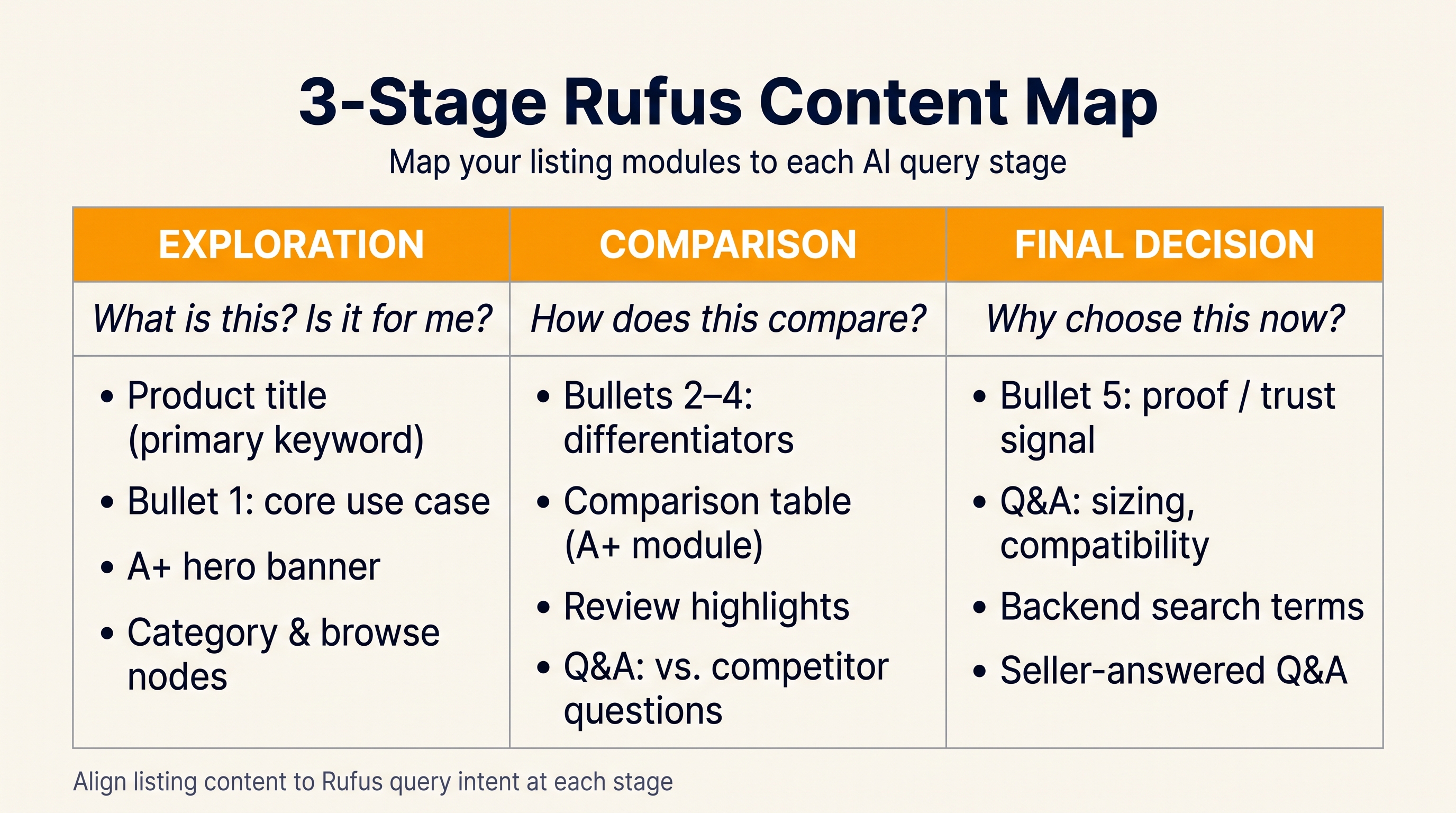
Caption: The listing should contain different evidence for broad research, product comparison, and last-mile purchase questions.
Step 3: write for natural-language shopping queries
Traditional Amazon SEO trained sellers to repeat root keywords. Rufus-era GEO rewards copy that sounds closer to how buyers describe constraints.
A keyword query might be:
portable espresso maker camping
A generative shopping query sounds more like:
"I need a compact espresso maker for camping that does not need electricity, works with ground coffee, and is easy to rinse after use."
Your listing needs the second kind of language. That does not mean abandoning keywords. It means placing them inside useful sentences.
Bad:
"Portable espresso maker, travel espresso maker, camping espresso maker, manual coffee maker, mini espresso machine."
Better:
"This portable espresso maker is built for travel and camping because it uses manual pressure instead of electricity, works with ground coffee, and rinses clean after each use."
The better version still contains the core terms. It also gives the shopping assistant something to match against a constraint-rich request.
Step 4: avoid the four listing moves that generative engines punish
The E-GEO paper is useful because it tests tactics sellers often reach for. Some sound good in a copywriting meeting. They are weak material for generative ranking.
Risky move | Why it fails in Amazon GEO | Safer replacement |
|---|---|---|
Brand storytelling in top sections | It delays product evidence and may not answer the buyer's task | Put origin story at the end, if at all |
Minimalist copy | It gives the model too little to compare | Add concise facts, constraints, and Q&A |
Ad-style hype | It is hard to verify and can trigger trust issues | Use specific attributes and proof |
Pure technical jargon | It may not match buyer language | Pair the term with a plain-English benefit |
Technical detail is fine. Unsupported technical dumping is the problem.
For example, "6061-T6 aluminum" is useful only if the buyer can understand the benefit. A better line is: "The mount uses 6061-T6 aluminum, a rigid alloy commonly used where low weight and strength matter; the 8 mm base helps reduce wobble during rough-road driving."
Step 5: run a 2026 Rufus GEO testing loop
Do not treat a listing rewrite as a one-time project. A better workflow is a controlled loop.
- Collect the top 20 buyer questions from Amazon Q&A, reviews, support tickets, competitor pages, and Rufus-style prompts.
- Rewrite the listing into three variants, changing only one major variable at a time: advantage order, FAQ depth, comparison format, or proof placement.
- Run each version long enough to collect directional data. For many sellers, that means one to two weeks, depending on traffic.
- Track impressions, click-through rate, conversion rate, return reasons, review language, and any available Rufus or conversational shopping traffic signals.
- Keep the best-performing structure, then test the next variable.
If you already track AI search visibility outside Amazon, apply the same idea to marketplace prompts. Auspia's AI Search Visibility Checker is a useful way to think about prompt-based visibility: define the questions, check whether the brand or product appears, then improve the evidence that answer systems can retrieve.
a practical before-and-after template
Here is a compact template sellers can adapt. Replace every number with real product data.
Listing area | Before | 2026 Rufus GEO version |
|---|---|---|
Title | "Portable Espresso Maker Travel Coffee Machine" | "Portable Manual Espresso Maker for Camping, Ground Coffee and Capsule Compatible, Battery-Free Travel Coffee Press" |
Bullet 1 | "Premium quality" | "Battery-free manual pressure system helps travelers make espresso-style coffee anywhere hot water is available." |
Bullet 2 | "Easy to clean" | "Removable cup and adapter rinse clean after use, reducing coffee residue during office, hotel, or campsite use." |
Bullet 3 | "Works great" | "Compatible with ground coffee and Nespresso-style capsules, giving buyers one brewer for home beans and travel capsules." |
Description | Brand story and generic claims | Buying criteria, comparison table, compatibility notes, cleaning instructions, and FAQ |
The exact words will vary by category. The structure should not.
the seller checklist
Before you publish a listing update, check these items:
- The first three bullets each answer a real buyer question.
- The strongest differentiator appears before general features.
- Claims include proof, limits, or context.
- The listing includes exploration, comparison, and final-consideration content.
- Important compatibility and exclusion details are explicit.
- Keywords appear naturally inside useful sentences.
- The brand story does not sit above product evidence.
- The FAQ uses plain answers, not promotional copy.
- Any review-derived claim is supportable and compliant.
- You have a plan to test one variable at a time.
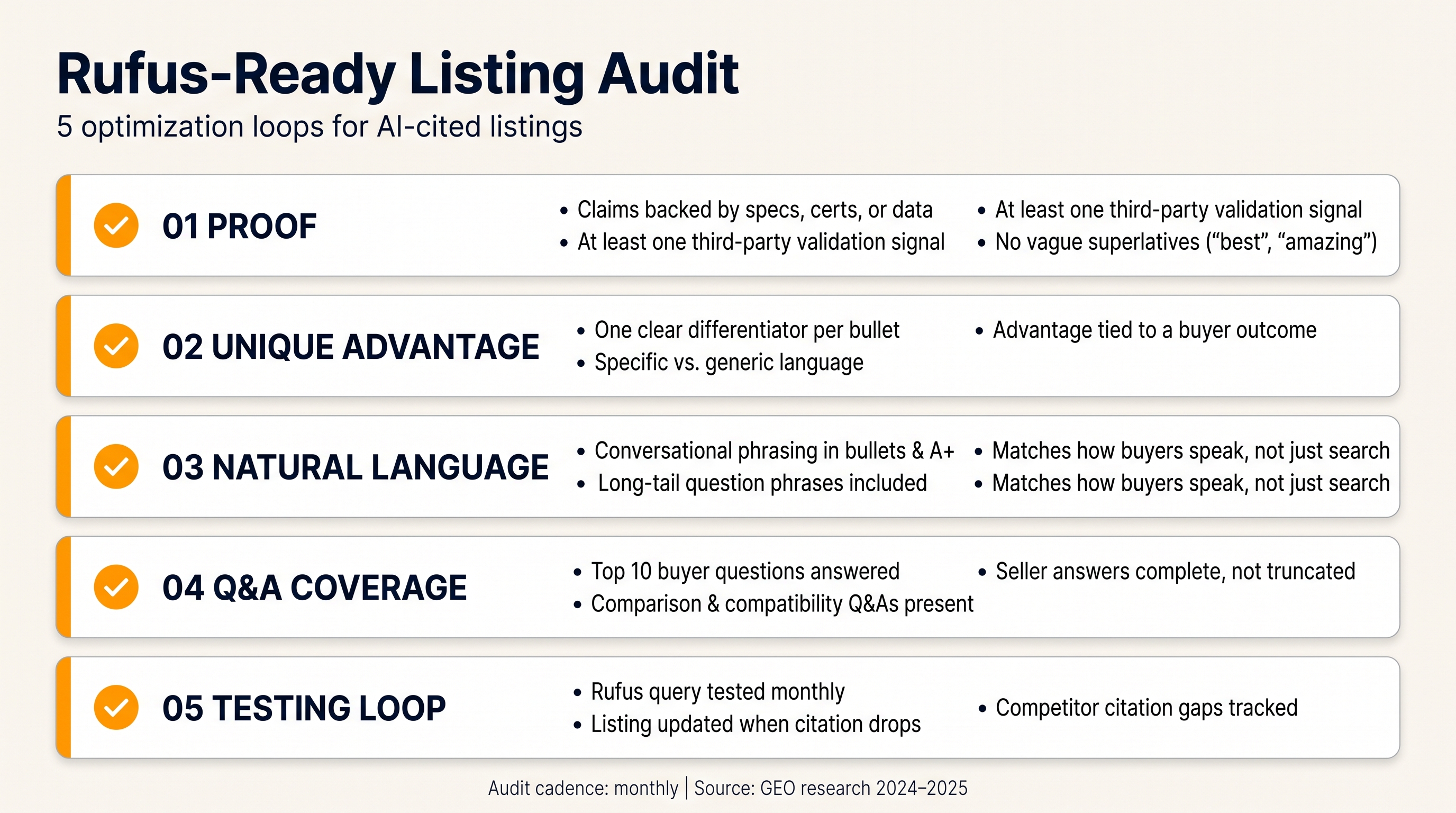
Caption: Use a checklist before publishing so the listing stays factual, scannable, and testable.
FAQ
Is Amazon Rufus GEO the same as Amazon SEO?
No. Amazon SEO still matters because products need to be retrieved as candidates. Rufus GEO focuses on the next layer: whether a generative shopping assistant can understand, compare, and recommend the product for natural-language buyer requests.
Should sellers still use keywords in 2026?
Yes, but keyword stuffing is the wrong habit. Keep the product type, core attributes, compatibility terms, and use cases in the listing. Write them in sentences that answer buyer questions.
What is the most important Amazon GEO tactic from the E-GEO paper?
The strongest initial tactic in the paper was emphasizing competitive advantages. The optimized version performed even better. For sellers, that means the listing should clearly explain why this product is a better fit for a specific buyer need than nearby alternatives.
Can I add a large FAQ to every listing?
Only if the questions are real and useful. A bloated FAQ can create noise. Start with the top five to ten purchase-blocking questions, then update the section as new reviews, returns, and customer messages reveal new concerns.
Does this guarantee better Rufus rankings?
No. Amazon's production ranking systems are not public, and research benchmarks are not a direct copy of Rufus. The safer claim is that factual, specific, buyer-intent-aligned listings give generative shopping systems better evidence to work with.
final takeaway
The old listing game was to be found. The 2026 listing game is to be understood.
Rufus-ready content gives the buyer a clear reason to choose the product and gives the shopping assistant clean evidence to reuse. That means fewer empty adjectives, more answerable claims, better comparison content, and a testing loop that treats Q&A as a ranking asset.
Author: Ryan Chen, Senior Amazon Operations Expert with 10 Years in Marketplace Growth at Auspia. Ryan writes about Amazon GEO, marketplace search behavior, AI-assisted product discovery, and practical listing optimization for sellers.